
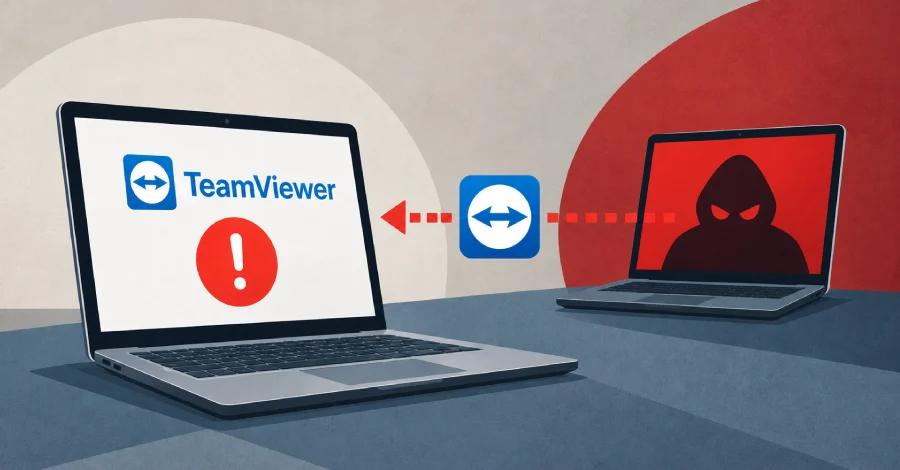
TeamViewer has officially addressed a high-severity security vulnerability that enables a host machine to execute unauthorized code on the computer of the user providing support. The flaw, tracked under the identifier CVE-2026-111585, represents a significant breach of the traditional trust model in remote access software, as it effectively reverses the power dynamic of a remote session. By exploiting a memory management error, a malicious host can force a crash or, in specific environments, gain full control over the viewer’s device. Security researchers at Remedio, who were credited with discovering and reporting the issue, have highlighted the severity of the vulnerability, which carries a CVSS score of 8.8, signaling a high-risk classification that necessitates immediate patching across all affected platforms.
Technical Breakdown: The Mechanics of the Exploit
The core of CVE-2026-111585 lies in how TeamViewer handles screen resolution metadata during the initiation of a remote control session. In a standard connection, the host machine transmits data regarding its screen dimensions to the viewer’s client. This information is utilized by the viewer application to allocate a specific segment of memory required to process the incoming visual stream.
According to the technical disclosure provided by Omri Dar of Remedio, the vulnerability manifests as an integer overflow during this memory allocation process. When a malicious host provides a specially crafted value for the screen dimensions, the viewer software reserves an insufficient amount of memory. Consequently, when the subsequent screen data is transmitted, the application attempts to write this information beyond the boundaries of the allocated buffer. This buffer overflow condition allows the host to corrupt the memory space of the viewer’s TeamViewer instance.
At a baseline, this manipulation results in an immediate application crash, which an attacker can trigger repeatedly to create a denial-of-service condition. However, on Windows systems, the researchers demonstrated that the exploit could be extended to bypass native operating system security mitigations, such as Address Space Layout Randomization (ASLR) and Data Execution Prevention (DEP), ultimately enabling arbitrary code execution. While the proof-of-concept for remote code execution was specifically documented for Windows, the underlying vulnerability affects the architecture of the TeamViewer Full Client, the Portable edition, and the Android Remote Control app across Linux, macOS, and Android platforms, making the potential impact broad and cross-platform.
Chronology of Discovery and Disclosure
The discovery of this flaw highlights the ongoing tension between software utility and security. The vulnerability was brought to light following a period of rigorous analysis by the security firm Remedio. On October 29, 2026, the firm published a comprehensive technical account of their findings, detailing the "host-to-viewer" attack vector.
The timeline of the vulnerability’s existence is particularly concerning for enterprise users who may have felt secure after applying previous updates. Many administrators believed they were protected following a security patch released in September 2026. However, that update—version 15.82—did not address this specific memory corruption issue. It was not until the release of version 15.83 that the vulnerability was mitigated.
The disclosure process followed standard responsible disclosure protocols, allowing TeamViewer to develop and distribute a patch before the details of the exploit were made public. As of the time of the disclosure, there were no reported instances of the vulnerability being leveraged in malicious campaigns in the wild, nor was the exploit included in the Cybersecurity and Infrastructure Security Agency (CISA) Known Exploited Vulnerabilities (KEV) catalog.
Assessing the Broader Security Implications
The implications of CVE-2026-111585 are substantial, particularly for IT support organizations and managed service providers (MSPs). In a typical remote support scenario, the "viewer" is an IT technician or a trusted administrator, while the "host" is the machine being repaired. This vulnerability turns that relationship into a potential attack surface. If a technician connects to a machine that has been compromised by an attacker, the attacker can leverage the host’s TeamViewer connection to pivot into the technician’s machine, effectively bypassing perimeter defenses.
This scenario is highly dangerous because it requires no authentication from the victim’s side other than the standard acceptance of a remote support session. The attack functions within the default configurations of the software, meaning that even users who follow strict security hygiene—such as using strong passwords and multi-factor authentication—could still be vulnerable if they connect to a malicious host.

The risk is further compounded by the ubiquity of TeamViewer in both professional and personal environments. With millions of active installations worldwide, the potential surface area for an attacker is immense. The fact that the vulnerability impacts the Android Remote Control app also introduces risks for mobile-to-desktop and mobile-to-mobile support workflows, areas that are often overlooked in traditional endpoint security assessments.
Mitigation Strategies and Official Guidance
TeamViewer has been unequivocal in its guidance: there are no workarounds for this vulnerability. The only effective defense is to update to version 15.83 or later. The company’s security bulletin (TV-2026-1011) explicitly lists the affected versions and provides the necessary links for users to secure their endpoints.
While the bulletin primarily emphasizes the Full Client, the Portable edition, and the Android application, security professionals are advised to update the Host module as well. This is because the 15.83 update bundle also addresses two additional high-severity flaws that do affect the Host software. Furthermore, a companion security bulletin, TV-2026-1012, details six additional vulnerabilities within TeamViewer’s Remote Management add-ons. These add-ons are often updated automatically, but administrators should verify that their systems are running the most current versions to ensure all identified gaps are closed.
For large-scale deployments, the recommendation is to leverage automated patch management tools to push the 15.83 update across all managed assets. Organizations that rely on legacy versions of TeamViewer for specific compatibility reasons are at particular risk and should consider air-gapping those machines or restricting their network access until a transition to a supported version can be completed.
Analysis of the Remote Access Threat Landscape
The emergence of CVE-2026-111585 serves as a poignant reminder of the inherent risks associated with remote access and screen-sharing software. Remote control applications operate at a high privilege level, often requiring deep hooks into the operating system’s graphics and input subsystems to function correctly. These deep integrations, while necessary for performance, create complex attack surfaces that are difficult to secure.
Historical data shows that remote access tools are high-value targets for threat actors. Whether it is state-sponsored groups looking to maintain persistence or ransomware operators seeking lateral movement capabilities, the ability to compromise a support technician’s workstation provides a "golden ticket" into a target network.
By exploiting the very mechanism that allows for remote collaboration, attackers can bypass traditional network security controls like firewalls and intrusion detection systems, which generally treat TeamViewer traffic as legitimate. The Remedio research team’s demonstration of bypassing ASLR and DEP on Windows underscores the sophistication of modern exploits. It highlights that even with robust OS-level defenses, application-level vulnerabilities can still provide a pathway to arbitrary code execution if the input validation logic is flawed.
Conclusion
The release of TeamViewer version 15.83 is a critical security milestone for the millions of users and organizations relying on the platform for daily operations. CVE-2026-111585 is a stark example of how a seemingly benign data exchange—such as screen resolution signaling—can be weaponized to undermine the integrity of an entire computing environment.
Moving forward, the incident reinforces the necessity for a "zero-trust" approach to remote support. Organizations should assume that any machine they connect to could potentially be compromised and should, where possible, utilize isolated environments or "jump boxes" to perform support tasks. Furthermore, the rapid identification and patching of this vulnerability demonstrate the importance of continuous monitoring and active participation in vulnerability management programs. For the end user, the lesson is clear: software updates are not merely for feature enhancements; they are the primary defense against evolving threats that target the very tools we use to maintain our digital infrastructure. As the industry moves toward more secure development lifecycles, the onus remains on both the vendor to provide secure code and the administrator to maintain the currency of their software stack.

