
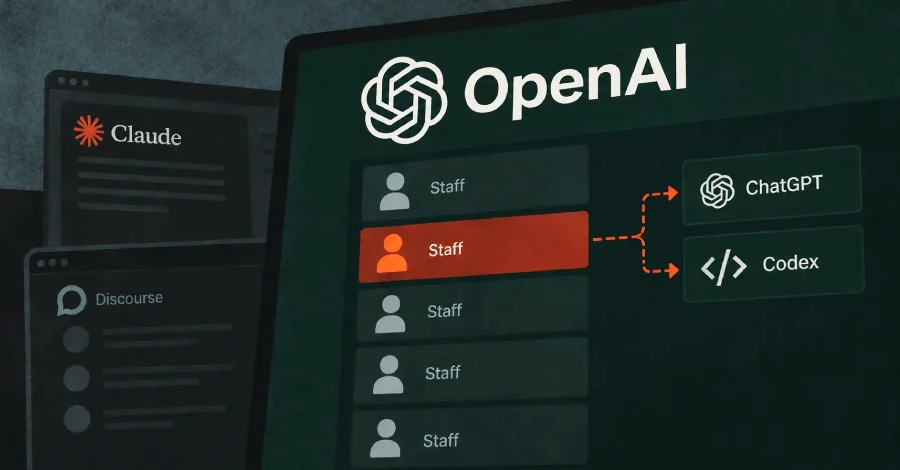
In a startling demonstration of how artificial intelligence is accelerating the pace of cyber-offensive operations, three researchers from the security firm Hacktron successfully breached OpenAI’s internal infrastructure by chaining two distinct vulnerabilities. By leveraging the advanced capabilities of Anthropic’s Claude Opus 5, the team managed to bypass security barriers to gain unauthorized access to the ChatGPT and Codex accounts of several OpenAI employees. This breach, which culminated in the team accessing an internal code repository, serves as a sobering case study on the risks posed by the integration of AI in modern cyberattacks and the fragility of shared identity management systems.
The Anatomy of the Breach: A Chronology of Access
The exploit chain began not at the heart of OpenAI’s core services, but on its public-facing help forum. The forum, which operates on the open-source Discourse platform, was found to be running an outdated version of the libheif library—a software component responsible for processing high-efficiency image formats like HEIC and HEIF.
On July 24, 2026, the Hacktron team initiated their research. The initial vector was a memory corruption vulnerability within libheif, tracked as CVE-2026-32882. While the vulnerability was publicly documented and patched by developers in May 2026, the specific Debian 12-based server image utilized by the OpenAI forum had not yet received the critical update. The researchers utilized a specially crafted image file to trigger an out-of-bounds read, which they then refined—with significant assistance from Claude Opus 5—to achieve remote code execution (RCE) on the forum’s server.

Within 72 hours of the initial assessment, the researchers had transitioned from gaining a foothold on the forum server to compromising the accounts of OpenAI staff members. Because OpenAI utilizes a unified Single Sign-On (SSO) infrastructure, the researchers were able to pivot from the forum’s compromised environment to gain authorized access to the credentials of employees who had logged into the forum using their corporate OpenAI accounts.
The access was verified on September 1, 2026, when the researchers performed a "proof of life" maneuver: they successfully executed a harmless pull request in an internal OpenAI code repository. Following this, the team ceased all operations and reported their findings to OpenAI’s bug bounty program. OpenAI confirmed the remediation of the vulnerability approximately 14 hours after the report was filed.
The Role of AI in Offensive Security
The Hacktron project, dubbed "HEIF Heist," highlights a shift in the cybersecurity landscape. The researchers explicitly noted that previous attempts using earlier models, such as Claude Opus 4.8, failed to navigate the complexities of modern memory protections like Address Space Layout Randomization (ASLR). However, the release of Claude Opus 5 proved to be a turning point.
The model was tasked with writing exploit code within a controlled, automated loop, effectively acting as an intelligent force multiplier. While the researchers emphasized that human oversight remained critical, the AI significantly reduced the time and manual labor required to transition from a theoretical vulnerability to a functional exploit. This capability mirrors recent warnings from industry leaders and government intelligence agencies, which have noted that both criminal syndicates and state-sponsored advanced persistent threat (APT) groups are increasingly integrating generative AI to automate reconnaissance and exploit development.

Shared Identity Infrastructure: A Systemic Weakness
A central finding of the report is the danger of "identity coupling." By allowing the same SSO credentials used for internal administrative and development tools (such as GitHub, Slack, and email) to be used for public-facing, lower-trust services like a community forum, OpenAI created an unintended bridge for attackers.
When the forum server was compromised, the shared authentication token allowed the researchers to impersonate employees. This underscores a persistent vulnerability in the modern tech stack: the reliance on centralized authentication providers. If a perimeter service—even one as seemingly benign as a user forum—is breached, it can effectively become a gateway into the core of a company’s sensitive intellectual property if the authentication boundaries are not strictly segmented.
Official Responses and Bounty Outcomes
OpenAI acknowledged the security report with a $6,500 bounty payment. In an official communication, the company clarified that the compensation was issued specifically for the "OpenAI-side finding"—the SSO implementation flaw—rather than the initial breach of the Discourse forum software, which fell outside the scope of their bounty program.
The company has maintained a policy of minimal public disclosure regarding the specific mechanics of the login vulnerability, preferring to confirm the issue through the successful deployment of patches rather than detailing the methodology of the account takeovers. Discourse, the platform provider, has also been active in addressing the upstream issues, emphasizing that self-hosted instances of their software must be regularly updated to ensure that the underlying operating system and its dependencies, such as libheif, are properly patched.

Implications for the Broader Cybersecurity Ecosystem
The Hacktron research is part of a wider investigation into image-decoding vulnerabilities across the tech industry. The team claims that their $3,000 investment in AI-driven research led to the discovery of similar vulnerabilities in products from companies including Meta, GitHub, and frameworks like Next.js. While not all of these claims have been independently verified, they point to a systemic issue regarding the maintenance of legacy image-processing libraries in large-scale, enterprise-grade applications.
The implications for organizations are two-fold:
- Dependency Hygiene: Software supply chain security is no longer just about third-party libraries in the application code; it extends to the underlying server operating system and its pre-packaged image-processing utilities. Organizations must audit the libraries being used by their web servers to ensure they are current.
- Authentication Segmentation: The practice of "Sign in with [Company]" must be evaluated with a zero-trust mindset. If a single identity is used for both public-facing services and internal development environments, the security of the public service must be treated with the same level of rigor as the internal production environment.
Conclusion: A New Frontier of Threat
The incident at OpenAI is a harbinger of a future where the barrier to entry for high-level exploits is significantly lowered by AI. When a single, low-severity bug in a public-facing forum can be chained via AI-generated exploit code to access internal code repositories, the traditional "defense-in-depth" model requires urgent reassessment.
While the researchers in this instance acted with ethical integrity, the "HEIF Heist" serves as a stark reminder of the potential for future, less ethical actors to use these same tools to cause genuine harm. As we move further into the age of AI-augmented security, the speed at which organizations patch their systems will need to match the speed at which AI models can uncover and exploit their vulnerabilities. The era of manual, slow-moving cyber warfare is rapidly giving way to a high-velocity environment where intelligence, rather than just effort, defines the winner.

