

The sprawling infrastructure of the consumer data broker industry suffered a rare and significant legal blow when a New Jersey court ordered the transfer of radaris.com and more than a dozen associated web domains to plaintiffs pursuing enforcement under the state’s strict privacy statute, known as Daniel’s Law. This unprecedented judicial action follows years of systematic stonewalling, shell companies, and legal evasion by the operators behind the prominent people-search platform. The development highlights a critical turning point in the ongoing battle between privacy advocates, state enforcers, and commercial entities that monetize personal data.
For years, Radaris.com maintained a notorious reputation for ignoring consumer requests to remove personal information from its extensive online database. That operational model collided with the legal reality of Daniel’s Law, a New Jersey statute designed to protect state law enforcement personnel, judicial officers, and their families by mandating the complete removal of their personal data from commercial people-search services. The law penalizes non-compliance with statutory fines of $1,000 per violation. When Atlas Data Privacy Corp initiated legal action against Radaris in February 2024, it triggered a complex legal showdown that exposed the inner workings of a massive, multi-tiered data-broker operation.
Anatomy of an Evasive Corporate Structure
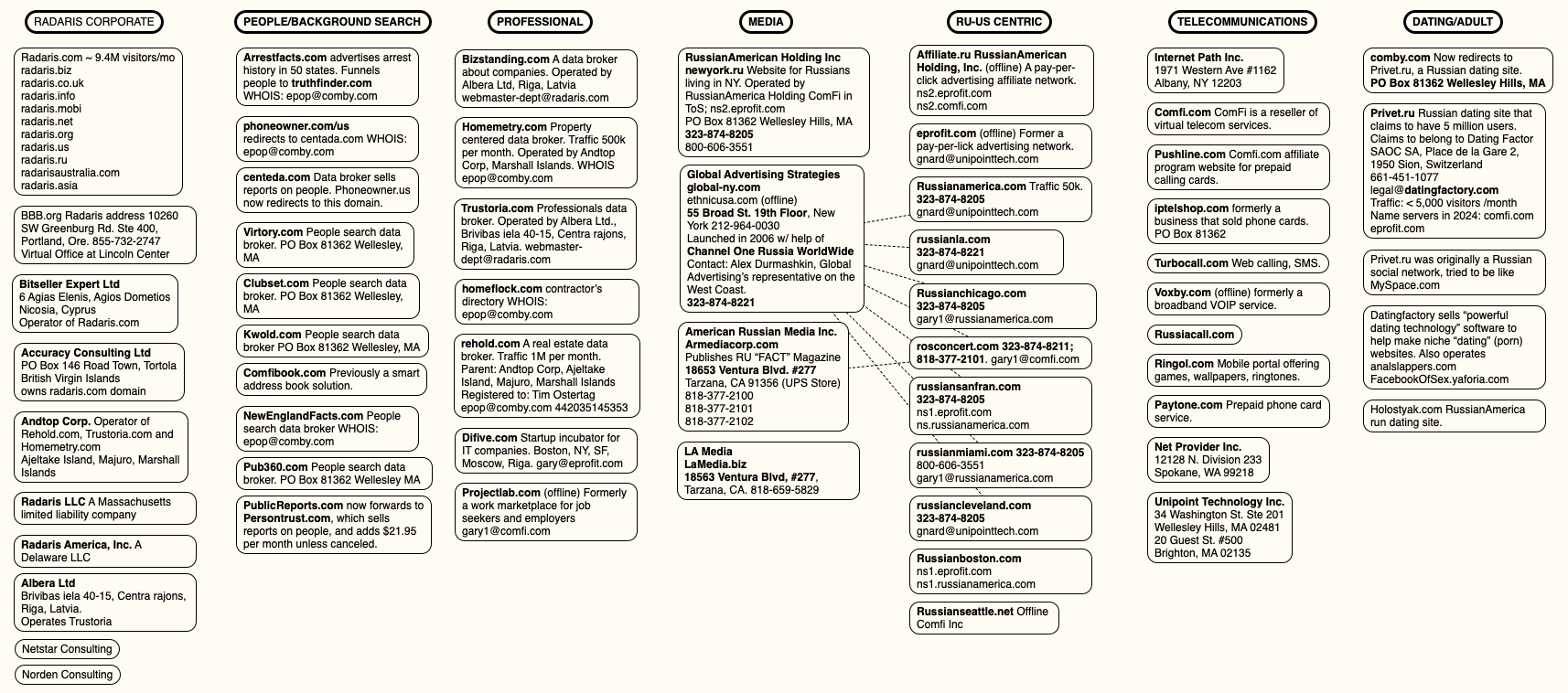
Investigative reporting and court records have revealed that Radaris was built and operated by Igor and Dmitry Lubarsky, Russian-born brothers residing in Massachusetts. The siblings constructed a dizzying array of people-search companies, Russian-language dating platforms, and affiliate programs, utilizing a revolving door of corporate entities to obscure ultimate ownership and liability.
According to statements from Atlas President and CEO Matt Adkisson, the defendants repeatedly engaged in procedural delays and corporate shell games. Privacy policies changed frequently, while managing entities shifted jurisdiction across international tax havens, including the Marshall Islands, the British Virgin Islands, and Seychelles. In one instance, after the defendants updated their terms of service to claim management by a newly minted Marshall Islands entity, an independent investigation revealed that the corporate entity did not even legally exist.
Legal representation for Radaris, led notably by Boston Law Group attorney Val Gurvits and later Victor Worms, argued that the plaintiffs failed to properly serve the true owners of the domains—such as a Cyprus-registered company named Bitseller Expert Limited—and contended that seizing non-entity domain names violated constitutional due process principles. Despite these vigorous defense strategies and appeals, the court ultimately found that the defendants had repeatedly failed to mount a substantive defense despite ample opportunity, culminating in the recent court-ordered domain transfers.
Financial Scale and Interconnected Ecosystem

Discovery documents obtained during the litigation, comprising more than 10,000 emails and corporate files, shed unprecedented light on the financial mechanics of the Radaris empire. The records confirm that numerous nominal legal vehicles—including Radaris America Inc., Bitseller Expert Limited, Digital Orbit Corp, Core Solutions Group Inc., and Veripages Inc.—were administered by a small group of individuals using shared banking channels, uniform payment processing configurations, and a centralized virtual office.
The documentary evidence established that radaris.com and at least twenty-five other people-search websites functioned as a unified operation managed from the Boston area. Financial disclosures indicate substantial revenue streams, with radaris.com pulling in approximately $42,000 monthly, and sister site Veripages.com generating roughly $45,000 per month through marketing partnerships with the Lifetime Value Company, operator of brands like PeopleLooker, PeopleSmart, and Bumper. Furthermore, the Radaris network reportedly derived up to $25,000 monthly from partnerships with Onerep, a privacy service that purportedly assists individuals in removing their data from people-search directories.
Broader Legal Implications and the Constitutional Challenge
While the transfer of fourteen domain names to Atlas marks a tactical victory for privacy enforcement, the broader legal battle surrounding Daniel’s Law is far from resolved. The data broker industry has mounted a coordinated counter-offensive, moving at least seventy similar lawsuits into federal court and challenging the constitutionality of Daniel’s Law on First Amendment grounds. Critics within the industry argue that the statute is overly broad and infringes upon constitutionally protected speech by restricting access to matters of public record.
The U.S. Court of Appeals for the Third Circuit is currently reviewing these constitutional challenges, with legal observers anticipating that the ultimate resolution will reach the U.S. Supreme Court. Meanwhile, the legislative landscape is shifting at the state level. At least fourteen other states have enacted statutes modeled after New Jersey’s framework, while additional jurisdictions consider similar protective measures. Conversely, federal district courts have demonstrated judicial friction; notably, a federal court in West Virginia ruled that state’s version of Daniel’s Law facially unconstitutional under the First Amendment in August 2025.
Regulatory Gaps and the Future of Federal Privacy Legislation
Privacy experts emphasize that state-level statutes, while impactful for specific professional classes such as law enforcement, do not solve the systemic vulnerabilities inherent in the modern data economy. Justin Sherman, a privacy researcher and author examining the data broker ecosystem, points out that state laws generally exempt records classified as public or government documents, including voting registries, property filings, marriage certificates, and motor vehicle databases.
Without comprehensive federal privacy legislation that addresses the core collection, retention, and monetization practices of data brokers, people-search platforms will continue to adapt and thrive. Sherman notes that intense lobbying from big tech, social media platforms, cryptocurrency firms, and artificial intelligence proponents has consistently neutralized legislative momentum at the federal level. Until Congress enacts enforceable data protection standards that govern the lifecycle of public records and consumer information, high-profile data broker enforcement actions will remain isolated skirmishes in a much larger, systemic war over digital privacy.

