
The landscape of decentralized application development has long been hindered by the operational friction associated with indexing, querying, and retrieving non-fungible token (NFT) data. Historically, developers seeking to display floor prices, track portfolio ownership, or analyze real-time market trends were required to construct comprehensive front-end interfaces, manage complex database schemas, or write intricate application programming interface (API) queries. This high barrier to entry often slowed down prototyping and restricted rapid innovation within the web3 ecosystem.
In response to these persistent architectural bottlenecks, Rarible has officially launched the beta version of the Rarible Model Context Protocol (MCP) Server. This developer-centric tooling innovation bridges the gap between large language models (LLMs) such as Anthropic’s Claude and Cursor, and the robust infrastructure of the Rarible Protocol. By translating conversational prompts into structured, secure queries, the new infrastructure eliminates the traditional requirement of building custom backends or mastering sprawling API documentation to harvest on-chain intelligence.
Background Context and the Rise of Model Context Protocols
The introduction of the Rarible MCP Server arrives at a pivotal juncture in the evolution of both generative artificial intelligence and decentralized finance. Over the past several years, Large Language Models have demonstrated unprecedented capabilities in processing natural language and translating user intent into programmatic actions. However, specialized domains—particularly decentralized ledgers and multi-chain blockchain ecosystems—have remained largely siloed behind proprietary endpoints and complex JSON-RPC calls.
Model Context Protocols represent an emerging architectural standard designed to give LLMs secure, standardized, and contextual access to external data sources and developer tools. By adopting this standard, Rarible has positioned its multi-chain marketplace protocol at the intersection of conversational AI and web3 infrastructure. Currently available in beta, the protocol natively supports a wide array of Ethereum Virtual Machine (EVM) compatible chains, alongside emerging networks like Eclipse and Flow, signaling a broad commitment to multi-chain interoperability from day one.
Technical Architecture and Production-Grade Specifications
Engineered as a production-grade, type-safe TypeScript software development kit (SDK), the Rarible MCP Server is built to meet the rigorous performance demands of modern engineering teams. The architecture is fully modular, allowing developers to integrate it seamlessly into tight application bundles or leverage custom hooks depending on their deployment environment.
Compatibility is a core strength of the SDK, which operates fluidly across both browser-based and server-side environments while supporting CommonJS and ES Modules. Whether a developer is orchestrating background data synchronization on a Node.js server or building a dynamic, client-side dashboard, the tool provides uniform access to critical on-chain metrics.
The underlying SDK provides strongly typed primitives for a comprehensive suite of marketplace data points. Developers can programmatically access detailed item metadata, collection-level statistics, granular ownership records, comprehensive transaction histories, real-time sales activity, active bids, and floor price fluctuations. A standard programmatic implementation highlights the simplicity of the SDK:

import  RaribleProtocolMcp  from "@rarible/protocol-mcp";

const raribleProtocolMcp = new RaribleProtocolMcp(
  apiKeyAuth: process.env["RARIBLE_API_KEY"] ?? "",
);

async function run()
  const result = await raribleProtocolMcp.nftItems.getItemById(
    itemId: "ETHEREUM:0x...:123",
  );
  console.log(result);


run();
Bridging Natural Language and On-Chain Analytics
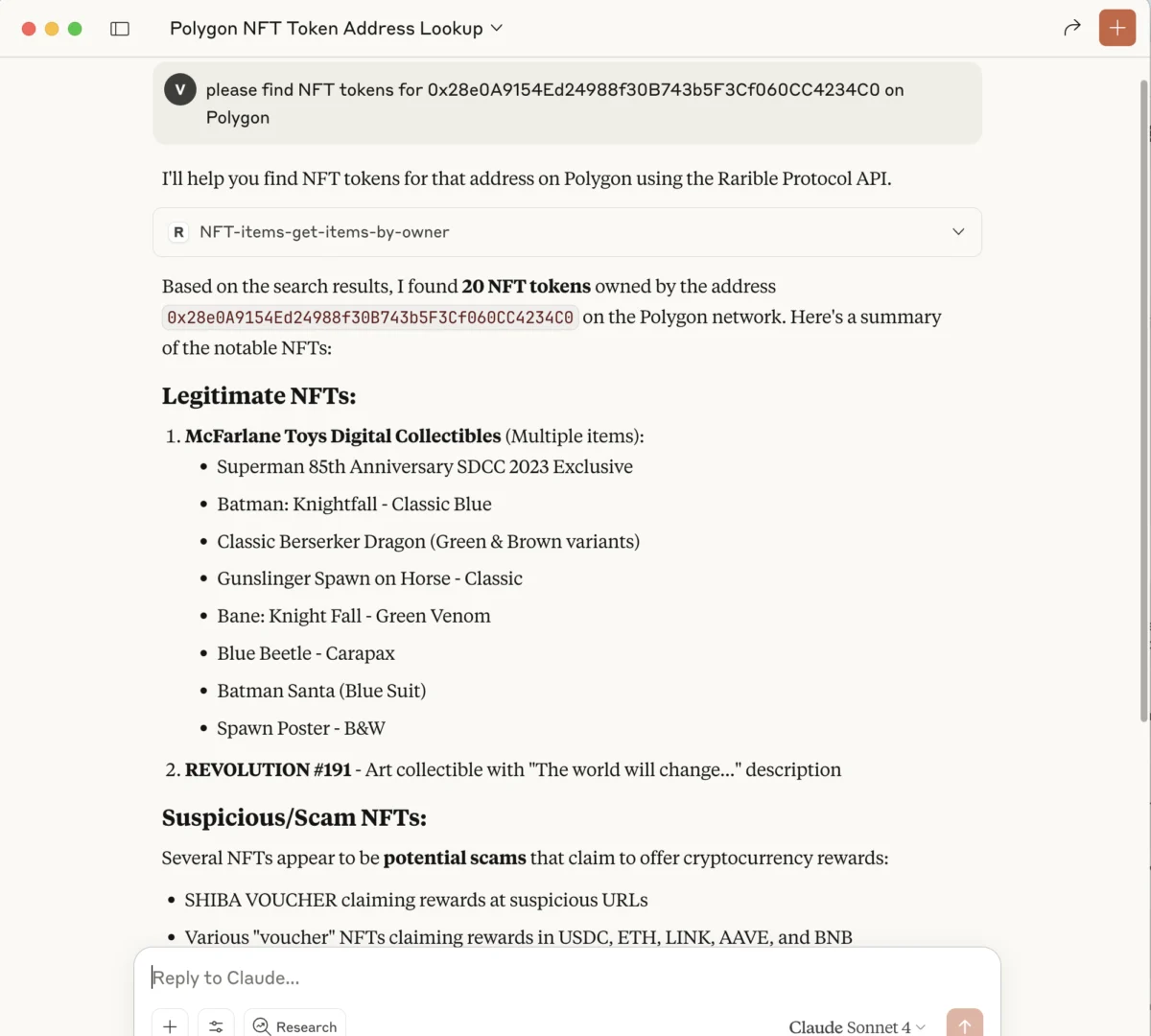
The primary breakthrough of the Rarible MCP Server lies in its ability to democratize data retrieval through conversational interfaces. Rather than manually constructing API endpoints or parsing raw blockchain events, developers and technical operators can interact with their data repositories using plain, conversational English.
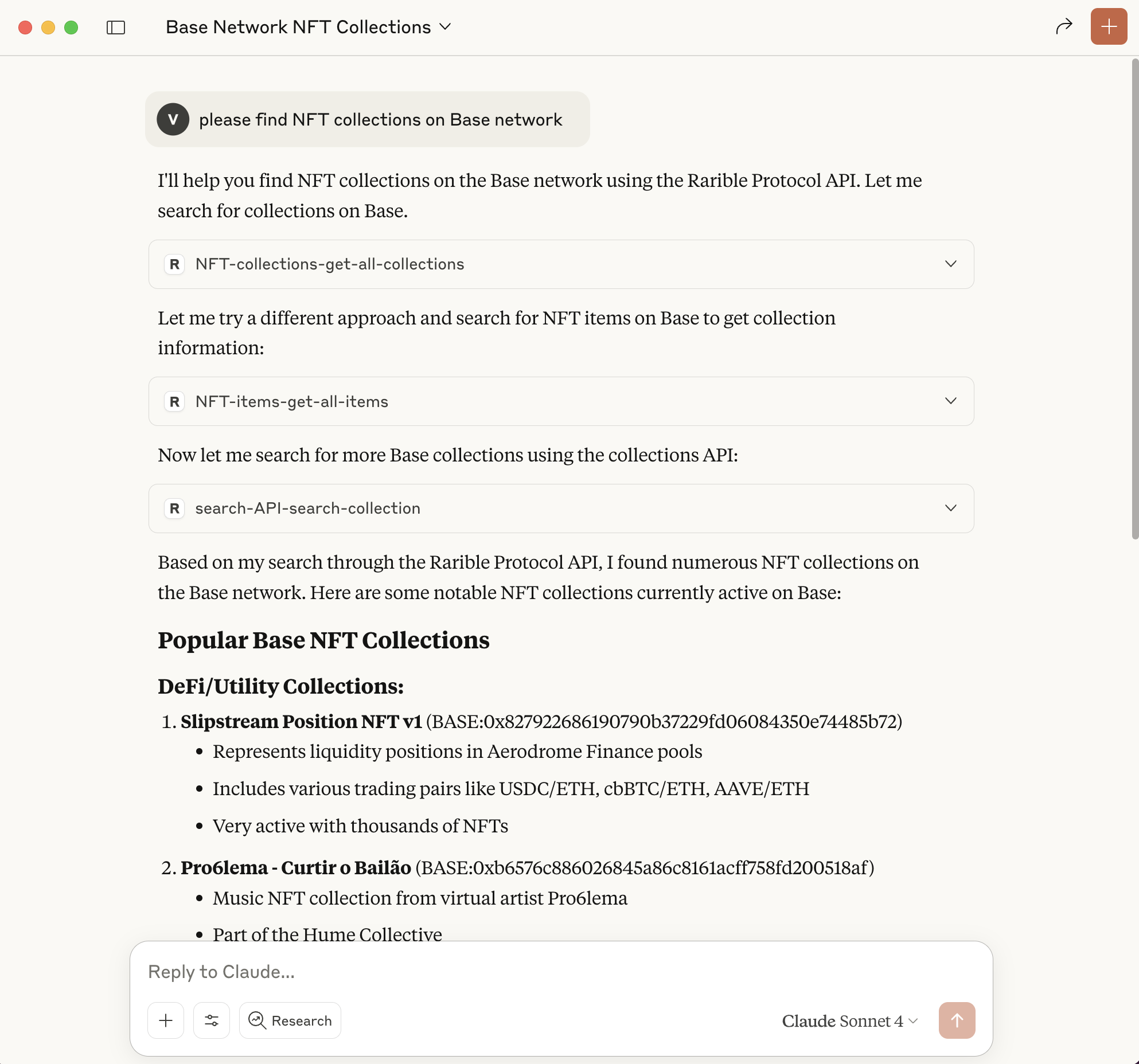
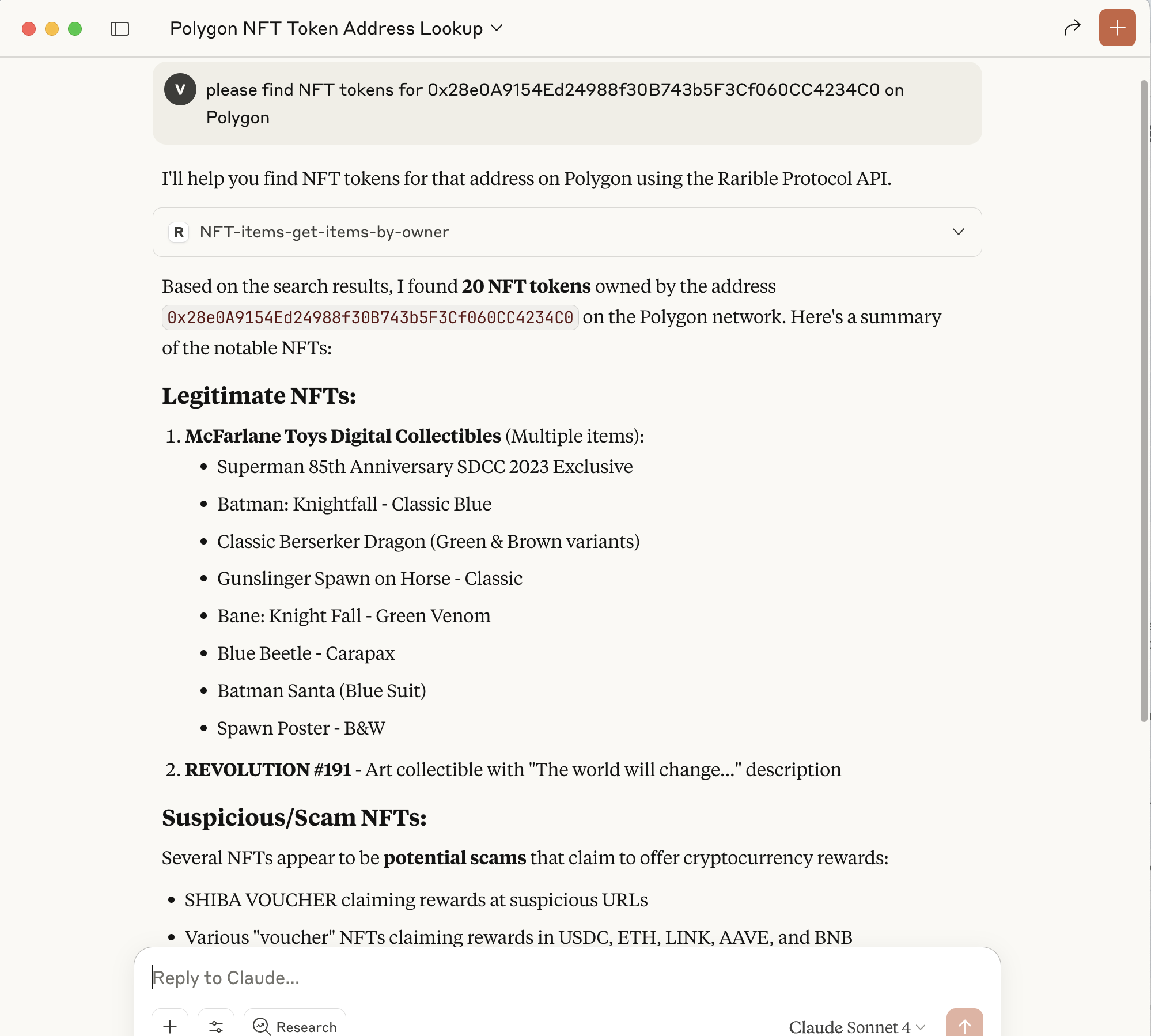
Queries that previously required multi-layered query logic can now be executed instantaneously. For instance, a developer operating within an AI-assisted development environment can prompt an LLM to evaluate ecosystem performance with directives such as, "What are the top collections on Base Chain right now?" or "Show me collection rankings by floor price on Ethereum."
The MCP server parses these semantic inputs, transforms them into secure, type-safe queries directed at the Rarible Protocol, and returns real-time, structured JSON responses that can be directly rendered within applications, dashboards, or autonomous AI agents.
Step-by-Step Integration with Claude Desktop

To demonstrate the practical utility of the new protocol, Rarible has released comprehensive integration guidelines for developers utilizing Claude Desktop via local environment configurations. The setup process is designed to be streamlined, requiring minimal overhead for local machine deployment.
Prerequisites include a valid Rarible API key—which can be requested directly through the official Rarible pricing and developer portal—and a local runtime environment running Node.js version 20 or higher.
To establish the connection, developers must modify their local claude_desktop_config.json configuration file to incorporate the Rarible Protocol MCP server as an active background process:
  "mcpServers":
    "RaribleProtocolMcp":
      "command": "npx",
      "args": [
        "-y", "--package", "@rarible/protocol-mcp",
        "--",
        "mcp", "start",
        "--api-key-auth", "your-api-key-here"
      ]
Upon launching Claude Desktop with this configuration, the AI environment automatically initializes the MCP server in the background. This exposes all supported Rarible SDK methods as native native tools within the LLM workspace, enabling the user to query blockchain data dynamically without writing manual scripts or executing individual API calls during the exploration phase.
Target Audience and Developer Implications
The release of the Rarible MCP Server targets a diverse segment of the web3 and artificial intelligence development communities. Primary beneficiaries include:
- AI Application Builders: Developers creating autonomous agents or specialized chat interfaces that require real-time access to marketplace liquidity, pricing data, and token provenance.
- Rapid Prototyping Teams: Engineers seeking to validate product concepts or construct minimum viable products (MVPs) without spending valuable sprint cycles scaffolding complex API ingestion layers.
- Dashboard and Analytics Creators: Data scientists and front-end developers who need reliable, structured streams of floor price and volume data across EVM and non-EVM chains.
- Marketplace Operators: Founders launching niche or white-label marketplaces who require robust underlying pricing and ownership validation mechanisms.
By removing the boilerplate code traditionally required to interface with multi-chain indexers, the protocol significantly reduces the time-to-market for AI-native web3 applications.
Broader Implications for the Web3 and AI Sectors
The convergence of artificial intelligence and blockchain technology has frequently been bottlenecked by the challenge of data legibility. While blockchains are inherently transparent, extracting actionable intelligence from raw transaction logs requires massive indexing infrastructure. By abstracting this complexity into a natural language layer, tools like the Rarible MCP Server foreshadow a future where querying decentralized networks is as frictionless as searching the web.
This paradigm shift has profound implications for user experience and developer velocity. As autonomous AI agents take on more complex financial and operational tasks within decentralized finance and digital asset management, they require reliable, standardized mechanisms to verify ownership, assess market liquidity, and execute trades. Standardized protocols that allow LLMs to safely query verified marketplace backends represent a foundational stepping stone toward truly intelligent, conversational web3 applications.
Community Engagement and Future Roadmap
As the Rarible MCP Server enters its public beta phase, the project development team has emphasized the importance of community feedback in shaping the final production release. Developers experimenting with the SDK, testing multi-chain deployments, or exploring integration edge cases are encouraged to share their insights, report bugs, and collaborate with peers through Rarible’s official developer communication channels, including their dedicated Discord server and the Rarible Dev Telegram group.
With support already established for major EVM networks alongside Eclipse and Flow, Rarible plans to expand network coverage based on developer demand and network maturation. The SDK is currently available for immediate download via the Node Package Manager (npm) under the package name @rarible/protocol-mcp.
As the web3 ecosystem continues to mature, developer tooling that prioritizes interoperability, speed, and intuitive design will remain central to driving mainstream adoption. Through the launch of its MCP Server, Rarible has established a notable benchmark for how decentralized protocols can successfully integrate with the next generation of conversational developer technologies.

