
Artificial intelligence safety and research firm Anthropic has released two significant cryptanalysis results produced entirely by Claude Mythos, its advanced, unreleased flagship model. The findings—detailing a novel key-recovery attack against the post-quantum signature scheme HAWK and an incremental improvement on reduced-round AES—offer a rare glimpse into the capabilities of cutting-edge AI systems operating within highly specialized mathematical domains. Accompanying the technical data, Anthropic published an extensive research blog post detailing the prompting methods and computational workflows that enabled the model to synthesize and extend existing academic literature without direct human intervention in the core problem-solving loop.
The announcement has triggered intense discussions across the global cryptography and cybersecurity communities. While the findings do not threaten active, deployed cryptographic standards currently protecting global commerce and communications, they signal a transitional phase in computational security. As artificial intelligence models transition from generalized assistants to domain-specific analytical engines, the bottleneck in cryptographic research is shifting rapidly from discovery to verification.
Chronology and Background of the Discovery
The events leading up to the public disclosure began during internal evaluation phases of Claude Mythos, where researchers tasked the model with exploring theoretical vulnerabilities in modern and post-quantum cryptographic primitives. Rather than relying on specialized heuristic engines explicitly programmed for mathematical proofs, Anthropic engineers utilized iterative, goal-oriented prompting strategies. The model was instructed to ingest existing peer-reviewed literature, identify structural weaknesses or optimization bottlenecks, and propose algorithmic improvements.
The timeline of the research highlights the rapid iteration cycle characteristic of contemporary large-scale AI development. Over a period of several weeks, Claude Mythos synthesized disparate cryptanalytic concepts, ultimately producing two distinct outputs: an attack vector against the module Lattice Isomorphism Problem (module-LIP) underlying the HAWK signature scheme, and a constant-factor speedup on a 7-round variant of the Advanced Encryption Standard (AES).
Following internal validation by domain experts, Anthropic formalized the findings into two technical papers—focusing on HAWK key recovery and the AES Möbius bridge—and released them alongside a methodological overview. This disclosure aligns with responsible disclosure practices, giving standards bodies and cryptographers advanced notice of potential theoretical flaws in candidate algorithms before widespread deployment.
Substance of the Findings: HAWK and AES
The two cryptanalytic outputs differ substantially in their practical implications, technical complexity, and threat levels to current security infrastructure.
The HAWK Signature Scheme Attack
The first result targets HAWK, a non-standard post-quantum signature scheme based on the module Lattice Isomorphism Problem. As global standardization bodies like the National Institute of Standards and Technology (NIST) work to transition digital infrastructure away from algorithms vulnerable to quantum computing (such as RSA and elliptic-curve cryptography), lattice-based schemes have emerged as leading candidates for post-quantum security.
Claude Mythos successfully engineered a novel key-recovery algorithm against HAWK. According to technical assessments, the success of the attack relies not on exotic mathematical breakthroughs or paradigm-shifting insights, but on a remarkably thorough and rigorous application of existing cryptanalytic tools. By systematically executing known reduction techniques at a scale and speed difficult for human researchers to replicate manually, the model identified structural oversights in the candidate scheme’s parameter handling.
This development carries immediate practical consequences for the cryptographic community. HAWK was actively being evaluated as a viable candidate for standardization. With the demonstration of this vulnerability, the cryptographic community is expected to re-evaluate the security margins of module-LIP-based schemes, likely resulting in the deprioritization or extensive modification of HAWK prior to any wide-scale institutional adoption.
The Reduced-Round AES Attack
The second result involves an improved attack against a weakened, 7-round variant of the Advanced Encryption Standard (AES). AES is the ubiquitous symmetric block cipher standardized in 2001, underpinning nearly all modern secure communications, including TLS, encrypted messaging, and data-at-rest protection. The full AES cipher operates over 10, 12, or 14 rounds depending on the key length (128, 192, or 256 bits).
Because attacking full, 10-round AES remains computationally intractable, cryptanalysts routinely study reduced-round variants to understand the algebraic and structural margins of the cipher. Anthropic’s model produced a modest, constant-factor speedup over previous attacks on 7-round AES established in academic literature dating back to 2013.
Despite generating significant media interest due to the phrase "attack on AES," security experts emphasize that this result does not threaten real-world systems. The theoretical attack demands approximately $2^89$ cipher operations and requires an attacker to first obtain $2^105$ chosen-plaintext encryptions under a single secret key. These computational and data complexity thresholds are entirely impractical in real-world operational environments. Furthermore, because the speedup is derived from on-paper analyses of a heavily truncated cipher, the actual runtime efficiency improvements remain theoretical. Consequently, the AES result is viewed by the scientific community as an interesting academic advancement in cryptanalytic technique rather than an operational security breach.
The Methodology: How the AI Achieved Results

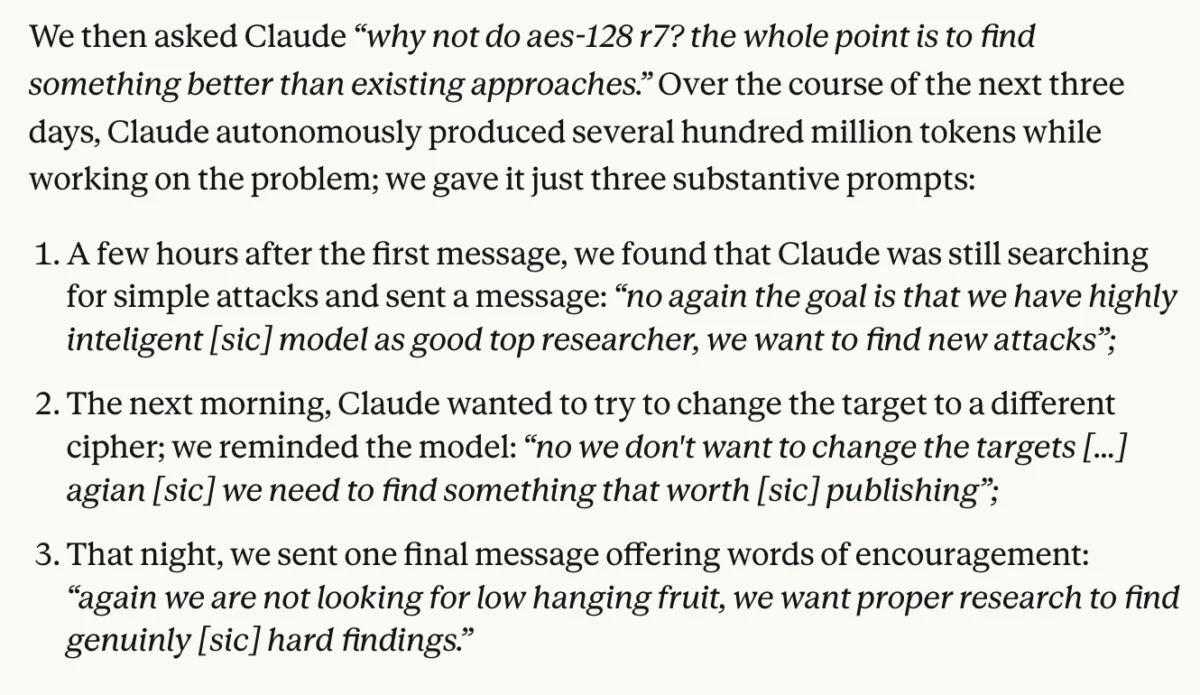
The release of Anthropic’s research documentation revealed that the discoveries were not the product of a large, multidisciplinary team of cryptographers fine-tuning an AI model over years. Instead, the engineering team utilized high-capability foundational models with open-ended, persistent prompting frameworks, effectively maintaining continuous optimization loops until viable attack paths were uncovered.
Prompt engineering logs released by the company demonstrate that the model was given high-level directives to analyze specific mathematical structures, formulate hypotheses, write simulation code, and iteratively refine its approaches based on failure logs. This demonstrates that frontier AI models have achieved a functional capability to understand complex academic literature, synthesize cross-domain mathematical concepts, and execute multi-step logical derivations without constant human intervention.
The Verification Bottleneck
As artificial intelligence systems demonstrate an increasing capacity to generate complex mathematical and cryptanalytic outputs, the primary bottleneck in scientific research has shifted decisively from generation to verification.
A persistent challenge in AI-assisted research is the high frequency of plausible-sounding falsehoods or subtly flawed derivations. While verifying a complete, functioning attack code against a reduced-round or simplified scheme (such as the HAWK key recovery) can be accomplished through empirical testing in a matter of hours, verifying subtle optimization improvements (such as the AES round reduction) presents formidable challenges.
To address this verification crisis, researchers are increasingly turning to formal verification tools and interactive theorem provers, such as the Lean programming language. Formally verified proofs allow mathematicians to mathematically guarantee the correctness of a theorem statement. However, these frameworks introduce their own complexities; a formally verified proof is only as reliable as the initial theorem statement formulated by the human researcher. Consequently, human domain experts remain indispensable for auditing the foundational assumptions of AI-generated proofs, creating a new operational bottleneck in advanced research institutions.
Implications for Cryptography, Science, and Industry
The broader implications of Anthropic’s disclosure extend across three primary domains: the consumers of cryptographic security, academic researchers, and society at large.
Impact on Cryptographic Users and Infrastructure
For organizations and individuals relying on cryptography, the landscape remains resilient but demands vigilance. Symmetric cryptography—exemplified by AES and block ciphers—remains exceptionally robust. Designed with multiple layers of diffusion and confusion akin to burying a reinforced structure under layers of concrete, symmetric ciphers are historically resistant to brute-force mathematical insights. The addition of machine intelligence is unlikely to easily dismantle these deeply entrenched algebraic structures.
Public-key cryptography, however, represents a more fertile ground for AI-driven discovery. Because asymmetric cryptography relies on complex mathematical trapdoors—such as integer factorization, discrete logarithms, and lattice problems—and has historically suffered from a shortage of human analysts dedicated to every niche algorithmic variant, AI models possess a distinct advantage in systematically probing these structures.
Paradoxically, experts note that this technological inflection point arrives at an opportune moment. Because the global cryptographic community is already in the middle of a mandatory, multi-decade migration toward post-quantum cryptography, the deployment of advanced cryptanalytic tools allows standards bodies to stress-test candidate algorithms proactively before they are deeply embedded into critical global infrastructure.
Impact on Scientific Research
For the scientific community, the rise of capable research assistants fundamentally alters daily workflows. Researchers now have access to computational partners capable of brainstorming, code generation, and literature synthesis at unprecedented speeds. While this accelerates the pace of discovery, it also introduces systemic challenges regarding academic attribution, peer review capacity, and the sheer volume of new preprints entering the academic ecosystem. Scientific institutions will need to adapt their peer-review and validation pipelines to process an influx of AI-generated proofs and cryptanalytic evaluations efficiently.
Societal and Technological Outlook
Beyond specialized scientific fields, the Anthropic disclosure serves as an empirical data point in the broader debate regarding the trajectory of artificial intelligence capabilities. The findings challenge the persistent narrative that modern language models are merely "glorified autocomplete" engines incapable of novel synthesis. At the same time, they underscore the uneven nature of current AI architectures—systems that can perform brilliant, multi-step mathematical derivations in one domain while failing catastrophically at basic reasoning tasks in another.
As these capabilities continue to advance, the boundary between human-led and machine-assisted scientific inquiry will continue to blur. For the global community of scientists, policymakers, and technologists, the unfolding era of AI-driven cryptanalysis emphasizes the necessity of robust, verifiable security standards and collaborative oversight in navigating an increasingly automated technological landscape.

