

Anonymous credential systems have rapidly evolved from abstract theoretical cryptography into foundational infrastructure for the modern web. In an era where online surveillance, data harvesting, and pervasive tracking threaten user confidentiality, these cryptographic protocols allow individuals to authenticate their requests to digital resources without sacrificing their personal privacy. Building upon the foundational principles of anonymous credentials—which separate a user’s real-world identity from their operational actions online—technologists have translated decades-old mathematical concepts into massive, globally deployed commercial standards. Among these, Privacy Pass stands out as the most widely implemented anonymous credential system in existence today, quietly protecting billions of users across platforms managed by tech giants such as Cloudflare, Apple, Google, and Microsoft.
The Mechanics of Privacy Pass and Chaumian Roots
At its core, Privacy Pass is a direct descendant of David Chaum’s pioneering 1980s research into blind signatures. The protocol was originally designed by researchers at Cloudflare to alleviate the friction caused by continuous anti-abuse mechanisms, most notably CAPTCHAs. Instead of forcing users to repeatedly prove they are human through frustrating visual puzzles, Privacy Pass allows a user to obtain a single-use cryptographic token, often described metaphorically as a digital "wristband." This token carries a binary assertion: the holder possesses a valid credential and has passed a preliminary, non-anonymous verification check by an Issuer.
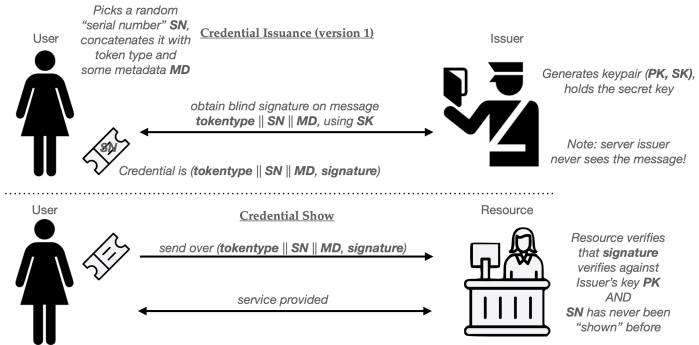
The standard execution of the Privacy Pass protocol relies on a structured, multi-step lifecycle. First, a User initiates a blind signature request with an Issuer, typically during an onboarding phase or initial connection. The User takes a randomized token, blinds it mathematically so that the Issuer cannot inspect its underlying value, and sends it over a secure channel. The Issuer signs the blinded token using its private key and returns it. The User then unblinds the token, yielding a valid credential tuple consisting of a token type, metadata, a serial number, and the cryptographic signature.
When the User subsequently attempts to access a Resource—such as a protected web application—they present this credential. The Resource validates the signature against the Issuer’s public key, ensuring authenticity without learning anything about the User’s identity or past browsing history. This decoupling of the issuance phase from the redemption phase prevents both the Issuer and the Resource from correlating the user’s initial identity verification with their subsequent web activity, provided the systems operate with appropriate operational hygiene.
Metadata Integration and Session-Specific Credentials
While early iterations of Privacy Pass functioned purely as pre-issued, single-use tokens, subsequent updates incorporated metadata flexibility to address more complex web security requirements. Standardized under Internet Engineering Task Force (IETF) Request for Comments (RFC) specifications 9576, 9577, and 9578, the protocol now supports arbitrary metadata strings, designated as MD, which bind a credential to specific contextual parameters.

For example, a user attempting to access a specific news portal on a designated date can request a credential bound explicitly to that domain and timeframe. Once bound, the metadata cannot be altered by the user, ensuring that the token holds zero utility outside of its intended scope. This capability enabled the development of session-specific credentials, an alternative issuance flow where the token is generated in real-time after a user arrives at a target website, rather than being stockpiled in advance.
Session-specific credentials offer distinct advantages for content delivery networks and anti-abuse systems like Cloudflare, allowing real-time traffic regulation and volumetric control. However, this operational model introduces notable trade-offs. Because credentials are requested dynamically during an active browsing session, the Issuer must remain continuously available; any downtime on the Issuer’s end halts access to the downstream Resource entirely. Furthermore, real-time issuance creates potential vectors for traffic-timing correlation attacks. If an adversary or a vertically integrated operator—where the Issuer and the Resource are controlled by the same corporate entity—analyzes the precise timestamps of issuance and redemption requests, they might theoretically correlate a user session with a token acquisition event. Nevertheless, at the massive operational scale handled by networks processing hundreds of thousands of transactions per second, executing such timing attacks remains extraordinarily complex and statistically improbable.
Cryptographic Trade-Offs: Publicly Verifiable Versus Privately Verifiable Tokens
A central engineering challenge in deploying Privacy Pass at scale involves balancing cryptographic security, performance, and verification models. The protocol defines two primary issuance frameworks to accommodate these competing engineering constraints: publicly verifiable tokens and privately verifiable tokens.
Publicly verifiable tokens closely mirror traditional Chaumian blind signatures using cryptographic primitives such as blind RSA signatures. The primary benefit of this architecture is public verifiability: any third-party Resource can verify the authenticity of a user’s token using only the Issuer’s publicly available cryptographic key. This eliminates any requirement for the Issuer and the Resource to share secret key material. However, RSA-based schemes introduce significant performance overhead. Achieving standard symmetric-equivalent security levels requires large RSA keys—typically 2,048 bits or greater—resulting in bulky signatures and computationally expensive mathematical operations during both signing and verification phases.
The alternative approach—privately verifiable tokens—trades public verification for extreme speed. By employing oblivious Message Authentication Codes (MACs) driven by oblivious pseudorandom functions built on elliptic-curve cryptography, these tokens can be generated and processed with remarkable computational efficiency. The critical drawback of privately verifiable tokens is that the validating Resource must possess the Issuer’s secret key to check the credential. Consequently, this model is typically restricted to tightly integrated ecosystem architectures where the Issuer and Resource operate within the same administrative domain.
Industry Adoption and Ecosystem Impact
The widespread deployment of Privacy Pass across the global internet represents a rare instance of major technology competitors aligning on an open, standards-based privacy protocol. Apple incorporates the standard into its operating systems via Private Access Tokens, Google integrates it through Private State Tokens within the Privacy Sandbox initiative, and browsers like Brave and Microsoft Edge have built-in support for the standard.
This multi-vendor convergence underscores a fundamental shift in how the technology sector approaches automated abuse mitigation. Rather than relying exclusively on intrusive device fingerprinting or aggressive tracking cookies to distinguish legitimate users from automated botnets, major platforms are increasingly turning to cryptographic credentials that verify humanity without exposing personal data.
Despite its massive deployment footprint, industry cryptographers note that Privacy Pass remains fundamentally limited in its functional scope. Operating essentially as a high-speed digital "wristband," the protocol is optimized solely for binary verification checks ("I am a legitimate user"). It does not naturally extend to complex attribute-based authorizations, such as proving a user’s age range, geographic location, or professional credentials, without engaging in continuous, interactive communication loops with the Issuer.
Future Horizons: Moving Beyond Basic Tokens
As regulatory pressures mount globally regarding digital safety, minor protection, and age verification mandates, the limitations of basic single-use anonymous credentials become increasingly apparent. While Privacy Pass successfully solves the challenge of bot mitigation without tracking, web architects are actively exploring more advanced cryptographic primitives to address richer authorization use cases.
Current industry research and emerging proposals—such as Google’s initiatives to standardize zero-knowledge credential systems—aim to bridge this gap. By leveraging zero-knowledge proofs, future credential architectures will allow users to reveal specific, granular attributes about themselves (such as verifying that a user is over the age of eighteen) without disclosing their exact birthdate, identity, or any persistent tracking identifiers.
As these next-generation cryptographic frameworks mature from academic proposals into formal standards, the digital landscape will likely see a transition from simple binary access tokens to sophisticated, policy-compliant cryptographic proofs. For now, Privacy Pass remains the invisible, battle-tested cryptographic workhorse securing the daily browsing experiences of billions of internet users worldwide.

