
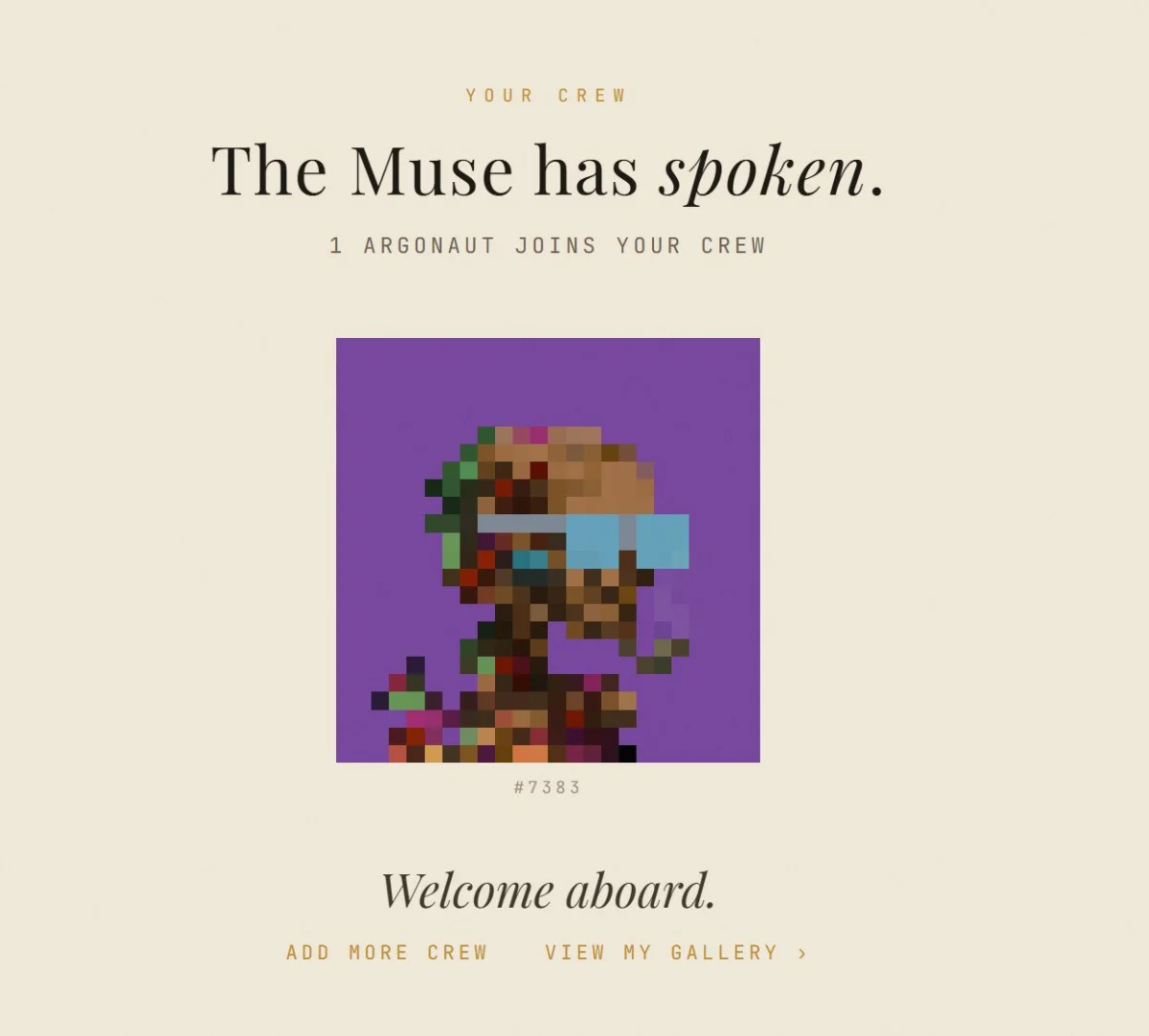
Today, the digital art community witnessed a significant milestone as Argonauts, the latest 10,000-piece collection by the crypto-native artist a.c.k. (@lphaCentauriKid), successfully minted out in a matter of minutes. Priced at approximately 0.12 ETH—roughly $300 at the time of transaction—the collection did not rely on the high-pressure sales tactics or the promise of extensive, vaporware-heavy "utility" that characterized the NFT market during the 2021-2022 speculative cycle. Instead, the rapid sell-out of Argonauts provides a compelling data point suggesting that the market for digital collectibles is undergoing a structural evolution, favoring artistic reputation and provenance over financial engineering.
The Mechanics of the Mint
The minting process for Argonauts was characterized by a steady, organic inflow of participants rather than the chaotic "gas wars" that once defined high-profile NFT drops. By setting a accessible mint price of 0.12 ETH, a.c.k. strategically lowered the barrier to entry for long-term collectors who had previously been priced out of the artist’s primary market, which typically consists of exclusive 1/1 digital works.
This decision to utilize a large-scale, accessible format represents a departure from the "whale-only" model that often limits the reach of high-end digital artists. By distributing 10,000 pieces, the artist effectively democratized ownership of his visual language, allowing a broader segment of the community to hold a stake in his body of work. The speed at which these tokens were claimed suggests that demand for high-quality, artist-led projects remains robust, even as the broader NFT ecosystem faces continued scrutiny and consolidation.
Chronology of a Shift
To understand the significance of this event, one must look at the trajectory of the NFT market over the last three years. In 2021, the market was defined by a rapid proliferation of generative collections, many of which were managed by teams with no prior artistic history. These projects frequently bundled art with elaborate "roadmaps" involving tokenomics, staking mechanisms, and promises of virtual real estate.
By 2023, the consequences of this model became apparent. As market liquidity tightened, projects that lacked fundamental artistic value or a clear creative vision struggled to maintain their floor prices. Conversely, artists who had been building consistent, long-term bodies of work—such as a.c.k.—began to see their reputations solidify. The Argonauts mint is the culmination of this maturation period. It follows a series of successful, artist-centric releases across the industry that have signaled a return to the medium’s original value proposition: the ability to own and verify digital provenance.
Data-Driven Analysis of Collector Behavior
Analysis of on-chain data surrounding the Argonauts launch reveals a distinct profile of the participating collectors. Rather than the transient, profit-seeking traders that dominated the previous cycle, the wallet addresses involved in this mint show a high degree of overlap with established art collectors and creators within the crypto-native space.
This phenomenon—"artists collecting artists"—is a critical indicator of a healthy, sustainable ecosystem. When a market is driven by creators, the value proposition is rooted in the history of the work rather than the expectation of a short-term secondary market flip. Data from major marketplaces indicates that the distribution of tokens in the Argonauts collection is widespread, suggesting that the supply has been absorbed by a committed base of supporters rather than concentrated in a few high-volume wallets. This decentralization of ownership is historically associated with lower volatility and longer-term asset retention.
The Role of Provenance and Artist Reputation
At the heart of the Argonauts success is the reputation of a.c.k. as a foundational figure in crypto-art. His visual language, which has been refined through years of digital creation, provides the project with an inherent narrative that does not require external marketing or "utility" fluff. In the art world, provenance is the history of ownership and the verified origin of a work; in the digital realm, blockchain technology provides this automatically.
The current market environment has become increasingly skeptical of projects that promise to "build" their way to value. Investors have shifted their focus toward "proven" entities—artists who have demonstrated a commitment to their craft over multiple years and through various market conditions. By leaning into this reality, a.c.k. has bypassed the need for manufactured hype, proving that artistic integrity remains the most reliable driver of demand in the NFT space.
Broader Implications for the NFT Industry
The implications of the Argonauts mint extend beyond the success of a single collection. If the market continues to prioritize art over utility-based gimmicks, the next phase of NFT development may look significantly more like the traditional fine art market than the tech-startup landscape of the past.
Industry analysts observe that this shift represents a return to the "Original Promise" of NFTs: providing a mechanism for digital artists to distribute their work directly to a global audience, with the added benefit of permanent, immutable ownership. When tokens are treated as digital assets rather than financial derivatives, the entire ecosystem benefits. The "community" surrounding such a project becomes a group of stakeholders interested in the preservation and appreciation of the artist’s work, rather than a cohort of speculators looking for an exit.
Reactions and Industry Sentiment
While no formal press release was issued by the artist regarding the sell-out, social media sentiment from prominent collectors and fellow artists has been overwhelmingly positive. The discourse has centered on the "health" of the mint, with many participants noting that the absence of artificial scarcity or complex mechanics was a refreshing change of pace.
Critics of the NFT space have long argued that the technology lacks a "use case" beyond speculation. Projects like Argonauts effectively counter this argument by demonstrating that the technology is, in itself, the utility. The ability to own a verified, immutable piece of an artist’s catalog is the functional purpose of the NFT. By focusing on this core capability, a.c.k. has effectively stripped away the layers of noise that have distracted the market for years.
Conclusion: A Path Toward Maturity
The success of Argonauts is not merely a financial achievement; it is a cultural signal. It indicates that the NFT market is entering a phase of maturity where artistic quality is once again the primary currency. For collectors, this means a shift away from the high-risk, high-volatility speculative environment of the past toward a more considered approach to building a digital collection.
For artists, the lesson is clear: the most sustainable path forward is one that prioritizes the work itself. By fostering deep, authentic relationships with a dedicated collector base, artists can insulate themselves from the boom-and-bust cycles that have plagued the sector. If the trajectory set by the Argonauts mint continues, the coming years could see a resurgence in high-quality digital art, characterized by sustained interest, stable ownership, and a renewed focus on the creative potential of the blockchain.
Ultimately, the market is not necessarily shrinking; it is refining. The participants in today’s mint have signaled that they are no longer interested in the "promises" of the past. They are interested in art, they are interested in the artist, and they are interested in the future of digital provenance. In that sense, the Argonauts collection serves as a blueprint for the next era of NFTs—an era where the art is the utility, and the community is built on the shared appreciation of digital creation. The industry, it seems, is finally coming home.

