
The global data landscape is undergoing a significant transformation as the traditional boundaries between data analysis and data engineering continue to blur, prompting a new wave of professionals to adopt project-based, self-study methodologies to master complex infrastructure. As organizations increasingly prioritize robust data pipelines over static reporting, the transition from interpreting data to building the systems that transport it has become a focal point for career development in the technology sector. This shift is exemplified by the emergence of structured, long-term self-study roadmaps that prioritize "learning by building," a departure from the passive consumption of theoretical tutorials that once dominated the field.
The Rising Demand for Data Engineering Expertise
The transition from data analyst to data engineer is not merely a personal career choice for many but a response to a broader industrial trend. According to recent industry reports, the demand for data engineers has consistently outpaced the demand for data scientists over the last three years. While data analysts focus on deriving insights from existing datasets, data engineers are tasked with the "plumbing"—the extraction, transformation, and loading (ETL) processes that ensure data is high-quality, accessible, and reliable.
Industry analysts suggest that the "Modern Data Stack" has become so complex that traditional academic programs often struggle to keep pace. This has led to the rise of independent practitioners who document their journeys, creating a blueprint for others. The core philosophy of these modern roadmaps is the rejection of "tutorial hell"—a state where learners continuously consume content without gaining the ability to apply it. Instead, the focus has shifted toward building incremental projects that introduce one or more complex variables at a time, such as containerization, orchestration, and idempotent database design.
Chronology of a 12-Month Professional Transition
The transition from an analytical role to an engineering one is typically characterized by a structured progression of technical milestones. In the case of documented industry transitions, such as those followed by Ibrahim Salami and other emerging engineers, the timeline often spans a year of focused application.
- Months 1-3: Fundamentals of Scripting and Extraction. The initial phase focuses on moving beyond SQL queries and into procedural programming, typically using Python. The primary goal is to interact with external APIs and move data from point A to point B, often utilizing simple file formats like CSV or local databases like SQLite.
- Months 4-6: Automation and Basic Scheduling. Practitioners introduce automation tools. Early-stage engineers often leverage GitHub Actions or basic Cron jobs to execute scripts without manual intervention, learning the basics of environment variables and secret management.
- Months 7-9: Containerization and Infrastructure. This phase marks a significant jump in complexity. The focus shifts from "code that runs on my machine" to "code that runs anywhere." Learning Docker becomes essential here, as it allows the application to be packaged with all its dependencies.
- Months 10-12: Orchestration and System Resilience. The final phase involves moving away from simple schedulers toward dedicated data orchestrators like Kestra, Airflow, or Dagster. This period is dedicated to learning how to handle system failures, retries, and complex dependencies between different data tasks.
Case Study: The Automated RSS Ingestion Pipeline
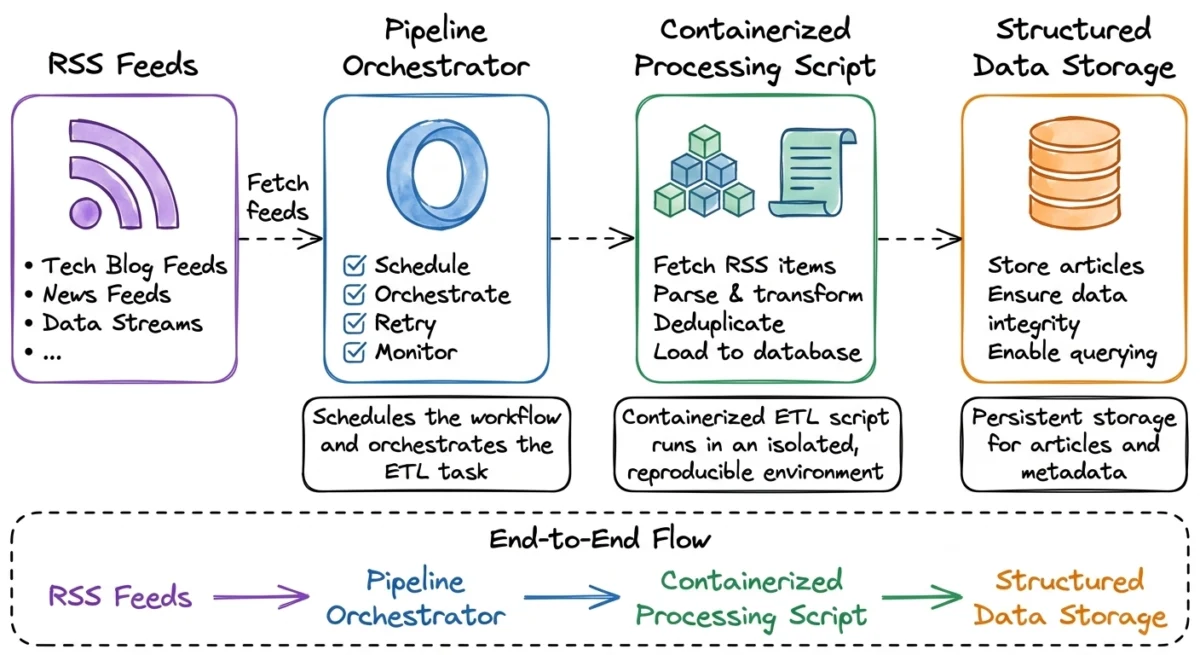
To understand the practical application of this roadmap, one can look at the development of an automated RSS ingestion pipeline. While an RSS reader may seem rudimentary, it serves as an ideal "sandbox" for testing sophisticated engineering principles without the distraction of overly complex business logic.
The architectural goal of such a pipeline is to fetch articles from various feeds, parse them into structured objects, and persist them in a production-grade database like PostgreSQL. However, the true value lies in the engineering decisions made during the build.

Layered Architectural Development
Professional-grade development requires a layered approach to minimize debugging complexity.
- The Application Layer: Initially, the ETL logic is written as a standalone Python script. It utilizes libraries such as
feedparserto handle the extraction andpsycopg2or SQLAlchemy for database interaction. - The Persistence Layer: To ensure the system is "idempotent"—meaning it can be run multiple times without changing the result beyond the initial application—engineers implement specific SQL logic. By using
ON CONFLICT (id) DO NOTHINGclauses in PostgreSQL, the system prevents the creation of duplicate records, a critical requirement for any automated data system. - The Execution Layer: By wrapping the application in a Docker container, the practitioner ensures that the Python version, library dependencies, and environment configurations remain constant regardless of the deployment environment.
The Role of Modern Orchestration
A pivotal moment in the transition to data engineering is the realization that building ETL logic is often the easiest part of the process. The complexity arises when the system must run autonomously. This is where orchestration tools like Kestra enter the framework.
Unlike simple schedulers, a modern orchestrator manages the lifecycle of the data task. It handles the "when" and "how" of execution, allowing the "what" (the Python script) to remain isolated. Industry experts note that using a declarative orchestrator—one where the workflow is defined in a configuration file like YAML—reduces the "glue code" that engineers previously had to write.
In a production-minded RSS pipeline, the orchestrator is responsible for:
- Task Launching: Triggering the Docker container to run the ETL script.
- Resilience: Implementing retry logic. If a network error occurs while fetching an RSS feed, the orchestrator can wait 30 seconds and try again, up to a specified maximum number of attempts.
- Visibility: Providing a centralized dashboard where the status of every execution is logged and monitored.
Technical Analysis: Orchestration vs. Execution
The distinction between execution and orchestration is a fundamental concept in modern DataOps. Execution refers to the actual processing of data—parsing JSON, calculating sums, or moving files. Orchestration refers to the management of those processes.
Data from the 2024 State of Data Engineering survey suggests that teams that clearly separate these two layers experience 40% fewer "silent failures"—instances where a script fails to run but no alert is triggered. By delegating retries and scheduling to a tool like Kestra, the engineer ensures that the Python application remains "lean." It does not need to know about the schedule or the retry logic; it only needs to know how to process data once it is invoked.
Observability and System Reliability
As pipelines move from manual execution to automated schedules, observability becomes the primary defense against data corruption. In the context of a self-study project, this involves a shift in logging strategy.

In the early stages of learning, practitioners often use "debug logging," printing raw data to the console to ensure a parser is working. However, as the pipeline matures into a system, logs must tell a story. Professional logs indicate the start and end of a process, provide a summary of the data processed (e.g., "Fetched 25 articles, saved 25 to database"), and highlight specific points of failure. This transition from "raw data dumping" to "meaningful status reporting" is a hallmark of an engineer’s growth.
Broader Industry Implications and Future Outlook
The trend of "learning by building" and the move toward modular, containerized data pipelines reflect a broader shift in how technology companies approach data infrastructure. The "monolithic" ETL tools of the past are being replaced by modular stacks where every component—the database, the container, the orchestrator, and the code—does exactly one job.
This modularity offers several advantages:
- Scalability: If the number of RSS feeds grows from one to one thousand, the orchestrator can manage the parallel execution of multiple containers.
- Maintainability: If the database needs to be switched from PostgreSQL to a cloud-native warehouse like Snowflake, only the persistence layer of the Python script needs to change; the orchestration and containerization layers remain untouched.
- Portability: Containerized workloads can be moved from local servers to cloud providers like AWS or GCP with minimal reconfiguration.
For professionals entering the field, the lessons learned from building simple pipelines—such as the importance of idempotency and the separation of concerns—are directly applicable to enterprise-scale systems handling petabytes of data.
Conclusion
The journey from data analyst to data engineer is characterized by a fundamental shift in mindset: from viewing data as a static resource to viewing it as a dynamic flow within a complex system. Through the use of 12-month roadmaps and incremental project building, a new generation of engineers is mastering the tools of the trade—Python, Docker, PostgreSQL, and Kestra—while reinforcing the core principles of reliability and repeatability. As the industry continues to evolve, the ability to design resilient, automated systems will remain the most critical skill in the data professional’s toolkit. The transition is not just about learning new software; it is about adopting a rigorous engineering discipline that prioritizes the integrity of the system above all else.

