
The international cybercrime landscape has shifted dramatically following the detention of a prominent teenage hacker in Amman, Jordan, who is widely suspected of leading the notorious data theft and extortion syndicate known as ShinyHunters. Operating under the online handle "Rey," the suspect—identified by investigative researchers as Saif Al-din Khader—has reportedly been cooperating with the Federal Bureau of Investigation (FBI) to unmask remaining affiliates of the hacking collective. This high-profile apprehension coincides with a chaotic period for the group, marked by aggressive zero-day exploitation, dramatic arrests across Europe, and a bizarre web of escalating international criminal investigations that now allegedly extends into murder-for-hire plots.
Anatomy of an Arrest and the Boeing Connection
The operation to detain Khader gained intense momentum as ShinyHunters set its sights on a lucrative and sensitive target: a navigation and digital aviation unit recently divested by aerospace giant Boeing. Sources close to the global investigation indicate that Khader and his associates were actively attempting to extort Jeppesen ForeFlight, a subsidiary that Boeing sold in November 2025 to private equity firm Thoma Bravo for approximately $10.55 billion. The theft of sensitive aviation data posed immediate, severe operational safety and security risks, prompting a rapid and prioritized response from American federal law enforcement.
Intriguingly, Khader’s alleged involvement in targeting the aerospace ecosystem carries a deeply ironic personal dimension. Strong evidence uncovered during earlier digital forensic analyses indicates that Khader’s father is employed by Royal Jordanian Airlines, a carrier predominantly controlled by the Jordanian government that relies heavily on Boeing aircraft for its long-haul operations. While an early 2025 claim by Rey on Telegram asserting his father was an airline pilot could not be independently verified, forensic recovery from a compromised family computer revealed that the elder Khader utilized identical login credentials across multiple internal portals for Royal Jordanian Airlines employees.

Following persistent inquiries from investigative journalists, Khader’s father did not respond to requests for comment. However, within hours of receiving an update regarding his son’s illicit activities, Rey swiftly began purging his digital footprint, systematically deleting his primary social media handles, including the Twitter/X accounts he frequently used to taunt law enforcement and rival cybercriminal organizations.
The PeopleSoft Zero-Day Campaign and the FBI Breach
The modern incarnation of ShinyHunters achieved global notoriety over the summer of 2025 and into 2026 through a relentless, mass-exploitation campaign targeting Oracle PeopleSoft servers. Utilizing a zero-day vulnerability tracked as CVE-2026-35273, the group bypassed standard security measures to harvest proprietary data from dozens of organizations spanning higher education, healthcare, technology, agriculture, transportation, and government sectors.
The hackers’ ambitions extended far beyond corporate espionage. In June, representatives for ShinyHunters admitted that their primary objective in weaponizing the PeopleSoft vulnerability was to infiltrate the FBI’s own internal recruitment and personnel databases. Although initial direct breaches of the bureau’s PeopleSoft infrastructure faced technical hurdles, the group eventually succeeded in compromising an unsecured FBI recruitment portal.
The security failure had immediate internal repercussions. In early October, international media reported that the FBI had formally terminated an Accenture contractor responsible for maintaining the compromised portal. The breach exposed sensitive, non-public records of more than 5,000 FBI personnel, including specialized unit assignments, medical evaluations, and psychiatric records.

When security firm Mandiant and the Google Threat Intelligence Group released defensive web application firewall (WAF) rules to mitigate the PeopleSoft vulnerability, ShinyHunters effortlessly bypassed the controls using sophisticated URL-encoding tricks. This technological escalation prompted the FBI to issue a formal flash notice in May 2026 warning organizations against yielding to the syndicate’s aggressive ransom demands—a public advisory that the hackers claimed motivated their attack on the bureau as a retaliatory public relations maneuver.
Franchising Cybercrime and the Fall of a Brand
Cybersecurity experts emphasize that the entities operating under the ShinyHunters banner today bear little resemblance to the original French nationals who founded the brand around 2019 and subsequently faced arrest and imprisonment. Instead, ShinyHunters has morphed into a decentralized franchise model, functioning similarly to the mythical "Dread Pirate Roberts" persona from popular culture, where succession is dictated by law enforcement arrests rather than natural retirement.
In this decentralized ecosystem, freelance affiliates feed stolen software-as-a-service (SaaS) credentials to the collective, negotiating multi-thousand-dollar payouts in exchange for a cut of the extorted funds. Rey reportedly leveraged this model, acquiring old Pretty Good Privacy (PGP) keys and spinning up fraudulent BreachForums channels to impersonate the original group, generating hundreds of thousands of dollars in damages while alienating veteran underground operators.
The illusion of operational invincibility shattered on September 15, 2026, when Dutch police executed a dramatic raid involving flash-bang grenades in Amsterdam, arresting 24-year-old convicted cybercriminal Pepijn van der Stap. Widely known in previous hacking circles by the alias "Umbreon," Van der Stap had cultivated a public persona as a "reformed" hacker, recently securing a position as an offensive security lead at a Dutch cybersecurity firm named Neo Security.

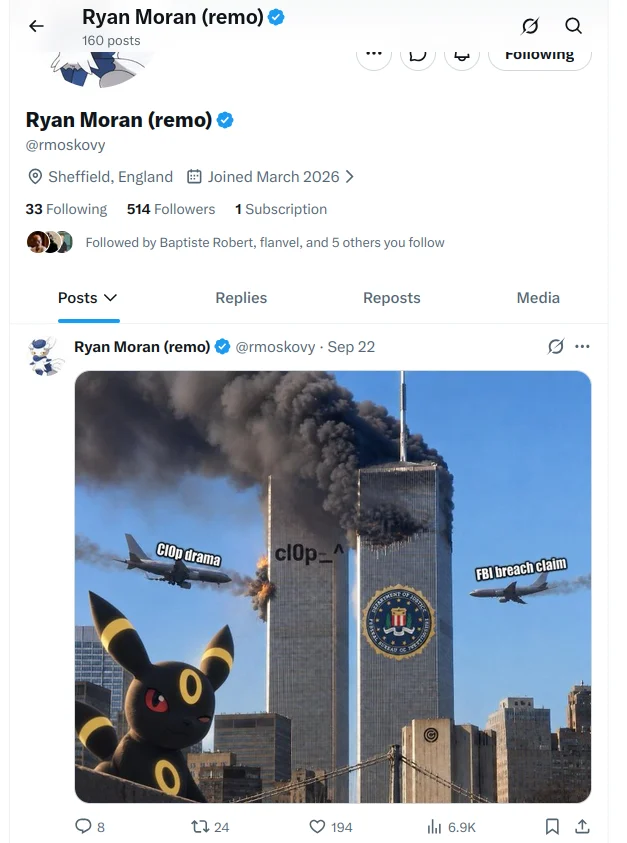
Following Van der Stap’s arrest, Rey attempted a bold disinformation campaign. Utilizing his social media platforms, Rey posted taunting memes targeting both the FBI and the notorious Cl0p ransomware group, strategically embedding images of the Pokémon character Umbreon to frame Van der Stap for the high-profile hacks. The gambit failed; the Telegram chat servers operated by Rey quickly turned against him, ridiculing his amateurish attempts to salvage a burned criminal brand. Shortly thereafter, his darknet sites went offline, and Jordanian authorities intervened.
Explosive Allegations: The Dutch Murder-for-Hire Investigation
While the cyber espionage community processed the arrests of both Rey and Van der Stap, Dutch media outlets published shocking new allegations against the latter. According to investigative reports published by Dutch broadcaster RTL in late September, law enforcement authorities suspect Van der Stap of attempting to orchestrate at least two murders abroad.
Investigators uncovered indications that the former software engineer, who previously served a prison sentence for multi-million-euro data extortion schemes, actively solicited and issued orders for contract killings outside the Netherlands. The revelation stunned former colleagues and clients, compounding the fallout from his sudden apprehension. Representatives for Neo Security confirmed that forensic investigators had thoroughly searched their offices, though initial audits revealed no evidence that Van der Stap had compromised his employer’s infrastructure or customer networks during his brief tenure.
Broader Implications and Enterprise Defense
The simultaneous collapse of key figures within the modern ShinyHunters apparatus underscores the volatile and precarious nature of modern cyber extortion syndicates. The ability of teenage operators to leverage unpatched enterprise software, orchestrate high-profile corporate shakedowns, and manipulate underground public relations highlights persistent vulnerabilities in global software supply chains.

As Jordanian authorities continue processing Saif Al-din Khader’s cooperation with American investigators, and as Dutch prosecutors prepare formal indictments regarding both data theft and conspiracy to commit murder against Van der Stap, the digital underworld faces an acute crisis of trust. The weaponization of SaaS platforms like Oracle PeopleSoft demonstrates that organizations can no longer rely on perimeter defenses alone. Cybersecurity analysts advise enterprises to accelerate patch management cycles, rigorously monitor internal authentication logs for credential abuse, and adopt zero-trust architectures to mitigate the risk of opportunistic exploitation by fragmented, franchise-style cybercrime gangs.
