
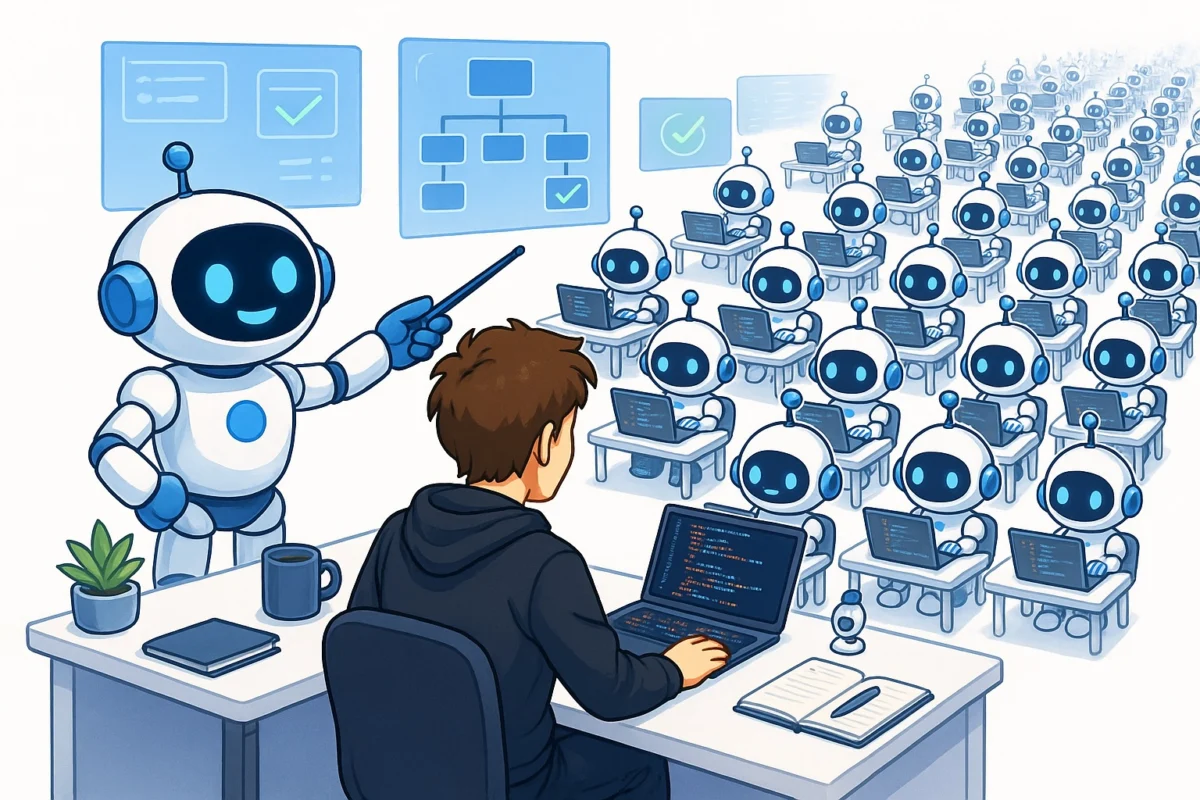
The landscape of software development is undergoing a fundamental shift as the industry moves from single-agent assistance to massive, multi-agent orchestration. As Large Language Models (LLMs) evolve from simple chat interfaces into robust Command Line Interface (CLI) tools, the ability to run dozens or even hundreds of coding agents in parallel has become the new benchmark for engineering productivity. By leveraging "headless mode" in tools such as Claude Code and Codex, developers are now transitioning into the role of orchestrators, managing fleets of autonomous sub-agents that handle complex refactoring, bug detection, and feature implementation simultaneously. This evolution marks a significant departure from traditional manual coding, moving the human developer an entire abstraction layer up in the software lifecycle.
The Emergence of the Orchestration Layer
The primary driver behind the push for multi-agent systems is the inherent limitation of human-speed development. While a single AI agent can assist a developer in writing a function or debugging a specific block of code, the true potential of generative AI is realized through parallelization. Orchestrating a multitude of agents allows for a massive increase in total work output, effectively compressing weeks of development time into hours. However, this scale introduces significant logistical challenges, including the difficulty of maintaining an overview of all active agents and responding to individual queries from separate sessions.
To solve this, industry experts are advocating for a hierarchical model. In this structure, a "Master Orchestrator"—a high-level agent—is tasked with coordinating a set of specialized sub-agents. This approach allows the human developer to interact with a single point of contact while the underlying system manages the complexities of parallel execution. By moving to this higher abstraction layer, engineers can direct the overall strategy of a project while the autonomous agents handle the granular execution of tasks.
Technical Foundations: The Role of Headless Mode
The technical linchpin of mass orchestration is "headless mode." In the context of coding agents like Claude Code or Codex, headless mode refers to a non-interactive execution environment where an agent is assigned a specific task via the CLI and operates without requiring constant human input. Once the task is completed, the agent reports the result back to the orchestrator or logs the changes to a version control system.
In Claude Code, this is typically initiated with a command such as claude -p "prompt", while Codex utilizes codex exec "prompt". These commands spin up isolated sessions that work independently on the provided instructions. The orchestrator agent monitors these sessions, reviewing logs only when necessary and receiving a final status report upon completion. This methodology allows for the execution of high-volume tasks, such as repository-wide code reviews or the migration of legacy codebases, without cluttering the developer’s primary workspace or cognitive load.
A Chronology of Agentic Evolution in Software Engineering
The journey toward 100-agent orchestration has been defined by rapid iterations in model capability and interface design:
- Late 2022 – The Codex Era: The introduction of OpenAI’s Codex paved the way for AI-powered code completion. While revolutionary, these early iterations were largely reactive, functioning as sophisticated "autocomplete" tools within Integrated Development Environments (IDEs).
- 2023 – The Rise of Autonomous Hype: Projects like AutoGPT and BabyAGI introduced the concept of autonomous agents. While these projects often struggled with "looping" and reliability, they established the theoretical framework for agents that could plan and execute multi-step tasks.
- Early 2024 – CLI Integration and Tool Use: The release of models with advanced tool-calling capabilities allowed agents to interact directly with the file system, run terminal commands, and perform web searches. This transformed agents from writers into "doers."
- Late 2024 to Present – Mass Orchestration and Headless Execution: With the launch of specialized CLI tools like Claude Code, the focus shifted toward reliability and scale. The ability to run agents in the background (headless) allowed for the current paradigm of managing hundreds of parallel sessions.
Strategies for Effective Multi-Agent Management
To successfully manage a fleet of 100+ agents, developers must implement specific operational strategies to ensure quality and prevent "agentic drift," where autonomous agents move away from the intended project goals.
1. Automated Verification and Self-Correction
One of the greatest risks in mass orchestration is the lack of direct human oversight for every line of code generated. To mitigate this, agents must be provided with a framework to verify their own work. This involves prompting the agent to write and run unit tests for any code it modifies. By making "self-verification" a mandatory step in the headless process, the orchestrator can ensure that only functional, tested code is presented for final review.

2. Task Suitability and the Refactoring Use Case
Not all tasks are suitable for headless orchestration. Highly creative or vaguely defined tasks still require significant human-agent interaction. However, refactoring is perfectly suited for this model. For example, a developer can task an orchestrator with identifying technical debt across a massive repository. Once the issues are prioritized, the orchestrator can spin up separate headless sessions for each individual refactoring task—such as updating deprecated API calls or improving variable naming—executing them all in parallel.
3. Tool Access and Autonomy (MCP and Permissions)
For agents to operate effectively in a headless environment, they require a high degree of autonomy. This includes access to the Model Context Protocol (MCP), which allows agents to connect to external data sources and tools seamlessly. Developers must configure these agents with the necessary permissions to perform actions autonomously while maintaining a "sandbox" environment to prevent unintended system-wide changes.
Industry Data and Economic Implications
The shift toward multi-agent orchestration is backed by emerging data regarding software development lifecycles. According to recent internal benchmarks from firms adopting agentic workflows, the time spent on "maintenance" and "refactoring"—which traditionally accounts for up to 60-70% of a developer’s time—can be reduced by as much as 80% through parallel orchestration.
Furthermore, the "cost-per-task" is plummeting. While running 100 instances of a high-tier model like Claude 3.5 Opus incurs significant token costs, the efficiency gains often outweigh the expenses when compared to the hourly rate of a senior engineer performing the same repetitive tasks. This economic shift is prompting many tech organizations to re-evaluate their hiring strategies, focusing more on "AI Orchestrators" who can manage complex systems rather than "Coders" who focus on syntax.
Responses from the Developer Community
The transition to mass orchestration has met with a mix of enthusiasm and caution within the global developer community. Lead engineers at several Silicon Valley startups have noted that while the productivity gains are undeniable, the "review bottleneck" remains a concern. "We can now generate a week’s worth of code in ten minutes," says one senior DevOps architect. "The challenge has shifted from ‘how do we write this’ to ‘how do we ensure this massive influx of code meets our architectural standards?’"
Others have raised concerns regarding the "black box" nature of headless sessions. If an orchestrator manages 100 agents, and five of those agents make subtle logical errors that pass automated tests, the cumulative technical debt could be catastrophic. This has led to the development of "Agentic Guardrails," a new category of software designed to monitor AI-to-AI communications and flag anomalous behavior.
The Broader Impact: The Future of Programming
The long-term implication of orchestrating 100+ agents is the eventual commoditization of syntax. As agents become more capable of handling the "how" of programming, the human role will focus almost exclusively on the "what" and "why." This democratization of software creation allows individuals to build complex, enterprise-grade systems that would have previously required a team of twenty engineers.
Looking ahead, the industry expects to see "Autonomous DevOps," where agents not only write and test code but also manage deployment, monitoring, and self-healing in production environments. The techniques discussed—using orchestrators to manage headless sessions—are the first steps toward a fully autonomous software development lifecycle. By mastering these orchestration layers today, developers are positioning themselves at the forefront of a technological revolution that redefines the very meaning of "engineering."
In conclusion, the ability to orchestrate a vast number of agents represents a massive competitive advantage. By moving up the abstraction layer and utilizing headless mode for parallel tasks, developers can transcend traditional productivity limits. While challenges in oversight and verification remain, the framework of multi-agent orchestration is undeniably the future of the software industry, promising a world where the speed of innovation is limited only by the clarity of the orchestrator’s vision.

