
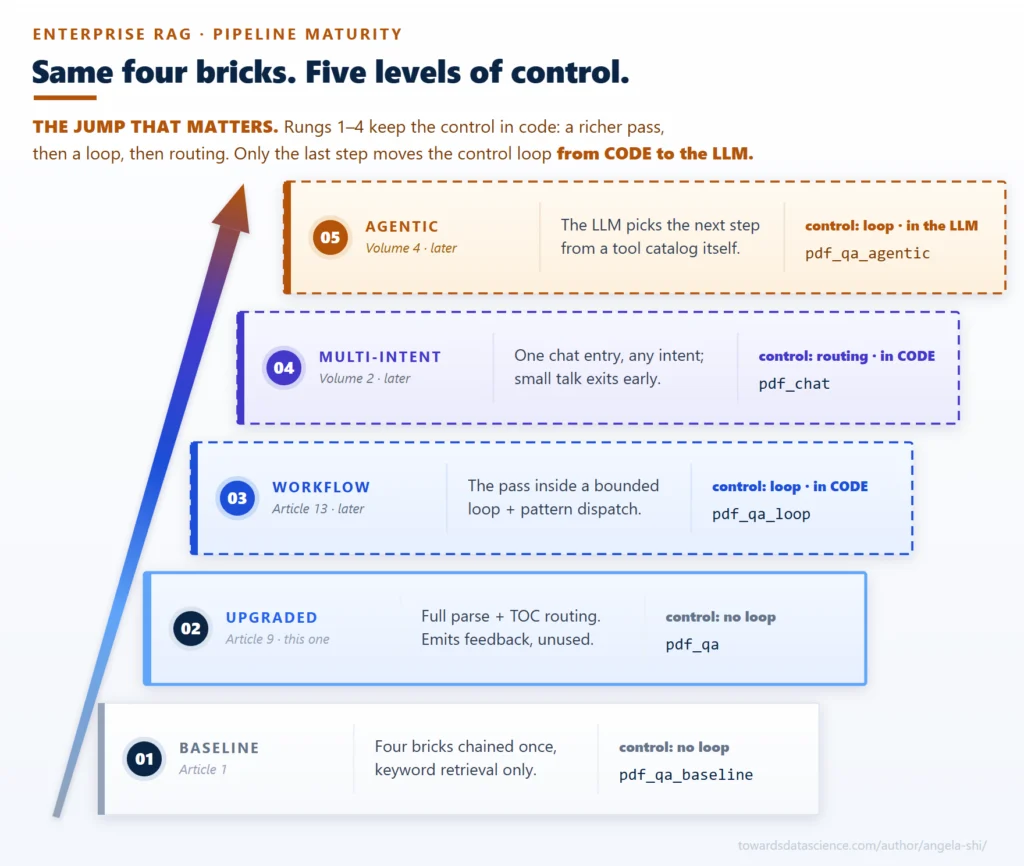
The rapid integration of Large Language Models (LLMs) into corporate infrastructure has hit a significant roadblock: the reliability of Retrieval-Augmented Generation (RAG) systems. While basic RAG pipelines are relatively simple to construct—often requiring fewer than 100 lines of code—recent technical evaluations reveal that these "naive" implementations frequently fail when confronted with complex enterprise documents such as financial reports and federal standards. A comprehensive analysis of RAG performance across four critical architectural stages—parsing, question processing, retrieval, and generation—demonstrates that the majority of AI "hallucinations" are not failures of the model’s intelligence, but rather failures of the data pipeline. By shifting the focus from prompt engineering to "context engineering," developers can mitigate these errors, ensuring that models receive the high-fidelity information required to produce accurate, cited, and typed answers.
The Evolution of Retrieval-Augmented Generation
Since the public release of GPT-3.5 and subsequent models, RAG has become the industry standard for grounding AI responses in private or specialized data. The process is conceptually straightforward: a document is parsed into text, converted into numerical vectors (embeddings), and stored in a database. When a user asks a question, the system retrieves the most relevant snippets of text and feeds them to the LLM to generate an answer.

However, as organizations move from pilot projects to production environments, the limitations of this "naive" approach have become glaringly apparent. In a series of stress tests using documents like the World Bank’s Commodity Markets Outlook and NIST (National Institute of Standards and Technology) cybersecurity frameworks, researchers found that standard pipelines often return confident but entirely incorrect answers. This phenomenon has prompted a re-evaluation of the RAG "bricks"—the individual components that make up the system.
The Four Pillars of Failure: A Brick-by-Brick Analysis
To understand why a production-grade pipeline succeeds where a naive one fails, it is necessary to examine the four distinct stages of the process. Each stage represents a potential point of failure where the "contract" between the data and the model can be broken.
1. Parsing: The Destruction of Relational Data
One of the most common failure points occurs at the very beginning of the pipeline: document parsing. Most naive RAG systems use simple text extraction methods that flatten a PDF into a continuous stream of characters. While this works for prose-heavy documents, it is catastrophic for tables and structured data.

In a test case involving the World Bank Commodity Markets Outlook, a report dense with price forecasts, a naive pipeline was asked for the 2025 annual average price forecast for U.S. natural gas (Henry Hub). The standard parser extracted the text but lost the grid coordinates of the table. Consequently, the label "Henry Hub" and the corresponding price "3.5" were separated into different text chunks. When the model attempted to retrieve the answer, it received fragments that no longer showed the relationship between the gas type and the price. The model correctly reported that the information was "not stated," resulting in a confidence score of 0.00.
The solution, termed "relational parsing," involves returning a data frame of lines where each row retains its bounding box and spatial context. By maintaining the relational shape of the document, the upgraded pipeline was able to provide the correct answer—$3.5 per mmbtu—with 0.99 confidence.
2. Question Parsing: The Vocabulary Gap
The second brick, question parsing, addresses the discrepancy between a user’s language and the document’s specific terminology. In a test using NIST SP 800-207 (Zero Trust Architecture), a user asked about the "pillars" of zero trust. The document, however, exclusively uses the term "tenets."

Because a naive pipeline searches for literal keyword matches or close vector proximities, the word "pillars" failed to trigger the retrieval of the section on "tenets." The model, lacking the relevant context, stated that the pillars were not listed. This is not a failure of the model’s reasoning but a failure to bridge the vocabulary gap.
Advanced pipelines now employ a pre-retrieval step where the query is expanded into the document’s own vocabulary. By mapping "pillars" to "tenets" or "principles" before the search begins, the system can anchor itself to the correct section of the document. In the NIST case, this allowed the upgraded pipeline to return all seven tenets with 0.95 confidence.
3. Retrieval: The Top-K Cutoff Problem
Retrieval failures often occur when a term appears frequently throughout a document, but only one specific instance contains the definitive answer. In the NIST Cybersecurity Framework 2.0, the word "Profile" appears on nearly every page. A naive pipeline using standard keyword or cosine similarity ranking will pull the "most relevant" pages based on frequency.

When asked to define a "Profile," the naive system retrieved several pages where the term was used in examples but missed the single page containing the formal definition. The defining paragraph fell below the "Top-K" cutoff—the arbitrary limit on how many snippets are sent to the model.
The upgraded approach utilizes "structural routing." Instead of relying solely on frequency, the system reads the document’s table of contents. By identifying a section titled "CSF Profiles," the retriever can route directly to the authoritative source. This method scales effectively; while frequency-based ranking degrades as documents grow from 30 to 400 pages, structural routing remains precise.
4. Generation: The Hallucination of Completeness
The final brick is the generation of the answer itself. When a model is asked a question in a free-text format, it is incentivized to provide a fluent response, even if the retrieved context is incomplete or missing the specific data point.

Using the World Bank report again, a query was made for the 2026 Brent crude oil forecast. The document, published in early 2024, only provides forecasts through 2025. A naive pipeline retrieved the energy price table, saw that 2026 was missing, but—in an attempt to be helpful—grabbed the nearest available number (the 2025 forecast of $79) and presented it as the 2026 figure.
To fix this, production pipelines are moving toward "typed generation contracts." Instead of asking for a prose paragraph, the system requires the model to fill out a structured schema (such as JSON) that includes a boolean field for complete_answer_found. Faced with a missing value, the model is forced to set this field to false and explain that the data is unavailable. This structural constraint makes missing information visible rather than allowing it to be masked by confident prose.
Chronology of RAG Development and the Shift to Context Engineering
The development of these advanced RAG techniques follows a clear timeline of industry maturation:

- Late 2022 – Early 2023: The "Naive RAG" era. Focus was on simple vector database integration (e.g., Pinecone, Weaviate) and basic PDF-to-text conversion.
- Late 2023: The "Reranking" era. Developers began adding a secondary step to re-score retrieved documents, though this still struggled with table data and structural gaps.
- Early 2024: The "Agentic RAG" and "Context Engineering" era. Introduction of multi-step reasoning, structural routing via Table of Contents, and the use of OpenAI’s Structured Outputs to enforce data integrity.
This chronology reflects a shift in the AI community. The initial excitement over "prompt engineering"—the art of coaxing better answers out of a model through clever wording—is being replaced by a focus on the upstream data architecture.
Supporting Data and Industry Implications
The data from these comparative runs is stark. In every instance where the naive pipeline failed, the error was traced back to a specific "brick" handing the model incorrect or incomplete context.
| Failure Mode | Document Type | Naive Confidence | Upgraded Confidence | Root Cause |
|---|---|---|---|---|
| Table Parsing | Financial Report | 0.00 (Not stated) | 0.99 (Correct) | Spatial alignment loss |
| Vocabulary Gap | Technical Standard | 0.20 (Incomplete) | 0.95 (Full list) | Synonym mismatch |
| Retrieval Cutoff | Multi-page PDF | 0.10 (Missing def) | 0.95 (Cited def) | Frequency dilution |
| Hallucination | Forecast Table | Confident/Wrong | False (Flagged) | Missing data point |
The implications for enterprise AI are profound. For industries such as legal, medical, and financial services, where a single incorrect digit can have significant consequences, the naive RAG model is increasingly viewed as a liability.

Professional Analysis of Future Trends
As organizations move toward "Context Engineering," we can expect several shifts in the AI landscape. First, the role of "AI Architect" will increasingly focus on data engineering skills—specifically, how to maintain the relational and structural integrity of documents as they pass through the pipeline.
Second, there will be a move away from "one-size-fits-all" RAG solutions. Different document types (e.g., a 1,000-page regulatory filing vs. a 5-page internal memo) require different retrieval strategies. Structural routing and relational parsing will become standard features in enterprise-grade AI platforms.
Finally, the concept of "confidence" in AI is being redefined. In a naive system, confidence is often a hallucinated byproduct of the model’s fluency. In an upgraded pipeline, confidence is a measurable metric tied to the presence of cited evidence and the fulfillment of a typed contract. By making the "missing answer" a first-class citizen in the AI’s output, developers can finally build systems that users can trust for critical decision-making.

The transition from naive RAG to context-engineered pipelines represents the professionalization of generative AI. It is the difference between a technology that is "impressive when it works" and one that is "reliable enough for production." As the industry moves forward, the focus will remain on the four bricks: ensuring that every piece of context delivered to the model is as accurate and structured as the document from which it came.

