• Home
  • About Us
  • Contact Us
  • Cookies Policy
  • Disclaimer
  • DMCA
  • Privacy Policy
  • Terms and Conditions
Dr Crypton
Secure Your Future in Crypto
Tech & Startup News

Khosla Ventures Breaks Decades-Long Tradition to Open Its First Non-Bay Area Office in New York City

by admin September 11, 2026
written by admin

Venture capital firm Khosla Ventures is officially breaking away from its historic Silicon Valley roots by establishing its first-ever permanent office outside of Menlo Park, California. The announcement, delivered by prominent venture capitalist and Khosla partner Keith Rabois during an appearance at TechCrunch’s StrictlyVC event in the West Village of New York City, marks a significant milestone for the 19-year-old investment firm. Known for its steadfast commitment to the affluent enclave of Sand Hill Road—and even operating without an office in downtown San Francisco—the firm’s expansion to the East Coast signals a shifting geographic paradigm in the American technology and venture capital landscape.

The new office, located on 14th Street in Manhattan, is slated to open its doors this fall, though internal skepticism regarding construction timelines remains. During the live interview, Rabois offered a pragmatic view of the project’s progress. "It’s actually allegedly being built out now," Rabois remarked to the New York audience. "We’ll see. This fall opening date is very vague in my mind." Despite logistical uncertainties, the strategic importance of the expansion is undeniable, reflecting a broader evolution in how top-tier venture capital firms interact with emerging tech hubs across the United States.

A Strategic Hub and Executive Briefing Center

Rather than serving as a traditional satellite office meant solely for deal-making, the Manhattan outpost is designed as an operational engine for Khosla’s extensive portfolio. The space will house a select group of investors, including Rabois, who relocated to the East Coast earlier this year to be closer to his family, including his husband, Jacob Helberg, the Under Secretary of State for Economic Growth, Energy, and the Environment, and their children based in Washington, D.C.

However, the defining feature of the 14th Street location is what Rabois termed an "executive briefing center." This specially engineered facility is designed to host 10 to 12 portfolio companies simultaneously, bringing them face-to-face with Fortune 500 decision-makers four days a week. By bridging the gap between early-stage disruptors and legacy enterprise clients, the firm aims to accelerate commercial validation for its startups.

"The portfolio companies love this," Rabois explained to event attendees. "They get pilots and customers, and so it’s going to be a very vibrant office because of that." This business-development-centric approach addresses a perennial challenge for young companies: securing enterprise-grade distribution channels and early revenue streams.

The Talent Equation: Juniors vs. Seniors in the New York Market

Rabois’s relocation and Khosla’s physical expansion have naturally reignited debates regarding talent density on the East Coast compared to the San Francisco Bay Area. Drawing on more than a decade of venture capital experience and his deep familiarity with both ecosystems, Rabois offered a nuanced assessment of New York’s labor market, dividing talent acquisition into distinct tiers.

At the entry-level and individual contributor stages, Rabois was unreserved in his praise for New York. He pointed to fintech powerhouse Ramp—a company he has backed through multiple funding rounds—as a prime example of successful localized talent generation. By tapping into local university pipelines and cultivating robust intern classes, companies can build exceptional operational density right out of school. "Individual contributor level, right out of school, absolutely," Rabois stated, emphasizing the high caliber of early-career talent emerging from East Coast institutions.

Conversely, sourcing senior technical talent presents a steeper hurdle. Rabois noted that finding architect-level senior engineers remains a challenge in New York, though he observed that modern software development methodologies often demand lower headcount volumes for these specialized roles than was historically necessary.

The most acute pain point, however, lies in recruiting seasoned executive leadership. According to Rabois, the challenge is less about absolute talent availability and more about regional geography and lifestyle constraints. Many senior executives who reside within the broader New York metropolitan area live in suburban commuter towns rather than the city center. Navigating a daily commute for a rigid five-day in-office culture creates significant friction.

"If you have an in-office culture, most of the more senior people that live and reside in the New York area live outside the city, and the commute in and out of the city for an office environment can be very painful," Rabois explained. He noted that growing up in a New York commuter suburb gave him firsthand insight into these transit dynamics. "When you need to recruit proven executive talent, and you really believe in an in-office culture, [that has] been very challenging."

To circumvent this hurdle, companies like Ramp have deliberately restructured their hiring philosophies. Rather than attempting to attract costly, highly experienced senior leaders who demand hybrid flexibility or cannot easily relocate their families to the heart of Manhattan, these firms focus on bottom-up organizational growth. "We don’t hire senior people. We just build from the bottom up, ground up," Rabois said. "It’s been a very conscious strategy, very intentionally, for the last three years."

A Growing Trend Among Elite Venture Firms

Khosla Ventures’ pivot toward New York places it within an elite, though gradually expanding, cohort of West Coast-centric venture capital institutions establishing a formal presence on the East Coast. While historic firms like Sequoia Capital and Andreessen Horowitz have maintained localized footprints in New York for years, their operations have historically been modest relative to their Silicon Valley headquarters.

This incremental East Coast migration coincides with sweeping structural shifts in regional labor statistics. A notable report published by commercial real estate services firm CBRE found that the New York metropolitan area has narrowly surpassed the San Francisco Bay Area in total tech talent headcount for the first time in the 13 years CBRE has tracked the metric. This shift has been catalyzed by aggressive hiring cycles within traditional financial institutions scaling up artificial intelligence capabilities, contrasted against workforce reductions and rationalization across several major West Coast technology firms.

Despite hard data pointing toward New York’s surging technological gravity, cultural skepticism persists among legacy operators. During the StrictlyVC gathering, reactions to the CBRE findings underscored a lingering attachment to Silicon Valley’s historical dominance. When reminded of the milestone study, one local attendee bluntly voiced a common sentiment within tech circles: "I heard about that study. I don’t buy it."

Broader Implications for the Venture Capital Ecosystem

The establishment of Khosla Ventures’ Manhattan office represents more than a simple real estate transaction; it reflects the maturation of New York as a primary nexus for enterprise technology and venture capital. By deploying an execution-focused model that directly connects startups with Fortune 500 enterprise buyers, Khosla is betting that proximity to traditional corporate headquarters will yield high-value commercial outcomes for its portfolio.

As venture capital firms continue to adapt to a post-pandemic operating environment marked by distributed teams, rising operational costs, and shifting talent pools, the strict dichotomy between Silicon Valley and the rest of the country is steadily dissolving. Whether New York can successfully overcome its regional transit and executive housing barriers to permanently claim the crown of tech talent density remains an open question. However, with heavyweights like Keith Rabois and Khosla Ventures planting a flag on 14th Street, the center of gravity in American venture capital is undoubtedly experiencing a historic recalibration.

September 11, 2026 0 comment
0 FacebookTwitterPinterestEmail
Tech & Startup News

Random rewards enrich classic game-theory insights

by admin September 11, 2026
written by admin

The Evolution of Game Theory

Game theory emerged as a formal academic discipline in the mid-20th century, most notably through the work of John von Neumann and Oskar Morgenstern. At its core, the field seeks to model decision-making processes in competitive situations where the outcome for one player depends on the choices made by others.

The most iconic of these is the Prisoner’s Dilemma. Developed by Merrill Flood and Melvin Dresher in 1950, and later formalized by Albert W. Tucker, the scenario presents two suspects held in separate interrogation rooms. Each faces a choice: cooperate with their partner by remaining silent, or defect by confessing to secure a lighter sentence. Under standard, static reward conditions, the Nash equilibrium—the point where no player benefits by changing their strategy—is for both to defect, despite the fact that mutual cooperation would yield a better collective outcome.

For decades, researchers have built upon this foundation, introducing variables like finite resources or repeated rounds. However, these models almost universally assumed that the "payoff matrix"—the reward structure—remained fixed. This assumption created a disconnect between theoretical predictions and the observable complexity of biological and social systems.

Introducing Environmental Stochasticity

The recent research led by a multidisciplinary team seeks to bridge this gap by incorporating "environmental stochasticity." In this model, the researchers allowed the rewards for cooperation and defection to fluctuate randomly between rounds. This shift is intended to mimic real-world scenarios, such as a business environment where market conditions change, or ecological settings where climate variability dictates the availability of resources.

The mathematical model applied this variability to three quintessential games: the Prisoner’s Dilemma, the Game of Chicken, and Rock-Paper-Scissors. The results were immediate and transformative.

Random rewards enrich classic game-theory insights

In the standard Prisoner’s Dilemma, the model typically converges rapidly to a "everyone defects" equilibrium. However, when the reward structure is subjected to even minor time-based variations, the system exhibits a dramatic shift. A second, stable equilibrium emerges, allowing for the coexistence of cooperators and defectors. As the volatility of the environment increases further, the "defector" equilibrium becomes entirely unstable, effectively forcing the population toward universal cooperation.

The Dynamics of Risk and Competition

The implications for the Game of Chicken—a model often used to represent high-stakes nuclear brinkmanship—are arguably more unsettling. In a static environment, the stable outcome is for all participants to swerve, avoiding mutual destruction. Introducing noise into the payoff system, however, disrupts this stability. The model reveals that even moderate environmental variation can lead to the emergence of a "non-swerving" population. When the noise reaches higher thresholds, the system enters a bistable state, where the population oscillates between survival and catastrophic collapse. This suggests that in volatile political climates, the likelihood of an "existential" crash is not merely a matter of human error, but a structural property of the game itself.

Rock-Paper-Scissors, a staple of evolutionary biology used to model cyclical population dynamics, also saw significant changes. In a static game, there are no fixed points; the system remains in a state of perpetual, predictable flux. By introducing random reward variation, the researchers identified new stable and unstable points that had previously been hidden. If rewards are uneven—for example, if rock provides a higher payoff than paper—the system develops "limit cycles." In these cycles, the probability of selecting a specific strategy evolves in a predictable, stable, and repeating fashion, providing a new mathematical framework for understanding how species or strategies persist in competitive environments.

Implications for Economics and Biology

The findings of this study have profound implications for several fields of inquiry. In economics, these models suggest that the "invisible hand" may be more sensitive to market volatility than traditional models imply. If the reward structure of a market is constantly shifting due to external economic shocks, the resulting behavior of actors will not necessarily settle into the predicted Nash equilibrium. Instead, it may foster a broader diversity of strategies, or conversely, drive the market toward unexpected extremes.

For evolutionary biologists, the study offers a clearer view of why cooperation persists in nature. Many organisms operate in environments characterized by extreme weather, food scarcity, and predation risk. If these environmental factors act as "noise" in the payoff matrix of survival, then cooperation might not be an altruistic anomaly, but an adaptive strategy necessitated by the instability of the environment. The research suggests that the "depressing conclusion" of the Prisoner’s Dilemma—that everyone loses—is a product of a simplified environment that rarely exists in the wild.

Broader Impact and Future Directions

The research team’s approach signals a move away from deterministic modeling toward a more nuanced, probabilistic understanding of human and biological behavior. By demonstrating that "noise" is not just a nuisance to be filtered out but a fundamental driver of strategic behavior, the study opens new avenues for researchers.

Random rewards enrich classic game-theory insights

Critics of traditional game theory have long argued that its reliance on static models makes it a poor tool for predicting real-world outcomes. By proving that even small amounts of variation can fundamentally alter the stability of a system, this study validates the skepticism of those who felt that classic models were overly reductive.

Looking forward, the researchers aim to expand their model to include multi-player scenarios and networks, where the influence of neighbors and the structure of communication channels could further complicate the findings. The goal is to develop a "unified theory of volatile games" that can be applied to everything from international diplomacy to the evolution of complex societies.

As the scientific community digests these findings, the focus will likely shift toward empirical validation. Can we observe these "limit cycles" in actual social or biological populations? If so, the ability to predict the onset of instability or the emergence of cooperation could prove vital for managing systemic risks in global systems.

Ultimately, this study serves as a reminder that the "hard bits" of life—the unpredictable, the random, and the uncontrollable—are not merely noise. They are the essential variables that define the game itself. By embracing this complexity, scientists are beginning to uncover a more accurate, and perhaps more hopeful, picture of why and how we choose to cooperate in an ever-changing world. The era of static game theory is effectively over; the age of dynamic, noise-driven strategy has begun.

September 11, 2026 0 comment
0 FacebookTwitterPinterestEmail
Tech & Startup News

Design the next iPhone game: I’ve created a true monstrosity of a phone

by admin September 11, 2026
written by admin

As the tech industry converges on Cupertino for the annual September product cycle, consumer attention is not solely focused on Apple’s official hardware announcements. Amid the widespread anticipation surrounding flagship device rollouts, social media platforms—particularly Meta’s Threads—have found a viral outlet in a browser-based interactive simulation titled "Design the next iPhone." Developed by independent web creator Neal Agarwal for his platform Neal.fun, the digital sandbox allows users to construct entirely customized, albeit absurd, iterations of the world’s most recognizable smartphone.

While tech enthusiasts dissect official keynote presentations and analyze incremental upgrades in camera arrays and processing chips, Agarwal’s simulation offers a lighter, highly satirical counterweight. By granting users unrestricted freedom to mix historical mobile aesthetics with chaotic hardware attachments, the mini-game has sparked a wave of digital creativity, highlighting both consumer fatigue with iterative design cycles and a collective nostalgia for the experimental hardware eras of the past.

I played 'Design the next iPhone' and made an abomination

The Rise of Neal.fun and the Interactive Sandbox Phenomenon

Neal Agarwal has built a reputation within the digital community for designing clever, lightweight web applications that blend humor, education, and user participation. Platforms like Neal.fun thrive on simple premises that quickly capture public interest, utilizing minimalist design to maximize engagement. Previous viral hits from the developer, such as "Draw logos from memory" and the apocalyptic "Asteroid launcher," established a formula of accessible, frictionless interaction that encourages social sharing.

"Design the next iPhone" continues this tradition by gamifying product development. The premise is disarmingly straightforward: participants are presented with a blank slate resembling the familiar silhouette of an Apple handset. From there, they can toggle through an exhaustive list of customizable components, including various port selections, button configurations, and camera modules. However, the true appeal of the application lies in its inclusion of eccentric, non-functional accessories. Users can affix physical elements such as retro retractable antennas, functional rotary dials, miniature steering wheels, and whimsical googly eyes directly onto the device chassis.

For tech journalists and casual consumers alike, the resulting creations are frequently antithetical to Apple’s notoriously rigid, minimalist design philosophy. The contrast between Apple’s sleek, industrial aesthetic and the chaotic, Frankenstein-esque combinations generated by users has transformed the web game into a viral sensation across professional and amateur tech circles alike.

I played 'Design the next iPhone' and made an abomination

Contextualizing the Simulation Within Apple’s Modern Product Lifecycle

The viral traction of "Design the next iPhone" coincides precisely with the high-stakes environment of Apple’s autumn hardware events. Historically, the September product showcase serves as the focal point of the mobile industry, drawing intense scrutiny from analysts, investors, and consumers. During this period, expectations for groundbreaking innovation routinely clash with the reality of iterative hardware refinement.

In recent years, critics have noted that smartphone design has reached a plateau. With rectangular glass-and-aluminum slabs becoming the industry standard, physical differentiation between generations has narrowed significantly. Consumers often find themselves evaluating upgrades centered around fractional changes in bezel thickness, incremental battery life improvements, and specialized computational photography features rather than radical structural overhauls.

By allowing users to play the role of chief design officer, Agarwal’s simulator taps into a latent consumer desire for radical personalization and hardware experimentation—qualities that modern consumer electronics largely abandoned in the pursuit of thinness, water resistance, and structural integrity. The ability to attach a physical joystick or a bulky mechanical dial serves as a humorous acknowledgment of how far contemporary smartphones have drifted from the tactile, highly varied form factors of the early 2000s.

I played 'Design the next iPhone' and made an abomination

Industry Reactions and the Limitations of Modern Smartphone Form Factors

While the simulator provides broad creative latitude, it also inadvertently underscores the engineering constraints that dictate contemporary mobile manufacturing. For instance, while users can slap retro aesthetic markers like external antennas or dual-support feet onto their virtual handsets, the game also highlights sought-after, highly rumored form factors that remain absent from Apple’s official lineup—most notably, a viable, vertically folding flip phone.

Industry analysts have spent years tracking Apple’s patent filings and supply chain movements for indications of a foldable device. While competitors such as Samsung, Google, and Motorola have iterated through multiple generations of book-style foldables and clamshell flip phones, Apple has remained notably methodical, prioritizing durability, crease mitigation, and software ecosystem integration over speed-to-market. The omission of a true flip-phone design mechanism within the Neal.fun simulator—noted by early testers as a notable boundary of the current web tool—reflects the genuine engineering complexities involved in commercializing foldable OLED technology at scale.

Furthermore, the physical configurations mocked up in the game serve as an unintentional critique of modern port minimalism. Over the past decade, manufacturers have systematically eliminated physical interfaces, transitioning from the 3.5mm headphone jack to proprietary connectors, and eventually standardizing around USB-C while phasing out physical SIM card trays in specific markets. The ability in Agarwal’s game to reintroduce obsolete inputs acts as a form of digital escapism for consumers nostalgic for universal connectivity and tactile feedback.

I played 'Design the next iPhone' and made an abomination

Broader Implications for Tech Culture and Viral Marketing

The intersection of indie web development and corporate product cycles illustrates a shifting paradigm in tech culture. Historically, viral marketing surrounding major tech launches was tightly controlled through official promotional campaigns, embargoed review units, and carefully choreographed keynote addresses. Today, user-generated content, viral memes, and interactive parodies exert a powerful secondary influence on public discourse.

By providing a low-stakes, humorous medium for consumer commentary, tools like "Design the next iPhone" allow internet communities to collectively process the anticipation and eventual fatigue surrounding major hardware cycles. The game transforms what could otherwise be dry consumer analysis into an active, participatory joke, bridging the gap between hardcore hardware analysts and casual internet users.

As tech companies continue to refine their product pipelines toward augmented reality glasses, artificial intelligence integration, and increasingly subtle hardware iterations, the appetite for whimsical, unstructured digital play remains high. Whether Apple designers take aesthetic inspiration from community-generated monstrosities featuring integrated steering wheels and googly eyes remains unlikely, but the enduring popularity of Neal Agarwal’s creation demonstrates that the public retains an enduring appetite for imagining what a mobile device could be, completely unbounded by market realities or engineering physics.

September 11, 2026 0 comment
0 FacebookTwitterPinterestEmail
Artificial Intelligence & Tech

5 Python Techniques for Efficient Resource Orchestration

by admin September 11, 2026
written by admin

Modern software engineering has largely conquered the challenge of concurrent execution. With the ubiquity of tools like asyncio.gather, thread pools, and asynchronous await patterns, developers can achieve parallel I/O throughput in a matter of hours. However, the chasm between a functional prototype and a production-grade system lies in the management of finite, bounded resources. As applications scale to handle thousands of concurrent requests, the naive approach to concurrency—where tasks are launched without regard for backend capacity—often leads to system instability, resource exhaustion, and cascading failures. The evolving landscape of Python, particularly with the arrival of versions 3.14 and 3.15, has provided developers with a robust, standardized toolkit for mastering resource orchestration.

The Evolution of Concurrency in Python

The history of Python’s concurrency model is a journey from cooperative multitasking to highly structured, deterministic execution. For years, developers relied on third-party libraries like Trio and AnyIO to implement structured concurrency patterns that the standard library lacked. The release of Python 3.11 marked a turning point, introducing TaskGroup and improved timeout mechanisms. By October 2025, the release of Python 3.14 solidified these gains by introducing first-class thread-safety improvements for asyncio, specifically tailored to support the new free-threaded build.

This progression continues into the current development cycle of Python 3.15, which reached feature-freeze status in May 2026. By incorporating TaskGroup.cancel()—a feature long-championed by the Trio community—Python 3.15 addresses a persistent gap in how developers manage task lifecycles. This shift reflects a broader industry mandate: as Python moves into performance-critical environments, the language must provide predictable, safe primitives for handling complex resource dependencies.

1. Structured Concurrency via TaskGroup

The primary risk in concurrent programming is the "orphaned task"—a process that continues to execute in the background after the parent function has terminated or failed. Traditionally, asyncio.gather was the standard, yet it suffered from a significant architectural flaw: if one task within the group raised an exception, the others would continue to run, often leading to memory leaks or inconsistent state.

The introduction of asyncio.TaskGroup in Python 3.11 fundamentally changed this paradigm. By utilizing an async with block, TaskGroup ensures that the lifecycle of every child task is strictly bounded by the scope of the group. If a single task fails, the remaining tasks are automatically cancelled, and the group does not exit until every task has reached a terminal state. This pattern prevents resource leakage and ensures that error handling is centralized and predictable, a critical requirement for high-availability systems.

2. Managing Capacity with asyncio.Semaphore

While TaskGroup provides architectural safety, it does not inherently limit resource consumption. In a scenario involving an internal dashboard aggregator—which might simultaneously query a pricing API, a positions database, a news feed, and a risk model—the system could easily overwhelm a backend with limited capacity. If 30 concurrent users trigger requests, and each user queries four services, the application might attempt 120 simultaneous connections. If the risk model service can only handle three concurrent calls, the system is destined for a performance collapse.

The solution is the implementation of asyncio.Semaphore, configured at the module level rather than the request level. By creating a semaphore for each backend based on its actual capacity, developers can effectively "throttle" traffic. When a task requests a connection, it must first acquire a slot from the semaphore. If the capacity is reached, the task suspends until a slot becomes available. This ensures that the system maintains steady, predictable load on backend dependencies, preventing the "thundering herd" problem that often plagues microservice architectures.

3. Dynamic Resource Cleanup with AsyncExitStack

In complex applications, the number of resources required is rarely known at compile time. Depending on user permissions, feature flags, or system state, an application may need to open two connections in one instance and five in another. Stacking multiple async context managers manually is error-prone and brittle.

The contextlib.AsyncExitStack serves as a dynamic controller for these scenarios. It allows developers to open an arbitrary number of asynchronous context managers and register them to a single stack. When the block exits, the stack orchestrates the teardown of these resources in reverse order, ensuring that dependencies are closed correctly. This pattern is essential for maintaining clean connections, particularly when dealing with unpredictable runtime configurations where the failure to close a socket or a database handle could result in a depleted connection pool.

4. Deadline Propagation and Nested Timeouts

Timeouts are often implemented as an afterthought, usually via a simple wait_for call on a specific function. However, this fails to account for the hierarchy of a request. In a sophisticated dashboard, a user might require a "global" timeout of one second for the entire page load, while each individual backend call should have a "local" timeout of 200 milliseconds to ensure one slow service does not degrade the entire experience.

The asyncio.timeout() context manager, introduced in Python 3.11, allows for elegant, nested deadline propagation. Because the timeout acts as a property of a scope rather than a wrapper for a single function, developers can set a global timer on an entire TaskGroup while simultaneously applying tighter constraints to specific tasks within that group. This allows for "graceful degradation": if a slow service times out, the system can return the partial results from the faster services rather than failing the entire request.

5. Live Diagnostics with Task Introspection

When prevention fails and a production system begins to hang, the traditional recourse has been to add verbose logging or attach a debugger—often requiring a new deployment. Python 3.14 introduced a powerful, built-in diagnostic tool: the asyncio command-line interface. By executing python -m asyncio ps or python -m asyncio pstree , engineers can inspect a running process without code modifications.

These commands provide a hierarchical view of the live task tree, revealing which tasks are currently executing, which are suspended, and what they are waiting for. This capability transforms the debugging process from a guessing game into a surgical operation. If a dashboard is hanging, an engineer can immediately identify whether the stall is caused by a blocked semaphore, an unresponsive backend, or a deadlock in the orchestration logic. This level of observability is a prerequisite for operating large-scale Python systems in production.

Broader Implications for Engineering Teams

The move toward these five techniques signifies a maturation of the Python ecosystem. By codifying these patterns into the standard library, the Python Software Foundation is reducing the "cognitive load" on developers. Instead of relying on idiosyncratic custom code to handle concurrency, teams can now adopt a shared, standard vocabulary for resource orchestration.

The financial and operational implications are significant. Properly orchestrated concurrency reduces the need for over-provisioning infrastructure, as systems can safely run at higher utilization rates without risking cascading failures. Furthermore, by standardizing on these tools, organizations can expect faster incident resolution and more reliable software lifecycles. As Python 3.15 approaches its stable release, the tools to build robust, fault-tolerant, and highly concurrent applications are no longer niche—they are the new standard for professional development. By combining structured concurrency, intelligent throttling, and deep introspection, engineers can ensure that their applications remain resilient under the most demanding production conditions.

September 11, 2026 0 comment
0 FacebookTwitterPinterestEmail
Artificial Intelligence & Tech

Try Google Pics: Easy image creation and editing in Google Workspace

by admin September 11, 2026
written by admin

The Technical Foundation of Google Pics

At the core of this new offering lies the Nano Banana image generation model. This proprietary technology has been engineered to prioritize precision, allowing users to move beyond the often-unpredictable results associated with early-stage generative AI. Unlike many consumer-grade AI tools that focus on "text-to-image" in a vacuum, Google Pics is designed for iterative refinement. Users are empowered to create, manipulate, and edit digital assets with a level of control that meets the requirements of corporate environments, such as graphic design for marketing materials, social media content, and internal business presentations.

The platform functions in two distinct capacities: as a standalone web application accessible via the domain pics.new, and as an embedded tool within the Google Workspace suite. This dual-deployment strategy is a direct response to user feedback suggesting that the friction caused by switching between creative software and documentation platforms—such as copying, saving, and re-uploading files—significantly hampers professional productivity.

A Timeline of Integration and Development

The introduction of Google Pics follows a long period of aggressive development in generative AI by Google. Since the public emergence of its large language models, the company has sought to bridge the gap between "creative" AI and "functional" AI.

  • Early 2024: Google began piloting image generation features within its Labs program, gathering user data on how professionals utilize AI for document illustration.
  • Mid-2024: Internal testing focused on integrating these models into Slides and Docs, identifying the need for a centralized "image workspace" rather than disparate, disconnected plugins.
  • September 2026 (Launch Window): The official release begins for AI Pro and Ultra subscribers, with a phased rollout for business-tier accounts.
  • Future Outlook: While currently focused on Docs, Slides, and Drive, the roadmap suggests further integration into other collaborative tools, potentially including Meet and Sheets, as the company seeks to standardize visual creation across its entire cloud infrastructure.

The Case for Integrated AI Productivity

The strategic rationale behind Google Pics is supported by extensive usage metrics. Millions of users interact with billions of images within the Workspace ecosystem every month. Historically, this has required a heavy reliance on third-party design software—such as Adobe Creative Cloud or Canva—to generate or refine assets before they are imported into a document.

By moving the creation engine into the environment where the document resides, Google is attempting to capture the "in-workflow" creative market. According to internal analysis, reducing the time spent switching between windows and managing file versions can improve document production efficiency by an estimated 15 to 20 percent for teams relying heavily on visual communication. This is not merely about generating art; it is about maintaining a consistent brand aesthetic within a corporate document without ever leaving the browser tab.

Try Google Pics: Easy image creation and editing in Google Workspace

Functionality and User Experience

Google Pics offers a suite of tools that go beyond simple text-to-image prompts. Key features include:

  1. Iterative Editing: Users can take an existing image and refine specific elements, a feature designed for users who need to adjust mockups or brand assets without regenerating the entire composition.
  2. Native Drag-and-Drop: By leveraging Google Drive, users can drag existing assets directly into the Pics editor, apply AI-driven transformations, and drop the result back into a Slide or Doc.
  3. Cross-Platform Sync: Because the tool is integrated into the Workspace layer, any image created in Pics is automatically saved to the user’s Google Drive, maintaining version history and metadata accessibility.

Market Context and Industry Implications

The release of Google Pics comes at a time of intense competition in the AI-assisted productivity space. Microsoft has integrated its own DALL-E powered image generation into the Microsoft 365 Copilot suite, while Adobe continues to refine Firefly for its Creative Cloud. Google’s advantage, however, lies in its ubiquity. By embedding image generation into the baseline Workspace experience—which serves hundreds of millions of enterprise users—the company is effectively commoditizing high-end image editing.

Industry analysts suggest that this development could disrupt the market for mid-tier graphic design tools. When enterprise users can generate professional-grade illustrations, modify them, and insert them into a pitch deck without ever paying for an additional software subscription or undergoing specialized training, the barrier to entry for high-quality visual communication is lowered significantly.

However, the shift also raises questions regarding copyright, provenance, and the potential for "AI-generated clutter." Google has addressed this by ensuring that all generated content is managed through the same security and privacy protocols as existing Workspace files, a crucial consideration for corporate clients concerned about intellectual property.

Official Stance and Future Projections

In announcing the tool, Meg Whittenberger, Google Pics Product Manager, emphasized that the goal is "unparalleled precision." By prioritizing a design-centric approach rather than a purely generative one, Google is signaling that it understands the needs of the professional user. For the corporate sector, the ability to generate images that adhere to specific brand guidelines or formatting requirements is significantly more valuable than the ability to create "spectacular" but non-compliant imagery.

As the product rolls out, the company expects to see a surge in adoption among marketing teams, educational institutions, and internal communications departments. The immediate availability in Docs and Slides serves as the initial testbed, with the integration into Google Drive—expected in the coming weeks—serving as the "hub" that will solidify the platform’s utility as a central file management and creation system.

Try Google Pics: Easy image creation and editing in Google Workspace

Broader Economic and Creative Impact

The widespread adoption of tools like Google Pics suggests a fundamental change in the digital workplace. We are moving toward an era where the "creator" and the "editor" roles are becoming increasingly blurred. The technical expertise required to produce high-fidelity visuals is being abstracted away by the Nano Banana model, effectively enabling a broader demographic of employees to participate in visual storytelling.

While some creative professionals have expressed concern over the automation of design tasks, the broader consensus in the software industry is that these tools serve to augment rather than replace human intuition. By removing the technical hurdles—such as file format compatibility, software licensing, and the tedious nature of image manipulation—Google is attempting to accelerate the pace of communication within the digital economy.

As of this writing, users with access to Google AI Pro and Ultra can begin utilizing the service immediately at the provided address. For businesses, the rollout will be managed through the standard Workspace administrative console, allowing IT departments to manage permissions and access levels as they would with any other Google service. This standardized approach to deployment is intended to reassure enterprise clients that the tool is enterprise-ready, secure, and compliant with current data governance standards.

Ultimately, the success of Google Pics will depend on its ability to evolve alongside its users. As the AI model learns from the specific patterns of corporate document creation, the expectation is that the tool will become increasingly predictive, suggesting visual improvements, layout adjustments, and stylistic refinements that align with the user’s history and document type. In a landscape defined by rapid innovation, Google is betting that the winning strategy is not just the most powerful model, but the most integrated one.

September 11, 2026 0 comment
0 FacebookTwitterPinterestEmail
Cryptocurrency News

MEXC Reports 130% Surge in August TradFi Trading Volume Driven by Semiconductor and Tokenized Asset Demand

by admin September 11, 2026
written by admin

The intersection of traditional finance (TradFi) and digital asset infrastructure reached a significant milestone in late summer 2026, as leading zero-fee digital asset trading platform MEXC released its operational performance data for August. The report highlights an unprecedented expansion in user engagement across equity-linked derivatives, tokenized stocks, and exchange-traded fund (ETF) spot markets. Total trading volume across stock, index, and ETF futures recorded a staggering 130% month-on-month increase, underscoring a broader paradigm shift in how retail and institutional market participants seek global exposure.

Simultaneously, the breadth of available financial instruments on the platform expanded significantly. MEXC reported a 35% increase in its available contract offerings, pushing the total count past the 400-asset threshold. This rapid portfolio scaling coincided with a robust 30% month-on-month growth in tokenized stocks and ETF spot trading volume, establishing August as one of the platform’s most dynamic trading periods in terms of product adoption and cross-market capital flows.

The explosive growth observed in August did not occur in a vacuum; it represents the culmination of a multi-year trajectory toward the convergence of decentralized finance (DeFi) rails and traditional equity markets. Over the past several quarters, macroeconomic headwinds, fluctuating interest rate expectations, and an insatiable global appetite for artificial intelligence (AI) and semiconductor hardware have driven traders to seek continuous, borderless market access. Traditional stock exchanges, bound by rigid operating hours and localized clearinghouses, have increasingly struggled to satisfy the demands of a 24/7 global investor base.

Platforms bridging this gap have experienced exponential growth. MEXC’s strategic positioning—allowing users to trade products linked to U.S., Korean, and Hong Kong equities utilizing Tether (USDT) through a unified account architecture—has served as a primary catalyst for this shift. By eliminating traditional brokerage barriers and introducing zero-fee trading structures, the platform has effectively democratized access to instruments that were previously constrained by geographical boundaries, high minimum capital requirements, and restrictive trading schedules.

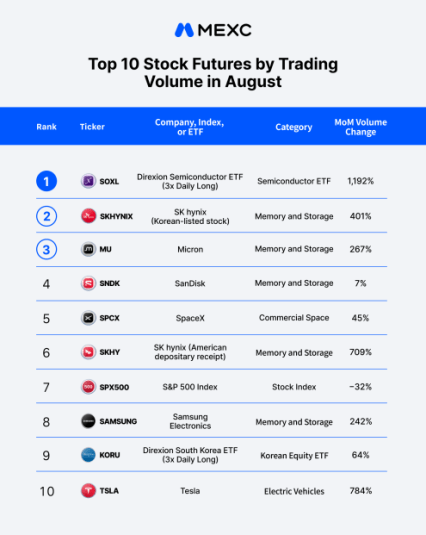
A deep dive into the August metrics reveals a structural evolution in market preferences, characterized by a decisive pivot away from broad-based index tracking toward hyper-focused sector exposure. Throughout the month, trading activity within Stock Futures broadened dramatically, moving away from isolated single-asset dominance to a multi-faceted rally centered on memory, storage, and semiconductor equities across both U.S. and Korean markets.

Data from August shows that five of the top ten Stock Futures by trading volume were dedicated entirely to memory and storage enterprises. Highlighting this trend, SKHYNIX (SK hynix) secured the second overall position and ranked first among individual stock futures, registering a monumental 401% month-on-month surge in trading volume. Not far behind, MU (Micron) claimed the third spot with a 267% volume increase.

The regional concentration of these trades was equally pronounced. The combined trading volume for Stock Futures tracking Korean companies and benchmark indices—specifically SKHYNIX, SKHY, SAMSUNG, and KORU—skyrocketed by approximately 348%. Consequently, Korean-linked assets expanded their footprint, commanding 27% of total Stock Futures trading volume in August, up significantly from 14% in July. Meanwhile, SNDK (SanDisk) continued to record positive volume growth, although its proportional share of total volume adjusted from 25% to 11% as capital diversified into a wider array of regional semiconductor plays.

The semiconductor enthusiasm extended beyond individual equities into leveraged and inverse ETF products. SOXL Stock Futures, which track a semiconductor ETF providing three times daily long exposure, claimed the number one ranking overall. Trading volume for SOXL surged by an astronomical 1,192%, driving its market share from under 4% in July to an impressive 20% in August. Its counterpart, SOXS Stock Futures—offering three times inverse daily leveraged exposure to the U.S. Semiconductor Index—also experienced robust demand, logging a 436% volume expansion.

MEXC Stock Futures Trading Volume Rises 130% in August as Trading Activity Broadens Across U.S. and Korean emory and Semiconductor Sectors

In sharp contrast to the booming semiconductor segment, broader macroeconomic indices faced a cooling-off period. Trading volume for SPX500 Stock Futures, which track the benchmark S&P 500 Index, declined by approximately 32%. Market analysts attribute this contraction not to a lack of risk appetite, but rather to a deliberate capital reallocation by traders who favored high-beta, sector-specific momentum over passive, broad-market exposure.

Beyond the technology and semiconductor sectors, niche growth stories played a pivotal role in shaping August’s volume distributions. Trading activity for SPCX (SpaceX) and TSLA (Tesla) Stock Futures climbed roughly 45% and 784%, respectively. Securing the fifth and tenth positions in the rankings, these assets highlighted persistent, speculative investor enthusiasm surrounding commercial space exploration, private aerospace equity valuation, and the electric vehicle ecosystem.

Parallel to the derivatives expansion, MEXC’s spot market for tokenized stocks and ETFs enjoyed substantial momentum. Spot trading volume within this segment grew by approximately 30% month-on-month, elevating its share of total TradFi spot trading volume from 63% in July to 73% in August.

Crucially, this growth demonstrated structural health rather than speculative concentration. Approximately 99% of all existing tokenized listings recorded upward volume trajectories. Furthermore, the top ten individual assets accounted for a modest 12% of the segment’s total volume, proving that retail and institutional participants were actively distributing capital across a wide basket of equities rather than chasing a single viral asset.

Within the spot rankings, CRCL (Circle) captured the top position, buoyed by a 69% increase in monthly trading volume. Other crypto-adjacent and fintech equities, notably COIN (Coinbase) and HOOD (Robinhood), also anchored positions within the top ten. Combined trading volume across these three digital-asset-linked listings rose by 47%, reflecting strong sentiment correlation between native cryptocurrency markets and their publicly traded corporate proxies.

Artificial intelligence infrastructure also maintained a formidable presence in the spot market. NBIS (Nebius), a specialized AI cloud infrastructure enterprise, ranked third overall, delivering a staggering 188% volume growth rate—the highest among all top-ten spot listings. Simultaneously, semiconductor giant NVDA (Nvidia) claimed the fifth spot with a 54% volume increase. This dual representation of Nebius and Nvidia illustrates that AI-driven capital flows successfully permeated both hardware manufacturing and backend cloud computing layers throughout the month.

The acceleration of volume on platforms like MEXC is heavily underpinned by structural innovations in trading accessibility. By collapsing the barriers between traditional equity markets and digital asset infrastructure, platforms enable global participants to execute complex hedging and speculative strategies around the clock.

A prime example of this utility is weekend trading behavior. During August’s ten weekend days—periods when traditional New York, Seoul, and Frankfurt stock exchanges remain shuttered—MEXC’s Stock Futures trading still accounted for approximately 11% of the entire monthly volume. This statistic provides empirical proof of sustained, unyielding global demand for price discovery and risk management during off-hours, a capability historically unavailable to retail investors reliant on legacy brokerages.

To incentivize participation and reward its expanding user base, MEXC rolled out targeted promotional infrastructure during the period. The MEXC 0808: Stock Season zero-fee trading event served as a major acquisition and retention driver, successfully attracting more than 86,000 active participants. Collectively, the event saved traders over $1 million in operational fees, supercharging liquidity depth across both spot and derivative books.

MEXC Stock Futures Trading Volume Rises 130% in August as Trading Activity Broadens Across U.S. and Korean emory and Semiconductor Sectors

Reacting to the robust monthly data, Vugar Usi, Chief Executive Officer of MEXC, emphasized the broader macroeconomic significance of the platform’s growth trajectory.

"The sustained growth in stock-related trading across multiple asset classes and markets underscores the accelerating global demand for accessible, diversified market exposure," stated Usi. "We remain committed to expanding our equity-linked offerings and simplifying access for users worldwide, consolidating trading into a single account and delivering on our core proposition: trading Wall Street, without walls."

Industry analysts evaluating the August data point toward several key implications for the future of global finance. First, the hyper-growth of tokenized equities and 24/7 stock derivatives signals that traditional financial institutions can no longer ignore the operational efficiency of blockchain-backed settlement and perpetual trading rails. As retail investors increasingly demand continuous access to equities, legacy exchanges face mounting pressure to adapt or risk losing market share to agile, crypto-native multi-asset platforms.

Second, the intense concentration of capital in AI, semiconductors, and memory components demonstrates that macroeconomic trading themes remain intensely sector-driven. Traders are actively utilizing leveraged instruments—such as the 3x long SOXL contracts—to amplify directional bets on secular technological shifts.

Finally, the success of multi-asset platforms in onboarding tens of thousands of users through zero-fee initiatives suggests that cost friction remains a primary deterrent in legacy financial markets. By systematically removing fee barriers and streamlining account requirements, platforms are effectively unlocking dormant retail liquidity from emerging and developed economies alike.

Established in 2018, MEXC has evolved into a premier global multi-asset trading platform engineered to serve as a zero-fee gateway to worldwide financial opportunities. Operating across more than 170 markets, the platform provides streamlined access to cryptocurrencies, traditional equities, tokenized assets, and sophisticated derivatives through a unified account framework.

Driven by a core philosophy of deep liquidity, zero trading fees, and expansive asset coverage, MEXC caters to modern retail and professional traders seeking to navigate both traditional and decentralized financial ecosystems without artificial barriers. As the boundaries separating crypto assets from traditional financial instruments continue to dissolve, MEXC remains positioned at the forefront of this financial transformation, empowering users worldwide to access global markets with speed, security, and efficiency.

September 11, 2026 0 comment
0 FacebookTwitterPinterestEmail
Blockchain Technology

The Global Rise of Sovereign Stablecoins and the Evolution of Digital Payments Across Borders

by admin September 11, 2026
written by admin

The global financial landscape is currently undergoing a structural transformation as the stablecoin sector continues its inexorable expansion. This week, the momentum was underscored by two significant developments in Switzerland and Uzbekistan, where authorities are advancing sovereign-backed stablecoin projects. These initiatives, coupled with new empirical data regarding the use of blockchain-based assets for cross-border transactions, signal a shift in how nations are approaching digital monetary sovereignty. While the meteoric growth rates observed in 2025 are projected to moderate in 2026, the underlying trend suggests that stablecoins are transitioning from speculative assets to practical infrastructure for the global economy.

Switzerland: Integrating the Swiss Franc into the Digital Frontier

On September 8, the Swiss financial sector achieved a milestone in its digital transformation as the Swiss exchange operator SIX and the prominent mobile payment service Twint joined a collaborative sandbox cohort. This group, now consisting of eleven entities, is actively stress-testing the Swiss franc-pegged stablecoin, known as CHFD. This initiative, which was formally launched in April, represents a strategic attempt by Swiss financial institutions to bridge the gap between traditional banking infrastructure and decentralized ledger technology (DLT).

The inclusion of SIX and Twint is particularly noteworthy due to their dominant roles in the Swiss payment ecosystem. By integrating these entities into the testing environment, the project aims to evaluate the real-world utility of the CHFD for programmable payments and the settlement of tokenized assets. The sandbox participants—which include major financial institutions such as UBS, PostFinance, Sygnum, Raiffeisen, Zürcher Kantonalbank, and BCV—are operating under a secure, live digital environment to ensure the stablecoin can withstand the rigorous demands of a modern financial center.

From a strategic perspective, the CHFD project is a defensive and proactive maneuver. With over 98% of the global stablecoin market currently denominated in U.S. dollars, Switzerland, like many other jurisdictions, is concerned about the long-term implications of "digital dollarization." By developing a native, regulated stablecoin, the Swiss financial ecosystem aims to bolster its competitiveness and provide local businesses with a blockchain-based alternative that remains anchored to the Swiss franc. The testing phase is scheduled to continue through the end of 2026, at which point the consortium will release a comprehensive assessment of the technical, operational, and regulatory viability of the project.

Uzbekistan: Building a Sovereign Payment Infrastructure

While Switzerland focuses on integrating digital assets into an established financial system, Uzbekistan is taking a more direct regulatory approach to modernize its domestic payment rails. On Monday, the Uzbekistan National Agency for Prospective Projects (NAPP) announced the registration of Humo Digital as a participant in a government-supervised stablecoin pilot program.

This project, conducted under the joint oversight of the NAPP and the Central Bank of Uzbekistan, revolves around the issuance and circulation of the HUMO stablecoin, which maintains a 1:1 peg to the Uzbek som. Unlike purely private initiatives, the HUMO stablecoin is explicitly backed by government securities, lending it a degree of institutional credibility that is rare in the volatile crypto-asset space.

The pilot, which incorporates over 20 local merchants and businesses, is a direct result of Presidential Resolution No. PQ-359, signed by President Shavkat Mirziyoyev in late 2025. The decree is part of a broader national strategy to foster a fintech innovation hub and provide a state-backed venture fund to catalyze domestic startups. By testing stablecoins as an "official means of payment," Uzbekistan aims to reduce settlement times and increase transparency in domestic transactions. The project is currently slated to run for up to three years, providing a long-term data set that will inform future national policy regarding digital currencies.

Data Analysis: The Shifting Growth Trajectory of Cross-Border Payments

The rapid adoption of stablecoins is supported by data provided by financial research firms FXC Intelligence and Allium Labs. According to their latest report, the volume of cross-border payments facilitated by stablecoins surged by an estimated 64% year-on-year in 2025. In stark contrast, traditional fiat-based cross-border payments grew by only 9% during the same period.

The granular data suggests that the utility of stablecoins is highest in specific segments of the economy:

  • Consumer-to-Business (C2B): Recorded a 72% increase, compared to 7% for fiat.
  • Business-to-Business (B2B): Increased by 69%, against 10% for fiat.
  • Business-to-Consumer (B2C): Grew by 62%, compared to 10% for fiat.

Despite these impressive percentages, it is critical to contextualize the market share. Of the $44.3 trillion in total retail, non-wholesale cross-border volume moved in 2025, stablecoins accounted for approximately $135 billion. While this represents a significant increase from the $82 billion observed in 2024, it constitutes just 0.31% of the total global market. The sheer scale of the legacy financial system remains a significant barrier to entry, even as the growth rates of stablecoin volume consistently outpace fiat.

A key driver for this adoption was the July 2025 enactment of the U.S. GENIUS Act. By establishing a federal framework for payment stablecoins, the legislation provided a roadmap for institutional engagement. The requirements for 100% reserve backing in liquid assets and mandatory public disclosures have served to de-risk the sector for traditional financial institutions, prompting many to switch their internal settlement operations to blockchain rails.

The 2026 Cooling Period: A Maturity Phase

While the 2025 numbers indicate an explosion of interest, preliminary data for 2026 suggests a cooling of the "stablecoin craze." Current growth rates for the year-to-date are hovering at approximately 23%. Analysts suggest this is not necessarily a sign of failure, but rather a maturation phase.

"The initial period of explosive growth was fueled by novelty and the low baseline of the previous years," says one industry observer. "As the market scales, it is natural for growth to transition from exponential to linear. The fact that stablecoins continue to outpace fiat in terms of growth, despite a slower pace than 2025, indicates that the technology is finding genuine utility rather than just speculative interest."

Implications for Global Monetary Policy

The concurrent rise of sovereign stablecoins in Switzerland and Uzbekistan illustrates a broader global trend: the decoupling of digital currency utility from private, unregulated entities. As nations observe the dominance of U.S. dollar-denominated stablecoins, they are increasingly concerned about the loss of monetary policy control.

The "fightback" against digital dollarization is now a formal component of national economic strategy for many central banks. By creating sovereign stablecoins, governments can retain the benefits of blockchain efficiency—such as 24/7 settlement and reduced counterparty risk—without ceding control over their currency’s issuance or the stability of their domestic markets.

Looking ahead, the success of these sovereign experiments will likely depend on interoperability. If the Swiss franc stablecoin and the Uzbek HUMO token can interact seamlessly with international payment networks, they may achieve mass adoption. However, if they remain siloed, their impact may be limited to domestic efficiency gains.

As the industry moves through 2026, the focus is shifting from "how can we create a stablecoin" to "how can we integrate this into the global financial architecture." With major regulatory frameworks now in place in the U.S. and other jurisdictions, the era of "move fast and break things" in the stablecoin sector is being replaced by a more deliberate, infrastructure-focused development cycle. Whether or not stablecoins will eventually rival the multi-trillion-dollar volumes of legacy fiat remains a question for the end of the decade, but the trajectory suggests that the digital evolution of money is no longer a possibility—it is an inevitability.

September 11, 2026 0 comment
0 FacebookTwitterPinterestEmail
Decentralized Finance (DeFi)

Crypto Card Volume in 2026: $1.1 Billion a Month, and What Is Inside It

by admin September 11, 2026
written by admin

At 16:49:48 UTC on Friday, August 28, 2026, a Solana-based wallet—funded just three hours prior with 1.79 SOL via a bridge from Ethereum—initiated a series of transactions that would expose a critical vulnerability in the architecture of modern "non-custodial" banking. By the time the dust settled, 1,685 users of Avici, a prominent Solana neobank, had seen their card-balance accounts drained of $500,859.22. This incident was not merely a local technical failure; it served as a jarring wake-up call for the rapidly expanding $1.1 billion-a-month crypto card industry, highlighting the precarious gap between the marketing of "self-custody" and the reality of underlying smart contract infrastructure.

The drain originated from a "Solana card contract" shared by Avici and a limited number of other programs, all managed by Rain, the infrastructure powerhouse behind a significant portion of the self-custodial card market. While Avici’s terms of service, last updated in June 2025, assured users that the platform would "not, in any circumstance, be holding custody of your Collateral," the reality proved more complex. While the company technically did not hold the funds in a traditional custodial sense, the design of the smart contract allowed for an administrative override that circumvented user security.

A Chronology of the August Drain

The attack followed a precise, automated cadence. The attacker’s wallet (FVNFzqAny8spWdPmYw6RQ9TkYa29ueFFiqCFD1gQnCEj) remained dormant for approximately three hours after funding. At 16:49:48 UTC, it launched the first of 21,405 exploit transactions. Using a signature-verification flaw in the Rain-controlled Solana program, the attacker exploited the SubmitSignatures instruction. By carefully manipulating the Ed25519 signature-verification offsets, the attacker was able to trick the contract into accepting a single signature as valid for a two-signature check.

This flaw allowed the attacker to grant themselves "collateral admin" status on over a thousand individual user accounts. With administrative privileges, the attacker methodically executed WithdrawCollateralAsset calls. The median loss per user was relatively small—approximately $24—but the aggregate impact was significant. The exploit window remained open for two hours and 29 minutes, concluding at 19:18:52 UTC.

The movement of the stolen funds was equally sophisticated. Throughout the attack, the perpetrator utilized deBridge to move over $1.1 million in USDC from the Solana blockchain to Ethereum. By 19:49:23 UTC, the stolen assets were being funneled into the Tornado Cash mixer in a standardized ladder of 455.9 ETH. Despite the speed of the theft, the remediation efforts were equally rapid. Avici confirmed that Rain, as the program manager, covered every refund, with both Avici and the secondary program Tria contributing an additional 10% on top of the losses to restore user confidence.

The Anatomy of Crypto Card Custody

To understand how this occurred, one must categorize the five distinct models of custody currently dominating the 18 major programs surveyed. At one end of the spectrum is the "Sold to the Operator" model, exemplified by KAST. As of their July 2026 terms, KAST treats user asset transfers as a sale, granting the user a debt claim against the company rather than ownership of the underlying assets. This essentially places the user in the position of an unsecured creditor in the event of bankruptcy.

At the other end is the "Self-Custodial Vault" model used by programs like Gnosis Pay and Ether.fi Cash. These programs utilize smart accounts where the user retains control via their own keys, with spend permissions scoped specifically to the card. The August exploit occurred in the middle-ground: a "Contract Pool" model where users own the collateral in a smart contract, but the contract is written and managed by a central entity—in this case, Rain—which retains upgrade authority.

The vulnerability was not in the users’ private keys, but in the upgrade authority of the contract itself. Before the incident, the upgrade authority for the affected programs was held by a plain keypair, allowing for single-point-of-failure risks. Following the exploit, Rain migrated the upgrade authority for these programs to a Squads multisig vault on September 5, 2026, effectively closing the administrative backdoor.

Crypto Cards 2026: Who Holds the Money Before the Swipe

Data and Market Concentration

Paymentscan data indicates that the crypto card market has seen an unprecedented surge, with August 2026 volume hitting $1.116 billion across 11 million transactions. However, this growth masks significant concentration. Approximately 42% of this volume is routed through programs settling via Rain. When combined with RedotPay, which reports its own spend metrics, two entities account for roughly 78% of the entire tracked market.

This concentration introduces systemic risk. The issuer behind seven of the programs surveyed—including KAST, Avici, Ether.fi, Plasma One, Solayer, Payy, and Tria—is "Third National." Crucially, Third National is not a traditional bank, but a Puerto Rico-based money transmitter. Rain’s own documentation clarifies that it does not provide FDIC insurance or hold deposits, but rather manages a network of capital partners who borrow stablecoins to facilitate card settlements. Essentially, the "non-custodial" card is a charge card financed by institutional debt, creating a layer of financial fragility that is rarely transparent to the average consumer.

Regulatory and Industry Implications

The regulatory environment is shifting to address these ambiguities. Regulation (EU) 2024/1624, set to apply from July 2027, will likely curtail the "no-KYC" (Know Your Customer) card model by prohibiting anonymous crypto-asset accounts and restricting the use of anonymous prepaid cards. Current no-KYC offerings, which often rely on business-entity verification to bypass individual identity checks, are increasingly finding themselves in the crosshairs of global regulators.

The industry has already seen the consequences of these regulatory pressures. The collapse of Paytend Europe UAB in March 2026, which led to the discontinuation of Bit.Store card services, demonstrates that when a regulator pulls an electronic money institution’s license, the brand the consumer interacts with is often powerless to retrieve user funds. The decision to shut down is rarely made by the consumer-facing app, but by the sponsor bank or the card network.

The Lessons of 2026

The August 28 incident provides three vital lessons for the future of decentralized finance. First, the term "non-custodial" is a legal and technical descriptor that often obscures the reality of who controls the contract’s upgrade authority. Even if a user holds their own keys, if the smart contract governing the collateral can be updated or bypassed by an administrator, the asset is not truly under the user’s absolute control.

Second, the distinction between "audited" and "deployed" code is a critical failure point. Rain’s contracts had undergone audits, but the specific, older versions deployed on the live programs were not covered by these checks. This highlights a need for rigorous lifecycle management in smart contract deployments, ensuring that legacy code is systematically patched or deprecated.

Finally, the resilience of the ecosystem is currently backed by venture capital, not by decentralized protocol security. The fact that users were made whole within 24 hours was a result of Rain’s balance sheet and corporate commitment, not the inherent safety of the smart contract code. While this protected the user base, it is an unsustainable model for long-term scalability. As the industry matures, the focus must shift from rapid growth and aggressive rewards toward verifiable, immutable custody models where upgrade authority is decentralized and the regulatory status of the issuer is beyond reproach.

For the consumer, the August event served as a stark reminder: the next time a card program touts its non-custodial credentials, the critical question is not who holds the keys, but who holds the keys to the code. Until the infrastructure is as decentralized as the marketing claims, these programs will remain subject to the same systemic risks that have plagued traditional finance for decades.

September 11, 2026 0 comment
0 FacebookTwitterPinterestEmail
Bitcoin & Altcoins

Ethereum Implements Strategic Gas Repricing to Facilitate Long-Term Scalability Through EIP-8037 and EIP-8038

by admin September 11, 2026
written by admin

Ethereum is currently preparing for a significant transition in its network architecture, centered on the introduction of a new gas repricing schedule designed to recalibrate the costs of state creation and access. This technical evolution, primarily codified through EIP-8037 and EIP-8038, represents a critical shift in how the network manages its computational resources. By aligning gas costs more precisely with the actual workload performed by validators and nodes, the Ethereum community aims to create a sustainable pathway for increasing the network’s base throughput by approximately 300 percent.

The Historical Context of Ethereum Gas Management

The mechanism of "gas" serves as the fundamental unit of accounting within the Ethereum Virtual Machine (EVM), ensuring that every computational step, storage operation, and memory allocation is compensated relative to its resource consumption. Since the inception of the Ethereum mainnet, the network has periodically adjusted these costs to reflect shifts in hardware performance, software optimization, and state growth.

The last major comprehensive overhaul of these costs occurred during the Berlin hard fork in 2021. In the intervening years, the Ethereum landscape has undergone radical transformation. The transition from Proof-of-Work to Proof-of-Stake via "The Merge" in 2022 drastically altered the security and economic model of the chain. Simultaneously, the state—the repository of all account balances, smart contract code, and storage variables—has grown at an exponential rate. As the state expands, the difficulty of maintaining a full node increases, necessitating higher costs for operations that force nodes to read from or write to disk.

Previous increases in the block gas limit, intended to allow more transactions per block, have inadvertently accelerated this state growth, placing additional strain on hardware. The current initiative is not merely a technical tweak but a proactive measure to ensure that increasing the block gas limit remains viable without jeopardizing the decentralization of the network. If nodes are required to perform increasingly expensive operations at legacy prices, the barrier to entry for running a validator node would rise, potentially centralizing the network.

Understanding the Mechanics of EIP-8037 and EIP-8038

The core of this update lies in the granular adjustment of gas costs for state-related operations. EIP-8037 focuses specifically on the cost of creating new state, while EIP-8038 addresses the costs associated with accessing existing state.

These proposals were derived from extensive performance profiling conducted by the Ethereum Foundation’s research teams and various client developers. By simulating the execution of historical transactions under the proposed new fee structures, researchers identified exactly where current gas pricing fails to account for the actual "real-world" computational cost of storage operations.

In the current ecosystem, some operations are underpriced relative to the time and memory required for a node to process them. When a node performs a state access, it must interact with the Merkle Patricia Trie—the data structure underlying Ethereum’s state. If the gas cost for these operations is too low, it creates an imbalance where the network is essentially subsidizing intensive storage activity. By raising these costs to reflect their true impact, the protocol forces efficient use of resources and prepares the foundation for a higher base throughput capacity.

Impact Analysis: The Four Tiers of Transaction Outcomes

The Ethereum R&D teams have utilized sophisticated replay tools to model the impact of these changes on historical mainnet traffic. By running past transactions against the new gas schedule, they have categorized the potential outcomes into four distinct tiers.

The vast majority of existing transactions will remain largely unaffected or will see only negligible changes in their gas consumption. However, a segment of "edge-case" contracts faces potential disruption. These are typically smart contracts that have integrated hardcoded gas assumptions directly into their source code. A prominent example is the use of Solidity’s transfer or send functions, which contain a fixed gas stipend of 2,300 gas. In scenarios where the underlying cost of state access increases, these fixed stipends may prove insufficient, causing transactions to fail unexpectedly.

Furthermore, developers who have implemented custom logic that relies on gasleft() to branch contract behavior are at high risk. If a contract logic path is dependent on a specific gas budget, the repricing could force the transaction into a different execution branch, leading to unintended outcomes or outright failure. Finally, users who rely on pre-signed transactions with fixed gas limits may find that their transactions are rejected by the network because the static limit no longer covers the updated cost of the operation.

Actionable Guidelines for Ecosystem Participants

The transition plan is segmented based on the role of the ecosystem participant. For smart contract developers and maintainers of Layer 1 (L1) applications, the primary directive is to audit existing codebases against the new schedule. The Ethereum Foundation has provided an "affected-contracts search" utility, allowing developers to input contract addresses to determine if their specific logic is vulnerable to the upcoming changes.

For the infrastructure layer—including wallet providers, RPC (Remote Procedure Call) node operators, and indexers—the requirements are more rigorous. These entities must update their gas estimation algorithms to account for the new price constants. Relying on cached gas values or legacy estimation libraries will almost certainly result in transaction failures for users. The eth_estimateGas function, a staple of Web3 interaction, must be re-calibrated to interpret the new EIP schedules correctly.

For the general end-user, the process is designed to be frictionless. Provided that wallet software and decentralized applications (dApps) update their backend infrastructure, users will not need to manually adjust any settings. The shift will be handled automatically by the software layer.

Chronology and Roadmap for Implementation

The rollout of these changes follows the standard Ethereum "all-core-devs" process. The new repricing schedule has already been deployed to private devnets, where core developers and client teams are monitoring performance metrics and edge-case behaviors.

Following the devnet phase, the updates will be systematically rolled out to public testnets, such as Sepolia and Holesky. This testing period is vital for identifying any unforeseen interactions between the new gas costs and existing protocols. It serves as a "stress test" for the broader ecosystem, providing a sandbox for DeFi protocols, NFT marketplaces, and DAO infrastructure to ensure their smart contracts remain operational.

The final activation on the mainnet will follow the conclusion of successful testnet deployments. While a specific calendar date has not been finalized, the community is encouraged to follow the Ethereum Improvement Proposal (EIP) discussion threads on Ethereum Magicians and monitor the GitHub repositories for EIP-8037 and EIP-8038. These forums serve as the primary communication channels for the technical specifications and the implementation timeline.

Broader Implications: Toward a Scalable Future

The decision to reprice gas operations is a testament to the ongoing maturity of the Ethereum network. It signifies a transition from a "growth-at-all-costs" mentality to one that prioritizes sustainable, long-term scalability. By acknowledging that state growth is a finite constraint, the developers are implementing the necessary "economic friction" to ensure the network can handle higher volumes without compromising its decentralization.

In the broader context, this update is a precursor to future upgrades aimed at increasing the block gas limit. Increasing the limit without first repricing would create a dangerous scenario where block times could increase, and the cost to maintain a node would spike, potentially causing many small-scale operators to drop off the network. By fixing the pricing structure first, the network creates the headroom required for future capacity increases.

Industry analysts observe that this move also places pressure on developers to write more gas-efficient code. In an era where storage was cheap, some developers neglected optimization. With the cost of state access now accurately reflecting the work performed, there is a renewed incentive to utilize storage-saving techniques, such as off-chain data availability or state-efficient contract design.

Conclusion

The upcoming gas repricing represents a mature, calculated step forward for the Ethereum network. By aligning the cost of operations with the real-world resources required to process them, the Ethereum community is ensuring the network remains robust, decentralized, and scalable. While the change presents a challenge for developers with hardcoded gas assumptions, the available diagnostic tools and the methodical rollout plan demonstrate the network’s commitment to a smooth transition. As Ethereum continues to scale, these foundational updates will be remembered as essential pillars that allowed the network to accommodate a global user base while maintaining the integrity of its core protocol. Participants across the ecosystem—from node operators to dApp developers—are urged to prioritize testing and integration efforts as the protocol approaches this significant milestone.

September 11, 2026 0 comment
0 FacebookTwitterPinterestEmail
Bitcoin & Altcoins

Kraken Introduces kHYPE: A New Era for Cross-Network Utility and Decentralized Finance Integration

by admin September 11, 2026
written by admin

The landscape of decentralized finance (DeFi) and cross-network asset management continues to evolve rapidly as major cryptocurrency exchanges seek to bridge the gap between centralized security and decentralized application ecosystems. In a strategic expansion of its product offerings, cryptocurrency exchange Kraken has officially announced the launch of kHYPE, a fully backed, cross-network-compatible ERC-20 token. Designed to unlock the potential of the underlying HYPE asset, kHYPE operates on a strict 1:1 backing model, leveraging Kraken’s robust institutional custody infrastructure to ensure that every minted token corresponds directly to an equivalent amount of HYPE held securely in reserve.

This development marks a significant milestone in how centralized exchange infrastructure can directly support decentralized applications (dApps), particularly within emerging blockchain ecosystems like Ink. By introducing kHYPE, Kraken aims to provide token holders with unprecedented flexibility, allowing them to harness the value of their assets across diverse network environments without sacrificing transparency or security. As the digital asset market matures, the demand for reliable wrapped-token solutions that maintain verifiable proof of reserves has become paramount, positioning initiatives like kHYPE at the forefront of modern blockchain interoperability.

Understanding the Mechanics and Architecture of kHYPE

At its core, kHYPE functions as a wrapped token designed to transcend the native limitations of the original HYPE asset. A wrapped token is fundamentally a cryptocurrency that represents another cryptoasset, typically locked in a secure digital vault, enabling it to be utilized on a blockchain network where it otherwise could not natively operate. In the case of kHYPE, the token is engineered as an ERC-20 compatible asset, opening the door for seamless integration with a wide array of decentralized applications, automated market makers (AMMs), lending protocols, and yield-farming platforms.

The primary value proposition of kHYPE lies in its uncompromising approach to security and transparency. Kraken has structured the tokenomics of kHYPE to ensure complete 1:1 backing at all times. This means that for every single unit of kHYPE circulating across decentralized networks, a corresponding unit of HYPE is locked and guarded within Kraken’s proprietary custody systems. To alleviate common industry concerns regarding the solvency and transparency of wrapped assets, Kraken has integrated onchain verification mechanisms. Clients and independent auditors can inspect the designated reserve addresses at any given time, fostering a high degree of trust that is often missing in traditional wrapped-asset models.

Furthermore, kHYPE is built to natively support Ink, a newly emerging layer network designed to streamline dApp development and execution. By deploying kHYPE at launch on Ink, Kraken is providing developers with a reliable, high-utility asset that can be seamlessly incorporated into smart contracts, liquidity pools, and other financial instruments within the ecosystem. The exchange has also outlined strategic roadmaps to extend kHYPE compatibility to additional blockchain networks in the near future, further broadening its utility footprint across the multi-chain universe.

The Strategic Context: Why Wrapped Tokens Matter in Modern DeFi

The introduction of kHYPE comes at a time when the decentralized finance sector is increasingly reliant on cross-chain bridges and wrapped assets to maintain liquidity and capital efficiency. Historically, the fragmentation of blockchain networks has posed a formidable barrier for users wishing to deploy their capital across multiple ecosystems. Native assets are typically confined to their respective blockchains, preventing holders from capitalizing on yield opportunities, lending markets, or governance functions available on competing or complementary networks.

Wrapped tokens serve as the primary economic bridge across this fragmented landscape. However, the history of wrapped assets—particularly those reliant on third-party bridge protocols—has been marred by high-profile security vulnerabilities, exploits, and solvency questions. Industry analysts frequently point out that centralized exchanges possess a distinct advantage in mitigating these structural risks. By leveraging more than a decade and a half of institutional-grade security expertise, infrastructure development, and risk management protocols, exchanges like Kraken are uniquely positioned to offer wrapped assets that benefit from centralized custody safeguards while retaining decentralized utility.

Kraken’s entry into the wrapped-token arena with kHYPE signals a broader trend: established cryptocurrency exchanges are moving beyond simple spot trading and custodial services to become foundational infrastructure providers for the broader Web3 and DeFi economies. By anchoring kHYPE in its proven security architecture, Kraken is addressing the perennial tension between the desire for decentralized financial freedom and the absolute necessity of institutional-grade asset protection.

Introducing kHYPE

Integration with the Ink Ecosystem and Developer Opportunities

A critical dimension of the kHYPE rollout is its integration with Ink. As blockchain developers continue to seek scalable, high-performance environments for building decentralized applications, network-specific assets play a vital role in bootstrapping initial liquidity and user engagement. Ink provides a specialized environment where kHYPE can function with high throughput and minimal friction, making it an ideal building block for developers looking to craft sophisticated financial products.

For software developers working within the Ink ecosystem, kHYPE represents a turnkey solution for integrating established crypto value into their applications. Rather than going through the cumbersome process of establishing bespoke bridging mechanisms or relying on unverified third-party liquidity providers, dApp builders can leverage an asset backed by one of the industry’s most trusted names. This integration facilitates the creation of robust lending markets, advanced trading pairs, and innovative yield-generating protocols that rely on the stability and recognizability of the underlying HYPE asset.

Moreover, the versatility of the ERC-20 standard ensures that kHYPE can easily interact with existing smart contract templates, reducing development time and minimizing the potential for implementation errors. As the Ink ecosystem expands and attracts a larger developer base, the availability of secure, cross-network assets like kHYPE is expected to serve as a major catalyst for onchain activity and total value locked (TVL).

Risk Disclosures, Regulatory Considerations, and Market Implications

While the introduction of kHYPE offers substantial benefits in terms of utility and cross-network mobility, financial authorities and market participants continuously emphasize the inherent risks associated with cryptocurrency derivatives and wrapped tokens. Kraken has proactively published comprehensive risk disclosures accompanying the kHYPE whitepaper, reminding users that wrapped tokens carry layered risks in addition to the standard volatility and security considerations inherent to all digital assets.

These risks include smart contract vulnerabilities within the target networks, potential risks associated with bridge infrastructure, and counterparty exposure related to custodial holding models. Additionally, the broader regulatory environment surrounding decentralized finance and cross-border crypto assets remains complex and subject to ongoing scrutiny from global financial watchdogs. Kraken’s launch of kHYPE operates under strict geographic restrictions, ensuring compliance with local regulatory frameworks in the jurisdictions where the exchange operates.

Market analysts note that while kHYPE provides significant operational advantages, users must conduct thorough due diligence and evaluate their individual risk tolerance before deploying assets into decentralized protocols. Kraken has explicitly stated that the information provided surrounding kHYPE is for general informational purposes only and does not constitute investment advice, financial planning, or a direct solicitation to buy, sell, or hold any specific cryptoasset. Furthermore, the exchange maintains a neutral stance, emphasizing that it does not engage in activities designed to artificially manipulate the price or market valuation of kHYPE or its underlying asset.

Looking Forward: The Broader Impact on the Crypto Landscape

The debut of kHYPE by Kraken represents more than just the release of a new token; it highlights the ongoing convergence of centralized exchange security and decentralized financial utility. As liquidity continues to flow freely between centralized platforms and onchain protocols, the demand for trustworthy, transparent, and seamlessly integrated cross-network assets will only intensify.

By combining the proven reliability of its long-standing custody infrastructure with the dynamic capabilities of modern layer networks like Ink, Kraken has established a compelling template for future asset-wrapping initiatives. Whether kHYPE will catalyze widespread adoption across additional networks remains to be seen, but its arrival underscores the continuous innovation driving the digital asset economy forward. As the project rolls out and developers begin to test its limits within the Ink ecosystem, the broader crypto community will be watching closely to see how effectively institutional security can harmonize with decentralized innovation.

September 11, 2026 0 comment
0 FacebookTwitterPinterestEmail
Newer Posts
Older Posts

Recent Posts

  • Web3 Venture Capital Surges to $7.2 Billion in September 2025 as Late-Stage Deals and Token Megarounds Dominate the Landscape
  • The Evolution of the Web3 Wallet: From Private-Key Vault to the Command Center of the Agentic Web
  • Ethereum Foundation Announces Annual Protocol AMA Session Scheduled for September 16
  • Kraken Expands Its Digital Asset Offerings with the Official Listing of Doppler Finance (Xdp)
  • CSD BR and Ripple Collaborate to Integrate XRP Ledger into Brazilian Financial Market Infrastructure

Recent Comments

No comments to show.
  • Facebook
  • Twitter

@2021 - All Right Reserved. Designed and Developed by PenciDesign


Back To Top
Dr Crypton
  • Home
  • About Us
  • Contact Us
  • Cookies Policy
  • Disclaimer
  • DMCA
  • Privacy Policy
  • Terms and Conditions

We are using cookies to give you the best experience on our website.

You can find out more about which cookies we are using or switch them off in .

Dr Crypton
Powered by  GDPR Cookie Compliance
Privacy Overview

This website uses cookies so that we can provide you with the best user experience possible. Cookie information is stored in your browser and performs functions such as recognising you when you return to our website and helping our team to understand which sections of the website you find most interesting and useful.

Strictly Necessary Cookies

Strictly Necessary Cookie should be enabled at all times so that we can save your preferences for cookie settings.