• Home
  • About Us
  • Contact Us
  • Cookies Policy
  • Disclaimer
  • DMCA
  • Privacy Policy
  • Terms and Conditions
Dr Crypton
Secure Your Future in Crypto
Tech & Startup News

Apple iPhone 18 Pro and Pro Max Introduce Industry-Shaking Variable Aperture and Cryptographic Camera Upgrades

by admin September 12, 2026
written by admin

While the revolutionary iPhone Duo commanded the spotlight during Apple’s highly anticipated September product showcase, the most profound technical evolution of the presentation was quietly reserved for the iPhone 18 Pro and Pro Max lineup. For the first time in the history of the Cupertino-based technology giant, the flagship Pro models incorporate a genuine physical variable aperture, paired with a sophisticated suite of manual controls, next-generation computational video tools, and an innovative approach to digital image authenticity.

Industry analysts are already calling this the most substantial and ambitious camera hardware overhaul Apple has shipped in years. By narrowing the gap between pocket-sized consumer tech and professional-grade mirrorless gear, Apple is redefining consumer expectations of mobile photography. Yet, this leap forward also introduces complex manufacturing challenges and engineering hurdles that have previously deterred industry competitors from maintaining similar hardware over the long term.

A Paradigm Shift in Mobile Imaging Architecture

The centerpiece of the iPhone 18 Pro and Pro Max camera system is an advanced 48-megapixel main sensor engineered around a physically adjustable aperture. In traditional optical physics, an aperture dictates the opening through which light travels to reach the sensor plane. A wider opening admits more illumination, proving indispensable in low-light environments while simultaneously producing a shallow depth of field that gracefully blurs background elements. Conversely, a narrower aperture restricts light intake but ensures that expansive scenes, complex architecture, and multi-subject group portraits remain sharply focused from foreground to background.

Historically, smartphones have relied on fixed apertures—such as the single-size setup found on the preceding iPhone 17 Pro—relying heavily on software algorithms to simulate background blur or low-light exposure balance. Apple’s newly designed mechanism utilizes six hair-thin, laser-cut mechanical blades. These blades dynamically widen or narrow across four distinct physical settings, operating autonomously based on environmental lighting conditions and user framing preferences.

This mechanical advancement is complemented by an entirely reworked computational imaging pipeline. Rather than leaning excessively on heavy algorithmic sharpening and multi-exposure stacking that can occasionally yield artificial-looking results, the iPhone 18 Pro prioritizes cleaner, more organic raw data capture. The popular Photographic Styles feature has also been expanded to include granular texture and grain controls, granting creators the ability to establish consistent, signature aesthetic moods directly at the point of capture.

Professional-Grade Manual Controls and Live Monitoring

iPhone 18 Pro: What's new with the cameras

Addressing long-standing requests from mobile videographers, independent filmmakers, and photography enthusiasts, Apple has integrated a comprehensive "Pro controls" panel natively into the default Camera app. Users can now manually adjust the newly introduced physical aperture alongside vital parameters like shutter speed—controlling the duration light hits the sensor to freeze rapid motion or introduce creative motion blur—and white balance, which neutralizes unwanted color tints under challenging indoor lighting or shaded outdoor environments.

Crucially, Apple has introduced a live histogram to the viewfinder. This real-time graphical representation of tonal distribution allows photographers to instantly evaluate exposure levels, preventing clipped highlights and crushed shadows before a shutter is ever released.

The video architecture has received an equally impressive suite of upgrades. Cinematic effects can now be seamlessly applied in post-production to high-framerate footage shot at up to 60 frames per second. Furthermore, time-lapse recordings now fully support 4K resolution paired with Dolby Vision HDR. Apple’s proprietary Audio Mix algorithms have also been overhauled to isolate background music more effectively while lifting human voices out of chaotic acoustic environments. To top it off, an AI-powered smart focus system intelligently tracks moving subjects across the frame, providing immense utility for capturing dynamic subjects such as children, pets, and fast-paced action.

The Ghost of Hardware Past: Durability and Competitor Hesitation

Despite the undeniable appeal of a mechanical variable aperture, the feature carries a complicated history within the broader mobile industry. Samsung famously experimented with variable apertures in its Galaxy S9 and S10 flagships before permanently retiring the technology in subsequent generations.

The primary obstacle is durability. Smartphones are subjected to rigorous physical environments—frequently dropped, tossed into crowded bags, and exposed to temperature extremes. Incorporating delicate moving mechanical parts into an ultrathin chassis introduces significant vulnerabilities. Even modern optical image stabilization modules can suffer calibration drift following severe impacts, meaning a physical aperture ring represents an entirely new mechanical point of failure.

More recently, supply chain insiders reported that Samsung initially planned to include a variable aperture system in the Galaxy S27 series, only to scrap those designs in August. Industry reports indicate that the South Korean electronics giant determined the mechanical complexity added undesirable bulk to the chassis and increased production costs for incremental improvements in everyday image quality.

Whether Apple’s precision engineering can overcome these historical durability hurdles, or whether the variable aperture will quietly vanish from future iPhone iterations, remains one of the most closely watched hardware narratives in modern consumer technology.

iPhone 18 Pro: What's new with the cameras

Combating Synthetic Media with Apple Reference Image

Beyond hardware mechanics, Apple has addressed one of the most pressing socio-technical crises of the digital age: the proliferation of generative AI and manipulated media. With the introduction of Apple Reference Image, the company has deployed a powerful cryptographic verification system designed to guarantee visual authenticity.

When capturing a photograph in the newly designated "Reference" mode, the sensor data is cryptographically signed at the hardware level and securely processed through Apple’s Private Cloud Compute infrastructure. This generates an immutable reference file—effectively functioning as a digital negative—that is safely stored alongside the final output within the Photos app. Journalists, investigators, and everyday consumers can directly compare the final output against the cryptographically verified reference image to confirm whether unauthorized alterations or manipulations have occurred.

Combined with native metadata validation and upcoming platform support for the SynthID watermarking standard, Apple is positioning the iPhone 18 Pro lineup as an essential trust-anchoring tool for photojournalism. In an era where deepfakes and advanced AI editing tools make distinguishing between reality and fabrication increasingly difficult, this proactive security measure may prove to be the device’s most vital contribution.

Market Implications and Broader Industry Outlook

The launch of the iPhone 18 Pro and Pro Max signals a mature smartphone market shifting its competitive battleground away from incremental processor speed bumps toward specialized hardware differentiation. By bridging the architectural divide between mobile convenience and professional DSLR capabilities, Apple is appealing directly to content creators who demand granular creative control without carrying bulky dedicated camera rigs.

However, the inclusion of sophisticated mechanical apertures and rigorous cryptographic verification suites will undoubtedly influence manufacturing yields and retail pricing structures. As reviewers put the iPhone 18 Pro through rigorous drop tests, environmental stresses, and field-testing workflows, the true resilience of Apple’s mechanical engineering will be thoroughly scrutinized.

For now, the iPhone 18 Pro lineup stands as a bold statement of intent. Whether it sparks a broader industry revival of mechanical optics or remains an exclusive pinnacle of Apple’s engineering prowess, the device has undeniably raised the ceiling for what mobile photography can achieve.


September 12, 2026 0 comment
0 FacebookTwitterPinterestEmail
Artificial Intelligence & Tech

Useful Python Scripts to Automate CSV Processing

by admin September 12, 2026
written by admin

The Comma-Separated Values (CSV) file format remains the lingua franca of data exchange in modern enterprise environments. Despite the rise of sophisticated cloud data warehouses, NoSQL databases, and complex APIs, the simplicity of the CSV file ensures its continued dominance. According to recent surveys on data engineering workflows, nearly 85% of data practitioners report that their daily pipelines involve at least one CSV file, often originating from legacy banking systems, retail inventory exports, or automated application logs. However, this ubiquity brings persistent technical challenges, including inconsistent delimiters, encoding failures, and silent data corruption.

To address these inefficiencies, a new suite of standardized Python scripts has been developed to automate the repetitive tasks associated with CSV maintenance. By utilizing only the Python standard library—bypassing the need for heavy external dependencies like Pandas—these tools offer a lightweight, high-performance solution for data professionals looking to streamline their ingestion pipelines.

The Persistent Problem of Data Inconsistency

The history of the CSV format dates back to the early days of personal computing, where it served as a simple bridge between disparate software packages. Because there is no rigid, universally enforced "CSV specification"—beyond the general structure defined in RFC 4180—data producers often generate files that violate standard assumptions.

Common errors include "delimiter drift," where a semicolon or tab is substituted for a comma without notice, or encoding mismatches, where a file exported from a legacy Windows-based system uses CP1252 encoding, while the destination system expects UTF-8. These inconsistencies are not merely administrative nuisances; they represent significant technical debt. When a pipeline fails due to an unexpected schema change or a character encoding error, the resulting downtime can cost enterprises thousands of dollars in lost productivity and delayed analytical insights.

A Chronology of Automated CSV Handling

Historically, data engineers relied on custom, one-off scripts—often written in Bash or Perl—to handle these edge cases. As Python gained prominence in the data science community, it became the tool of choice, though early implementations often relied on heavy libraries. The current shift toward using the Python standard library for these tasks represents a "minimalist" movement in data engineering.

By leveraging native modules like csv, json, and hashlib, developers can now create robust, portable scripts that run in any environment—from local development workstations to restricted CI/CD runners—without the security risks or deployment overhead associated with installing third-party packages.

Technical Deep Dive: The Five Essential Scripts

1. Schema Validation at the Edge

The schema validator serves as a gatekeeper for data ingestion. Unlike traditional database constraints that only trigger upon insertion, this script inspects files at the point of origin. By comparing a CSV against a JSON-defined schema, the script ensures that required columns exist and that data types match expectations. It does not simply return a binary "Pass/Fail" result; instead, it generates a comprehensive audit log identifying the exact row and column where a violation occurred. This is particularly critical for financial data, where a missing decimal point or an incorrectly formatted date can lead to catastrophic reconciliation errors downstream.

2. Row-Level Differential Analysis

Comparing two versions of a large dataset is a common auditing requirement. The row-level diff tool addresses this by using unique identifiers to map rows between two files. By focusing exclusively on "delta" changes—added, removed, or modified entries—it allows auditors to ignore unchanged records, which often constitute the vast majority of a file. This reduces the mental load on analysts and ensures that critical changes in pricing, customer information, or inventory levels are highlighted with precision.

3. Encoding and Delimiter Normalization

The "Normalizer" script acts as an automated triage tool. It employs a two-stage process: first, it samples the file’s binary stream to detect encoding and delimiter patterns; second, it rewrites the file into a standardized UTF-8, comma-delimited format. This process effectively strips problematic byte-order marks (BOM) and corrects non-standard line endings, which are common culprits in "File not found" or "Index out of range" errors in legacy data systems.

4. Configurable Column Transformation

Data shaping—the process of renaming, dropping, or reordering columns—is often performed manually in spreadsheet software. This manual approach is non-reproducible and prone to human error. The transformation script replaces manual manipulation with a configuration-driven approach. By defining operations in a JSON config file, organizations can enforce standardized naming conventions across all departments. This ensures that a customer_id column is never accidentally renamed to user_id by different teams, preserving the integrity of downstream data models.

5. Reservoir Sampling and Anonymization

In an era of stringent data privacy regulations like GDPR and CCPA, sharing raw production data for testing or support purposes is a significant liability. The sampler and anonymizer script mitigates this risk by providing a dual function: it uses reservoir sampling to pull a statistically valid, random slice of data from a large file, and it applies keyed hashing to sensitive fields. Because the hashing is consistent within a single run, the data remains functional for testing purposes while ensuring that personally identifiable information (PII) is masked and irreversible.

Implications for Data Infrastructure

The broader impact of these tools lies in the transition from "ad-hoc data cleaning" to "data engineering as code." When tasks that were previously performed in a spreadsheet are moved into a version-controlled, script-based workflow, they become auditable and repeatable.

Industry analysts have observed that organizations adopting such automated workflows report a 30% reduction in "data firefighting"—the time spent debugging data ingestion failures. Furthermore, by standardizing the way CSVs are processed, companies can improve the interoperability between their various software stacks. As data continues to grow in volume and velocity, the ability to sanitize and transform files with minimal computational overhead is no longer just a "nice to have"; it is a foundational requirement for any scalable data architecture.

Analysis: Security and Performance

A key advantage of the scripts described is their reliance on streaming rather than loading entire files into system memory. By using csv.DictReader and csv.DictWriter, these scripts can process multi-gigabyte files on standard hardware with limited RAM. This is a crucial design choice. Many common data tools fail when file sizes exceed the available system memory, leading to "Out of Memory" (OOM) errors. By iterating through files one row at a time, these Python scripts maintain a flat memory profile, ensuring reliability even when dealing with massive historical exports.

Furthermore, the emphasis on a "safe expression syntax" for column transformations prevents common security pitfalls like arbitrary code execution, which can occur if developers use eval() on user-provided configuration files. By restricting the transformation engine to predefined functions and templates, the scripts remain both flexible and secure.

Conclusion

The ubiquity of CSV files is a testament to the simplicity and longevity of the format. However, the complexities involved in maintaining the integrity of these files require professional-grade automation. The five scripts presented offer a robust, dependency-free toolkit for common data operations. By integrating these tools into existing CI/CD pipelines or local workflows, data teams can ensure that their data is accurate, consistent, and secure, ultimately allowing them to focus on the high-level analysis that provides genuine business value. Whether for auditing, migration, or testing, automating the "grunt work" of data preparation is the most effective way to build a resilient data culture.

September 12, 2026 0 comment
0 FacebookTwitterPinterestEmail
Artificial Intelligence & Tech

5 ways to upgrade your home decor with Google Search

by admin September 12, 2026
written by admin

The modern approach to home interior design has undergone a significant transformation, moving from the traditional reliance on physical mood boards and retail catalogs to a highly digitized, AI-assisted process. Recent data from Google indicates that interest in home aesthetics is surging, with searches for "home decor inspo" increasing by 300% over the last month alone. As homeowners seek to blend aesthetic vision with practical execution, tech giants have pivoted to provide tools that bridge the gap between imagination and reality. This shift marks a broader trend in consumer technology: the transition of search engines from simple information repositories to functional, creative partners in everyday life.

The Evolution of Digital Interior Design

Historically, the process of renovating or decorating a home involved extensive physical scouting, manual measurement, and significant financial trial and error. The digital era initially simplified this with e-commerce platforms, but the integration of artificial intelligence and augmented reality (AR) has taken the experience further. According to market research, the home decor market is increasingly driven by social media trends—specifically platforms like Instagram and Pinterest—which have fueled a 140% spike in niche searches for items like "fish wallpaper."

The current landscape of home decor is defined by bold choices. Search trends reveal a distinct pivot toward vibrant palettes, with teal and magenta emerging as top-tier paint colors for 2025. However, the hurdle for most consumers remains the "execution gap"—the difficulty of moving from a digital image to a physical space. To address this, Google has rolled out a suite of integrated tools designed to streamline the renovation process, from visualization to budget tracking.

1. Advanced Visualization Through AI Integration

The primary pain point for most interior decorators is the uncertainty of scale. A piece of furniture that appears ideal in a studio-lit product image may prove disproportionate in a real-world living room. Google’s AI Mode in Search now attempts to mitigate this by allowing users to upload high-resolution photos of their physical spaces.

By analyzing the dimensions of a room—such as a specific wall measurement—the AI provides tailored recommendations that align with the spatial constraints provided by the user. For instance, a user can input, "Based on my living room, what kind of couch would you recommend for an 84-inch wall?" The system then generates visual mockups, allowing users to experiment with textures, such as "emerald green velvet," to observe how light and color interact with their specific environment. This reduces the return rates often associated with online furniture shopping, an area that has historically struggled with a 15–20% return rate for large items.

2. The Rise of Visual Commerce with Lens

The demand for vintage aesthetics has reached an all-time high, with items like "vintage braided rugs" and "vintage wood coffee tables" dominating trending search queries. This interest in the "pre-loved" market mirrors the broader consumer shift toward sustainability and unique, non-mass-produced goods.

Google Lens has become the primary conduit for this movement. By utilizing image-recognition technology, users can capture a photograph of an item encountered in a retail setting, a museum, or a friend’s home. The search engine then cross-references this image against a global database to identify the item, locate similar pieces, and—crucially—provide pricing comparisons. This democratizes the "vintage hunt," allowing individuals to find mid-century modern or antique pieces without requiring the expertise of a professional interior designer or the time to visit specialized boutiques.

3. Streamlining Discovery with Circle to Search

The digital discovery phase of home decor often happens in fragmented environments—scrolling through social media feeds, watching video tutorials, or browsing architectural blogs. Previously, a user would have to take a screenshot, open a separate shopping app, and attempt to describe the item in a search box.

5 ways to upgrade your home decor with Google Search

The implementation of "Circle to Search" technology on flagship devices, such as the Samsung Galaxy S26 and Pixel series, removes these friction points. By allowing users to long-press their navigation bar and physically circle an object on their screen, the device initiates a search for that exact item or its nearest match. This capability has proven particularly effective for viral trends, such as the aforementioned fish wallpaper. Industry analysts suggest that this "zero-friction" search capability is likely to increase conversion rates for mid-sized retailers who lack the massive marketing budgets of global furniture conglomerates.

4. Navigating the DIY Movement via Search Live

As home ownership costs continue to rise, there has been a quantifiable increase in DIY (Do-It-Yourself) projects. The popularity of floating shelves is a prime example; while they are relatively affordable to purchase, the installation process remains a deterrent for many.

To address this, Google introduced "Search Live," a feature that leverages real-time video input. By enabling the camera feed within the Google app, users can interact with a digital assistant as if they were speaking to a contractor. The assistant provides step-by-step guidance based on the visual context of the user’s tools and the specific wall material. This shift toward conversational, visual-assisted tutorials marks a transition in the "Help" economy, moving away from static blog posts toward interactive, synchronous support.

5. Financial Transparency and Price Optimization

The final barrier in any home upgrade is the financial commitment. With the volatility of supply chains affecting the price of raw materials like wood and textiles, consumers are increasingly price-sensitive.

Google’s price-tracking tools now offer a granular look at market fluctuations. When a user navigates to a product page, the search engine provides a price history graph. This allows the consumer to determine if a "sale" price is genuinely discounted or if it represents a standard market fluctuation. Furthermore, the "Track Price" feature allows users to set alerts, essentially automating the haggling process. This functionality provides a significant level of consumer leverage, ensuring that design enthusiasts can maintain their aesthetic standards without overpaying for goods.

Broader Economic and Design Implications

The integration of these search technologies into the home decor industry has profound implications for both retailers and consumers. For the consumer, the barrier to high-end design is significantly lowered. The ability to visualize, identify, and price-check items in real time creates a more informed, confident buyer.

For retailers, the shift represents both a challenge and an opportunity. Businesses that optimize their online presence to be compatible with visual search engines like Google Lens are likely to capture a larger share of the market. Conversely, those that rely on opaque pricing or poorly optimized images may find themselves losing visibility as search algorithms prioritize visual accuracy and transparent pricing data.

From a sociological perspective, this trend reflects a desire for individual expression in an era of mass-market furniture. As more people leverage AI to curate their spaces, the home is becoming an increasingly personalized environment, dictated less by retail trends and more by algorithmic assistance tailored to the user’s specific preferences and spatial realities. Whether it is the bold inclusion of magenta paint or the tactical installation of floating shelves, the modern home is being built one search query at a time. The transition is not merely about finding products, but about integrating sophisticated technological tools into the intimate, creative process of building a home.

September 12, 2026 0 comment
0 FacebookTwitterPinterestEmail
Cryptocurrency News

TRON DAO and Ethena Labs Announce Integration of USDe and sUSDe to Expand Digital Dollar Utility Across the TRON Network

by admin September 12, 2026
written by admin

Geneva and Lisbon – In a landmark development for the decentralized finance (DeFi) sector, TRON DAO and Ethena Labs have officially announced the integration of Ethena’s synthetic dollar asset, USDe, and its rewards-bearing counterpart, sUSDe, onto the TRON blockchain. Revealed on September 12, 2026, this strategic deployment brings one of the fastest-growing digital dollar products in cryptocurrency history directly to one of the world’s most heavily utilized stablecoin settlement networks.

The integration represents a major milestone in Ethena’s ongoing multichain expansion strategy. By securing deployment on TRON, Ethena gains direct access to a sprawling user base comprising over 403 million accounts, while TRON users secure a new avenue for holding yield-generating digital dollar assets within their preferred transactional environment. As blockchain ecosystems increasingly prioritize interoperability and capital efficiency, this collaboration bridges two foundational pillars of the modern digital asset economy.

Immediate Accessibility and Bridge Architecture

As of the launch date, participants within the TRON ecosystem can bridge USDe and sUSDe onto the network using Stargate Finance. This initial phase enables holders to seamlessly transfer, hold, and manage both digital assets across the TRON blockchain infrastructure.

To ensure robust utility, the rollout is scheduled to progress in systematic stages. Over the coming weeks, deep integration is anticipated across TRON’s core decentralized finance applications, including major liquidity and lending protocols such as JustLend DAO and SUN.io. Following these protocol-level integrations, wider adoption is expected to unfold across various decentralized wallets, centralized cryptocurrency exchanges, and consumer-facing payment applications.

Crucially, the deployment does not isolate USDe within the TRON environment. The digital dollar assets on TRON maintain active liquidity connections with Ethena’s broader multichain ecosystem. This ensures that users can move assets fluidly across more than a dozen supported networks, reinforcing cross-chain liquidity pools and maintaining frictionless asset interoperability.

Background and Context of the Integration

To fully understand the significance of this integration, it is necessary to examine the individual trajectories of both organizations involved. Ethena Labs has rapidly emerged as a dominant force in the digital asset landscape. Developed as a synthetic dollar protocol, Ethena’s USDe is engineered to provide a crypto-native, scalable form of money that does not rely on traditional banking infrastructure. Backed by prominent venture capital firms and industry giants—including Fidelity, Franklin Templeton, Dragonfly, Binance Labs, Bybit, and OKX—Ethena has experienced unprecedented expansion since its inception.

Ethena Brings USDe and sUSDe to TRON, Expanding Digital Dollar Access Across Its Stablecoin Ecosystem

The protocol’s core offering centers on USDe, which derives its stability through delta-hedging strategies against collateralized crypto assets, and sUSDe, which allows holders to capture yield generated by the underlying protocol mechanisms. The capacity of sUSDe to offer rewards-bearing mechanics has driven substantial demand among institutional and retail investors seeking alternatives to traditional fixed-income products.

Conversely, the TRON network has established itself as the undisputed global settlement layer for stablecoin transactions, particularly for Tether (USDT). Founded in September 2017 with its MainNet launching in May 2018, TRON has evolved under community governance into a massive decentralized ecosystem. As of September 2026, TRON metrics illustrate its immense scale: the network hosts a circulating supply of USD Tether exceeding $94 billion, accounts for more than 15 billion total transactions, and maintains a Total Value Locked (TVL) surpassing $28 billion, according to data from TRONSCAN. With over 403 million registered user accounts, TRON serves as critical financial infrastructure for millions of individuals globally, particularly in emerging economies where dollar-denominated assets serve as a hedge against local currency inflation.

Official Statements and Executive Perspectives

Leadership from both entities emphasized the strategic alignment and mutual benefits driving the partnership.

Justin Sun, Founder of TRON, highlighted the practical utility the integration brings to the network’s vast user base. "Millions of people rely on the TRON network every day to make payments, save, and move value globally," Sun stated. "Bringing USDe and sUSDe to TRON broadens the options available to users and further strengthens the network as decentralized infrastructure for everyday use."

Guy Young, Founder of Ethena Labs, echoed these sentiments, pointing to the immense scale of TRON’s transactional volume as a natural fit for Ethena’s growth objectives. "TRON has a massive user base that already holds and moves digital dollars in significant size," Young remarked. "Bringing USDe and sUSDe to that ecosystem means those users can hold a dollar that accrues rewards on the network they already use. This integration is the latest step in our effort to bring our digital dollar products to as many people as possible, and we look forward to continuing to work with the TRON DAO team to find new ways to bring value to TRON’s users."

Chronology of Multichain Expansion

The integration with TRON is the culmination of a deliberate, phased scaling strategy executed by Ethena Labs over the past several years.

  • Early Development and Mainnet Launches: Ethena initially gained traction within the Ethereum ecosystem, rapidly scaling its Total Value Locked as investors sought alternative yields during bullish market cycles.
  • Multichain Deployment Phase: Recognizing the high transaction fees and congestion on single-layer networks, Ethena initiated a multichain rollout, expanding USDe compatibility to high-throughput layer-1 blockchains and layer-2 scaling solutions.
  • Exchanges and DeFi Integration: Throughout its expansion, the protocol secured listings across top-tier centralized exchanges, including Binance, Bybit, and OKX, while embedding itself into major decentralized finance primitives.
  • TRON Ecosystem Integration (September 2026): Marking its expansion into the premier stablecoin settlement network, Ethena bridges USDe and sUSDe to TRON via Stargate Finance, setting the stage for deep integration with JustLend DAO and SUN.io.

Broader Market Implications and Analysis

Ethena Brings USDe and sUSDe to TRON, Expanding Digital Dollar Access Across Its Stablecoin Ecosystem

The deployment of USDe and sUSDe on TRON carries several notable implications for the broader decentralized finance landscape.

First, it enhances capital efficiency within TRON. While TRON has historically been dominated by USDT for transactional and settlement purposes, the introduction of sUSDe introduces a native, yield-bearing mechanism directly into the network’s financial stack. Users who previously held static dollar-denominated balances can now access rewards-bearing products without abandoning the speed and low transaction costs associated with the TRON blockchain.

Second, the move accelerates the convergence of synthetic stablecoins with high-volume payment rails. Traditional stablecoins like USDT derive their utility primarily from liquidity and acceptance. Synthetic stablecoins like USDe introduce complex yield-generation and delta-hedging dynamics into the equation. By introducing these assets to an audience of over 403 million accounts, Ethena is effectively testing the mainstream appetite for yield-bearing synthetic dollars at a massive retail scale.

Finally, the partnership underscores a broader industry trend toward cross-chain liquidity sharing. Rather than operating in isolated silos, major protocols are increasingly compelled to make their assets accessible wherever high-volume user activity resides. For TRON, welcoming Ethena expands its product offerings beyond basic stablecoin transfers, positioning the network as a comprehensive hub for advanced decentralized finance applications.

About the Respective Organizations

Ethena Labs is the core development team responsible for engineering USDe and USDtb, serving as a primary contributor to the broader Ethena protocol. The organization is backed by a consortium of elite traditional financial institutions and crypto-native venture funds, positioning it at the intersection of traditional finance and decentralized architecture.

TRON DAO functions as a community-governed decentralized autonomous organization dedicated to accelerating the decentralization of the internet through blockchain technology and decentralized applications. Guided by its motto, "Moving Trillions, Empowering Billions," TRON continues to serve as a foundational global settlement layer for digital commerce and asset transfer.

September 12, 2026 0 comment
0 FacebookTwitterPinterestEmail
Blockchain Technology

OKX Launches Pioneering AI Agent Marketplace to Power the Autonomous Agent Economy

by admin September 12, 2026
written by admin

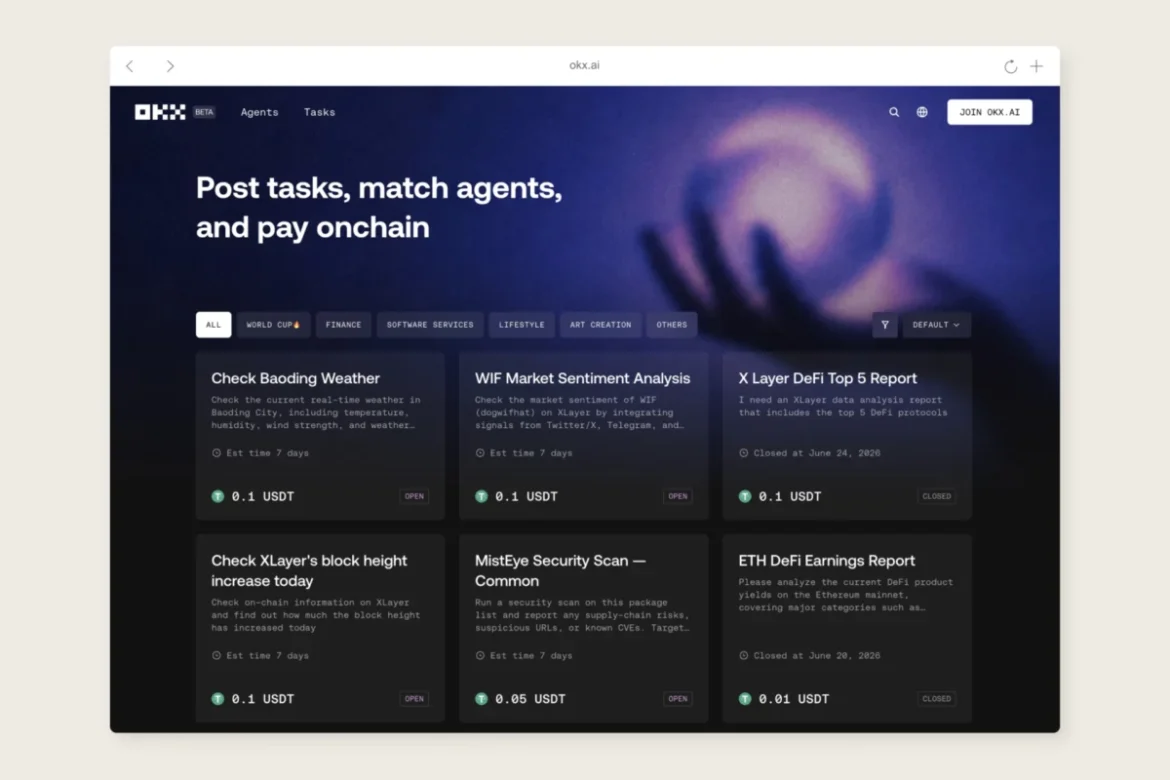
Major cryptocurrency exchange OKX is officially opening its groundbreaking AI marketplace to developers, marking a massive strategic leap beyond digital asset trading and directly into the architecture of the emerging autonomous software economy. The newly launched platform, designated OKX AI, provides a centralized digital ecosystem where artificial intelligence agents can independently discover tasks, hire other specialized AI programs, execute autonomous stablecoin settlements, and build verifiable, portable on-chain reputations.

The launch follows a rigorous closed beta phase involving 50 elite early AI service providers. This infrastructure builds directly upon core technologies previously engineered by OKX, which empower autonomous software entities to securely hold digital wallets, transact using stablecoins, and maintain persistent cryptographic identities. By extending its proprietary fraud detection, compliance systems, and blockchain-based infrastructure to software-driven entities, OKX aims to capture what company leadership projects could blossom into a trillion-dollar market over the next half-decade.

The Evolution of Agentic Commerce: Background and Vision

The concept of an "agentic economy" represents a fundamental paradigm shift in how digital labor and financial transactions are conducted. For decades, traditional global financial infrastructure has been architected exclusively around human verification, institutional clearinghouses, and manual account management. However, as generative AI advances from conversational assistants to proactive, autonomous workers capable of executing complex multi-step workflows, the necessity for machine-to-machine financial rails has become critical.

OKX founder and CEO Star Xu articulates this transformation through the lens of individual productivity and enterprise scalability. According to Xu, the upcoming decade will be heavily defined by hyper-lean, one-person enterprises capable of generating over a million dollars in annual revenue. This unprecedented economic efficiency is made possible because individual creators and entrepreneurs will effectively command an unlimited, on-demand workforce of specialized software agents. Traditional financial rails, Xu notes, are fundamentally unsuited for autonomous software operations, making dedicated infrastructure like OKX AI an absolute necessity.

Haider Rafique, OKX’s chief marketing officer and global managing partner, underscores the immense commercial potential of this shift. Rafique projects that agentic commerce—powered heavily by micro-transactions, automated machine-to-machine negotiations, and instant cross-border settlement—will evolve into a trillion-dollar industry within five years.

Chronology and Strategic Expansion

The rollout of OKX AI represents a meticulously planned progression in the company’s corporate roadmap, reflecting its ongoing diversification from a pure-play crypto exchange into a comprehensive fintech powerhouse.

In March 2024, OKX temporarily suspended its core crypto exchange services in India as it proactively navigated complex domestic regulatory compliance frameworks. Despite this setback, the Indian subcontinent remained a pivotal geographic priority for the firm due to its position as one of the world’s densest hubs for elite AI and blockchain developers. By introducing a developer-centric product framework—namely OKX AI and its accompanying Onchain OS toolkit—OKX has found a compliant, frictionless pathway to re-engage with the Indian developer ecosystem without immediately reintroducing spot crypto trading rails.

The momentum of OKX accelerated significantly earlier this year when Intercontinental Exchange (ICE), the prestigious parent company of the New York Stock Exchange, injected approximately $200 million into OKX at a towering $25 billion valuation in March 2026. Executive leadership has characterized the ICE partnership as a vital step toward modernizing traditional global markets via tokenization, while OKX AI functions as the parallel vehicle designed to modernize money for the automated software era.

Crypto exchange OKX wants AI agents to hire and pay each other

Foundational Ecosystem Partners and Technical Architecture

Rather than building an isolated ecosystem from scratch, OKX has integrated foundational launch partners into the marketplace to address the primary friction points of autonomous commerce: security, data accessibility, and contractual dispute resolution.

Among the key early ecosystem builders is CertiK, whose specialized service enables autonomous AI agents to dynamically evaluate the security posture of crypto wallets and smart contracts before executing financial transactions. Another foundational partner is CoinAnk, which supplies real-time, granular market data on a granular pay-per-query basis, allowing AI trading and analytical agents to consume premium data feeds instantaneously.

Furthermore, GenLayer has integrated its advanced dispute-resolution infrastructure into the marketplace. In complex commercial interactions, autonomous software entities inevitably encounter unexpected contractual disagreements. GenLayer acts as a decentralized digital court system, arbitrating disputes between autonomous programs. Albert Castellana, co-founder and CEO of GenLayer Labs, emphasizes that while enabling AI agents to transact is technically feasible, the critical bottlenecks remain agent discovery and reliable dispute resolution. By partnering with OKX, GenLayer gains immediate, massive distribution across OKX’s global user base of over 150 million accounts.

Technical accessibility remains a cornerstone of the OKX AI launch. Developers can interface with the marketplace via Onchain OS, an advanced developer toolkit designed to bridge artificial intelligence models with decentralized blockchain networks. Notably, utilizing the platform does not require a traditional OKX exchange account, and the infrastructure natively integrates with popular AI coding environments and agent frameworks, including Claude Code, Codex, Hermes, and OpenClaw.

Implications for the Global Developer and Fintech Landscape

The commercial debut of OKX AI highlights a broader, hyper-competitive race among global technology conglomerates and blockchain startups to establish the foundational layers of the artificial intelligence economy. While tech giants focus on foundational large language models, the ancillary infrastructure—spanning developer platforms, automated marketplaces, cryptographic identity systems, and machine-native payment rails—remains wide open.

By leveraging stablecoins and blockchain networks, OKX AI allows autonomous software agents to settle financial obligations 24 hours a day, 365 days a year. This capability is especially transformative for low-value micropayments, such as sub-cent data queries or fractional computing resource rentals, which remain entirely impractical and cost-prohibitive when processed through legacy banking rails and traditional credit card interchange networks.

Moreover, the implementation of robust internal compliance frameworks—borrowed directly from OKX’s institutional-grade cryptocurrency exchange operations—ensures that the marketplace maintains high standards of systemic security and fraud mitigation. As regulatory scrutiny around artificial intelligence and automated systems intensifies globally, platforms that embed compliance, identity verification, and auditability directly into their core architecture will likely capture the trust of enterprise developers.

Ultimately, OKX AI bridges two of the most disruptive technological forces of the modern era: artificial intelligence and decentralized finance. By providing the economic machinery necessary for software to hire software, pay for services, and build verifiable reputations, OKX is positioning itself not merely as a marketplace creator, but as the central central bank and employment exchange of the impending autonomous agent economy.

September 12, 2026 0 comment
0 FacebookTwitterPinterestEmail
Cybersecurity & Hacking

CISA Adds 5 Actively Exploited Artifactory, ScreenConnect, and RouterOS Flaws to KEV

by admin September 12, 2026
written by admin

The United States Cybersecurity and Infrastructure Security Agency (CISA) has taken decisive action to secure federal networks by mandating urgent remediation for five distinct security vulnerabilities currently being weaponized by threat actors in the wild. The newly identified flaws, which impact widely deployed enterprise software including JFrog Artifactory, ConnectWise ScreenConnect, and MikroTik RouterOS, were formally added to the agency’s Known Exploited Vulnerabilities (KEV) catalog between September 10 and September 11, 2026. This move highlights a growing trend in the cyber threat landscape where attackers are increasingly sophisticated in chaining multiple vulnerabilities to bypass perimeter defenses and establish long-term, persistent access to high-value infrastructure.

The Anatomy of the Exploitation Campaigns

The influx of threats targeting these specific technologies underscores the strategic value attackers place on tools that provide administrative control. According to security researchers, the current wave of exploitation is not merely opportunistic but highly orchestrated, involving the use of complex exploit chains to maximize impact.

JFrog Artifactory: A Multi-Stage Compromise

The situation surrounding JFrog Artifactory is particularly concerning. Attackers have been observed chaining two specific vulnerabilities alongside the previously documented critical flaw, CVE-2026-82329—which carries a maximum CVSS score of 9.8. This specific vulnerability was already flagged by CISA earlier this month. The attack sequence typically begins with the exploitation of these flaws to achieve unauthenticated remote code execution.

Once inside the environment, attackers perform a series of post-exploitation steps to cement their presence. Security firm Wiz, which provided telemetry on the campaign, noted that the primary goal is the creation of persistent administrator accounts. By gaining administrative privileges, threat actors have been able to deploy malicious Groovy plugins, which allow for seamless arbitrary code execution. Furthermore, the installation of Rust-based backdoors provides the attackers with a resilient command-and-control (C2) channel, enabling them to exfiltrate sensitive build artifacts and source code, potentially compromising the entire software supply chain of the affected organizations.

ConnectWise ScreenConnect: Unauthorized Remote Execution

While the JFrog incidents center on server-side control, the exploitation of CVE-2026-84869 in ConnectWise ScreenConnect represents a different vector of attack. Huntress, a cybersecurity firm that has been tracking these incidents, reported a series of events where threat actors leveraged the ScreenConnect client to push malicious Visual Basic Script (VBScript) payloads to connected systems.

This particular vulnerability is classified as a logic flaw within the client application. Under specific circumstances, it allows for the unauthorized transfer and execution of files on a host system without the explicit confirmation or awareness of the host user. Because ScreenConnect is frequently used in IT administrative workflows, the ability to execute code with elevated privileges makes this a high-risk vector for lateral movement across enterprise networks.

MikroTik RouterOS: The "MikroTrick" Campaign

In the network infrastructure space, CISA has added CVE-2026-67277 and CVE-2026-86060 to the KEV catalog following reports from CERT Polska. These vulnerabilities, collectively referred to by researchers as the "MikroTrick" exploit chain, allow for full device takeover without requiring authentication. MikroTik devices, which are ubiquitous in both small office/home office (SOHO) environments and larger enterprise edge deployments, are prime targets due to their function as the gateway to the network. By seizing control of these routers, attackers can intercept traffic, perform man-in-the-middle attacks, or repurpose the hardware for botnet participation.

Chronology of the 2026 Incident Wave

The escalation of these threats has occurred rapidly, following a timeline that suggests a coordinated effort by multiple threat actor groups to exploit these specific software weaknesses:

CISA Adds 5 Actively Exploited Artifactory, ScreenConnect, and RouterOS Flaws to KEV
  • August 15 – September 8, 2026: Attackers systematically exploit JFrog Artifactory instances, deploying backdoors and establishing persistence.
  • September 8, 2026: ConnectWise releases a formal security bulletin regarding the ScreenConnect client vulnerability, confirming that unauthorized file execution is possible in specific configurations.
  • September 10, 2026: CISA formally adds the two identified MikroTik RouterOS vulnerabilities to the KEV catalog.
  • September 11, 2026: CISA expands the KEV catalog to include the JFrog Artifactory flaws and the ConnectWise ScreenConnect vulnerability.
  • September 13, 2026: Deadline for Federal Civilian Executive Branch (FCEB) agencies to patch the MikroTik RouterOS vulnerabilities.
  • September 14, 2026: Deadline for FCEB agencies to address the ConnectWise ScreenConnect flaw.
  • September 25, 2026: Deadline for FCEB agencies to remediate the JFrog Artifactory vulnerabilities.

Official Responses and Mitigation Mandates

The inclusion of these vulnerabilities in CISA’s KEV catalog carries significant weight. Under Binding Operational Directive (BOD) 22-01, all Federal Civilian Executive Branch agencies are legally required to remediate these vulnerabilities within the specified timeframes. While these mandates apply specifically to federal entities, CISA strongly urges the private sector, critical infrastructure operators, and state and local governments to treat these deadlines as benchmarks for their own security posture.

ConnectWise has explicitly advised users to upgrade to version 26.6.5 or later to mitigate the risks associated with the ScreenConnect client flaw. The company has emphasized that the issue is confined to the client side and does not inherently compromise the server infrastructure, provided that the client-side patching is prioritized.

Meanwhile, for JFrog Artifactory and MikroTik users, the advice from security professionals is clear: given the severity of the exploits and the evidence of persistence, organizations should not only apply the patches but also conduct a thorough audit of their systems. This includes checking for the presence of unauthorized administrator accounts, unexpected Groovy plugins, or signs of unauthorized outbound traffic from routers—all of which serve as indicators of compromise (IoC) linked to these recent campaigns.

Broader Impact and Industry Analysis

The current wave of exploits highlights an alarming trend in the "professionalization" of cyberattacks. The ability of attackers to chain disparate vulnerabilities—from high-level software development tools like Artifactory to foundational networking equipment like MikroTik routers—indicates a deep level of technical reconnaissance.

The primary implication is that the perimeter of the enterprise is no longer a static line. Instead, it is porous, consisting of various interconnected tools, each of which represents a potential entry point. The "supply chain" nature of the JFrog Artifactory compromise is particularly concerning for the software industry. By targeting the repository where build artifacts are stored, attackers are positioning themselves to inject malicious code into the final products being shipped to customers. This represents a "downstream" risk that could impact thousands of end-users beyond the initial victim organization.

Furthermore, the prevalence of these exploits confirms that threat actors are shifting their focus away from "noisy" ransomware attacks that attract immediate attention toward "quiet" persistence-based campaigns. By maintaining stealthy administrative access, attackers can exfiltrate data or maintain access for future large-scale operations without triggering standard intrusion detection systems.

Conclusion: Strengthening Enterprise Defenses

The rapid addition of these five vulnerabilities to the KEV catalog serves as a wake-up call for the IT and cybersecurity community. Organizations that rely on JFrog, ConnectWise, and MikroTik technology must move beyond routine patching cycles. The current threat environment demands a proactive approach, including:

  1. Continuous Monitoring: Implementing robust logging and anomaly detection to identify unauthorized configuration changes, such as the creation of new user accounts or the installation of unknown plugins.
  2. Zero Trust Architecture: Moving toward a zero-trust model where administrative access to critical infrastructure is strictly controlled and verified, reducing the blast radius if a single component is compromised.
  3. Timely Patch Management: Treating KEV-listed vulnerabilities as high-priority "must-fix" items, regardless of the perceived risk to a specific network segment.

As the industry moves forward, the reliance on automated threat intelligence feeds and the synchronization of internal security protocols with CISA’s KEV updates will remain the most effective strategy for mitigating the risks posed by sophisticated, multi-stage cyber campaigns. The events of September 2026 serve as a stark reminder that in the interconnected digital ecosystem, no system is an island, and the security of one is inextricably linked to the resilience of all.

September 12, 2026 0 comment
0 FacebookTwitterPinterestEmail
Bitcoin & Altcoins

Ethereum Ecosystem 2026: A Comprehensive Overview of Strategic Research and Protocol Development Initiatives

by admin September 12, 2026
written by admin

The Ethereum ecosystem is currently navigating a period of intensive development, characterized by a multifaceted approach to scaling, security, and institutional resilience. As the network approaches the milestone Glamsterdam upgrade, a global coalition of researchers, developers, and academic institutions has launched a series of targeted initiatives. These projects, ranging from formal cryptographic verification and zero-knowledge (ZK) proof infrastructure to the decentralization of block-proving hardware, represent a coordinated effort to secure the network against both current operational risks and future quantum-computing threats.

Strengthening the Foundation: The Glamsterdam Upgrade and Protocol Security

At the heart of the 2026 development roadmap is the proactive reinforcement of the Ethereum protocol. With the Glamsterdam upgrade looming, security research has shifted toward identifying vulnerabilities in both the execution and consensus layers before they can be exploited.

A primary focus involves the deployment of agentic systems, such as the ETHeorem project and various LLM-powered security analyzers like Octane and the Cantina Apex AI tool. These systems utilize program analysis to systematically map Ethereum consensus specifications to client implementations across major clients including Geth, Lighthouse, Prysm, and Reth. By automating compliance checking and bug discovery, these tools significantly reduce the risk of consensus divergence, a critical concern for network stability.

Complementing these automated efforts are long-standing development programs for core consensus clients. Projects like Lighthouse (supported through October 2026) are prioritizing ePBS (executable Proof-of-Stake), Gloas, and partial message networking. Simultaneously, the development of lean, Rust-based clients such as Ream and Go-based clients like Gean are diversifying the network’s client landscape. This diversity is essential for mitigating the impact of single-client vulnerabilities, a core principle of Ethereum’s decentralized philosophy.

The Shift to On-Premise Proving Infrastructure

One of the most significant shifts in the 2026 landscape is the strategic pivot away from centralized cloud dependence in the realm of Zero-Knowledge (ZK) proofs. Historically, ZK-rollups and L1 block-proving have relied heavily on centralized cloud infrastructure. To address this, the "Ethproofs On-Prem Multi-GPU Prover Initiative" has engaged major players—including Brevis, Succinct Labs, ZisK, and Matter Labs—to transition to on-premise, multi-GPU hardware setups.

The implications of this transition are profound. By fostering operational resilience through on-premise configurations, these teams are not only stress-testing the network against cloud outages but are also producing an open-source "On-Prem Ops Playbook." This resource is designed to provide a blueprint for future provers, effectively lowering the barrier to entry for decentralized, hardware-resilient infrastructure. The initiative is further supported by research into RISC-V zkVM arithmetization, where tools like the SP1 Hypercube are being formally verified using Lean 4, ensuring that constraint systems accurately reflect hardware semantics.

Cryptographic Advancements and Formal Verification

The integration of formal methods—specifically the use of the Lean 4 theorem prover—has become a hallmark of 2026 Ethereum development. This is evident in the development of Verity, a language and compiler designed to ensure that smart contracts are not only functional but mathematically proven to adhere to their specifications.

Beyond smart contracts, the cryptographic layer is undergoing a rigorous audit and modernization process. The "CompPoly" initiative, for instance, is delivering verified implementations of prime and binary tower fields, as well as complex polynomial operations required for next-generation ZK-proofs. This work, which includes the formal verification of the Guruswami-Sudan algorithm, provides a mathematically sound foundation for the next generation of scalable proof systems.

Furthermore, research into "Private Information Retrieval" (PIR) and recursive SNARKs is addressing the dual challenges of privacy and scalability. By optimizing batched queries for large key-value databases and probing the limits of knowledge extractors in deep recursion, developers are laying the groundwork for a more efficient and private Ethereum experience.

Ecosystem Development and Global Outreach

The 2026 roadmap is not limited to technical protocol development; it places a heavy emphasis on talent cultivation and ecosystem sustainability. The Ethereum Foundation’s 2026 Internship Program is a central pillar of this strategy, covering diverse areas such as protocol consensus, zkEVM research, cryptography, and game theory modeling through the Robust Incentives Group.

Geographic expansion is also a priority. The "Blockchain Curriculum" program for academic institutions in Mindanao, Philippines, and the "Bhutan Blockchain Offline Residency" illustrate a commitment to fostering local expertise in emerging markets. These programs are designed to seed self-sustaining developer communities, ensuring that the next generation of Ethereum contributors is global and inclusive.

In Europe, the Urbe Hub in Rome has become a focal point for the convergence of AI and blockchain technologies. By hosting recurring workshops and builder sessions in collaboration with the Ethereum Foundation’s dAI team, the hub is facilitating the cross-pollination of ideas that are essential for integrating AI agents into the Ethereum ecosystem.

Data-Driven Insights: Security and UX Infrastructure

User experience and application-layer infrastructure continue to receive substantial investment, particularly in the realm of self-sovereign wallets and developer tools. The Steward wallet project, for example, represents a move toward full-stack, on-device security, where even the light client and AI assistant run locally on macOS. This design philosophy prioritizes user sovereignty, ensuring that interactions with the blockchain are verifiable and independent of third-party servers.

Developer tooling is also seeing significant improvements. Tools like mevlog-rs allow for the indexing of on-chain data into local SQLite databases, providing developers and AI agents with the ability to perform flexible, local querying. Meanwhile, the maintenance of the Web3j library ensures that the JVM and Android ecosystems remain compatible with the latest hard forks, preventing the fragmentation of Ethereum’s developer base.

Analysis: Implications for the Future of Ethereum

The cumulative impact of these 2026 initiatives is a more robust, decentralized, and formally verified protocol. By addressing the "centralization debt" incurred during the rapid expansion of ZK-scaling solutions and prioritizing the formal verification of cryptographic primitives, the ecosystem is systematically closing the gap between theoretical security and practical, production-grade resilience.

The move toward on-premise hardware for provers is perhaps the most critical development for the network’s long-term health. As Ethereum scales, the ability to generate proofs must remain decentralized; reliance on a small number of cloud providers creates a potential point of failure that could jeopardize the entire network. By standardizing the "On-Prem Ops Playbook," the ecosystem is proactively neutralizing this risk.

Furthermore, the emphasis on AI-assisted security—ranging from the automated scanning of client repositories to the development of AI-enhanced smart account wallets—demonstrates that Ethereum is successfully leveraging emerging technologies to solve long-standing problems. The integration of LLMs into the development lifecycle does not replace human oversight; rather, it amplifies the capabilities of existing security teams, allowing them to scan for edge-case bugs and compliance issues at a scale that was previously impossible.

Conclusion

The research and development trajectory for 2026 reflects a mature ecosystem that is no longer focused solely on immediate scalability, but on the long-term sustainability of the network as a global settlement layer. From the formal verification of ZK-circuits to the global dissemination of blockchain education, the initiatives highlighted here create a comprehensive defense-in-depth strategy. As the Glamsterdam upgrade approaches, the combination of protocol hardening, cryptographic innovation, and decentralized infrastructure positions Ethereum to continue its role as the primary foundation for the next generation of decentralized applications. The collective effort of these teams—ranging from academic researchers and protocol engineers to regional developer communities—ensures that Ethereum remains a resilient, transparent, and user-centric platform for the years to come.

September 12, 2026 0 comment
0 FacebookTwitterPinterestEmail
Bitcoin & Altcoins

Kraken Pro Launches Native TWAP Order Type to Streamline Execution for Institutional and Advanced Retail Traders

by admin September 12, 2026
written by admin

The landscape of cryptocurrency trading continues to evolve rapidly as digital asset exchanges race to bridge the functionality gap with traditional financial markets. In a significant development for high-volume and institutional market participants, cryptocurrency exchange Kraken has officially announced the rollout of Time-Weighted Average Price (TWAP) as a native order type on its flagship advanced trading platform, Kraken Pro. Designed to minimize market impact, eliminate the burden of manual trade staggering, and prevent execution slippage, the new feature allows users to automate the distribution of large orders across customizable time horizons ranging from a single minute up to thirty days.

Main Facts and Core Functionality of the New Offering

At its core, the newly introduced TWAP functionality on Kraken Pro addresses one of the most persistent challenges faced by active cryptocurrency traders: executing sizeable orders without tipping off the broader market or devastating the existing order book spread. When a trader attempts to purchase or sell a massive volume of a digital asset in a single transaction, they frequently encounter severe slippage. This occurs when the trade exhausts available liquidity at the current price level, forcing the execution engine to fill the remainder of the order at increasingly unfavorable prices.

To mitigate this risk, the TWAP algorithm takes a single overarching parent order and systematically segments it into a series of smaller child orders. These individual child components are then spaced out evenly across a user-defined schedule. According to technical specifications provided by the exchange, traders can configure these execution windows anywhere from 1 minute to a maximum of 30 days, tailoring the strategy to their specific liquidity requirements and market volatility expectations.

Furthermore, every child order generated by the TWAP engine is routed to the market as an Immediate-Or-Cancel (IOC) order, targeting the best available bid or ask price. To ensure robust risk management, the algorithm strictly adheres to any limit price parameters established by the trader on the parent order, ensuring that no fractional execution occurs outside of predetermined pricing boundaries. Participants utilizing Kraken Pro can deploy TWAP strategies for both buy and sell directions, incorporating either market or limit child orders depending on their tactical objectives.

The Evolution of Advanced Order Types in Digital Asset Markets

The integration of TWAP into Kraken Pro represents a broader maturation of the cryptocurrency exchange ecosystem. Historically, advanced execution algorithms—such as TWAP and VWAP (Volume-Weighted Average Price)—were exclusive tools of traditional Wall Street brokerages, proprietary trading desks, and sophisticated institutional algorithmic funds. Retail traders and smaller funds operating in the digital asset space were typically forced to either accept significant execution slippage on large market orders or rely on third-party trading software, custom-built scripts, or manual execution to break up their trades.

Over the past several years, however, digital asset exchanges have steadily upgraded their technological infrastructure to attract institutional liquidity. As regulatory clarity improves and traditional financial institutions enter the cryptocurrency space through exchange-traded funds (ETFs) and direct custody solutions, the demand for institutional-grade execution tools has surged. By embedding TWAP natively into the exchange architecture, Kraken reduces technical friction for professional traders who previously had to maintain external API connections or proprietary execution management systems (EMS) to achieve the same result.

Technical Guardrails and Operational Transparency

In designing the native TWAP system, Kraken has emphasized built-in operational controls rather than operating the algorithm as an opaque "black box." Transparency and risk mitigation are critical components of algorithmic execution, particularly in volatile digital asset markets where sudden liquidity crunches can disrupt multi-day trading strategies.

The platform’s risk management framework ensures that parent orders are continuously monitored against real-time market depth and connectivity standards. By utilizing IOC child orders that respect preset limit boundaries, the system prevents runaway executions during flash crashes or sudden upward price spikes. If market conditions breach the specified limit price thresholds, the algorithm pauses or ceases child order execution until favorable parameters are restored, safeguarding the user from unintended losses.

Platform Availability and Comprehensive API Integration

To ensure broad accessibility, the new TWAP order type is available immediately across multiple interfaces of Kraken Pro. Traders can access and configure TWAP strategies directly through the web platform, the dedicated desktop application, and mobile trading environments.

TWAP orders are now available on Kraken Pro: move size without moving the market

In addition to front-end interface support, Kraken has rolled out comprehensive Application Programming Interface (API) integration for the new feature. Institutional desks and algorithmic developers can programmatically submit, amend, and cancel TWAP orders utilizing the platform’s REST API endpoints. Furthermore, real-time order status tracking and execution telemetry are fully supported across both REST and WebSocket protocols, allowing automated trading systems to monitor the progress of their child orders dynamically without polling latency.

Step-by-Step Execution: How Traders Deploy TWAP on Kraken Pro

Utilizing the new feature within the Kraken Pro ecosystem has been designed to mirror the workflow of standard advanced order placement. Traders navigating to the order type menu will find TWAP listed alongside traditional market, limit, and stop orders.

The configuration process requires the user to select their desired trading pair, specify the trade direction (buy or sell), input the total aggregate size of the parent order, and designate the execution time window. Once these parameters are locked in, the Kraken Pro matching engine takes over, autonomously managing the lifecycle of the order until the entire volume has been executed or the time horizon expires.

Implications for Market Liquidity and Price Discovery

Financial analysts and market structure experts view the widespread adoption of native exchange algorithms like TWAP as a positive development for overall market health. By enabling large participants to distribute their trading volume evenly across time, the feature helps smooth out volume spikes and reduces the market distortion typically caused by whale transactions.

When large orders are executed instantaneously, they often create artificial price volatility, triggering stop-loss orders and liquidations across leveraged derivatives markets before prices violently snap back. Spreading these transactions over minutes, hours, or days fosters a more stable price discovery mechanism. It allows natural market depth to absorb supply and demand gradually, resulting in tighter spreads and more reliable benchmark pricing.

Industry Context and Competitive Landscape

Kraken’s introduction of native TWAP orders places the exchange in closer competition with other tier-one digital asset platforms that have similarly upgraded their institutional toolkits. As global regulatory standards tighten and compliance requirements become more uniform, differentiation among cryptocurrency exchanges increasingly hinges on technological superiority, execution quality, and API reliability.

The ability to offer sophisticated execution algorithms directly within a retail and institutional hybrid platform allows exchanges to capture higher-value trading volume from professional market makers, family offices, and corporate treasuries. As these entities continue to allocate capital to digital assets, the availability of robust execution management tools will remain a primary determinant of platform selection.

Outlook for Algorithmic Trading on Kraken Pro

Looking ahead, the deployment of TWAP sets a technological baseline for future feature rollouts on Kraken Pro. Industry observers anticipate that as algorithmic infrastructure matures, exchanges will likely introduce additional execution models, such as VWAP, Implementation Shortfall, and iceberg orders, further aligning digital asset trading capabilities with traditional global capital markets.

For now, the immediate availability of native TWAP across web, desktop, mobile, and API channels marks a milestone for Kraken Pro users. By democratizing access to institutional-grade execution strategies, the exchange has removed a significant operational barrier for high-volume participants, reinforcing its position as a leading venue for professional cryptocurrency trading.

September 12, 2026 0 comment
0 FacebookTwitterPinterestEmail
Bitcoin & Altcoins

Binance Records Over $1 Billion in August Stablecoin Inflows Amidst Broader Market Liquidity Challenges

by admin September 12, 2026
written by admin

The cryptocurrency market is currently navigating a complex duality where price appreciation for major assets like Bitcoin stands in contrast to a lingering, long-term trend of capital withdrawal from centralized exchanges. According to recent data provided by CryptoQuant, August marked a subtle but significant shift for Binance, the world’s largest cryptocurrency exchange, which recorded more than $1 billion in net stablecoin inflows. This development occurred during a month characterized by a robust 25% recovery for Bitcoin, which successfully reclaimed the $75,000 threshold. While this influx provides a glimmer of optimism for market participants, it exists within the context of a year-to-date trend that has seen more than $5.1 billion in net stablecoin outflows from Binance alone, and over $16 billion from the broader ecosystem of centralized trading platforms.

Chronology of Liquidity Trends in 2024

To understand the significance of the August inflows, one must examine the broader liquidity trajectory of the 2024 calendar year. Throughout the first and second quarters, the crypto industry experienced a period of relative stagnation in exchange-held liquidity. Stablecoins, which serve as the primary "dry powder" for crypto trading, have been consistently moved off-exchange by institutional and retail investors alike.

In the early months of the year, major exchanges witnessed a steady decline in reserve balances. This trend was largely attributed to a shift in investor behavior, where participants increasingly opted for self-custody solutions or shifted capital into decentralized finance (DeFi) protocols rather than leaving funds idle on centralized order books. By the end of Q2, the cumulative exodus of stablecoins from major exchanges had surpassed the $10 billion mark, setting a tone of caution for the summer months.

August, however, disrupted this narrative. As Bitcoin rallied from its local lows, the $1 billion influx to Binance signaled a potential reversal in sentiment. Market analysts have noted that when stablecoins flow into exchanges, it is often a precursor to "buy-side" pressure, as traders prepare to deploy capital into volatile assets. However, the data suggests that this August recovery, while noteworthy, remains a modest correction in a much larger, sustained outflow trend.

The Role of Stablecoins in Market Infrastructure

Stablecoins—pegged assets like USDT, USDC, and FDUSD—act as the lifeblood of the digital asset economy. Their utility is twofold: they provide a medium of exchange for high-frequency trading and serve as a safe-haven asset during periods of market volatility. When an investor sells Bitcoin, they frequently rotate into stablecoins to preserve value without exiting the crypto ecosystem entirely.

When these stablecoins are held on an exchange, they are readily available for immediate deployment. Conversely, when investors withdraw stablecoins to external wallets, it typically signals a desire to reduce exposure to exchange-related risks or a long-term "HODL" strategy where capital is removed from the immediate, high-liquidity environment.

The current dilemma for market observers is the decoupling of price action from exchange liquidity. Historically, a 25% rise in Bitcoin’s price would be accompanied by a surge in stablecoin exchange reserves as traders flocked to the market to participate in the momentum. The fact that Bitcoin managed to climb above $75,000 despite a net year-to-date drain of $16 billion across the industry suggests that the recent rally may have been driven by spot buying or institutional acquisitions that did not rely on exchange-held stablecoin reserves.

Comparative Analysis: Binance vs. The Market

Binance remains the dominant force in the industry, commanding approximately 71% of all stablecoin flows across centralized exchanges. Because of this dominance, its reserve movements are often viewed as a proxy for the health of the entire market.

While the $1 billion inflow in August is a positive indicator, the $5.1 billion net outflow recorded by Binance since January provides a sobering counterpoint. This discrepancy highlights that while the exchange remains the primary venue for liquidity, it has not been immune to the broader trend of capital flight. Analysts suggest that this trend may be linked to changing regulatory environments and a growing emphasis on security and self-sovereignty among crypto holders.

Furthermore, the outflow data from other major exchanges reflects a similar sentiment. Across the sector, investors have been moving billions in stablecoins to cold storage or other non-exchange environments. This widespread movement suggests that the "liquidity crunch" on centralized platforms is not a specific issue with Binance’s platform, but rather a structural shift in how market participants manage their digital wealth.

Implications for Bitcoin’s $75,000 Threshold

The $75,000 level has emerged as a critical psychological and technical resistance point for Bitcoin. The asset’s ability to sustain this level following the August rally is a testament to its current resilience. However, market technicians argue that for this rally to be considered sustainable rather than a temporary "bull trap," a consistent increase in exchange-held liquidity is required.

Without a steady replenishment of stablecoins on exchanges, the market faces a "thinning" effect. When order books have less liquidity, volatility tends to increase, as smaller trade sizes can lead to outsized price swings. If the current trend of outflows continues, Bitcoin may face significant headwinds in maintaining its current valuation. The market currently lacks the deep pool of readily available stablecoins that characterized the peaks of previous bull runs.

Strategic Outlook and Expert Perspective

Industry analysts and institutional researchers are divided on what the next quarter holds. Some suggest that the August inflow is the beginning of a "re-accumulation" phase, where investors return to exchanges in anticipation of a year-end rally. Others maintain a more skeptical view, suggesting that the recent price gains are driven by a limited supply of Bitcoin on exchanges, rather than an increase in buyer demand fueled by stablecoin liquidity.

From a regulatory standpoint, the continued movement of stablecoins into private wallets is often viewed favorably as it reduces the risk of "run on the bank" scenarios that have historically plagued centralized platforms. However, from a market efficiency standpoint, the reduction in exchange liquidity makes it more difficult for the market to absorb large sell orders.

In recent commentary, observers have highlighted that the "sustainability" of the recent 25% gain is entirely dependent on the return of institutional capital. If the flow of stablecoins continues to favor private wallets over exchange reserves, the market may enter a period of consolidation. Conversely, if the August inflow proves to be a trend-setter, the crypto market could see the necessary liquidity support to push Bitcoin toward new, higher resistance levels.

Summary of Market Metrics

  • August Net Inflow (Binance): Over $1 billion.
  • Year-to-Date Net Outflow (Binance): $5.1 billion.
  • Industry-wide Net Outflow (Major Exchanges): Exceeds $16 billion.
  • Market Share of Stablecoin Flows (Binance): Approximately 71%.
  • Bitcoin Monthly Performance (August): ~25% appreciation, reclaiming $75,000.

As the market moves into the final quarter of the year, the interplay between price action and exchange liquidity will remain the most critical metric for investors. While Bitcoin’s recent recovery has provided a much-needed boost to market morale, the underlying data regarding liquidity serves as a reminder that the digital asset space is still in a transitional phase. Whether the current inflow represents a genuine shift in market sentiment or a temporary fluctuation will become clear as exchange reserves either continue to stabilize or resume their downward trajectory.

Ultimately, the goal for the industry is to achieve a balance where liquidity is sufficient to support price discovery while investors maintain the confidence to participate in the ecosystem. Until that equilibrium is reached, the market is likely to remain in a state of high sensitivity, where each weekly movement in exchange-held stablecoins will be scrutinized for clues regarding the long-term health of the crypto economy.

September 12, 2026 0 comment
0 FacebookTwitterPinterestEmail
Cryptography & Privacy

Decoding the WhatsApp Encryption Controversy: Lawsuits, Backdoors, and the Realities of Digital Privacy

by admin September 12, 2026
written by admin

The landscape of digital communication has long been defined by a fundamental tension between user privacy and government oversight. For years, the prevailing narrative surrounding end-to-end encrypted messaging applications like WhatsApp involved law enforcement agencies and legislative bodies arguing that these platforms offered too much security. Governments across the globe—including the United States, the United Kingdom, Australia, and members of the European Union—have repeatedly contended that robust encryption shields illicit activity and impedes lawful investigations. However, a recent wave of legal action and mainstream media scrutiny has inverted this dynamic entirely, introducing a wild and contentious allegation: that one of the world’s most ubiquitous messaging platforms lacks true encryption altogether.

This dramatic shift centers on a class-action lawsuit filed by the prominent law firm Quinn Emanuel on behalf of several plaintiffs. The legal complaint alleges that despite Meta’s longstanding public representations that WhatsApp utilizes end-to-end encryption to safeguard private conversations, the underlying architecture secretly permits unauthorized access to user data. While the complaint lacks concrete, verifiable technical evidence to substantiate these sweeping claims, it has nonetheless catalyzed significant fallout. High-profile figures, including tech executives Elon Musk and Pavel Durov—both of whom operate competing messaging platforms—have amplified the allegations across social media. Compounding the public discourse, investigative reports from outlets such as Bloomberg revealed that United States authorities have initiated inquiries into Meta regarding these claims, though the formal weight and ultimate trajectory of such investigations remain subject to ongoing scrutiny.

To understand the gravity of these allegations, it is essential to examine the technical foundation upon which modern messaging operates. Instant messaging technology has evolved significantly since its commercial inception in the 1990s, expanding from desktop-based services like AOL Instant Messenger to ubiquitous mobile platforms. Today, WhatsApp boasts an active user base of approximately three billion monthly users, representing nearly half of the global population. In many international markets, the platform serves as the primary telecommunications infrastructure, surpassing traditional telephony.

WhatsApp Encryption, a Lawsuit, and a Lot of Noise

This vast scale introduces unprecedented data aggregation risks. Every message transmitted through a standard messaging application typically traverses a centralized server managed by the platform provider before reaching its final destination. Without robust protective measures, this architecture exposes massive volumes of real-time traffic and long-term archives to potential interception by malicious hackers, state-sponsored actors, or corporate overreach via legal compulsion.

To mitigate these vulnerabilities, WhatsApp began integrating end-to-end encryption in 2014 following its acquisition by Facebook (now Meta), implementing a protocol derived from Open Whisper Systems’ Signal framework. End-to-end encryption fundamentally alters data transit by ensuring that messages are encrypted on the sender’s device and can only be decrypted by the intended recipient’s device. Under this architecture, the cryptographic keys required to decode messages reside exclusively on the end-users’ hardware. Consequently, the platform provider itself theoretically possesses no technical capability to read message contents, even when pressured by valid legal warrants or subpoena requests.

The deployment of this technology across billions of accounts was a watershed moment for consumer privacy, shielding personal communications from corporate data harvesting for advertising and artificial intelligence training. Yet, it simultaneously ignited intense political friction. Throughout the late 2010s and early 2020s, international intelligence and law enforcement agencies pushed back aggressively against the expansion of uncrackable encryption, culminating in open letters from attorneys general and security ministers urging technology firms to incorporate lawful access mechanisms, commonly referred to as backdoors.

Given this historical backdrop, the current allegations carry profound implications. If the assertions presented in the Quinn Emanuel lawsuit were proven valid, it would constitute one of the most severe corporate deceptions in the history of the technology sector.

WhatsApp Encryption, a Lawsuit, and a Lot of Noise

Evaluating the Technical Feasibility of a Secret Backdoor

Analyzing whether WhatsApp could successfully execute a hidden circumvention of its own encryption protocol requires an understanding of client-side software architecture. Because WhatsApp is a closed-source application—meaning external security researchers cannot independently inspect the raw source code or compile their own verified versions of the client binary—users must place a degree of trust in Meta’s operational integrity. Unlike open-source counterparts such as Signal, which supports reproducible builds to guarantee that distributed applications match public source code, WhatsApp relies on proprietary development practices.

Nevertheless, closed-source status does not equate to total immunity from external analysis. Security researchers frequently perform reverse-engineering on compiled application packages distributed through official app stores. Over the years, numerous independent forensic audits of WhatsApp clients have been conducted, examining network traffic patterns, local database storage, and key-exchange mechanisms.

For Meta to secretly exfiltrate plaintext messages or master encryption keys for billions of users without detection, the application code running on user devices would necessarily have to incorporate routines that package and transmit unencrypted data to external servers. Executing mass-scale data exfiltration of this magnitude across three billion active accounts covertly is technically improbable. Network monitoring and reverse-engineering efforts would almost certainly flag anomalous data transmissions or structural deviations in the client-server protocol.

WhatsApp Encryption, a Lawsuit, and a Lot of Noise

Alternatively, critics have hypothesized whether Meta could compromise encryption strictly on the server side, such as by orchestrating man-in-the-middle attacks during the key-exchange phase. While intelligence agencies have previously theorized about server-side proxy manipulations to compromise targeted accounts, executing a blanket, mass-scale man-in-the-middle intervention across billions of users would require subverting core application security verification systems in a manner that external security analysts would readily detect through cryptographic auditing.

Differentiating Meta’s Actual Data Practices from Unfounded Allegations

While the core allegations of a universal decryption backdoor lack empirical backing, public confusion is frequently exacerbated by legitimate, documented limitations within WhatsApp’s operational framework. It is critical to distinguish between end-to-end encryption failures and the distinct categories of data that fall outside the scope of message content protection.

First, end-to-end encryption secures the content of interpersonal messages, but it does not inherently shield metadata. Information regarding communication frequency, timestamps, recipient lists, and social graph topologies remains accessible to platform infrastructure to facilitate message routing and service delivery. Meta’s official privacy documentation explicitly delineates these distinctions.

WhatsApp Encryption, a Lawsuit, and a Lot of Noise

Second, the security of message histories frequently depends on user-managed configurations, particularly concerning cloud backups. When users elect to back up chat histories to third-party cloud storage providers—such as Apple’s iCloud or Google Drive—the resulting archives may reside outside the direct protection of WhatsApp’s end-to-end encryption protocol unless secondary end-to-end encrypted backup features are explicitly enabled. These cloud storage mechanisms represent a well-documented vector where law enforcement agencies can occasionally retrieve historical communications via legal process directed at the cloud provider, a reality distinct from intercepting live transit data.

Furthermore, recent integrations of artificial intelligence features introduce specialized data handling protocols. Capabilities such as automated message summaries utilize systems designed around Trusted Execution Environments, allowing specific computational tasks to occur securely without exposing underlying plaintext data to the platform provider. While these advanced features represent modern expansions of platform utility, they are chronologically distinct from the core architectural encryption protocols established years prior.

Implications and the Role of Trust in Digital Infrastructure

Ultimately, the controversy underscores a fundamental philosophical reality articulated decades ago by computer scientist Ken Thompson in his seminal work on trusting trust: absolute zero-trust verification in complex computing environments is an elusive ideal. Users must ultimately anchor their trust in foundational layers, whether in software vendors, compilation toolchains, or cryptographic design principles.

WhatsApp Encryption, a Lawsuit, and a Lot of Noise

Cryptographic protocols do not eliminate the necessity of trust; rather, they extend it, allowing individuals to operate securely across untrusted networks and infrastructure. For users who fundamentally distrust Meta based on its corporate history and business model, the logical recourse is not to give credence to speculative and unverified legal claims, but rather to migrate toward fully open-source, independently audited alternatives such as Signal. Conversely, for the billions of individuals relying on WhatsApp, the technical consensus among independent cryptography and security engineering experts remains clear: current empirical evidence strongly supports the integrity of the application’s end-to-end encryption implementation, distinguishing reasoned technical critique from unsubstantiated legal noise.

September 12, 2026 0 comment
0 FacebookTwitterPinterestEmail
Newer Posts
Older Posts

Recent Posts

  • The Evolution of the Web3 Wallet: From Private-Key Vault to the Command Center of the Agentic Web
  • Ethereum Foundation Announces Annual Protocol AMA Session Scheduled for September 16
  • Kraken Expands Its Digital Asset Offerings with the Official Listing of Doppler Finance (Xdp)
  • CSD BR and Ripple Collaborate to Integrate XRP Ledger into Brazilian Financial Market Infrastructure
  • Web3 Venture Funding Surges to Record $22 Billion in Third Quarter 2025 Driven by Institutional Adoption

Recent Comments

No comments to show.
  • Facebook
  • Twitter

@2021 - All Right Reserved. Designed and Developed by PenciDesign


Back To Top
Dr Crypton
  • Home
  • About Us
  • Contact Us
  • Cookies Policy
  • Disclaimer
  • DMCA
  • Privacy Policy
  • Terms and Conditions

We are using cookies to give you the best experience on our website.

You can find out more about which cookies we are using or switch them off in .

Dr Crypton
Powered by  GDPR Cookie Compliance
Privacy Overview

This website uses cookies so that we can provide you with the best user experience possible. Cookie information is stored in your browser and performs functions such as recognising you when you return to our website and helping our team to understand which sections of the website you find most interesting and useful.

Strictly Necessary Cookies

Strictly Necessary Cookie should be enabled at all times so that we can save your preferences for cookie settings.