
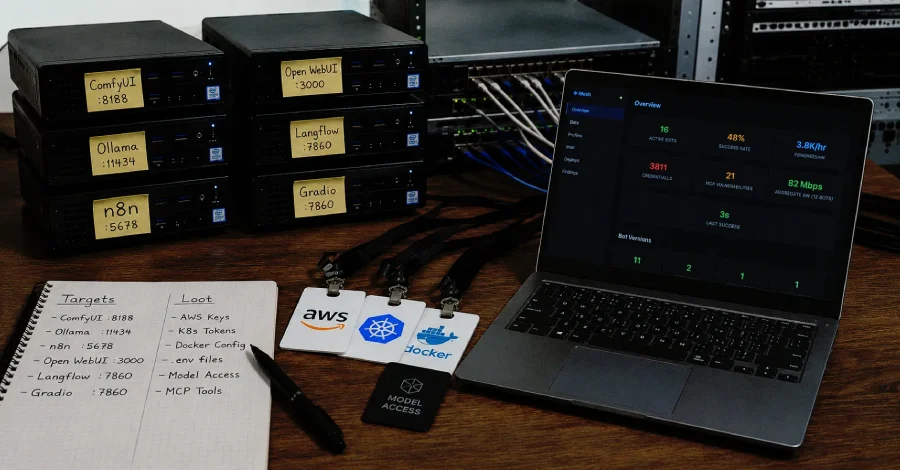
A sophisticated Go-based botnet, recently dubbed NadMesh, emerged in early July, specifically engineered to hunt for and compromise exposed artificial intelligence (AI) services. This new threat highlights a significant escalation in cyberattacks targeting the burgeoning AI ecosystem, with operators primarily focused on exfiltrating valuable cloud credentials rather than merely hijacking computational resources. Intelligence gathered from the botnet operator’s own dashboard, as reported by cybersecurity firm QiAnXin’s XLab, claimed an alarming 3,811 unique AWS keys had already been harvested, underscoring the severe implications for cloud security.
The Rise of NadMesh: A Product-Grade Threat for the AI Era
The discovery of NadMesh signals a critical juncture in the evolution of cyber threats. While botnets have long been a staple in the arsenal of malicious actors, NadMesh represents a "product-grade" threat, meticulously designed and continuously updated, specifically tailored to exploit the often-overlooked security vulnerabilities inherent in rapidly deployed AI infrastructure. Its name, derived from the "n4d mesh controller" string found within its source code, hints at a structured, networked approach to compromise.
At its core, NadMesh leverages a Shodan harvester, a tool renowned for identifying internet-facing devices and services, to meticulously stock its scan queue. The targets are a specific array of popular AI services: ComfyUI, Ollama, n8n, Open WebUI, Langflow, and Gradio. These platforms, which range from image generators and local model runners to workflow builders, are frequently adopted by development teams for their speed and ease of deployment. However, this rapid adoption often comes at the cost of robust security practices, leaving them "stood up fast and firewalled late," as observed by security researchers. This creates an expansive attack surface that NadMesh is expertly exploiting.
QiAnXin’s XLab, a prominent cybersecurity research lab, published a comprehensive report on Friday, July 12, detailing their analysis of NadMesh. The report provided crucial insights, including screenshots of the operator’s command-and-control (C2) panel, which offered a glimpse into the scale and objectives of the operation. The figures presented on this panel, captured on July 10, while exhibiting some internal inconsistencies, painted a stark picture of active compromise and credential theft.
Chronology of an Evolving Threat
The activity associated with NadMesh saw a significant spike in the first week of July. XLab’s sensors indicated that distinct source IP addresses pushing NadMesh malware, which had been near zero through late June, surged dramatically to approximately 139 per day. This sudden vertical growth underscored the rapid deployment and expansion of the botnet’s infrastructure.

This recent surge follows earlier warnings about the vulnerability of AI-related infrastructure. In April, another operator was observed targeting exposed ComfyUI instances, primarily for GPU cryptojacking – mining Monero and Conflux, and establishing Hysteria proxy nodes for resale. While that operation focused on resource exploitation, NadMesh represents a pivot towards a more valuable prize: cloud credentials. This evolution was somewhat predicted; Censys, a search engine for internet-connected devices, had, as recently as May 27, concluded its own census of Model Context Protocol (MCP) services with a cautionary note, guessing that exposed shell tools would likely result in the host becoming "part of some future botnet or abuse infrastructure." Just seven weeks later, XLab published its report on NadMesh, a botnet actively exploiting mcp_cmd_execute functionalities.
The Model Context Protocol itself has a history that inadvertently contributes to this vulnerability. Its first specification, released on November 5, 2024, placed authentication entirely outside the core protocol. While an authorization flow was subsequently added in March 2025, the specification explicitly states that it remains optional. This design choice has left numerous deployments without crucial security layers, making them prime targets for botnets like NadMesh. Censys’s data from April and May confirmed this exposure, counting over 12,520 reachable MCP services by April 28, growing to more than 21,000 by May 6, with approximately 90 of them advertising a tool that runs commands. Critically, 39 of these exposed services featured the exact execute_command call, precisely what NadMesh prioritizes.
Discrepancies and Deception: Unpacking the Operator’s Dashboard
The NadMesh operator’s command-and-control dashboard provided a fascinating, if contradictory, insight into the botnet’s operations. On July 10, the dashboard displayed a counter reading 17,700 total deploys, yet a separate funnel claimed 95,700 deploys in the past 24 hours – a significant and puzzling discrepancy. Similarly, the number of active bots fluctuated between 16 and 12 across different tiles. While the credential count of 3,811 unique AWS keys was stated twice, lending it some credibility, these inconsistencies suggest either sloppy record-keeping, an attempt by the operator to inflate perceived success, or perhaps a deliberate obfuscation tactic to confuse potential trackers.
More revealing, however, was a critical footnote on the panel: "success is scored on an outcome allowlist that explicitly excludes the Ollama and AWS harvest." This detail is profoundly significant. It implies that the botnet operator is aware of the true value of the AWS keys and Ollama data they are harvesting and has chosen not to include these high-value acquisitions in their public-facing "success" metrics. This suggests a calculated effort to downplay or hide the primary objective of the operation, making it harder for researchers to fully grasp the scope of the theft based solely on the operator’s own reports. Despite the dashboard’s internal contradictions, the core objective remains clear: the acquisition of cloud credentials.
Exploitation Vectors: A Blend of Old and New
While NadMesh is designed to target cutting-edge AI services, its exploit arsenal combines both modern vulnerabilities and time-tested methods of compromise. The intel feed behind the operator’s counter showed 47 credential hauls and 41 model inventories within its last 100 records. These inventories included identifiers for DeepSeek, GLM, and Kimi, often tagged with ":cloud," indicating that the cataloged data extends beyond the compromised host itself, reaching into cloud environments.
The researchers at XLab closely monitored the exploit traffic generated by NadMesh. Their observations revealed a diverse set of attack vectors, though not always aligning perfectly with the operator’s stated priorities or dashboard counts. The highest percentage of observed exploit traffic, 30.31%, targeted docker_containers_api_rce (Remote Code Execution), exploiting exposed Docker API sockets, often left open on port 2375. This allows attackers to execute commands directly on the host’s Docker daemon, gaining significant control. Another substantial portion, 22.28%, targeted jenkins_scripttext_rce, indicating exploitation of unauthenticated or poorly secured Jenkins script consoles.

Older, but still effective, methods also featured prominently: weak Telnet passwords accounted for 10.36% of traffic, and unauthenticated Redis instances were targeted in 8.29% of observed attacks. While mcp_cmd_execute was indeed present in XLab’s observed traffic, it constituted a smaller fraction, sitting in an unlabeled tail at 0.78%. This discrepancy between the operator’s priority list (which places MCP at the top) and the observed exploit traffic might suggest that while MCP is a high-value target, other, more prevalent misconfigurations offer easier initial entry points.
The botnet also targets specific, known vulnerabilities. Among them is CVE-2026-39987, a pre-authentication Remote Code Execution (RCE) flaw in Marimo notebooks prior to version 0.23.0. This vulnerability is particularly critical, having been added to CISA’s Known Exploited Vulnerabilities (KEV) catalog in April, mere hours after its disclosure, indicating active exploitation in the wild. Another significant vulnerability is CVE-2026-41176, which allows an unauthenticated caller to flip the rc.NoAuth setting on rclone RC servers (versions 1.45.0 to 1.73.5) that were started without HTTP authentication. Given that rclone configurations frequently contain cloud credentials, this exploit provides a direct path to sensitive data.
The botnet’s activity also includes attempts to exploit older vulnerabilities, such as CVE-2022-22947 (at 6.48% of traffic), which affects Spring Cloud Gateway Actuator endpoints if enabled and exposed unsecured, and CVE-2017-12611 (at 4.15%), a Struts Freemarker tag flaw. This blend of targeting recent, high-impact vulnerabilities alongside long-standing misconfigurations and older CVEs demonstrates NadMesh’s comprehensive approach to compromise.
Operational Sophistication and Evasive Tactics
NadMesh exhibits a high degree of operational sophistication, indicative of a well-resourced and continuously developed threat. Its scanning mechanism is designed for efficiency and persistence: subnets that yield successful hits are resampled more densely every five minutes. IPs flagged as "dangerous" within the last 24 hours are subjected to rescans every quarter hour, with AI-specific ports prioritized. A full sweep brings any target marked "dangerous" within the last seven days back to the top of the queue. This adaptive scanning strategy ensures that promising targets are thoroughly probed and re-engaged.
The botnet also employs evasion techniques. Any target that absorbs ten deployment attempts without returning a result is automatically blacklisted as a suspected honeypot. XLab interprets this as a clear sign that the botnet’s authors are aware of and actively trying to counteract detection by security researchers. Should the scanning queue run dry, the bots are programmed to generate a random /24 CIDR block and continue their search, ensuring a continuous supply of potential targets.
From a development perspective, NadMesh operates with impressive agility. Five different build versions run concurrently, with examples like eleven bots on the 33.8-GO-TITAN build, while stragglers remain on older versions like 30.0. A "canary endpoint" is utilized to stage new builds to a slice of the fleet, serving 5,448 responses for new versions against 84,024 null responses, demonstrating a systematic approach to testing and deploying updates. A sophisticated funnel tracks tasks from initial deployment attempts down to live host compromises, providing the operator with a detailed view of their campaign’s progress.
Furthermore, the malware itself is designed for resilience and stealth. It achieves persistence through three different mechanisms simultaneously, meaning that removing one component leaves the others to re-establish the agent. Each build undergoes Garble obfuscation, UPX -9 packing, and random padding, resulting in no two agents sharing the same hash. This dynamic obfuscation makes it challenging for traditional signature-based antivirus solutions to detect and for researchers to track all variants using a single hash. Consequently, a published sample hash will only identify that specific build, missing the vast majority of other active agents.

Mitigation and Defensive Strategies
The emergence of NadMesh underscores the urgent need for robust cybersecurity practices, particularly for organizations deploying AI services and operating in cloud environments. Most of what NadMesh exploits stems from exposed services and administrative functionalities left callable and unsecured.
Immediate Actions for Defenders:
-
Secure Exposed Services: The paramount recommendation is to place critical services behind proper authentication and, ideally, remove them from the public internet entirely. This includes:
- Open Docker APIs (often on port 2375).
- Unsecured Jenkins script consoles.
- Unauthenticated Redis instances.
- Systems with weak Telnet and SSH passwords.
- Specific AI service ports targeted by NadMesh: 8188 (ComfyUI), 11434 (Ollama), 7860 (Gradio), and 5678 (n8n).
-
Patch Management: Organizations must maintain a rigorous patch management program. Prioritize patching vulnerabilities, especially those listed in CISA’s Known Exploited Vulnerabilities (KEV) catalog, such as CVE-2026-39987 for Marimo notebooks. Also, address CVE-2026-41176 for rclone RC servers. While older vulnerabilities like CVE-2022-22947 (Spring Cloud Gateway) and CVE-2017-12611 (Struts Freemarker) are less common targets, their presence in NadMesh’s arsenal means they should not be ignored if applicable. Verify the conditions for exploitation before panicking, but assume compromise if conditions are met.
-
Credential Management: If any indicators of compromise (IOCs) are found, the immediate isolation of the affected host is critical. Subsequently, all credentials that the compromised host could access must be immediately revoked, not merely rotated. This includes AWS keys, Kubernetes cluster tokens,
.envfile contents, and Docker registry logins. It is crucial to pull any persistent malware agents before issuing replacements, as new keys will otherwise be compromised just as quickly as the old ones. After revocation, a thorough review of how the old credentials were used during their live exposure period is essential to understand the full extent of the breach.
Indicators of Compromise (IOCs):
- Command and Control (C2) Server: 209.99.186[.]235
- Domain: cdnorigin[.]net
- Agent Sample SHA1: 31c69b3e12936abca770d430066f379ec1d997ec (Note: Due to obfuscation, this hash will only identify one specific build version).
Broader Implications for AI and Cloud Security

NadMesh serves as a stark reminder of the escalating risks in the rapidly expanding AI landscape. The "AI gold rush" has led to an accelerated deployment of AI services, often with insufficient attention paid to foundational security principles. This creates a significant "security debt" that attackers are now actively cashing in on.
The shift in botnet objectives from resource hijacking (like GPU mining) to cloud credential theft represents a more profound and dangerous threat. Cloud keys are often referred to as the "keys to the kingdom" because they grant access to an organization’s entire cloud infrastructure, including sensitive data, computational resources, and the ability to launch further attacks. A compromise originating from an exposed AI service can quickly escalate into a full-scale cloud breach, leading to data exfiltration, service disruption, and significant financial and reputational damage.
The interconnectedness of modern IT environments means that a vulnerability in one component, such as a seemingly isolated AI model runner, can serve as a pivot point for lateral movement into more critical systems. The optional authentication in protocols like MCP, combined with rapid, unsecure deployments, creates a perfect storm for attackers.
As AI adoption continues to grow exponentially, the cybersecurity community and organizations leveraging AI must prioritize proactive security measures. This includes embedding security from the design phase (security by design), implementing robust access controls, ensuring continuous vulnerability management, and educating development teams on secure coding and deployment practices. The battle for cloud credentials and AI infrastructure has just begun, and NadMesh is a potent new adversary in this evolving conflict.

