
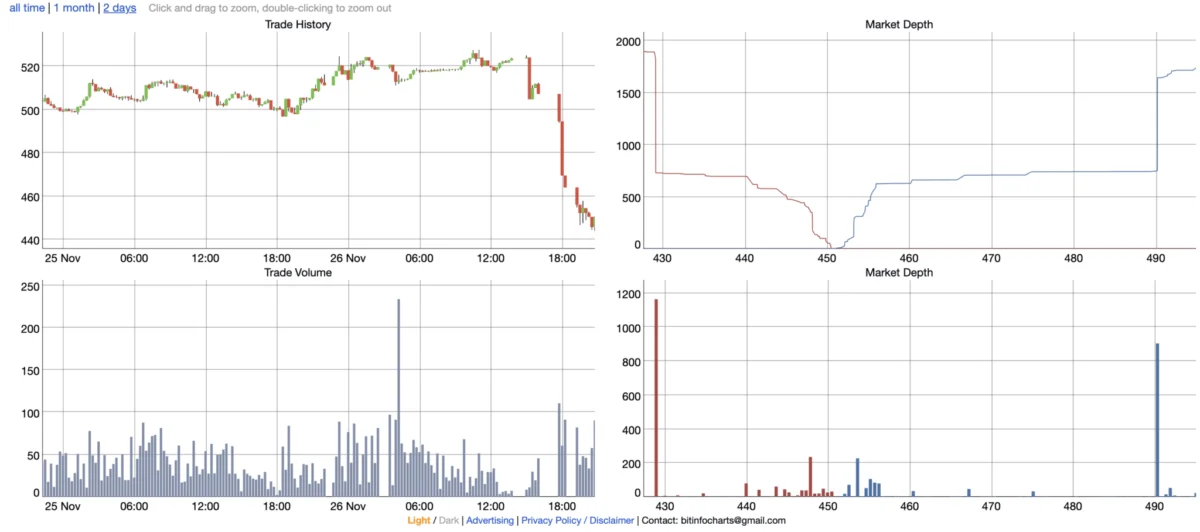
Monero (XMR), one of the cryptocurrency market’s oldest and most prominent privacy-focused digital assets, suffered a severe downward correction on Thursday, shedding approximately 15% of its market value in a span of less than five hours. The sudden and aggressive sell-off was triggered by an announcement from digital asset exchange KuCoin confirming that it would systematically remove all Monero trading pairs from its platform. This regulatory and operational blow comes merely nine days after rival exchange MEXC discontinued its XMR spot trading operations, compounding a shrinking ecosystem of centralized liquidity for privacy coin investors.
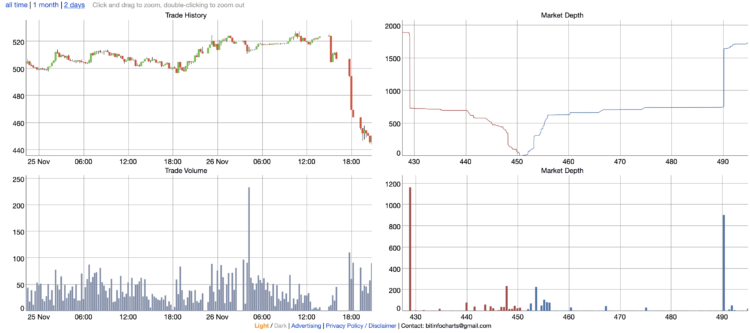
Market data extracted from BitInfoCharts illustrates the swiftness of the decline, showing XMR plummeting from a trading high of $525.36 down to $446.54 over the course of Thursday’s active trading sessions. For long-term holders and institutional observers of the privacy coin sector, the market reaction served as an uncomfortable echo of the severe volatility witnessed in February 2024, when global crypto exchange Binance announced its own phased delisting of Monero. However, market analysts point out a critical difference between then and now: the remaining roster of globally recognized, high-volume centralized exchanges willing to support Monero has dwindled to a fraction of its former breadth.
A Chronology of Retreat: The Shrinking Centralized Footprint for Monero
The systematic exclusion of privacy-centric digital assets from major centralized trading platforms is not a sudden phenomenon, but rather the culmination of years of intensifying global regulatory scrutiny. Anti-Money Laundering (AML) directives, the Financial Action Task Force (FATF) travel rule, and heightened compliance expectations from international securities and banking watchdogs have increasingly placed cross-border privacy coins in the regulatory crosshairs.
The modern chronology of Monero’s exchange availability highlights a steady erosion of access points:
- February 2024: Binance, historically one of the largest liquidity pools for cryptocurrency assets worldwide, announced the complete delisting of Monero, citing changing industry compliance standards and risk management assessments. This triggered an immediate, sharp downturn across the privacy coin sector.
- October 2024: Kraken, a major US-headquartered exchange, officially halted XMR spot trading and deposits for clients residing within the European Economic Area (EEA). The platform explicitly attributed the move to evolving regional regulatory frameworks governing privacy-enhancing technologies.
- November 17, 2026: Mid-tier exchange MEXC quietly discontinued spot trading services for Monero, removing core trading pairs and giving users a limited window to liquidate or withdraw their capital.
- November 26, 2026: KuCoin issued a definitive platform notice confirming its intention to completely phase out Monero support, accelerating the ongoing liquidity squeeze and precipitating Thursday’s 15% intraday price crash.
This multi-year retreat underscores a structural shift within the cryptocurrency exchange industry. Platforms increasingly prioritize regulatory compliance and banking relationship preservation over the inclusion of untraceable or stealth-address assets, leaving privacy-centric networks to navigate an increasingly hostile centralized market architecture.
KuCoin’s Phased Exit Strategy and Direct Impact on Traders
In its formal announcement published on November 26, 2026, KuCoin outlined a strict timeline for the removal of Monero, leaving market participants with a narrow four-day window to adjust their positions, repay loans, and relocate funds.
According to the platform guidelines, KuCoin will terminate all four of its primary Monero spot trading pairs—XMR/USDT, XMR/USDC, XMR/ETH, and XMR/BTC—on November 30 at precisely 08:00 UTC. Anticipating potential capital flight and structural volatility, the exchange suspended all incoming XMR deposits immediately upon releasing the announcement, with no plans to reinstate them. While outgoing withdrawals are slated to remain technically operational until December 31 at 08:00 UTC, the exchange included a caveat reserving the right to curtail the withdrawal window early should unexpected technical or network maintenance issues arise.
The delisting parameters extend far beyond simple spot market pairs, deeply affecting auxiliary financial services offered on the platform:
- Flexible Savings: KuCoin scheduled the termination of XMR flexible savings products for November 27, halting daily yield accrual for participating depositors.
- Automated Trading and Conversions: Bot trading, portfolio rebalancing, and direct conversion services involving Monero are mandated to cease entirely alongside the spot market shutdown on November 30.
- VIP Loans and Collateral Risk: Perhaps most critically for leveraged traders, KuCoin announced it would stop accepting Monero as collateral for its VIP loan products. Borrowers utilizing XMR as security were immediately notified to pledge alternative, non-delisted assets or face immediate account liquidations.
- Forced Liquidation Warnings: For account holders choosing to leave residual balances on the exchange past the ultimate withdrawal deadline, KuCoin issued a stern advisory indicating that remaining XMR balances could potentially be converted into stablecoins at the platform’s discretion, though it explicitly noted that "such conversion is not guaranteed."
Notably, KuCoin’s official statements cited internal platform policies and risk management frameworks as the primary drivers behind the decision, omitting explicit references to specific regulatory subpoenas or enforcement actions—a standard phrasing often utilized by exchanges navigating complex legal jurisdictions.
Quantifying the Liquidity Crunch: Market Depth and Volume Migration
The departure of KuCoin represents an acute shock to Monero’s market structure because of the sheer volume of trade the platform historically processed. Market metrics captured by CoinGecko on November 26 identified KuCoin as the single most active centralized exchange supporting Monero trading activity. Over a standard 24-hour testing period prior to the announcement, the exchange’s flagship XMR/USDT trading pair alone recorded approximately $62.6 million in transactional volume.
Historical data compiled by blockchain analytics firm Kaiko Research provides deeper context regarding the deterioration of privacy token liquidity. Even prior to the 2024 regulatory wave led by Binance, market depth—defined as the ability of an order book to absorb large trades without inducing massive price slippage—had been steadily narrowing across major privacy assets including Monero (XMR), Zcash (ZEC), Dash (DASH), and Oasis Network (ROSE).
When a dominant liquidity venue like KuCoin removes an asset, trading volume does not simply evaporate from the global economy; rather, it is forced to migrate. A portion of displaced capital invariably flows into decentralized alternatives, peer-to-peer (P2P) networks, or remaining centralized exchanges. However, the macro-implication centers on market efficiency. With fewer venues competing for order flow, the overall market becomes fragmented. During periods of heightened market stress or macro uncertainty, thinner order books on surviving exchanges mean that large-scale buy or sell orders will encounter significantly higher price volatility, wider bid-ask spreads, and exaggerated slippage.
Consequently, Monero’s core challenge is transitioning from a fundamental utility problem to an acute market structure and liquidity crisis. Investors requiring rapid, large-scale execution face mounting friction when converting decentralized privacy assets back into fiat currency or mainstream liquidity anchors like Tether (USDT) or Bitcoin (BTC).
Resilience Versus Reality: Can Monero Survive the Centralized Exodus?
Despite the bearish technical indicators and the psychological weight of consecutive exchange departures, market analysts advise against writing off Monero based solely on centralized platform access. History suggests that the privacy coin possesses a resilient user base and a robust organic ecosystem capable of weathering regulatory storms.
Earlier in 2026, long after Binance had severed ties with the network, Monero demonstrated unexpected upward momentum, defying regulatory gravity as XMR tokens pushed past the $700 threshold amid surging global demand for financial privacy and data sovereignty. Proponents argue that Monero’s underlying cryptographic infrastructure—utilizing ring signatures, stealth addresses, and confidential transactions—is inherently decentralized and permissionless. The protocol does not rely on KuCoin, Binance, or any other centralized intermediary to validate transactions, maintain its distributed ledger, or ensure peer-to-peer transmission of value.
However, financial pragmatists emphasize a vital distinction between ideological survival and market viability. While a protocol can function flawlessly on-chain, everyday market participants require functional, low-cost off-ramps and liquid trading venues to manage risk. Without reliable access to broad liquidity pools, price discovery becomes erratic, and institutional capital participation is effectively locked out.
As the calendar turns toward the final days of November, the immediate focus of the digital asset community shifts squarely to November 30. Market participants will not merely be watching whether Monero can reclaim psychological price milestones such as the $500 level; rather, seasoned analysts will track the precise migration patterns of KuCoin’s $62.6 million daily trading volume. Whether secondary exchanges and decentralized liquidity protocols can successfully absorb the influx of displaced orders—or whether the market will suffer sustained degradation in depth—will determine if Thursday’s 15% drop was a temporary panic reaction or the precursor to a permanent structural realignment for Monero.

