

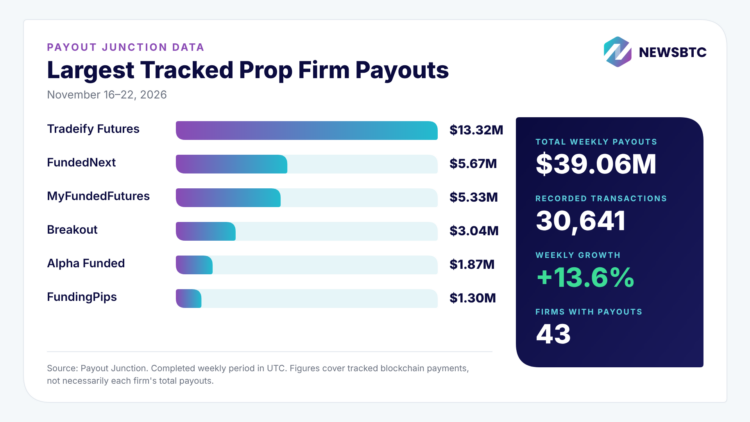
The global retail proprietary trading industry is rapidly approaching a monumental financial milestone, with cumulative payouts tracked across major platforms nearing the $2 billion threshold. According to recent market data from Payout Junction covering 45 prominent firms since October 2023, nearly $1.97 billion has been successfully disbursed to retail traders. November 2026 alone has accounted for more than $115 million in verified payments, underscoring the massive scale and enduring popularity of the funded trading ecosystem.

However, beneath the headline-grabbing statistics lies a complex operational reality. While public payout trackers offer a clear window into aggregate capital distribution, industry analysts and consumer advocates emphasize that gross payout figures should not be mistaken for net trader profitability. Evaluating the "best" prop firm requires looking far beyond flashy marketing claims, high profit splits, and advertised account balances to examine the rigorous, and often restrictive, operational rules that govern challenge evaluations and capital withdrawals.
Background Context and Industry Evolution
The modern retail prop trading model emerged as a hybrid alternative to traditional retail brokerages. Instead of risking personal capital in a standard margin account, retail traders pay an upfront evaluation or challenge fee to demonstrate their trading competence within simulated environments. Successful participants who navigate predetermined profit targets and strict drawdown limits are subsequently granted access to funded accounts, sharing in the generated profits according to a specified split—often ranging from 80% to 90% in favor of the trader.
Over the past several years, the industry has expanded aggressively beyond its traditional stronghold of foreign exchange (forex) and contracts for difference (CFDs). Modern prop firms now frequently incorporate futures markets, spot cryptocurrencies, and even tokenized U.S. equities into their product pipelines. This diversification allows retail participants to tap into a broader spectrum of global financial instruments without committing the full notional value of the advertised account balance out of pocket.
Despite this rapid expansion, regulatory scrutiny has intensified globally. Financial watchdogs, such as Belgium’s Financial Services and Markets Authority (FSMA), have issued cautionary warnings to retail consumers regarding the speculative nature of shadow investment and prop trading programs. Regulators frequently highlight the financial risks associated with purchasing repeated challenge attempts and remind participants that retail funded programs predominantly utilize simulated accounts where payouts represent contractual performance rewards rather than direct institutional employment.

Analyzing the Top Prop Firms of 2026
To understand how contemporary platforms serve different trading styles, industry researchers categorize leading firms by their evaluation models, asset classes, and payout structures rather than relying on a singular, monolithic leaderboard.
Traditional Forex and CFD Evaluations: FTMO and FundedNext
FTMO remains a benchmark for traditional two-phase evaluation models, offering structured profit objectives (typically 10% in phase one and 5% in verification) alongside fixed daily and overall loss limits. Its mathematical clarity appeals to systematic forex traders who require predictable risk parameters. Similarly, FundedNext provides extensive model variety—including its popular Stellar 2-Step challenge—giving traders multiple structural pathways to funded-stage trading, though users must carefully parse the varying performance reward conditions attached to each product variant.

Futures and Structured Risk: Topstep, Tradeify, and Take Profit Trader
In the futures sector, Topstep dominates with its structured Trading Combine and Express Funded accounts. Industry veterans frequently note a critical distinction in futures evaluations: the maximum loss allowance (e.g., a $2,000 loss limit on a $50,000 advertised account) represents the actual capital buffer rather than the headline account size.
Meanwhile, platforms like Tradeify and Take Profit Trader have captured market share by introducing flexible payout structures. Tradeify allows successful futures traders to select between distinct payout policies (such as Select Flex and Select Daily) upon graduation. Take Profit Trader emphasizes frequent withdrawal opportunities and streamlined evaluations, though traders must maintain a mandatory account buffer before earnings become eligible for payout.

Asset Class Diversification: Lucid Trading and HyroTrader
Lucid Trading caters to futures participants seeking freedom from restrictive consistency formulas through its LucidFlex program, which eliminates funded-stage profit-concentration caps while maintaining a 90% profit share. On the digital asset front, HyroTrader addresses the crypto-native community by offering specialized evaluation infrastructure tailored to cryptocurrency volatility, moving away from repurposed forex platforms to provide dedicated digital-asset trading environments.
The Financial Reality: Gross Payouts Versus Net Trader Profitability
A central analytical challenge in assessing the prop trading industry involves contextualizing the $2 billion payout milestone. Financial analysts point out several critical blind spots in public payout data:

- The Cost of Entry: Cumulative payout ledgers record successful withdrawals but do not track the cumulative capital spent by the broader customer base on failed challenges, account resets, monthly subscriptions, and platform fees. A trader who spends $400 across four failed evaluation attempts before securing a single $300 payout has not generated a net profit.
- The Illusion of Advertised Balances: A $100,000 account with a tight $3,000 trailing drawdown offers significantly less room for error than a $50,000 account with a static $5,000 loss limit. Higher headline balances often mask aggressive drawdown mechanics that disproportionately favor the firm.
- Consistency Rules and Payout Buffers: Many firms enforce strict consistency formulas—limiting the percentage of qualifying profit that can stem from a single trading session. Furthermore, mandatory withdrawal buffers require traders to leave substantial capital inside the simulated account to absorb future drawdowns, delaying access to earned income.
Fact-Based Analysis and Future Implications
The continued growth of retail proprietary trading highlights a profound structural shift in how independent speculators access financial markets. By lowering the financial barrier to large-scale capital deployment, prop firms have democratized high-leverage trading for a global audience.
However, the long-term viability of the industry will likely depend on increased regulatory transparency and consumer education. As oversight tightens, successful prop firms are expected to place greater emphasis on transparent rulebooks, clear risk disclosures, and fair withdrawal policies. For the retail participant, navigating this multi-billion-dollar landscape requires meticulous due diligence—prioritizing an alignment between personal trading strategies and firm-specific rules over the alluring optics of massive headline payouts.

