
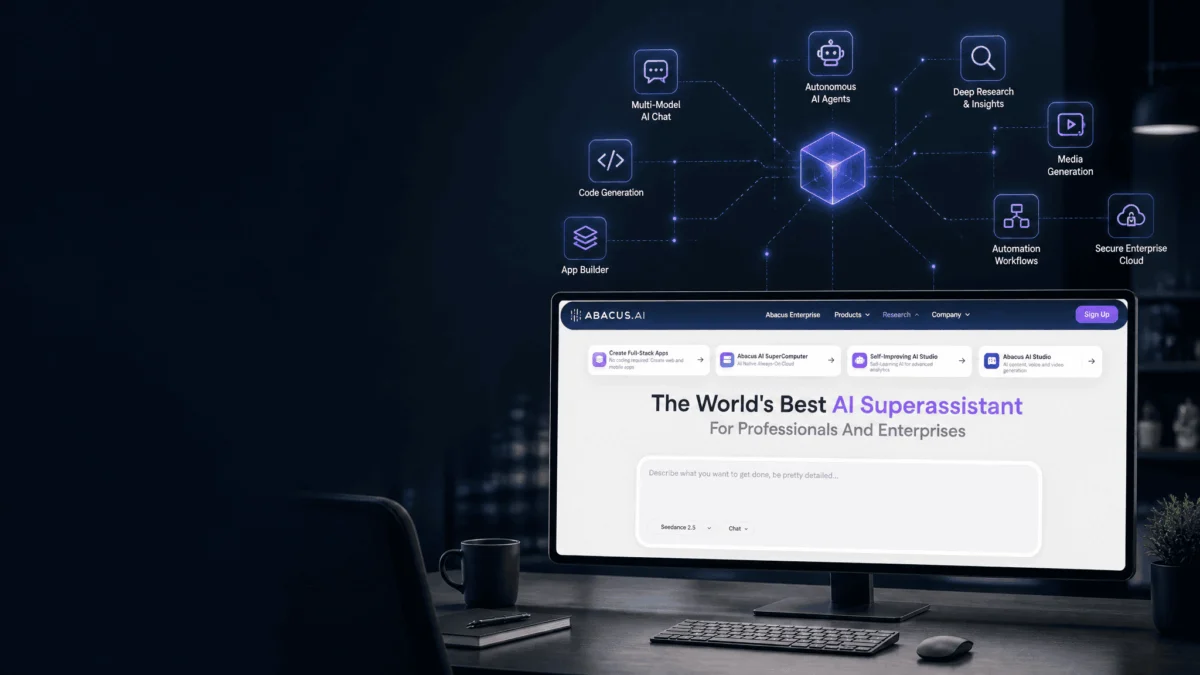
The landscape of generative artificial intelligence has undergone a rapid metamorphosis since the initial explosion of large language model (LLM) adoption in 2022. As individual model providers like OpenAI, Anthropic, and Google solidified their dominance with standalone consumer products, a secondary challenge emerged for professional users: software fragmentation. Managing a stack of subscriptions—one for coding, one for creative tasks, and another for general research—has created both administrative and financial overhead. Abacus AI, an ambitious platform founded by veterans of Google Brain and other elite machine learning institutions, has positioned itself as the solution to this fragmentation. By consolidating model access, agentic workflows, infrastructure, and creative tools into a single, resource-based ecosystem, the platform represents a significant, albeit complex, shift in how professionals interact with AI.
The Origin and Evolution of the Platform
Founded in 2019, Abacus AI initially focused on enterprise-grade machine learning, specializing in predictive modeling, anomaly detection, and fraud prevention. However, the 2023 shift toward generative AI prompted the company to pivot, leveraging its existing infrastructure to launch a consumer-facing, professional-grade suite. This transition was marked by a strategic expansion: moving from the backend, enterprise-only space into the public spotlight with the release of ChatLLM. This evolution reflects a broader trend in the industry where specialized machine learning firms are increasingly wrapping their powerful computational engines in user-friendly, application-focused interfaces to capture the growing market of power users who require more than a basic chatbot.
The Platform Architecture: Consolidation as a Service
At the core of the Abacus AI value proposition is the concept of an "AI super assistant." The platform is not a singular tool but a modular suite of services: ChatLLM for conversational interaction, RouteLLM for API-level model management, and Abacus AI Agent for autonomous task execution.
The primary draw for most users is the capability to toggle between more than 100 different language and vision models within a unified interface. This eliminates the necessity of maintaining three or four distinct browser tabs or separate service accounts. For professionals working in data-heavy fields, this allows for rapid, side-by-side comparison of how different models—such as GPT-4o, Claude 3.5 Sonnet, or Gemini 1.5 Pro—process the same document or dataset. The inclusion of "routing" logic, which attempts to automatically select the most efficient model based on the complexity of the prompt, is a nod toward cost optimization, though research indicates that automated routing still lags behind human-curated model selection in terms of nuance.
Deep Dive into the Toolset
The platform’s functionality is categorized into several distinct pillars, each serving a specific professional requirement:
- ChatLLM: Serving as the front-end, this interface supports file-based analysis, document research, and project-based organization. It acts as the central hub for the user, allowing for persistent conversations and file management that remains consistent regardless of the underlying model being utilized.
- Abacus AI Agent (formerly DeepAgent): This is arguably the most ambitious component of the platform. It is designed to move beyond simple chat, enabling the execution of multi-step, complex workflows such as automated research, browser-based data extraction, and code deployment.
- Desktop and CoWork: Recognizing the need for privacy, Abacus AI offers local-first tooling. Desktop allows users to interact with local files without cloud transmission, a critical feature for developers handling sensitive source code or proprietary data.
- Studio: Targeted at the creative sector, this workspace aggregates dozens of image, video, and audio generation models. By centralizing creative workflows, the platform enables users to rapidly prototype media concepts.
- AppLLM: This environment allows users to build, host, and deploy full-stack applications directly from a prompt, complete with database integration and authentication.
Operational Implications and the Credit-Based Economy
A defining characteristic of Abacus AI—and perhaps its most controversial element—is its credit-based billing system. Unlike subscription models that offer "unlimited" usage with soft caps, Abacus AI utilizes a tiered system where credits are consumed at varying rates based on the computational intensity of the task.
For the $10 Basic plan, users receive a monthly allocation of credits, which are sufficient for standard text-based interactions. However, as users move into agentic tasks, high-resolution image generation, or persistent cloud hosting, the depletion rate accelerates significantly. This creates a "hidden" complexity: the cost of the platform is not a flat fee, but rather a variable expense tied to usage density. Data from independent user feedback suggests that professional power users often find the $10 tier insufficient, necessitating a move to the $20 Pro tier to avoid mid-month service interruptions. This, in turn, requires a level of operational discipline—monitoring a billing dashboard to ensure that a rogue agent or a high-end video render does not exhaust the monthly quota prematurely.
Security, Privacy, and Enterprise Governance
For organizations evaluating Abacus AI, the security architecture is a focal point. The company maintains certifications including SOC 2 Type II and ISO/IEC 27001:2022. These standards are foundational for enterprises operating in regulated sectors. Furthermore, the platform’s commitment to data privacy—specifically the promise that customer data is not utilized to train the company’s own foundational models—aligns with the industry standard for enterprise-grade AI.
However, a distinction must be drawn between the self-serve platform and the enterprise-level offering. While the $10 or $20 subscription provides a robust toolkit for individuals and small teams, the Enterprise tier, which reportedly starts at $5,000 per month, offers the governance, Single Sign-On (SSO), and dedicated VPC deployments required for true institutional compliance. Users often conflate these two, leading to misunderstandings regarding the level of support and security guarantees available at the lower price points.
Comparative Analysis: The "Wide vs. Deep" Trade-off
When comparing Abacus AI to first-party providers like OpenAI or Anthropic, the choice comes down to a fundamental trade-off: breadth versus specialization.
ChatGPT and Claude are optimized for a seamless, "best-in-class" experience within their own model ecosystems. Their interfaces are cleaner, more intuitive, and highly refined for their specific model strengths. Abacus AI, conversely, offers a "wide" experience. It is a Swiss Army knife that includes features—such as full-stack app hosting and terminal-integrated coding—that the first-party providers simply do not offer.
The disadvantage of this breadth is cognitive load. Navigating the Abacus AI interface is objectively more complex than using a native ChatGPT interface. For the average user who simply needs a high-quality chatbot for email drafting or basic summarization, the added complexity of Abacus AI’s menu systems, routing settings, and project folders can be a deterrent. Conversely, for a developer or a technical product manager who needs to integrate API calls, build a prototype, and compare three different models in one sitting, the platform’s utility is unparalleled.
Fact-Based Implications for the User
The current market sentiment toward Abacus AI is bifurcated. Enthusiastic users cite the cost savings of consolidating four or five separate subscriptions into one. Skeptics point to the learning curve and the potential for "credit shock." The reality is that the platform demands a specific type of user: one who is willing to treat their AI usage as an operational process rather than a casual utility.
For prospective users, the most rational approach involves a staged evaluation:
- Catalog your current AI subscriptions and calculate the total monthly expenditure.
- Identify the specific tools (Agent, Desktop, AppLLM, etc.) you intend to use at least twice weekly.
- Test the platform during the introductory month to verify if the credit consumption patterns align with your actual workflow volume.
- Critically evaluate whether the time saved by having an "all-in-one" environment outweighs the time spent learning the platform’s unique interface and managing its credit-based ecosystem.
As the AI industry matures, platforms like Abacus AI are likely to become the standard for professional workflows, moving away from the era of "model-first" interaction toward "workflow-first" interaction. While the platform currently faces challenges regarding interface polish and pricing transparency, its fundamental premise—the unification of the fragmented AI stack—addresses a clear and persistent pain point in the modern digital workspace. Whether it successfully captures the broader market depends on its ability to balance the technical power of its tools with the simplicity required for mass-market adoption. For now, it remains a potent, highly specialized, and deeply capable instrument for those willing to invest the time to master it.

