
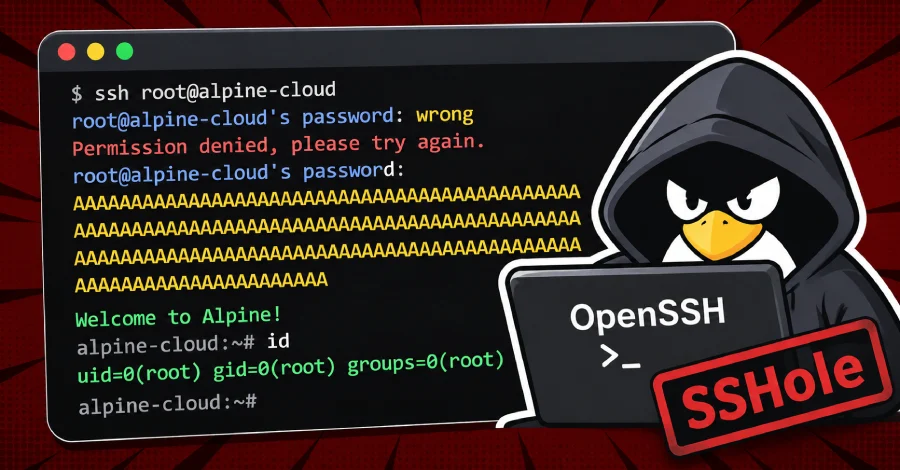
A severe security vulnerability in the widely used OpenSSH suite, designated as CVE-2026-123158 and colloquially dubbed "SSHole," has triggered an immediate response from the global cybersecurity community. The flaw, which carries a critical CVSS score of 8.1, allows unauthenticated remote attackers to bypass authentication mechanisms on Linux systems that utilize the musl C library with Pluggable Authentication Modules (PAM) disabled. This specific configuration is notably common in default deployments of Alpine Linux, making a significant portion of containerized and lightweight server environments potentially susceptible to unauthorized access.
The vulnerability stems from a legacy logic error in the way OpenSSH handles password-hashing operations. By providing an exceptionally long password—specifically between 257 and 1,024 bytes—an attacker can induce a failure in the password-hashing process. Under the conditions present in the vulnerable versions, the system mistakenly interprets this failed hash attempt as a successful authentication. Specifically, the system returns an asterisk (*), which is the same value used by the operating system to indicate that an account is locked or has no password set, thereby granting the attacker entry to the account.
A Chronology of Discovery and Exploitation
The timeline surrounding the disclosure and subsequent weaponization of CVE-2026-123158 underscores the rapid pace at which modern threat actors capitalize on newly identified flaws. The issue was initially identified by security researcher Ozgun Kultekin, who alerted maintainers to the underlying logic flaw that dates back to a 2016 patch intended to resolve a username enumeration vulnerability (CVE-2016-6210).
The formal disclosure of the vulnerability occurred in early November 2026, alongside the release of OpenSSH 10.6p2, which included the necessary security patches. However, the window of opportunity for exploitation was alarmingly narrow. According to telemetry provided by the threat intelligence firm Previdian, the first recorded attempt to weaponize the vulnerability occurred less than nine hours after the CVE details were made public.

Previdian reported that a single IP address, geolocated to Japan (89.116.89.18), conducted eight distinct exploitation attempts against a honeypot system running Alpine Linux. The attackers did not merely test the vulnerability; they proceeded to execute reconnaissance commands—including id, uname, and hostname—to verify the level of access gained. This swift transition from disclosure to exploitation highlights the necessity for immediate patching cycles in enterprise environments, particularly those relying on containerized infrastructure where configuration management can often lead to the use of default settings that lack robust PAM authentication.
Technical Context and the "Musl" Factor
To understand why this vulnerability is highly specific to certain environments, one must look at the interplay between the OpenSSH daemon (sshd) and the underlying C library. The flaw is not universal across all Linux distributions. It is primarily isolated to systems utilizing the musl C library where PAM is not utilized for the authentication process.
In many standard desktop and server distributions, such as Debian, Ubuntu, or RHEL, OpenSSH is configured to delegate authentication to PAM, which acts as a middleware that enforces complex authentication rules. In these configurations, the vulnerability is effectively mitigated because the authentication request is handled by a different subsystem. However, Alpine Linux and similar lightweight, performance-oriented distributions often favor the musl C library and may be configured to skip PAM, opting instead for direct password checking against the system’s /etc/shadow file.
When an attacker inputs an oversized password on these specific systems, the code path that generates the hash fails. Because the system checks for the presence of the asterisk—the indicator for a password-disabled account—and receives a failure value that matches that same asterisk, the logic gate opens. It is a classic case of an "authentication bypass," where the software is tricked into believing that the provided credentials, while technically incorrect, fulfill the criteria for a "null" or "disabled" password, thus bypassing the requirement for a valid cryptographic key or password.
Implications for Enterprise Infrastructure
The impact of the SSHole vulnerability is highly dependent on the target system’s configuration and the privileges assigned to the accounts that do not have passwords set. While the vulnerability does not allow for a universal bypass of every account, it creates a significant risk for systems where "root" or other high-privilege accounts have been configured without a password for administrative ease, or where service accounts are left in a state that permits password-based login.

Safe Security, a firm specializing in cybersecurity risk management, has warned that the implications for enterprise environments are substantial. "For enterprise, the consequences of SSHole depend on the privileges of the compromised account," the firm noted in its analysis. Beyond the immediate threat of unauthorized shell access, the vulnerability serves as a beachhead for lateral movement within a network. Once an attacker has gained a foothold, they can extract application secrets, deployment credentials, and sensitive configuration files, potentially escalating their privileges or disrupting critical services.
The fact that this vulnerability resides in the very foundation of remote management—the SSH protocol—makes it particularly dangerous. Unlike an application-level flaw, which might only compromise a single database or web interface, a successful SSHole attack provides the attacker with command-line access, effectively turning the compromised server into a node for further malicious activity.
Response and Remediation Strategies
The official guidance from the OpenSSH development team is clear: all administrators must upgrade to OpenSSH 10.6p2 or the latest patched version provided by their specific distribution vendor. Simply updating the software is the primary defense, but it is only the first step in a comprehensive incident response process.
Alpine Linux, acknowledging the prevalence of this vulnerability within its ecosystem, has provided a specific checklist for security teams to follow:
- System Auditing: Search system logs (typically found in
/var/log/messagesor viajournalctl) for entries containing "Accepted password for." Specifically, look for any logins that involve accounts that should not be accepting password-based authentication, such as therootuser or service accounts that rely on public-key authentication. - Account Review: Examine existing user accounts to identify any that have been recently created or modified.
- Integrity Checks: Review the use of
doasorsudoto determine if the attacker attempted to elevate privileges after the initial login. - Credential Rotation: If any machine is suspected of having been compromised, it must be treated as a total loss. This requires the rotation of all secrets, SSH keys, API tokens, and credentials stored on the machine, as the attacker must be assumed to have exfiltrated these assets.
The community has also emphasized that systems that do not use the vulnerable configuration—including those running Dropbear, those based on the standard glibc library, or those correctly configured with PAM—are safe from this specific attack vector. However, the existence of the vulnerability serves as a sobering reminder of the "technical debt" associated with long-standing codebases. The fact that a 2016 patch for a separate vulnerability (CVE-2016-6210) created the conditions for this 2026 exploit highlights the importance of comprehensive security auditing and the necessity of re-evaluating legacy code paths when introducing new functionality.

A Broader Security Perspective
The SSHole incident brings to light a recurring theme in modern cybersecurity: the danger of relying on default configurations. In the rush to deploy containerized environments and microservices, administrators often prioritize speed and portability. Alpine Linux is a favorite for this reason, as its small footprint and rapid boot times are ideal for modern cloud architectures. However, these benefits often come at the cost of simplified security configurations.
As organizations move forward, the lessons from CVE-2026-123158 should inform future infrastructure-as-code (IaC) strategies. Security teams must ensure that hardening guides are not merely suggestions but mandatory components of the deployment lifecycle. This includes disabling password-based authentication entirely in favor of SSH keys, implementing robust PAM policies, and maintaining a strict patching regimen that monitors not just the OS kernel, but the foundational network services that act as the gatekeepers of the infrastructure.
Furthermore, the rapid exploitation of this flaw demonstrates that "security by obscurity" is a failing strategy. Once a vulnerability is identified and assigned a CVE, the global network of automated scanners and threat actors begins searching for vulnerable targets immediately. The speed at which the Japan-based IP address probed the honeypot is a warning to every network administrator: the time between disclosure and total compromise is now measured in hours, not weeks. Preparedness, proactive monitoring, and a rapid-response capability are the only defenses against the next iteration of such critical protocol-level flaws.

