
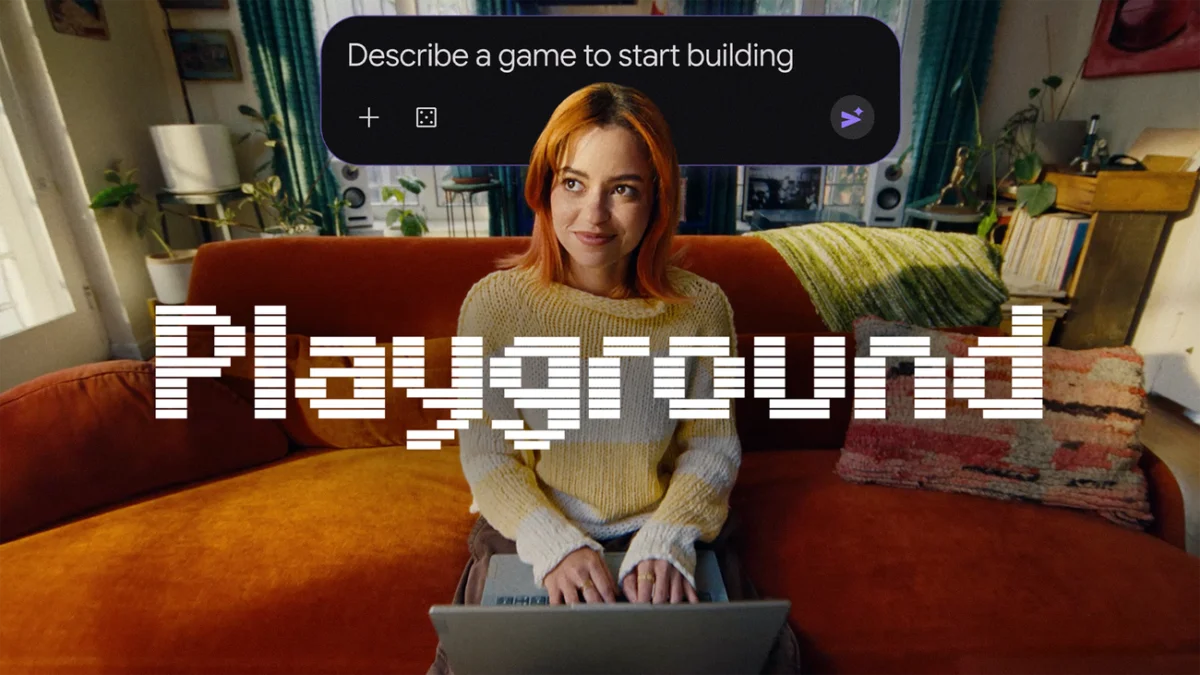
The Evolution of Democratized Game Design
The history of game development is a narrative of increasing complexity. In the 1980s, hobbyists could build games using BASIC; by the 2010s, the rise of professional-grade engines made high-fidelity graphics possible but alienated the casual user who lacked formal computer science training. Playground sits at the intersection of generative AI and interactive media, acting as a bridge between the creative intent of a non-coder and the computational requirements of a functional game engine.
This experimental platform, led by Software Engineer Maryam Karimzadehgan and her team, leverages large-scale generative models to interpret user intent. When a user inputs a prompt—such as "a 2D platformer set in a futuristic coffee shop"—the system performs a series of complex tasks in the background: asset generation, physics configuration, and logic scripting. This transition from "code-first" to "intent-first" development marks a pivotal moment in the software industry, echoing similar trends in generative art and text-to-video production.
Chronology and Development Timeline
The path to the launch of Playground began within Google’s internal R&D labs, where researchers sought to address the "creative gap" observed in the gaming community. While platforms like Roblox and Minecraft have long provided sandboxed environments for creation, they still required users to learn specific proprietary scripting languages or building mechanics.
- Early 2024: Google’s AI Innovation team began testing internal prototypes capable of generating basic physics-based mechanics through Large Language Model (LLM) integration.
- Mid-2024: Development shifted toward browser-based deployment to ensure cross-device accessibility, eliminating the need for high-end hardware.
- Late 2024: Beta testing commenced, focusing on safety guardrails and the integration of community-driven moderation tools.
- October 2026: Official public launch of Playground in the United States, alongside the announcement of a future partnership with Unity.
Data-Driven Insights: The Gaming Landscape
The gaming industry has experienced exponential growth, with global market revenue exceeding $200 billion annually. However, the vast majority of this revenue is generated by a small fraction of developers. According to recent market analysis, user-generated content (UGC) platforms have become the fastest-growing segment in the industry, as players increasingly prefer to create their own narratives rather than consume static experiences.
Playground taps into this demographic shift. By allowing users to iterate on their games in real-time—tweaking gravity, modifying enemy behavior, or changing environment textures via text—the platform reduces the iteration cycle from weeks to minutes. For the average user, the time saved is substantial. Traditional indie development cycles often span six to eighteen months; Playground aims to compress the "idea-to-playable" phase into a single session.
Strategic Partnership with Unity Spark
One of the most consequential aspects of the Playground announcement is the upcoming integration with Unity Spark. Unity, the industry leader in real-time 3D development, provides the technical backbone for a significant portion of the mobile and PC gaming market. By bridging the gap between Playground’s accessible interface and Unity’s professional-grade toolset, Google is positioning this platform as a potential "gateway" for aspiring developers.
Industry analysts suggest this move is a strategic play to standardize the transition from hobbyist to professional. If a user creates a successful, popular game in Playground, the Unity Spark integration will theoretically allow them to port that game into a more professional environment, where they can add high-fidelity shaders, complex lighting, and advanced AI behaviors. This creates a scalable ecosystem where Google provides the entry point and Unity provides the professional ceiling.
Safety, Moderation, and Community Guidelines
As with any platform that allows for open-ended user creation, content safety remains a primary concern. Google has implemented a multi-layered moderation strategy to ensure that the Playground ecosystem remains compliant with its broader Community Guidelines.
Every game published to the "Explore" gallery undergoes an automated safety screening. This includes checks for prohibited content, copyright infringement, and malicious code. Furthermore, the platform utilizes a user-reporting system that allows the community to flag inappropriate content. This approach is similar to the moderation frameworks seen in Google Play and YouTube, reflecting a mature approach to risk management in the generative AI space. By tying participation to Google AI subscriptions and age-restricted access (18+), the company is also attempting to curate the user base, ensuring that the initial wave of content adheres to professional standards.
Broader Implications for the Software Industry
The launch of Playground carries significant implications for the future of software development. If the platform succeeds, it could fundamentally alter the job market for game designers and developers. While "no-code" platforms rarely replace professional-grade engineering, they do shift the value proposition of a developer. In a future where the mechanical "grunt work" of coding a jump mechanic is handled by AI, the role of the game designer shifts toward high-level creative direction, narrative structure, and user experience design.
Furthermore, the shift to a browser-based, AI-driven development environment challenges the dominance of desktop-heavy development suites. If users can build complex, interactive experiences on a smartphone or a low-spec laptop, the geography of game development may shift from established tech hubs to a global, decentralized community of creators.
Looking Ahead: The Future of Playground
As the platform evolves, Google intends to introduce more sophisticated collaborative features. Currently, the focus is on solo creation and leaderboard-based social play, but the trajectory suggests an eventual move toward synchronous, multi-user development environments.
For now, the platform is restricted to users in the United States over the age of 18, with tiered access linked to Google AI subscriptions. This rollout strategy is typical for experimental Google products, allowing the engineering team to monitor server load and community feedback before a potential global expansion.
As the lines between player and creator continue to blur, Playground stands as a testament to the belief that the future of digital entertainment is not just about playing games, but about the instantaneous manifestation of ideas. Whether it becomes a standard tool in the creator’s arsenal or remains a niche experiment will depend on the community’s ability to move beyond simple prototypes and build lasting, engaging, and innovative digital worlds. The technology is present, the interface is accessible, and the infrastructure is now in place—the rest, as Google suggests, is up to the imagination of the user.

