
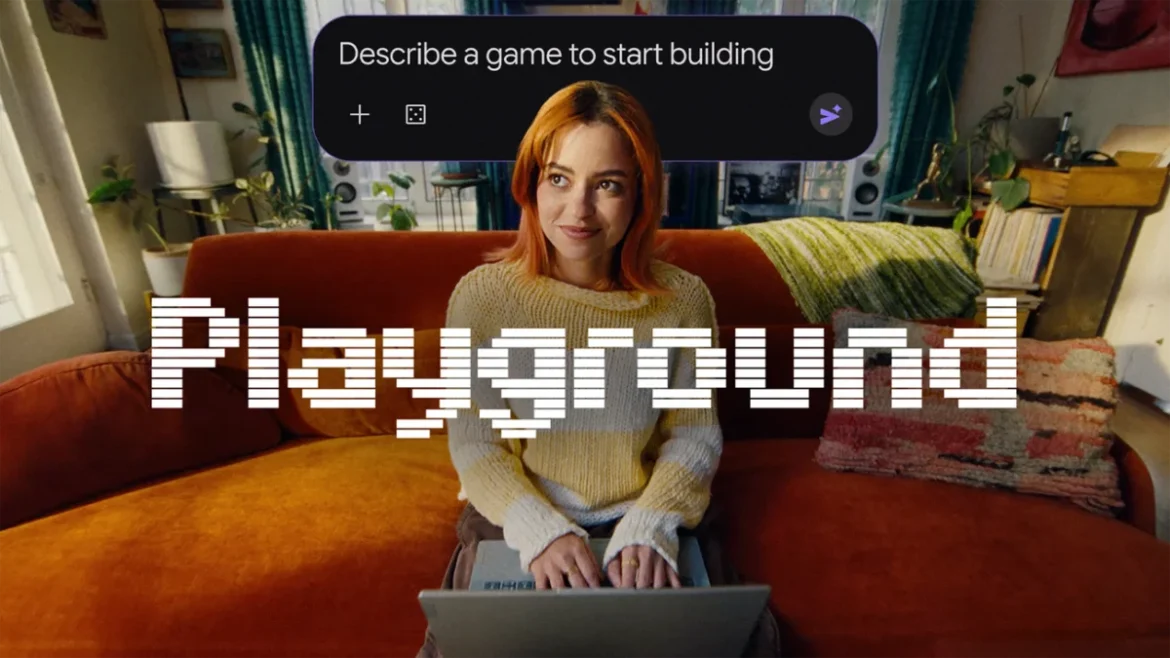
The Democratization of Game Development
The gaming industry has experienced explosive growth over the last decade, with global revenues now exceeding $180 billion annually. Despite this massive market, the actual creation process remained siloed. Traditional development pipelines—involving assets, physics engines, lighting, and networking—required specialized software and years of training. Playground challenges this status quo by utilizing generative AI to bridge the gap between imagination and implementation.
Maryam Karimzadehgan, a lead software engineer at Google’s AI Innovation and Research unit, spearheaded the development of this platform with a core philosophy: if a user can describe an experience, they should be able to play it. By leveraging large-scale language models, the platform interprets user prompts to build game logic, environment aesthetics, and rule sets in real-time. This eliminates the "syntax barrier," where a user’s creative vision is often stifled by the inability to write complex code.
Chronology and Technical Evolution
The trajectory toward this launch began in the early 2020s, as generative AI moved from theoretical research to consumer-facing applications. The transition from LLMs (Large Language Models) that could write text to those capable of generating functional software architecture provided the technical foundation for Playground.
- 2022–2023: Initial research into "text-to-game" logic began within Google’s internal labs, focusing on simple 2D mechanics.
- Early 2024: Integration of multimodal AI allowed for the generation of visual assets, moving the platform beyond simple text-based adventure games toward interactive, graphical experiences.
- Late 2024: The platform underwent extensive closed-beta testing, focusing on safety guardrails and the implementation of community-driven moderation.
- October 2026: Official launch of the experimental platform for users in the United States aged 18 and older.
How Playground Functions
At its core, the platform operates via a conversational interface. Users engage with a prompt box where they can define the genre, tone, and specific gameplay mechanics. A user might, for example, input: "Create a 2D platformer where the character is a sloth moving across city rooftops, and the game should increase in difficulty as time passes."
The AI then generates the underlying code, maps the physics, and constructs the environment. Crucially, the platform allows for iterative design. Users do not need to get it perfect on the first prompt. They can ask the system to "change the color of the rooftops to sunset orange" or "make the sloth move faster when it collects coffee beans." This back-and-forth process mimics the traditional game development cycle of prototyping and refining, but compresses what would take weeks into a matter of minutes.
The Role of Community and Social Integration
Google has positioned Playground not merely as a tool for creation, but as a social ecosystem. The platform includes a "Playground Explore" gallery where creators can publish their work. This moves the platform into the territory of social gaming hubs like Roblox or Unity’s own community portals, albeit with a significantly lower entry threshold.
The social features include:
- Multiplayer Capabilities: Select game genres support real-time interaction, allowing users to challenge friends.
- Leaderboards: Integrated tracking allows for competitive play, fostering a sense of community engagement.
- Player Feedback: A rating system ensures that the best-designed games rise to the top, providing a feedback loop for creators to improve their skills.
To maintain a secure environment, all published games are subject to automated safety screenings. These screenings scan for content that violates Google’s community guidelines, such as hate speech or non-consensual imagery. Furthermore, the platform utilizes a user-reporting system, ensuring that the community remains self-policing in tandem with automated oversight.
Expanding Horizons: The Unity Spark Integration
Perhaps the most significant development on the horizon is the upcoming integration with Unity Spark. While Playground is currently optimized for rapid, accessible creation, the partnership with Unity Technologies signals an intention to move into professional-grade development.
Unity Spark, currently in its testing phase, is designed to provide high-fidelity 3D capabilities and professional-level mechanics that are currently beyond the scope of a standard text-to-game interface. By building a pipeline where a user can start with a simple text prompt in Playground and eventually export or expand that project into Unity’s robust engine, Google and Unity are creating a "pathway of growth" for creators. This ecosystem approach acknowledges that many users will eventually want to move beyond basic games to create immersive, 3D experiences without losing the initial work they created on the Playground platform.
Market Implications and Future Outlook
The introduction of Playground has profound implications for the gaming industry and the broader software development sector. If successful, it effectively turns every user into a developer. This mirrors the shift seen in digital media creation—just as YouTube allowed anyone to become a filmmaker and Substack allowed anyone to become a publisher, Playground aims to allow anyone to become a game designer.
Industry analysts suggest that this will likely lead to a "long tail" of creative content. While major studios will continue to dominate the high-budget "AAA" market, the middle market—indie games and casual experiences—could be entirely reshaped. A massive influx of user-generated games could lead to a saturation of the market, forcing platforms to rely more heavily on AI-driven curation and discovery algorithms to highlight high-quality content.
Moreover, the platform’s browser-based nature is a strategic choice. By avoiding the need for dedicated gaming hardware or high-end PCs, Google ensures that the barrier to entry is not just technical, but also financial. The platform runs on any modern web browser, making game creation accessible on everything from tablets to budget-friendly laptops.
Safety and Ethical Considerations
As with any generative AI tool, questions surrounding copyright and intellectual property remain prevalent. Google has stated that all games are moderated for safety, but the broader question of who owns the rights to a game generated via AI prompts is a subject of ongoing legal debate. Currently, the platform operates as an experimental environment, but as the technology matures, it will likely require more robust frameworks for digital rights management and creator compensation.
Furthermore, the tiered access model—which limits some features based on a user’s Google AI subscription—suggests that Google views this as a premium utility. While the basic creation tools are likely to remain accessible, power users will need to invest in the ecosystem to unlock higher-fidelity assets and advanced development features.
Conclusion: The Next Phase of Digital Creativity
The launch of Playground marks a pivotal moment in the intersection of artificial intelligence and interactive entertainment. By abstracting the complexities of coding and game engine management, Google is inviting a new demographic of creators into the fold. Whether this leads to a new generation of game designers or simply provides a fun, creative outlet for casual users remains to be seen. However, the trajectory is clear: the ability to build, iterate, and share virtual worlds is moving from the domain of the expert to the fingertips of the general public.
As the community begins to populate the Playground gallery with their unique creations, the platform will serve as a barometer for how generative AI can enhance, rather than replace, human creativity. For now, the experiment is live, the tools are in the hands of the public, and the future of game design is becoming significantly more accessible.
