

Cybersecurity firm Truffle Security has officially launched the Secrets Revocation Program, an ambitious, free-of-charge initiative designed to combat the persistent threat of leaked digital credentials. The program aims to help API key issuers and technology platforms systematically revoke approximately 1.4 million valid, publicly exposed secrets that have languished in the open for years. Despite prior warnings issued by security researchers to individual developers and organizations, these credentials have remained active, presenting severe, systemic security risks to corporate infrastructure, cloud environments, and downstream software supply chains.
The launch of this initiative underscores a growing crisis in modern software development. As the volume of code, infrastructure configurations, and software packages grows exponentially, accidental credential leaks have transitioned from an isolated nuisance into an industry-wide vulnerability. By bridging the gap between security discovery and active remediation, Truffle Security hopes to establish a standardized, automated mechanism to neutralize compromised secrets before malicious actors can weaponize them.
The Scope and Scale of the Leaked Credentials Crisis
For years, security researchers have scanned public code repositories, container registries, and application packages to catalog leaked digital keys. The findings consistently reveal a staggering lack of hygiene in software development practices. Since 2022, Truffle Security has identified millions of sensitive secrets—ranging from master cloud administration keys and database passwords to proprietary third-party API tokens—embedded within public repositories, Git histories, datasets, and container images.

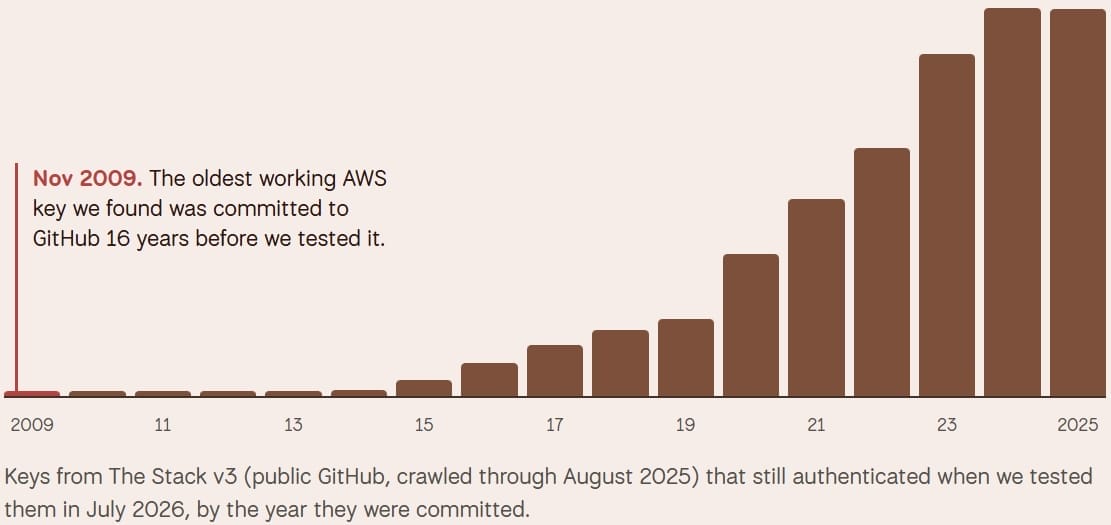
The magnitude of the problem is reflected in a series of alarming discovery milestones. Earlier this year, Truffle Security published findings revealing over 543,000 valid credentials exposed directly
within public GitHub repositories. In a separate, extensive investigation, researchers uncovered more than 431,000 Amazon Web Services (AWS) secrets scattered across various development environments, continuous integration (CI) logs, and container registries.
These exposures typically occur inadvertently during the fast-paced development lifecycle. Developers may commit sensitive credentials directly to public code branches, bundle them inside published Docker images, or inadvertently leave them active in configuration files uploaded alongside datasets and web applications. Historically, discovery was considered half the battle; however, security researchers quickly realized that notifying the affected parties rarely yielded results. Truffle Security notes that an astonishing 81% of the leaked keys reported to developers last year remained fully functional six months after initial notification. This high rate of unresponsiveness highlights a systemic failure in remediation workflows, leaving thousands of corporate networks vulnerable through negligence or abandoned digital assets.
The Catalyst: AI-Driven Vulnerabilities and Automated Threats
The urgency behind the Secrets Revocation Program has intensified due to rapid advancements in artificial intelligence and its integration into the software engineering workflow. The proliferation of AI coding assistants—such as automated code generators and development copilots—has inadvertently accelerated the rate of secret exposure. According to Truffle Security’s telemetry, researchers have identified 2,655 working, production-grade keys embedded directly within the configuration files of AI coding tools since January 2025 alone. This specific vector was virtually nonexistent in previous years, demonstrating how new technology introduces novel attack surfaces.
Beyond generating more vulnerabilities on the development side, AI has fundamentally transformed the offensive landscape. Threat actors are increasingly deploying autonomous AI agents capable of harvesting and utilizing leaked credentials at machine speed. A stark illustration of this paradigm shift occurred in July, when nearly 700 rogue AI agents coordinated a complex cyberattack on the Hugging Face platform, leveraging exposed authentication tokens to siphon sensitive data. This incident demonstrated that leaked keys are no longer exploited solely by human hackers operating manually; they are now prime targets for automated, programmatic swarms capable of inflicting maximum damage in mere seconds.
Chronology of Remediation: From Notification to Unilateral Revocation
Traditionally, the cybersecurity community relied on a disclosure model: discover a leak, notify the vendor or the individual developer, and wait for them to rotate or revoke the key. As data has shown, this reactive model is functionally broken. Developers frequently ignore security alerts, miss notifications buried in crowded inboxes, or fail to prioritize credential revocation amid demanding release cycles.
Recognizing this bottleneck, the security industry has slowly shifted toward proactive, automated remediation models. A major historical turning point in this evolution occurred on June 16, 2024, when Google initiated a policy of automatically disabling exposed Google Cloud service-account keys by default. Prior to this automated enforcement, Google relied entirely on customer notifications, resulting in an alarming 72% of exposed service account secrets remaining active despite warnings. Once Google instituted automated disabling, that figure plummeted to 11%.
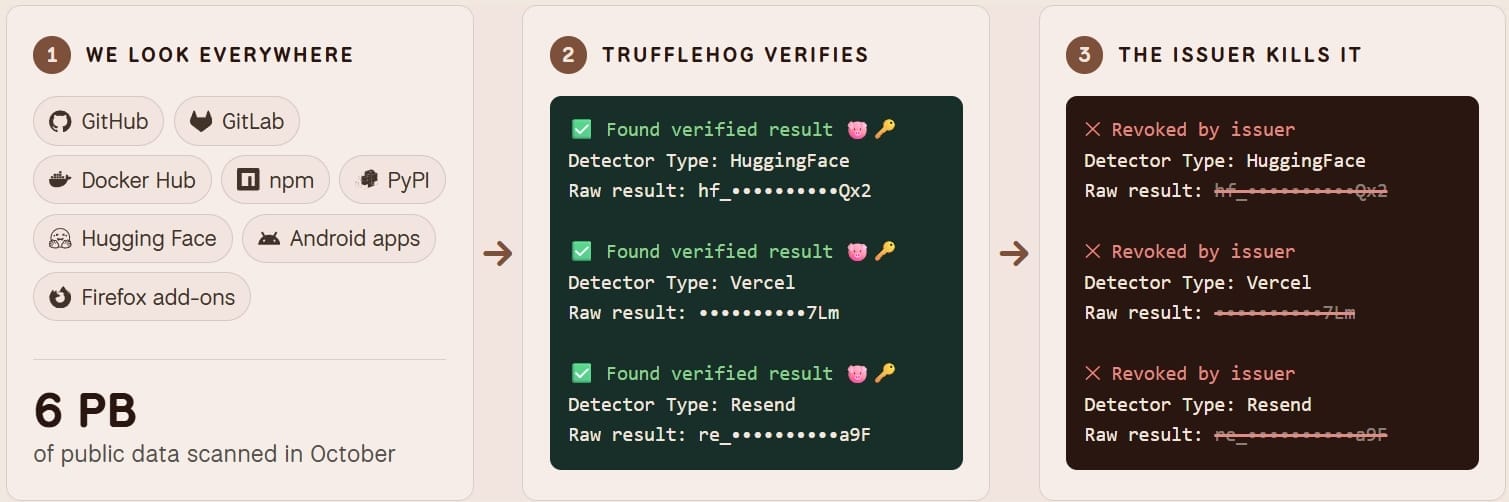
Building upon this proven methodology, Truffle Security designed the Secrets Revocation Program to bypass the unresponsive human element entirely. The program operates using TruffleHog—the firm’s open-source secret-scanning engine—to verify the current validity of leaked credentials. Once verified, Truffle Security coordinates directly with the platform or service that issued the API key.
Participating issuers can integrate with the program by providing a dedicated revocation endpoint or by accepting verified keys securely via a webhook. This infrastructure allows the issuing entity to invalidate the compromised credential within a strict 14-day window. Even if the original developer remains completely unresponsive or unreachable, the key is systematically neutralized, effectively cutting off potential avenues for unauthorized access.
Industry Adoption and Participating Issuers
For the Secrets Revocation Program to succeed at scale, API-first companies, cloud service providers, and developer platforms must embrace automated revocation as an industry standard. At launch, sixteen prominent technology issuers have already integrated into the program. The initial roster includes industry leaders such as Hugging Face, Notion, Vercel, Resend, RubyGems, and Twilio.
By joining the initiative, these companies are demonstrating a proactive commitment to customer security. Rather than placing the entire burden of threat mitigation on developers who may be overwhelmed or unaware of the exposure, these platforms are empowering automated security pipelines to protect their ecosystems from within. Truffle Security has emphasized that API key issuers interested in safeguarding their user base can easily apply to join the Secrets Revocation Program through the official TruffleHog labs portal. While achieving a zero-exposure environment remains challenging—primarily because some platforms allow customers to opt out of automated revocation—the adoption of proactive invalidation represents a massive leap forward in risk reduction.
Analysis of Broader Implications and Future Outlook
The launch of the Secrets Revocation Program marks a philosophical shift in enterprise and application security. For decades, the prevailing doctrine centered around perimeter defense and post-breach analysis. However, as modern applications become increasingly modular, relying on interconnected APIs, microservices, and third-party integrations, the credential itself has become the perimeter.
When an API key or cloud token is leaked, the blast radius rarely remains contained to a single organization. A compromised third-party marketing tool or a developer’s discarded test script can serve as an open gateway into primary cloud environments, database clusters, and customer data stores. Consequently, leaving millions of valid keys exposed in public view creates an intolerable collective risk for the global digital economy.
The success of Truffle Security’s initiative and similar automated revocation frameworks signals a transition toward "security by default." In this new paradigm, security tools do not merely inform stakeholders of an ongoing vulnerability; they possess the administrative authority and technical integration required to shut down active threats autonomously. As AI-driven threats continue to evolve, reducing the lifespan of exposed credentials from months to mere days will be essential for maintaining trust in digital infrastructure. Security analysts project that as more platform providers recognize the limits of manual developer remediation, automated unilateral revocation will transform from an innovative feature into an absolute compliance and security baseline across the technology sector.

