
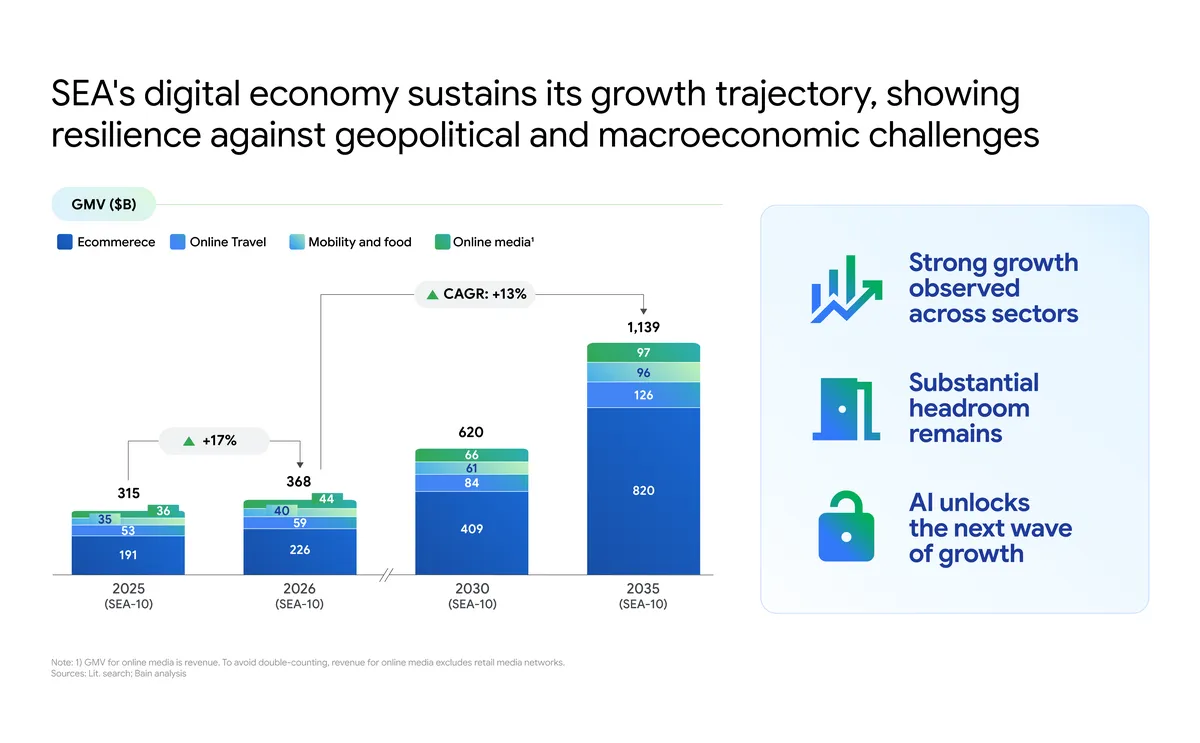
The digital landscape of Southeast Asia is undergoing a profound transformation, propelled by the rapid integration of generative artificial intelligence into the daily lives of 243 million people. According to the 11th edition of the e-Conomy SEA report, titled Building the Intelligent Economy—a collaborative research effort by Google, Temasek, and Bain & Company—this technological shift is a primary driver behind the region’s projected digital economy Gross Merchandise Value (GMV) of $368 billion in 2026. This figure represents a 17% year-on-year increase, signaling that the region remains firmly on a trajectory to surpass the $1 trillion milestone by 2035.
The adoption of generative AI in Southeast Asia is scaling at a rate four times faster than the initial rollout of the mobile internet, fundamentally altering the way consumers engage with commerce, travel, and media. As of 2026, 58% of the regional working population utilizes generative AI, marking it as an essential tool rather than a luxury. This transition toward an "intelligent economy" is characterized by the emergence of agentic commerce, where AI systems act with increased autonomy to facilitate complex consumer tasks.
A Decade of Digital Evolution: The Chronology of Growth
The e-Conomy SEA report, now in its eleventh year, serves as a benchmark for the region’s digital development. Over the past decade, the report has tracked the evolution from basic internet connectivity to the current era of artificial intelligence.
In the early years of the report, the focus was primarily on infrastructure and the basic penetration of smartphones. By the mid-2010s, the narrative shifted toward the rapid growth of ride-hailing, e-commerce marketplaces, and digital payments. Following the global pandemic in 2020, the digital economy experienced an unprecedented acceleration as lockdowns forced a mass migration to online services. Today, the focus has pivoted toward efficiency and intelligence. The transition from simple digital tools to AI-driven agents marks the current phase of development, setting the stage for what researchers identify as a 60-fold surge in regional AI usage over the next five years.
Sectoral Impact: AI as a Catalyst for Efficiency
The growth of the digital economy is not uniform; it is driven by the strategic application of AI across five primary pillars.
E-commerce remains the cornerstone of the regional digital economy, contributing $226 billion in GMV with an 18% year-on-year growth rate. AI has become central to the shopping experience through multimodal discovery tools and in-app assistants. These features allow consumers to navigate complex product catalogs with ease, resulting in a 10% increase in conversion rates and, in some segments, order volume uplifts of up to 75%.
Online Travel has seen a 10% growth, reaching $59 billion in GMV. While traditional search engines remain the primary planning tool, generative AI has now surpassed social media as the second-most popular method for organizing complex, multi-stop travel itineraries.
Online Media is experiencing a 22% growth, generating $44 billion in revenue. The integration of AI in personalizing content feeds has proven effective in matching audiences with relevant advertising. This has led to a 10% to 20% improvement in engagement quality, with the commerce media sector now emerging as a significant $4 billion market.
Mobility and Food Delivery continue to show steady growth, reaching $40 billion in GMV, an increase of 15%. AI-powered predictive routing and smarter dispatch systems have allowed for more efficient pooled rides and faster delivery times, directly translating into higher consumer retention.

Digital Financial Services represent the backbone of the ecosystem, with a Gross Transaction Value (GTV) of $1.65 trillion and 16% growth. AI is being utilized to enhance real-time fraud detection and expand credit access to underbanked populations through alternative data scoring, while simultaneously offering personalized financial advice that complements traditional banking services.
The Rise of Agentic Commerce and Consumer Trust
A critical takeaway from the 2026 report is the shifting consumer sentiment toward AI. There is a palpable rise in confidence, with 62% of Southeast Asian users reporting higher trust in AI tools compared to the previous year. This trust is built on a foundation of observable utility: 56% of users point to the proven track record of AI in handling tasks, while 53% cite improved accuracy as a key driver for their reliance on these tools.
This confidence is paving the way for "agentic commerce"—a model where AI agents are empowered to compare prices, verify seller reliability, and finalize transactions on behalf of the user. Research indicates that 75% of users are willing to allow AI to handle these tasks autonomously, provided that specific guardrails are established. Among the requested protections, 44% of users prioritize robust privacy safeguards, 36% demand transparency regarding the limitations of AI capabilities, and 30% insist on the ability to reverse automated transactions.
Broader Implications and Strategic Challenges
While the growth trajectory is optimistic, the report highlights that sustaining this momentum requires a systematic evolution of the digital ecosystem. To support a 60-fold increase in AI usage by 2030, stakeholders across the region—including governments, private corporations, and educational institutions—must address four critical conditions:
- Infrastructure Readiness: The massive data requirements of generative AI necessitate a robust expansion of local data centers and cloud computing capabilities.
- Regulatory Harmonization: As AI agents begin to operate across borders, regional policy alignment is essential to ensure consistent data privacy, cybersecurity, and consumer protection standards.
- Human Capital Development: The shift toward an intelligent economy requires a workforce capable of leveraging AI, necessitating a large-scale reskilling and upskilling program to prevent a widening digital divide.
- Sustainable Capital Allocation: Investment must shift from subsidizing customer acquisition—a hallmark of the previous decade—toward funding high-quality, AI-driven innovation and infrastructure that generates sustainable long-term value.
Analysis: A New Benchmark for Growth
The 2026 report marks a departure from previous metrics, as "tokens"—the units of data processed by AI models—now serve as a primary benchmark for the region’s digital health. By moving beyond simple GMV, the report acknowledges that the value of the digital economy is increasingly derived from the speed, efficiency, and intelligence of information processing.
Nitin Gajria, Managing Director for Southeast Asia and South Asia Frontier Markets, emphasizes that the region’s unique demographic profile—characterized by a young, tech-savvy, and rapidly urbanizing population—positions it to be a global leader in AI adoption. The integration of these technologies is not merely an incremental improvement; it is a structural change that is allowing Southeast Asia to leapfrog traditional economic development hurdles.
However, the transition is not without risk. The reliance on centralized AI models and the potential for digital exclusion mean that policymakers must remain vigilant. The emphasis on "intelligent" growth suggests that the region is entering a phase where the quality of digital interactions will dictate market leadership. As the regional economy approaches the $368 billion mark, the focus is clearly shifting from "being online" to "being intelligent," setting a new standard for global emerging markets in the digital age.

