
The United Kingdom has launched a decisive economic offensive against Cryptomus, a fluid and highly evasive cryptocurrency platform that blockchain intelligence agencies and financial watchdogs identify as a critical financial conduit for the Russian state. Operating under a rotating series of corporate identities, Cryptomus has systematically funneled capital for ransomware syndicates, darknet narcotics vendors, high-profile cybercrime operations, and international fraud rings. By keeping cash flowing through alternative pathways, the platform has actively assisted Moscow in circumventing sweeping Western financial sanctions designed to cripple its wartime economy.
The formal economic penalties, unveiled by the U.K. government on October 8, freeze all domestic assets tied to Cryptomus across British banking institutions. Furthermore, the sweeping directive strictly prohibits any UK-registered company or citizen from engaging in commercial, virtual, or operational business with the network. Alongside Cryptomus, the U.K. Treasury targeted a cluster of associated virtual payment conduits, including VexPay, TokenSpot, and the opaque Tsunami Payments service. This coordinated action marks a fundamental shift in how Western allies are attempting to dismantle the digital infrastructure underwriting illicit cross-border transactions and state-sponsored sanctions evasion.
The Evolution of an Illicit Empire: From Certa Payments to Heleket
Cryptomus has cultivated a reputation as a corporate shape-shifter since its inception in 2022. Originally incorporated under names such as Certa Payments and Xeltox Enterprises, the platform established itself as a preferred checkout and payment processor for dozens of Russian cryptocurrency exchanges and underground websites peddling malicious cyber services. Despite facing intense regulatory scrutiny and global investigations, the platform has consistently adapted its operational facade to evade law enforcement interdiction.
Following a massive investigative report published in December 2024 that detailed how digital currency was converted into liquid cash within Russian banking networks, the platform faced mounting pressure. In late 2025, after Canadian authorities levied a record-shattering CAD $176 million fine against Cryptomus for egregious anti-money laundering (AML) violations, the network executed a strategic pivot. It rebranded itself under the moniker “Heleket,” launching a parallel service designed to bypass compliance mandates and maintain uninterrupted, zero-KYC (Know Your Customer) payment processing for its high-risk clientele.
Blockchain intelligence firm Chainalysis underscored the systemic danger posed by these entities in an October 8 advisory. According to Chainalysis data, Cryptomus and its alter ego Heleket rapidly evolved into premier payment hubs for illicit digital assets. At their peak, these platforms received more illicit funds across tracked categories than traditional cryptocurrency mixers. The number of flagged illicit counterparties interacting with the network surged to an astonishing 900 unique entities within a single month in late 2025, demonstrating the immense scale of transactional velocity moving through the ecosystem.

A Timeline of Regulatory Interventions and Enforcement Escalations
The international crackdown on Cryptomus reflects years of mounting concern from blockchain analytics firms, financial intelligence units, and independent cyber investigators. A chronological overview highlights the escalating efforts to neutralize the network:
- 2022: Cryptomus emerges onto the digital landscape, quickly establishing a network of payment gateways catering to Russian exchange services and cybercrime cartels.
- December 2024: Investigative reporting exposes the seamless mechanics by which Cryptomus bridges illicit cryptocurrency holdings with traditional cash settlement inside Russian banks.
- April 2026: Comprehensive data released by TRM Labs reveals that Cryptomus has processed over $7 billion in cumulative transactions since its founding. The portfolio includes funds tied directly to child sexual abuse material (CSAM) vendors, terrorist financing networks, and international human trafficking rings. TRM Labs notes that while the platform instituted superficial KYC rules that temporarily depressed transaction volumes, it quickly circumvented these constraints by launching Heleket as a non-compliant alternative.
- Late 2025 – Early 2026: Canada imposes a historic CAD $176 million fine against Cryptomus. The platform responds by appealing the penalty, establishing Heleket, and continuing unhindered operations.
- October 8, 2026: The United Kingdom issues formal economic sanctions freezing Cryptomus assets and criminalizing business interactions with the platform, alongside actions against VexPay, TokenSpot, and Tsunami Payments. Concurrently, operational support channels on platforms like Telegram report widespread processing outages and frozen transaction flows.
The Enforcement Gap: Why Fines Fail Where Sanctions Succeed
A central debate among blockchain security professionals centers on the efficacy of traditional regulatory penalties versus direct sovereign sanctions. Richard Sanders, a prominent blockchain analyst and investigator who spent months mapping the labyrinthine infrastructure of Cryptomus, emphasized that financial penalties alone are insufficient to halt operations.
In a public statement following the U.K. announcement, Sanders noted that Canada’s record-breaking CAD $176 million fine was ultimately unenforceable and uncollectible. "A fine doesn’t stop a cryptocurrency payment processor from processing payments," Sanders wrote. "Sanctions kill the operation. The distinction matters."
When Canadian authorities penalized Cryptomus, the company’s corporate apparatus simply absorbed the legal blow, launched the Heleket parallel network, and maintained its transactional momentum. By contrast, a sovereign economic sanction criminalizes interactions across international banking systems, severing access to liquidity providers, forcing domain seizures, and fracturing the trust required to operate a global financial clearinghouse. Observers noted that within hours of the U.K. sanctions announcement on October 8, customer support bots for the platform on Telegram were actively acknowledging widespread processing failures and unexpected operational shutdowns.
Furthermore, industry experts have pointed out a historic milestone in the U.K.’s action. Legal scholars and intelligence analysts indicate this is the first documented instance where a member of the "Five Eyes" intelligence-sharing alliance (Australia, Canada, New Zealand, the United Kingdom, and the United States) has formally sanctioned a cryptocurrency enterprise incorporated within the jurisdiction of another Five Eyes partner. Given that Cryptomus maintained corporate footprints tied to Canadian registration spaces—such as a shared Vancouver address populated by dozens of inactive foreign currency dealers—the U.K. sanctions underscore a new willingness among allies to pierce jurisdictional silos when domestic enforcement proves deadlocked.

The Phony Regulatory Architecture of Western Sahara
Perhaps one of the most bizarre and revealing dimensions of the Cryptomus enterprise lies in the sophisticated corporate fiction it used to legitimize its operations. Entities seeking to offer international financial services typically rely on verifiable licenses issued by recognized central banks or legitimate regulatory bodies. Cryptomus and its parent entities bypassed this requirement by inventing an entire bureaucratic apparatus anchored in a geopolitical phantom zone.
The 2024 investigative findings revealed that the sole shareholder of Certa Payments—the original parent company of Cryptomus—was a 25-year-old Ukrainian national. Alongside her role in the payment processor, she served as a key executive for several other corporate entities, including the WS Management and Advisory Corporation. This organization marketed itself as an exclusive regulatory body responsible for issuing licenses to cryptocurrency exchanges, foreign exchange brokers, and online gaming enterprises operating within the disputed northwest African territory of Western Sahara.
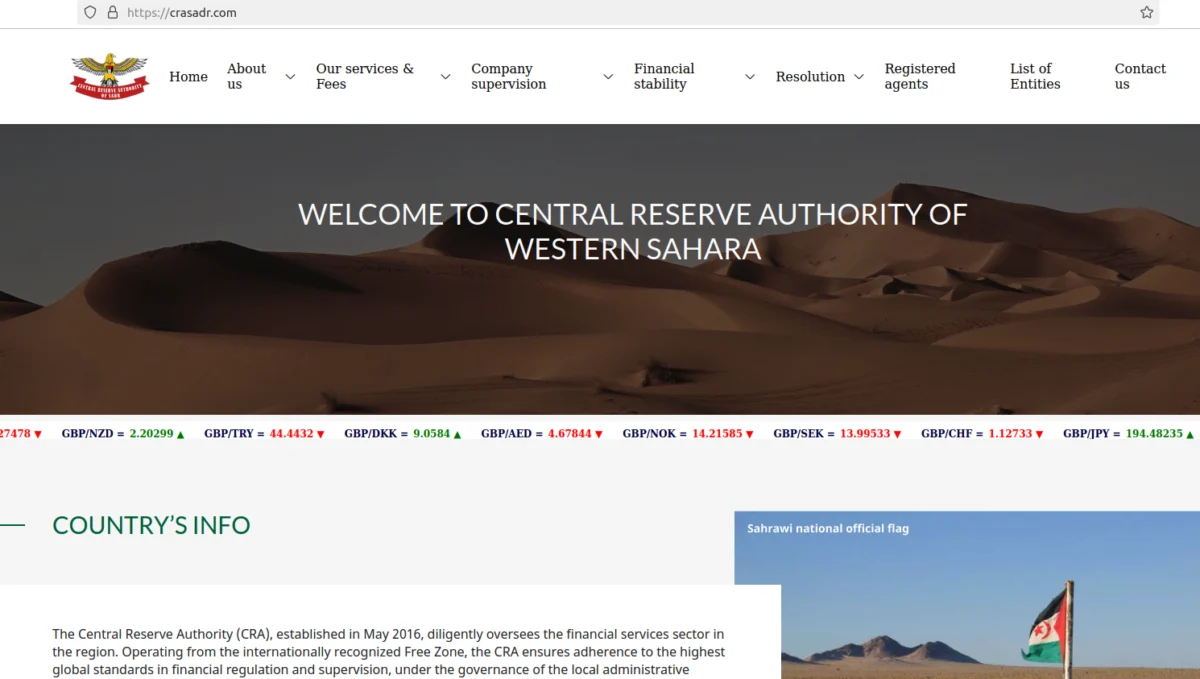
The regulatory body operated out of a web domain—crasadr.com—representing the fictional or unrecognized "Central Reserve Authority of the Western Sahara." The site provided prospective illicit payment processors with blueprints for corporate formation, offshore bank setup, and regulatory clearance. Digital forensics uncovered that Certa Payments shared server infrastructure with over a dozen associated domains, including rasd-state.ws, which served as the digital front for this pseudo-governmental financial authority. By fabricating a sovereign regulator in a territory lacking international recognition, the architects of Cryptomus created a self-contained regulatory loop, granting themselves the formal appearance of compliance while operating entirely outside the boundaries of international law.
Broader Implications for Global Crypto Compliance
The decisive action taken by the United Kingdom against Cryptomus, Heleket, and their satellite platforms signals a profound evolution in how modern nation-states police the decentralized financial ecosystem. As criminal syndicates and sanctioned nation-states increasingly rely on agile, multi-branded payment processors to launder capital and purchase illicit goods, traditional financial institutions and cryptocurrency exchanges face intense pressure to tighten transaction monitoring.
The collapse of Cryptomus’s operational infrastructure demonstrates that while digital assets offer pseudonymous fluidity, the physical and corporate choke points—ranging from server hosting and domain registration to banking gateways and jurisdictional compliance—remain vulnerable to targeted state intervention. As global regulators digest the lessons of the Cryptomus investigation, financial intelligence agencies are expected to increase scrutiny on pseudo-regulatory licensing bodies and cross-border payment hubs that operate in regulatory grey zones. For illicit platforms attempting to shield the Russian wartime economy or finance transnational crime, the closure of Cryptomus serves as a stark warning: corporate rebranding and fabricated regulatory licenses can no longer guarantee immunity from coordinated Western sanctions.

