
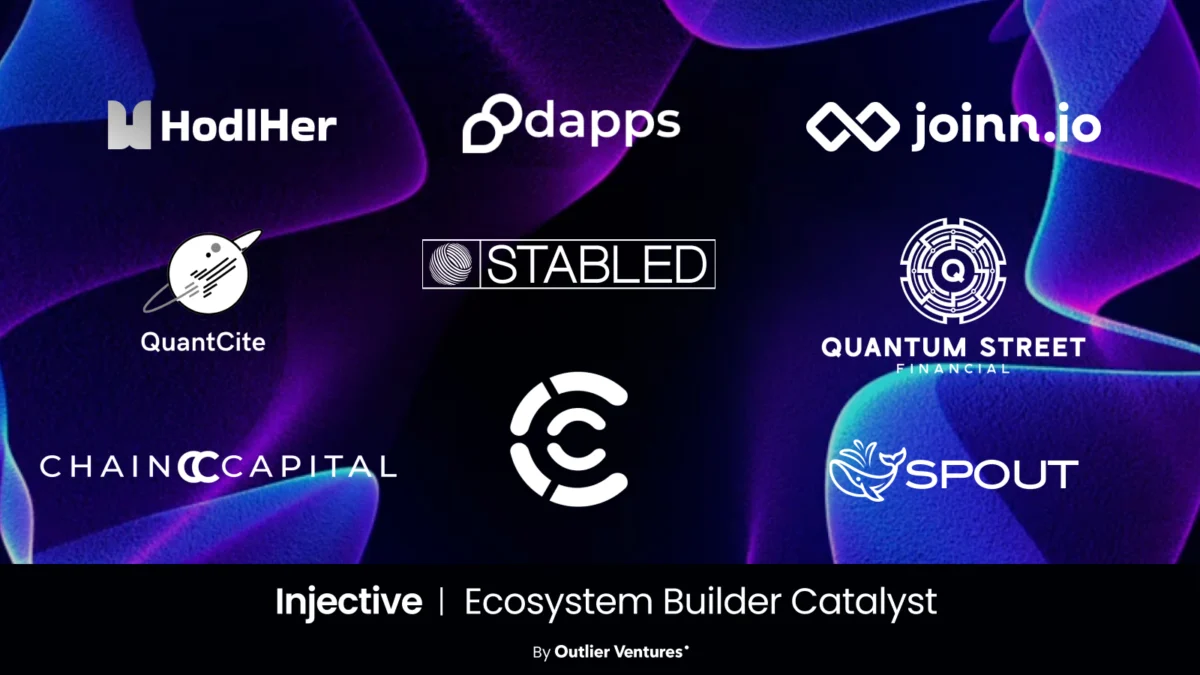
Outlier Ventures, a globally recognized Web3 accelerator and venture capital firm, has officially announced its latest collaborative initiative alongside Injective, a layer-one blockchain purpose-built for finance. The partnership marks the launch of the Injective Ecosystem Builder Catalyst, a highly selective nine-week virtual accelerator program engineered to incubate and scale the next wave of high-growth decentralized finance (DeFi) and infrastructure protocols.
The announcement arrives at a pivotal juncture for the digital asset industry. As decentralized finance matures beyond basic peer-to-peer token swaps, the broader financial ecosystem is undergoing a structural evolution. Modern decentralized applications (dApps) are increasingly demanding institutional-grade performance parameters, including sub-second transaction finality, gasless user experiences, and seamless MultiVM interoperability. By leveraging Injective’s high-performance, modular infrastructure, the newly selected cohort of startups aims to bridge the operational gap between traditional finance (TradFi) and decentralized architectures, establishing a robust foundation for the next decade of global financial markets.
Background Context and the Evolution of the Injective Ecosystem
The launch of the Ecosystem Builder Catalyst cohort is underpinned by profound macroeconomic and sector-specific shifts within the blockchain industry. Over the past several years, decentralized finance has experienced remarkable resilience and growth. Total Value Locked (TVL) across the DeFi landscape has surged toward the $140 billion threshold, reflecting renewed institutional confidence and deeper liquidity pools. Simultaneously, the tokenization of Real-World Assets (RWAs)—ranging from United States Treasury bills to private credit and corporate debt—has expanded exponentially, scaling by more than 380% since 2022.
Despite this macro expansion, developers building sophisticated financial applications have frequently encountered bottlenecks stemming from fragmented liquidity, slow execution times, and limited interoperability across disparate blockchain networks. Injective was architected specifically to resolve these systemic inefficiencies. By offering native financial primitives—such as an on-chain order book module, oracle data feeds, and cross-chain bridging capabilities—Injective provides developers with a vertically integrated environment where code, culture, and capital converge.
The partnership between Outlier Ventures and Injective is designed to capitalize on this technological edge. Outlier Ventures brings its extensive pedigree in Web3 venture acceleration, having successfully mentored hundreds of early-stage startups across tokenomics, product-market fit, and operational scaling. Meanwhile, Injective supplies the underlying high-performance layer-one environment. Together, the two entities aim to transition early-stage founders from concept validation to production-ready market deployment.
Comprehensive Breakdown of the Inaugural Cohort
The nine-week virtual accelerator has curated an elite group of startups whose solutions span institutional order routing, cross-border payments, Real-World Asset tokenization, artificial intelligence-driven Web3 operating systems, and tokenized equities. Rather than simply porting legacy Web2 financial applications onto the blockchain, the participating teams are engineering novel primitives uniquely enabled by Injective’s shared liquidity infrastructure.

QuantCite has been selected to deliver an institutional-grade Order and Execution Management (OEM) and smart-routing platform. Designed specifically for quantitative trading funds and professional market participants, QuantCite unifies execution venues across both centralized exchanges and decentralized protocols, providing high-frequency infrastructure and deep liquidity access.
Joinn addresses the financial inclusion and savings gap in emerging markets. The fintech application functions with a familiar Web2 user interface while operating entirely on secure blockchain rails. Offering gasless and signless multi-chain transactions, 24/7 account access, a companion Visa payment card, and an embedded AI agent, Joinn enables everyday users in developing regions to seamlessly access yield-generating tokenized financial assets and automate compound growth.
Choice is establishing a decentralized exchange and aggregation layer optimized specifically for the Injective network. Utilizing a sophisticated proprietary routing algorithm that taps into aggregated liquidity across all available venues, Choice guarantees optimal swap execution parameters while minimizing price slippage for traders.
Stabled tackles the friction-heavy landscape of international business payments. The platform allows enterprises to execute compliant, cross-border stablecoin transactions instantly without relying on legacy correspondent banking networks. By bypassing traditional banking hours and legacy intermediaries, Stabled significantly minimizes foreign exchange (FX) losses and eliminates settlement delays.
Quantum Street brings deep capital markets and financial engineering expertise to the on-chain economy. By structuring transactions for cash-flowing traditional businesses, Quantum Street facilitates the seamless migration of off-chain yield-generating assets onto the blockchain. This initiative injects genuine economic utility into stablecoins while systematically driving Total Value Locked (TVL) growth within the ecosystem.
Spout introduces a paradigm shift to the global equities market by enabling the decentralized borrowing and lending of U.S. public equities. Through the tokenization of equities and the implementation of a Collateralized Debt Position (CDP) model, Spout allows users to access 0% APR margin loans while concurrently earning competitive lending yields of approximately 10% APY.
Dapps.co focuses on the creator economy by deploying a Web3-native social network designed to restore financial agency to digital creators. Featuring tokenized communities and resilient on-chain economies, the platform incorporates an advanced AI provenance layer to combat low-quality synthetic media while enabling direct monetization channels through direct messaging (DMs) and audience tipping.
Chain Capital transforms traditionally illiquid private debt instruments into transparent, tradable securities. By tokenizing corporate invoices and accounts receivable, Chain Capital automates the end-to-end securitization workflow. The protocol reduces middle-office operational costs by up to 75% while providing institutional investors with compliant, frictionless access to high-yield credit exposures.
HodlHer represents the world’s first artificial intelligence-driven Web3 operating system built natively on Injective. Utilizing specialized intelligent personas, HodlHer assists individual users, creators, and protocol developers in navigating the full lifecycle of decentralized engagement, ranging from market perception and analytical reasoning to automated on-chain execution.

Chronology, Program Structure, and Support Mechanisms
The Injective Ecosystem Builder Catalyst operates on a structured nine-week curriculum. From inception to completion, the selected cohort members undergo rigorous mentorship, strategic business development workshops, legal and regulatory compliance guidance, and direct access to specialized ecosystem incentives.
The timeline of the accelerator is meticulously designed to accelerate product development and strategic positioning:
- Weeks 1–3: Deep-dive product architecture reviews, tokenomic modeling, and technical integration with Injective’s native financial modules.
- Weeks 4–6: Refinement of go-to-market strategies, regulatory alignment, and institutional partnership development.
- Weeks 7–9: Pitch preparation, mock investor panels, and preparation for the public Demo Day.
The culmination of the nine-week intensive program will be celebrated at the upcoming Injective Ecosystem Builder Catalyst Demo Day, scheduled for February 25, 2026. This flagship event will serve as a virtual stage for the cohort founders to present their refined protocols to a curated audience of leading Web3 venture capitalists, angel investors, and institutional partners. Stakeholders and industry participants can register for the event via the official Luma platform.
Fact-Based Analysis of Implications and Industry Impact
The intersection of Outlier Ventures’ institutional backing and Injective’s specialized infrastructure signals a broader maturation phase for the decentralized finance sector. Historically, blockchain accelerators have focused broadly on generalized layer-one or layer-two ecosystems. However, the success of purpose-built environments like Injective demonstrates a structural shift toward vertical integration—tailoring the base layer specifically to the high-performance demands of financial applications.
The inclusion of protocols focused on Real-World Asset tokenization, institutional-grade execution management, and international stablecoin settlements highlights the merging paths of traditional financial engineering and decentralized networks. By reducing middle-office costs by up to 75%, as demonstrated by firms like Chain Capital, and providing 0% APR equity-backed margin loans via protocols like Spout, these startups are not merely replicating legacy financial instruments; they are creating systemic efficiencies that legacy financial institutions cannot match.
Furthermore, the integration of advanced artificial intelligence layers across multiple cohort protocols—such as HodlHer and Joinn—points toward an emerging standard in Web3 UX. By abstracting complex blockchain interactions behind intelligent agentic systems and gasless transaction rails, these protocols are directly targeting the primary friction points that have historically hindered mainstream adoption.
As the nine-week accelerator progresses toward its culmination in late February 2026, the performance of the Injective Ecosystem Builder Catalyst cohort will serve as a bellwether for the scalability and institutional viability of purpose-built financial blockchains. Observers, developers, and investors alike are advised to monitor the cohort’s developments closely, as the infrastructure being deployed today will likely form the operational backbone of tomorrow’s global financial architecture.

