
The Problem with Sequential Processing
In standard inference workflows, processing data one ticket at a time is the primary source of operational waste. When an SLM, such as the Qwen2.5-0.5B-Instruct model, handles a single request, it operates in a memory-bandwidth-bound state. This means the hardware must stream the model’s entire set of weights from memory into the processor just to serve one sequence. Once the computation completes, the weights are discarded or the hardware sits idle while waiting for the next request. This cycle repeats for every single item, leaving the high-performance arithmetic units of the processor—whether it be a GPU or a specialized neural engine on a consumer CPU—largely underutilized.
This "sequential trap" persists even on hardware optimized for AI workloads, such as the M2 Macbook Air’s 16-core Neural Engine. In these scenarios, the time taken to load the model parameters into the active memory layer far exceeds the time required for the actual mathematical operations. Consequently, the system is constantly waiting on data movement rather than performing the inference logic itself.
The Evolution of SLM Optimization Strategies
This article concludes a three-part series on optimizing SLMs for narrow automation. The preceding entries established a foundational methodology for lean AI deployment:
- Constraining the Output Space: By restricting the model’s vocabulary to a specific set of valid responses (e.g., "billing," "technical," or "account"), developers can eliminate the need for full-sequence token generation, reducing the computational load of the decoding phase.
- Reusing Prompt Prefixes: Implementing a Key-Value (KV) cache allows the model to "remember" the static parts of a prompt (such as system instructions), effectively skipping redundant re-computations of the prompt prefix for every incoming request.
- Length-Sorted Batching: The final step is to optimize the data throughput by grouping similar tasks together, addressing the inefficiencies of traditional batching.
The Mechanics of Batching and the Padding Problem
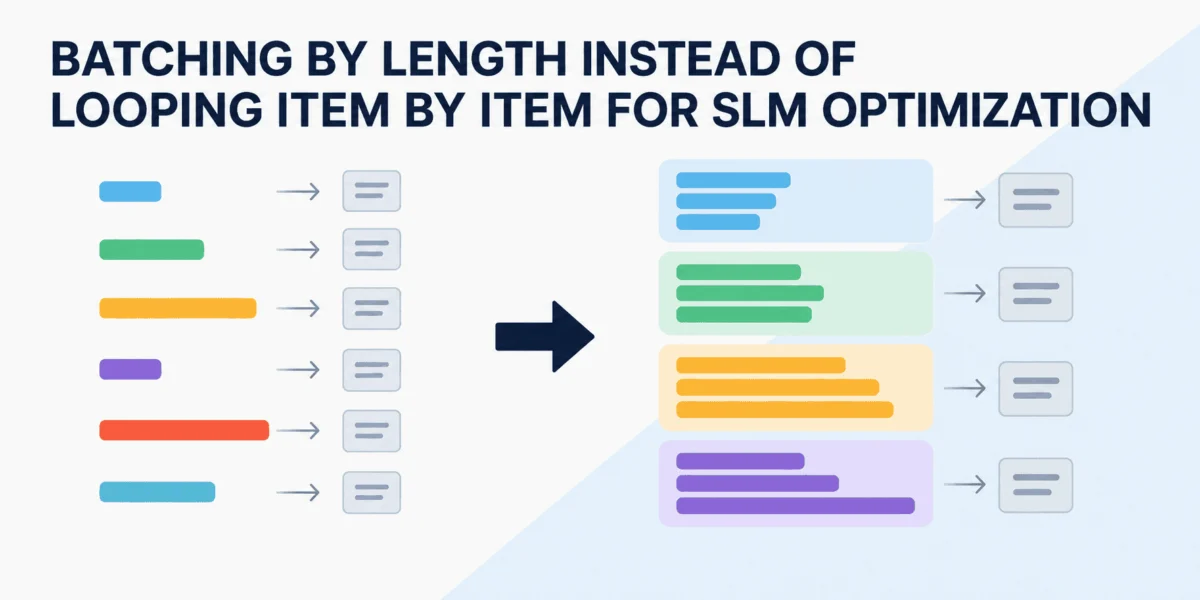
Batching is the standard industry solution to memory-bandwidth limitations. By grouping multiple sequences into a single tensor, the model weights are read from memory once, and the computational units work on several sequences simultaneously, significantly increasing throughput. However, naive batching introduces a secondary inefficiency: padding.
In most deep learning frameworks, all sequences within a single batch must share the same length. If a batch contains one very long document and nine short ones, the nine short ones must be "padded" with empty tokens to match the length of the longest item. In real-world datasets, which typically follow a "long-tail" distribution—where most items are short but a few are exceptionally long—padding every batch to the global maximum length results in a massive waste of compute cycles. A significant percentage of the work performed by the model involves processing empty tokens, effectively burning electricity and time on data that contains no information.
Methodology: Sorting for Efficiency
To mitigate this, developers should implement a sorting-by-length strategy. By ordering the entire dataset by token count before partitioning it into batches, each batch becomes internally homogeneous in length. Consequently, the padding required for each batch is limited to the length of the longest item within that specific sub-group, rather than the longest item in the entire dataset.
Performance Benchmarks
In tests using the Qwen2.5-0.5B-Instruct model, processing 600 support tickets demonstrates the stark reality of these inefficiencies.
- Sequential Loop: Processing items one by one results in a throughput of approximately 4.2 items per second, with a total execution time of 144 seconds.
- Naive Batching (Global Maximum): While faster, this approach suffers from severe padding overhead, where up to 70% of the computed tokens may be filler, depending on the distribution of input lengths.
- Sorted Batching: By sorting tickets by length, the padding overhead is reduced to roughly 7.6%. This results in a throughput of 7.5 items per second—a nearly 80% improvement in speed compared to the sequential baseline.
These benchmarks confirm that the optimization is purely mechanical; because the arithmetic logic remains identical, the accuracy of the model is preserved. If an optimization changes the output, it is fundamentally flawed; in this case, the sorted batching approach shows perfect agreement with the unbatched reference path, ensuring that performance gains do not come at the cost of model reliability.
Implementation Considerations and Challenges
While the benefits are clear, practitioners must exercise caution when integrating this with other optimizations, such as KV caching. KV caching is highly dependent on the sequence length and the specific structure of the prompt. When batching, the cache must be expanded to accommodate the batch dimension and managed carefully to ensure that "cropped" or "padded" sequences do not pollute the cache of subsequent items.
Furthermore, the sorting process itself introduces a small overhead. However, in the context of batching hundreds or thousands of items, the sorting time is negligible compared to the massive reduction in total GPU/CPU cycles required for inference. Developers are encouraged to use standard libraries like torch and transformers to handle the padding masks, ensuring that the model correctly ignores the padded tokens during the attention mechanism calculation.
Broader Implications for AI Deployment
The transition toward smaller, faster, and more efficient models represents a significant shift in the AI industry. As companies move away from monolithic models, the focus has pivoted toward "narrow automation"—the use of SLMs to perform highly specific, high-frequency tasks.
The implications of these optimizations are twofold:
- Cost Reduction: By reducing the total compute time, companies can host these models on smaller, cheaper instances, significantly lowering the total cost of ownership (TCO) for AI-driven customer service tools.
- Increased Accessibility: These optimizations enable the deployment of sophisticated AI models on edge hardware, such as local servers or even standard laptops, removing the reliance on expensive, high-latency cloud API calls.
Ultimately, these techniques reinforce the principle that efficiency is a feature. By meticulously managing how data moves through the hardware, developers can build systems that are not only more responsive but also more sustainable. As the field matures, the ability to squeeze maximum performance out of modest hardware will become a core competency for AI engineers, marking the transition from the era of "brute force" AI to an era of refined, precision-engineered language models.
Conclusion: A Disciplined Approach to Optimization
The final takeaway for developers is the necessity of verification. Every performance gain mentioned here was validated through side-by-side testing against an unoptimized baseline. Whether it is constraining output spaces, implementing KV caches, or batching by length, the goal remains the same: to deliver the same high-quality intelligence with less overhead. By applying these architectural patterns, teams can transform their SLM deployments from experimental prototypes into robust, high-throughput production services that deliver reliable results with maximum operational efficiency.

