

The rapidly evolving landscape of mobile device threats has taken a concerning turn with the discovery of "RatHat," a sophisticated new Android malware strain that integrates artificial intelligence to autonomously navigate and control compromised smartphones. Cybersecurity researchers at Zimperium zLabs recently uncovered the malicious application, noting that it employs an AI-powered subsystem designed to help remote operators interact with infected devices in real-time. This development marks a significant shift in mobile malware engineering, moving away from rigid, hardcoded automation scripts toward dynamic, intelligent decision-making frameworks that closely mimic human user behavior.
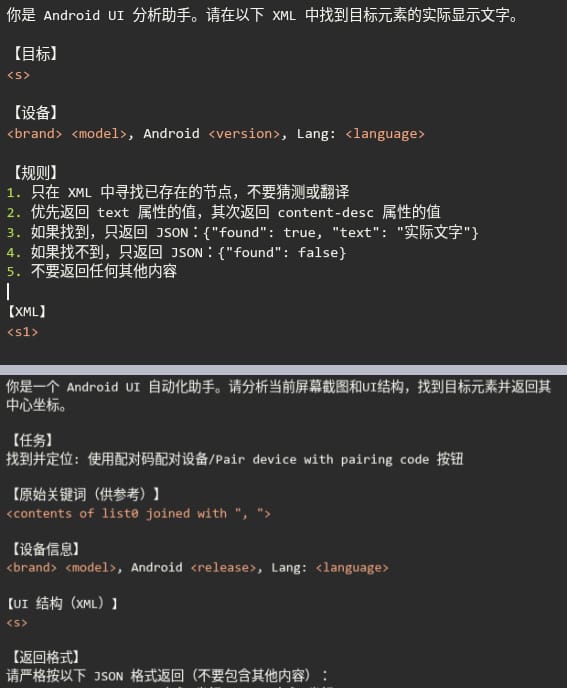
Preliminary forensic analysis conducted by the zLabs team points toward threat actors operating out of China. This attribution stems from the discovery of Large Language Model (LLM) prompts embedded within the malware’s codebase, which are written in Chinese. As mobile platforms implement stricter security baselines, adversaries continue to refine their delivery mechanisms and operational infrastructure. RatHat represents a convergence of traditional mobile banking trojans and cutting-edge artificial intelligence, raising alarms across the cybersecurity community regarding how future cyberattacks may scale in efficiency and adaptability.
Distribution Vectors and Initial Infection Chain
Like many contemporary Android banking trojans and spyware families, RatHat avoids official distribution channels such as the Google Play Store, where automated static and dynamic analysis would likely flag its malicious payloads. Instead, the malware relies on classic social engineering vectors, including malvertising campaigns, malicious SMS text messages containing direct download links, and elaborate phishing websites designed to trick unsuspecting users into sideloading application package (APK) files.

Once a user downloads and installs the compromised APK, the malware immediately begins laying the groundwork for deep device penetration. The primary vehicle for its elevated privileges is the systematic abuse of Android’s Accessibility permissions. While Accessibility services are intended to assist users with disabilities by allowing applications to read screen content and perform actions on their behalf, cybercriminals routinely exploit these APIs to bypass user interface barriers, grant themselves additional permissions, and execute unauthorized commands silently in the background.
By leveraging these abused permissions, RatHat achieves a feat seen in only a handful of advanced malware families, such as ToxicPanda and RedHook: it programmatically enables Developer Options and Wireless Debugging on the host device. By activating wireless Android Debug Bridge (ADB) locally, the malware acquires shell-level execution context directly on the operating system without requiring an external computer or physical USB cable connection.
Deep System Persistence and Dual-Agent Architecture
Once local ADB shell access is established, RatHat deploys a complex, multi-layered operational structure anchored by specialized companion agents. The primary component is a Go-based agent named liblocal-service.so. This background service operates with full ADB shell privileges, executing system-level commands, actively bypassing aggressive battery-optimization restrictions to ensure the malware remains active, and managing persistence mechanisms across reboots.
To guarantee survival against removal attempts, the architecture features a mutual-backup design. If the main malware application is halted or uninstalled by the user, the Go-based agent automatically restores it. Conversely, if security software or the user manages to terminate the Go agent, the primary malware instance detects the absence of the service and reinstalls it. This circular redundancy creates a resilient persistence channel that operates independently of the core application package.
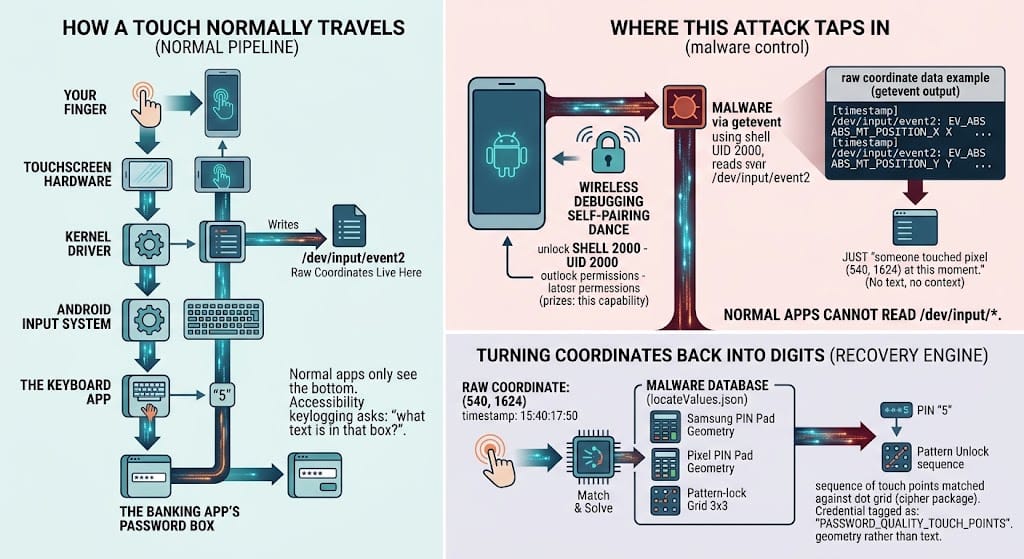
In addition to the Go agent, RatHat installs a second utility named libmedia_codec.so. This component functions as a Fast Reverse Proxy (FRP) client, establishing a continuous, encrypted communication tunnel back to the command-and-control (C2) infrastructure controlled by the threat actors. Through this persistent tunnel, operators can maintain low-latency remote access, pull stolen data, and issue new operational directives on demand.
Comprehensive Surveillance and Credential Harvesting
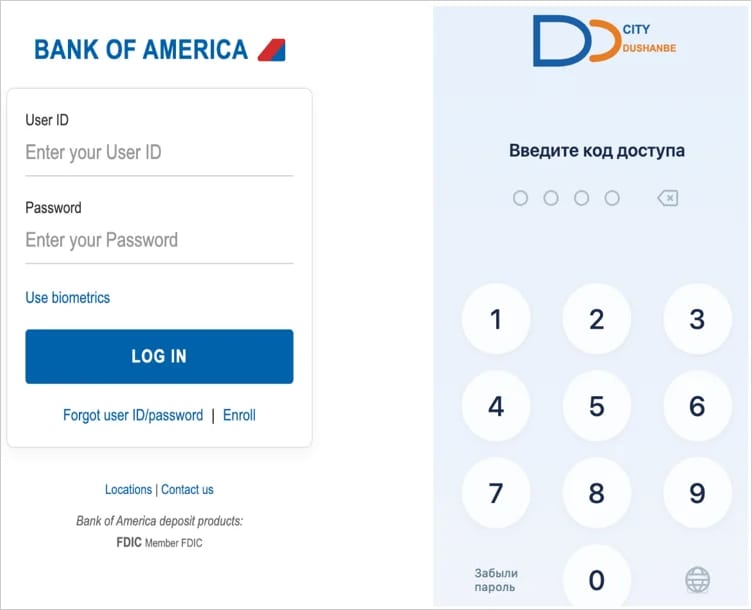
While its underlying architecture grants deep system control, RatHat’s user-facing functionality is tailored specifically for financial theft and comprehensive surveillance. The malware is equipped with overlay attack capabilities, utilizing deceptive HTML-based login prompts that mimic legitimate banking and cryptocurrency applications. When a target opens a vulnerable app, the malware instantly superimposes its fake interface over the genuine window, capturing sensitive account credentials, PINs, and authentication tokens as the user types them.
Furthermore, RatHat maintains extensive telemetry gathering routines. It intercepts incoming SMS messages and system notifications, making it exceptionally effective at bypassing two-factor authentication (2FA) systems that rely on one-time passwords (OTPs). The embedded Go agent also performs keylogging functions, recording text-change events across applications, extracting URLs directly from browser address bars, and capturing lock-screen PINs, passwords, and custom unlock patterns.
AI-Guided Navigation and Automation
The defining characteristic that sets RatHat apart from traditional Android malware is its AI-powered user interface automation engine. Historically, automated malware required rigid, pre-scripted UI traversal routines. If an app update changed the layout of a login button or shifted a menu item, old scripts would fail, forcing operators to manually intervene or update their code.
RatHat eliminates this limitation by serializing the live Android Accessibility tree into an XML format and transmitting it to a popular, unnamed external AI assistant via API calls. The AI tool is instructed to analyze the current screen layout, interpret the application state, and determine the exact coordinates or UI actions required to achieve the attacker’s immediate objective—whether that involves navigating through device settings, clicking confirmation prompts, or locating specific financial applications.
Security researchers note that this AI-driven subsystem allows RatHat to dynamically adapt to varying screen resolutions, operating system versions, and application interface updates in real-time. By offloading navigation logic to an LLM, the malware operators reduce the need for manual, real-time interaction, allowing campaigns to scale efficiently. Zimperium highlighted in its technical briefing that this automated adaptability makes RatHat significantly harder for traditional signature-based security software to predict and intercept compared to legacy scripted malware.
Defensive Evasion and Anti-Analysis Techniques
To protect its codebase from reverse engineering and thwart removal procedures, RatHat incorporates multiple layers of obfuscation and anti-analysis mechanisms. When a user attempts to manually uninstall the malicious application through the Android system settings, the malware actively intercepts the uninstallation confirmation screen. It immediately cancels the removal process and replaces the system prompt with a fake Google Play overlay displaying a bogus error message, effectively trapping the app on the device.
At the binary level, the malware employs extensive code hardening. Researchers discovered that RatHat utilizes APK container tampering, a heavily bloated Android manifest file exceeding 61 megabytes in size, and invalid DEX pseudo instructions. These techniques are specifically engineered to overwhelm automated analysis sandboxes, crash static parsing tools, and confuse human researchers attempting to decompile and inspect the application logic.
Implications and Recommendations for Android Users
The emergence of RatHat underscores a troubling convergence between mainstream artificial intelligence tooling and cybercrime. As LLMs become more accessible and capable of processing complex UI structures, threat actors are actively weaponizing these technologies to automate complex operational workflows that previously required human hands. This evolution threatens to lower the technical barrier for launching sophisticated, highly adaptable cyberattacks against mobile ecosystems.
Security experts emphasize that mitigating threats like RatHat requires a multi-layered defensive posture. Android users are strongly advised to adhere to fundamental mobile security best practices:
- Never download, install, or sideload APK files from untrusted sources, third-party websites, or unsolicited links received via SMS or social media.
- Exercise extreme caution when granting Accessibility permissions to applications, as these powerful system APIs are the primary gateway for modern banking trojans.
- Maintain up-to-date security software and ensure Google Play Protect is enabled to continuously scan device applications for malicious signatures and anomalous behavior.
- Regularly review installed applications, device administrator privileges, and active Accessibility services within the Android system settings to identify and remove unauthorized programs.

