

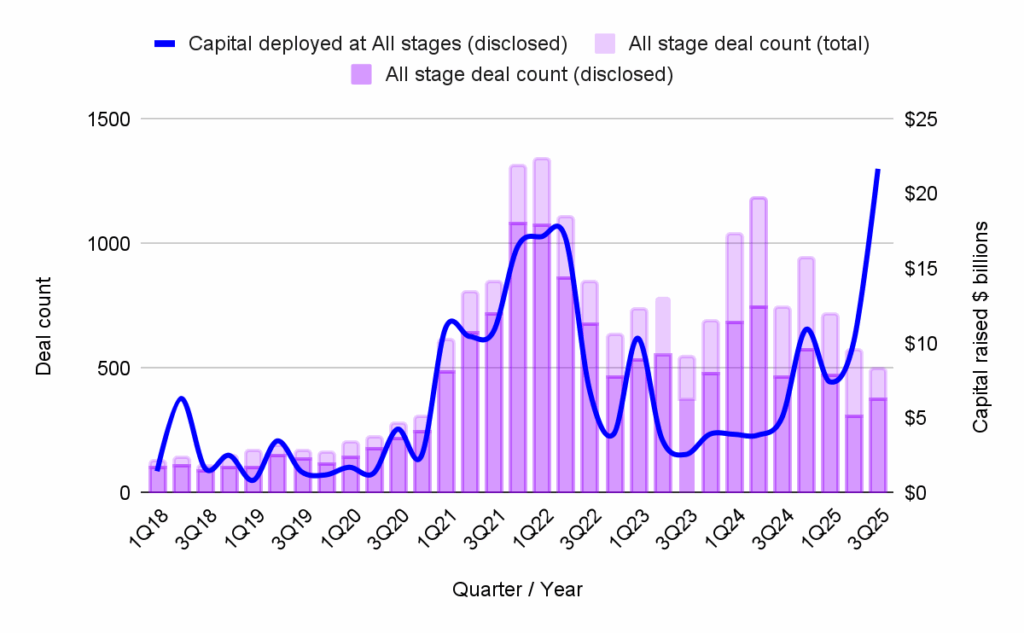
Global Web3 venture capital deployment experienced a dramatic resurgence during the third quarter of 2025, reaching a cycle high of nearly $22 billion deployed across 376 disclosed deals. According to comprehensive market data compiled by Outlier Ventures and Messari, total capital committed to the sector more than doubled compared to the previous quarter, surging by 113 percent from $10.2 billion in the second quarter of 2025 to $21.7 billion in the third.

Despite this massive influx of liquidity, the total number of disclosed deals saw a modest increase of only 22 percent, moving from 309 to 376 transactions. This fundamental divergence between capital velocity and deal count underscores a core market characteristic: the third quarter was defined overwhelmingly by larger cheque sizes and institutional concentration rather than a broad-based surge in early-stage venture activity. The capital raised eclipsed even the peak valuations of the 2021 and 2022 bull runs, yet market participation remained highly selective, heavily favoring mature infrastructure and compliant financial rails.
Evolution of Institutional Architecture and Market Chronology
The record-breaking performance of the third quarter of 2025 did not occur in a vacuum; it represents the culmination of a multi-year institutional maturation process. Throughout the first half of 2025, market observers noted a distinct philosophy of conviction over coverage, where venture capitalists and traditional financial institutions prioritized proven infrastructure over speculative consumer experiments.
As the third quarter unfolded, several critical financial products transitioned from experimental frameworks to fully operational production environments. Ethereum-focused exchange-traded funds emerged as a primary catalyst, pulling in approximately $8.7 billion during the quarter and surpassing Bitcoin-focused funds. Assets under management for Ethereum ETFs surged by roughly 170 percent quarter-on-quarter, reaching $27.4 billion. Concurrently, Digital Asset Treasuries captured an estimated 3.8 percent of the circulating Ethereum supply, signaling a structural evolution in corporate treasury management.
Traditional financial institutions aggressively integrated blockchain-based settlement rails into their daily operations. Major institutions moved tokenization pilots into live production, exemplified by JPMorgan launching its Kinexys network for tokenized repurchase agreement settlements. Simultaneously, SWIFT expanded its tokenization trials in collaboration with global custodians including BNY Mellon, Citi, Clearstream, Euroclear, and Northern Trust to test cross-network settlement of bonds and fund shares on-chain. Visa Direct also commenced processing cross-border payments utilizing USDC, reinforcing the operational depth that drew institutional capital toward later-stage Web3 projects.
Regulatory Clarity and Policy Catalysts
Regulatory developments throughout 2025 provided the legal certainty required for large-scale institutional deployment. Market analyses from DBS Bank highlighted that 2025 marked a definitive transition from regulatory consultation to direct execution. Legislative milestones, including the proposed GENIUS Act and various official international recommendations, served as primary catalysts for stablecoin adoption and real-world asset tokenization within traditional banking and payment sectors.
These policy shifts significantly lowered compliance barriers for institutional allocators. However, institutional mandates inherently dictate capital concentration. Large financial institutions operating under strict governance frameworks and short delivery horizons find deploying numerous small cheques into early-stage ventures operationally inefficient. Consequently, venture funding skewed heavily toward infrastructure projects that could seamlessly integrate with traditional financial compliance frameworks.
To bridge the gap between risk-averse institutional capital and early-stage innovation, market participants increasingly turned to hybrid investment structures. Collaborations such as Outlier Ventures’ partnership with Morgan Creek demonstrated how traditional asset managers can gain structured exposure to early-stage Web3 ventures while leveraging specialized due diligence and portfolio support infrastructure to mitigate risk.
Venture Fund Formation and Secondary Market Dynamics
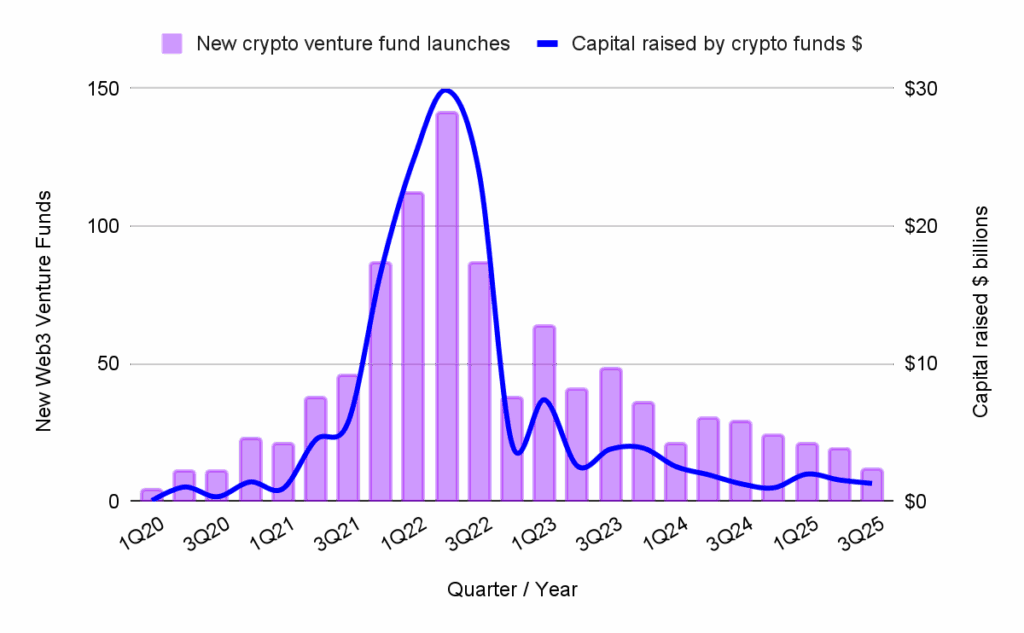
While capital deployment reached historic highs, the creation of new crypto-focused venture funds remained notably subdued. Only 11 new crypto venture funds were launched globally in the third quarter of 2025, raising a combined total of $1.3 billion. This figure continues a downward trajectory observed throughout the year, mirroring the cautious fundraising environment of mid-2020.
General partners increasingly relied on remaining dry powder within existing vehicles rather than raising fresh mandates, while limited partners maintained a highly selective approach. Industry reports characterized the period as a recycling phase, wherein capital circulated primarily through secondary market trades and exits rather than fueling new venture creation.
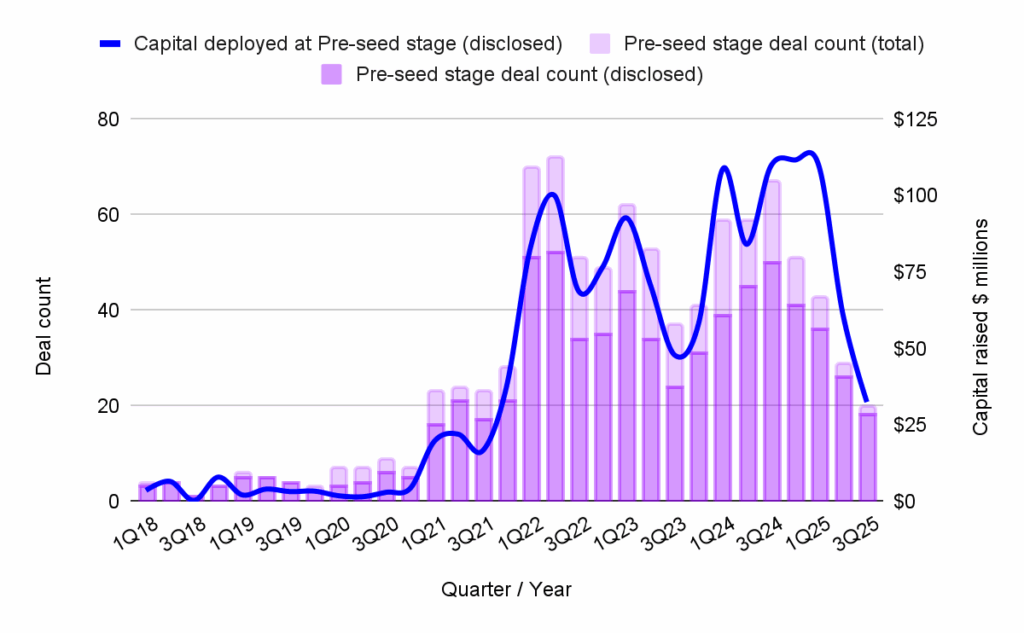
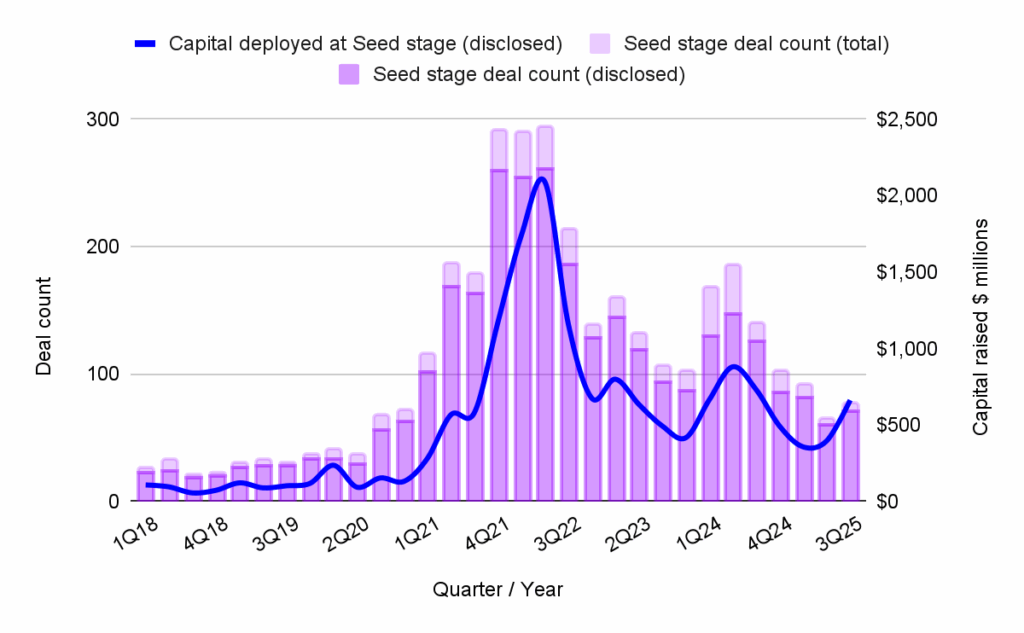
This macroeconomic caution was further reflected in early-stage deal distribution. Pre-seed funding dropped to a multi-year low, recording only 18 disclosed rounds totaling $32.5 million, with the 12-month running median slipping below $2.5 million. Conversely, seed-stage fundraising reached $663 million across 71 disclosed rounds, though these figures were heavily skewed by outlier transactions such as Flying Tulip’s $200 million raise. Flying Tulip’s unconventional financing structure—granting investors on-chain redemption rights and yield-bearing capital without sacrificing upside—exemplified a growing investor preference for liquid, capital-efficient instruments over traditional illiquid agreements.
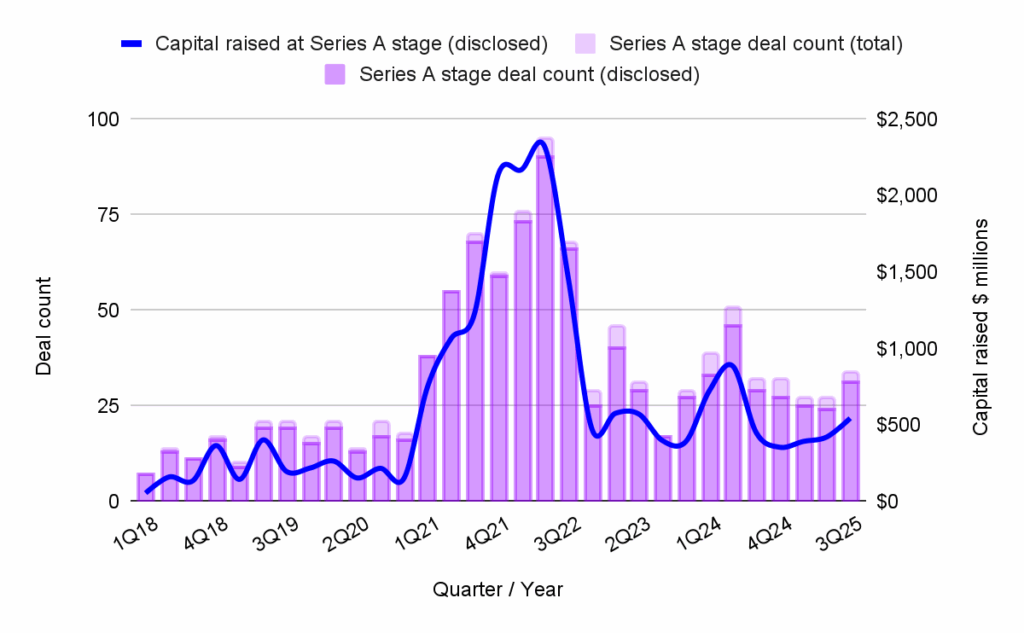
Series A fundraising demonstrated relative stability, logging 31 disclosed rounds totaling approximately $545 million, with a steady 12-month running median of around $16 million. Analysts noted that Series A capital remained accessible primarily to teams demonstrating clear alignment with institutional rails, such as payments, data analytics, and tokenization services.
Category Concentration and Token Fundraising Shifts
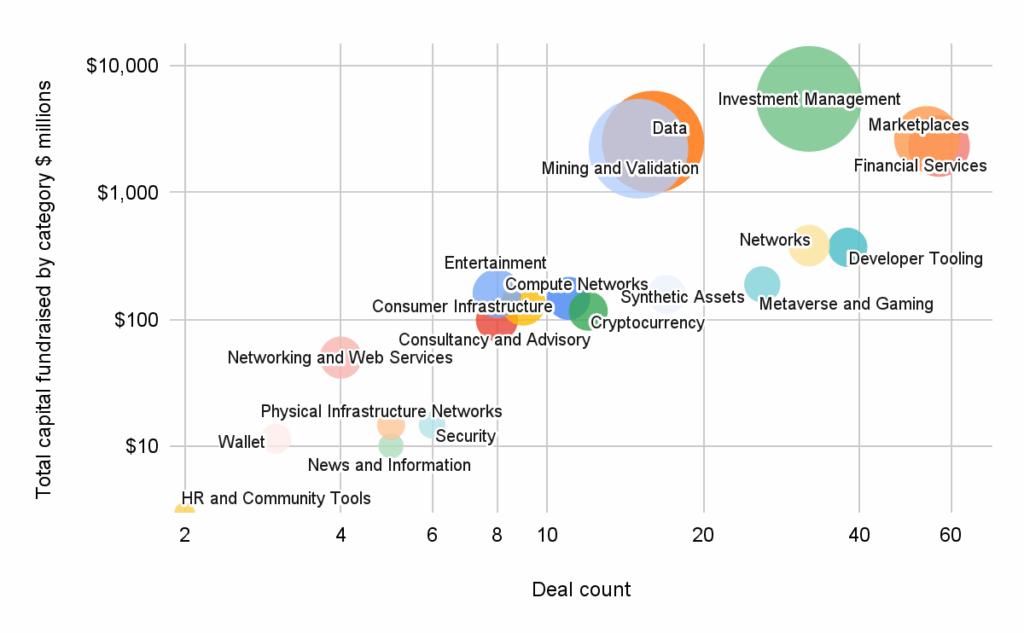
Capital composition across all stages in the third quarter was unmistakably institutional. Investment management, marketplaces, data infrastructure, financial services, and mining and validation together absorbed roughly 70 percent of all deployed capital. These specific sectors directly support issuance, custody, settlement, and blockspace supply, benefiting directly from ETF inflows and enterprise tokenization programs.
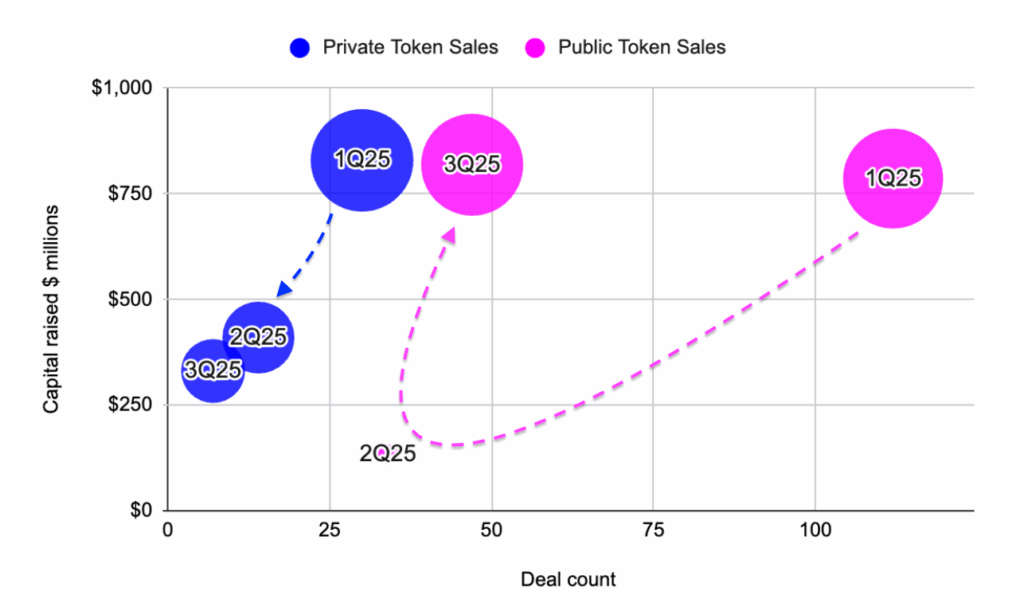
Concurrently, token fundraising experienced a notable shift back toward public distribution models. Public token sales climbed to 47 events totaling $819 million, while private token sales contracted to just 7 events totaling $331 million. Improved market depth, rising capitalization, and receding regulatory uncertainty emboldened project teams to utilize public token sales for transparent price discovery and community alignment. Industry research indicated that initial public offerings and public listings increasingly functioned as regulatory-compliance certification marks, granting firms legitimacy in the eyes of institutional investors.
Implications and Outlook for Upcoming Quarters
The third quarter of 2025 firmly established that the convergence of cryptocurrency and traditional finance is no longer a speculative hypothesis but an operational reality. While mainstream adoption has predominantly manifested at the infrastructure layer rather than the consumer-facing layer, this quiet integration ensures that blockchain technology is sustainably embedding itself into global financial systems.
As the market transitions into the final quarter of 2025 and looks toward 2026, the primary challenge for founders will be engineering products with undeniable utility, regulatory compliance, and proven market traction to successfully navigate a highly selective funding environment. For venture capitalists and institutional allocators, the critical test will involve designing sustainable investment frameworks that can successfully revive the early-stage funnel and support the next generation of decentralized innovation.

