
Over the past twelve months, enterprise security operations centers (SOCs) have witnessed the emergence of a new, rapidly expanding category of telemetry: alerts triggered by the integration of artificial intelligence tools and autonomous agents into the corporate workflow. This phenomenon is not characterized by malicious actors weaponizing AI to breach systems, but rather by the ordinary, everyday operational footprint of an organization actively deploying AI. From developers utilizing sophisticated coding agents to non-technical staff connecting consumer-grade AI platforms to corporate accounts, the volume of AI-related security alerts is growing at an unprecedented rate.
According to a comprehensive review of AI-related activity across numerous enterprise environments conducted by security researchers at Intezer, these alerts currently represent a small but rapidly scaling fraction of the total security stream. While AI-related alerts account for only 0.43% of all SOC activity today, the trajectory is vertical. Between February and June 2026, the volume of these alerts surged by 685%. This indicates that while AI is currently a minor component of the alert stream, it is simultaneously the fastest-growing source of noise and potential risk for security teams.

The Anatomy of the New Alert Stream
The surge in AI-related alerts is driven by two distinct, concurrent behaviors within the modern enterprise. The first is technical: developers are increasingly relying on coding agents capable of spawning shells, querying credential stores, establishing network tunnels, and downloading software packages. To a traditional detection engine, these actions are indistinguishable from the reconnaissance and lateral movement phases of a sophisticated cyberattack. This activity is inherently "loud," dominating the volume of incoming security alerts.
The second behavior is quieter but arguably more hazardous: the proliferation of shadow AI. This involves employees granting OAuth permissions to third-party AI applications, sharing proprietary information, or pasting sensitive documents into generative AI interfaces. Unlike the technical activity of coding agents, these actions rarely trigger endpoint detection systems, yet they represent a significant avenue for data exfiltration and intellectual property loss.
For the SOC, both categories present a significant diagnostic burden. When an alert arrives, the primary challenge is not necessarily volume, but the effort required to discern signal from noise. The data suggests that security teams must shift their triage philosophy, as legacy detection rules are increasingly ill-equipped to handle the nuances of AI agent behavior.

Statistical Breakdown: Noise Versus Risk
A granular analysis of approximately 16.9 million SOC alerts reveals a stark reality regarding the composition of AI-related activity. Of these, roughly 73,000 alerts were classified as AI-related. When these 73,000 instances were subjected to forensic scrutiny, they were categorized into three buckets: real attacks, genuine security risks, and operational noise.
The findings are striking:
- Noise (94.1%): The vast majority of alerts are false positives—legitimate, authorized AI activity that triggers legacy detections designed for human-driven threats.
- Security Risks (5.8%): These represent instances where an AI agent, while not necessarily part of a malicious compromise, is operating in a way that exposes the organization to unnecessary danger, such as running with permission-bypass flags enabled.
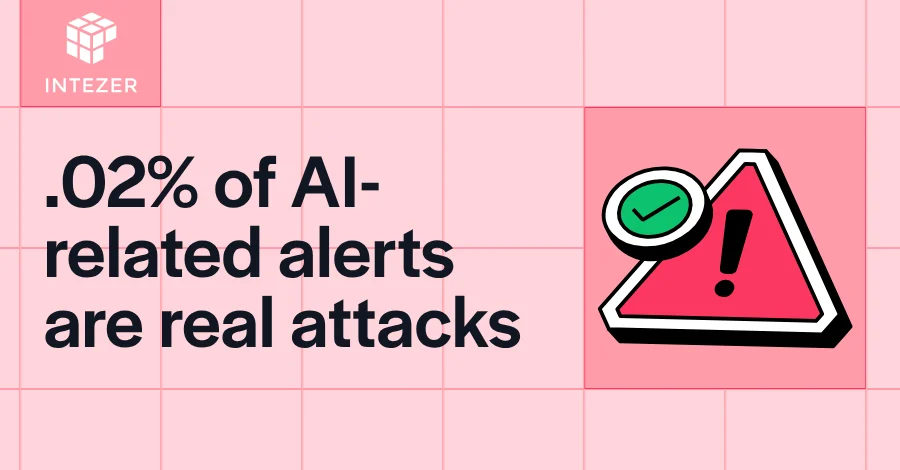
- Real Attacks (0.02%): Confirmed, malicious compromises or attacker operations riding on AI adoption represent an infinitesimal fraction of the total volume.
This lopsided distribution carries significant operational consequences. A SOC that treats every AI-generated alert as a high-severity threat will inevitably face burnout and resource exhaustion, ultimately burying genuine exposures under a mountain of false positives.

The Illusion of Severity: A Case Study
The danger of relying on automated severity scores for AI activity is best illustrated by recent incidents involving legitimate software. In one notable example, a single detection pattern accounted for 55% of all "critical" alerts at a specific client organization. The alert identified the Windows binary Expand.exe as a lateral-tool-transfer, a common indicator of an ongoing intrusion. However, upon manual investigation, the activity was revealed to be a developer’s coding agent simply setting up a shell environment.
This highlights a critical failure point in modern security operations: severity labels are often disconnected from context. When an agent acts on behalf of a user, it inherits the user’s credentials and permissions. Consequently, when an AI agent performs routine tasks, it creates an audit trail that mimics the behavior of an unauthorized intruder. Security teams are increasingly finding that the "what" (the action) is no longer a sufficient indicator of intent; the "who" or "what" behind the keyboard has become the most important variable in the triage process.
Real-World Threats: AI as an Attack Vector
While the percentage of "real attacks" is statistically small, the threat is not non-existent. Notably, these attacks do not necessarily involve hacking an AI model; rather, they weaponize the ubiquity of AI tools. Attackers have launched sophisticated phishing campaigns that utilize the branding of major AI platforms to gain user trust. Because employees now routinely receive notifications from these tools, they are far more likely to click malicious links or provide credentials when presented with an AI-themed lure.

Furthermore, investigators must remain vigilant for cases where an AI agent is compromised. While most alerts titled "AI agent running Mimikatz" or "reverse shell from coding tool" have historically been resolved as legitimate work or false positives, the theoretical risk remains. If an attacker gains control of a developer’s workstation, they can leverage the agent’s pre-approved access to conduct malicious operations, effectively hiding their activity behind the agent’s standard operational noise.
Unsafe Use and the Permission-Bypass Risk
The 5.8% of alerts classified as "security risks" represent the most significant area for proactive policy intervention. The most prominent risk factor identified is the use of "permission-bypass" flags—settings that allow an AI agent to execute commands without user confirmation.
While these flags are intended to streamline developer productivity, they effectively remove the "human in the loop" safeguard. If the agent is instructed to run a command that is inherently dangerous, or if the code it is asked to execute contains a vulnerability, there is no mechanism to stop the action before it occurs. Research shows that these specific configurations are the largest source of legitimate, yet unsafe, security events. Consequently, organizations are being urged to implement "harnesses"—programmatic restrictions that prevent agents from accessing sensitive directories or executing high-risk binaries, regardless of the user’s configuration.

Recommendations for SOC Modernization
To navigate the rising tide of AI-generated alerts, security teams should adopt a multi-pronged strategy:
- Tune Legacy Detections: The immediate priority is to suppress or refine legacy detection rules that frequently trigger on benign AI behavior. This is essential to prevent "alert fatigue" and ensure that genuine threats remain visible.
- Establish Clear Usage Policies: Organizations must define strict boundaries for what information can be shared with third-party AI platforms. This includes auditing OAuth grants and ensuring that AI tools are not permitted to access sensitive internal repositories without appropriate oversight.
- Implement Isolation Layers: To separate the user’s context from the agent’s, security teams should mandate that AI tools run within isolated environments, such as Docker containers or dedicated virtual machines. This limits the "blast radius" of an agent and makes it significantly easier for security tools to distinguish between a user’s manual actions and an agent’s automated processes.
- Adopt Proactive Threat Hunting: Rather than waiting for alerts to hit the dashboard, teams should proactively hunt for unauthorized tunnels, excessive OAuth permissions, and permission-bypass configurations.
Implications for the Future of Security Operations
The transition of the SOC into an era defined by AI adoption is inevitable. The operational reality is that the volume of these alerts will continue to scale as AI becomes more deeply embedded in software development and administrative tasks. The data provided by firms like Intezer serves as a warning: the current methodology of reactive, alert-based triage is approaching its limit.
The fundamental challenge for the security industry is to move away from binary "attack vs. no-attack" thinking. Instead, the future of security operations lies in understanding the context of agent behavior and building automated systems that can differentiate between a productive developer using a tool and a compromised agent acting on behalf of an adversary. Those organizations that fail to adapt their detection engines and triage workflows will find their resources consumed by the sheer volume of AI-related noise, leaving their most critical assets vulnerable to the quiet, subtle threats that hide within the data.

In conclusion, while the threat of "AI-enabled breaches" is often exaggerated in popular discourse, the reality of "AI-induced noise" is a clear and present danger to operational efficiency. By acknowledging the shifting landscape and adjusting security posture accordingly, enterprises can ensure that the adoption of AI remains a driver of productivity rather than a catalyst for security oversight. The goal is not to stop the use of AI, but to govern it with the same rigor applied to any other critical component of the corporate technology stack.

