
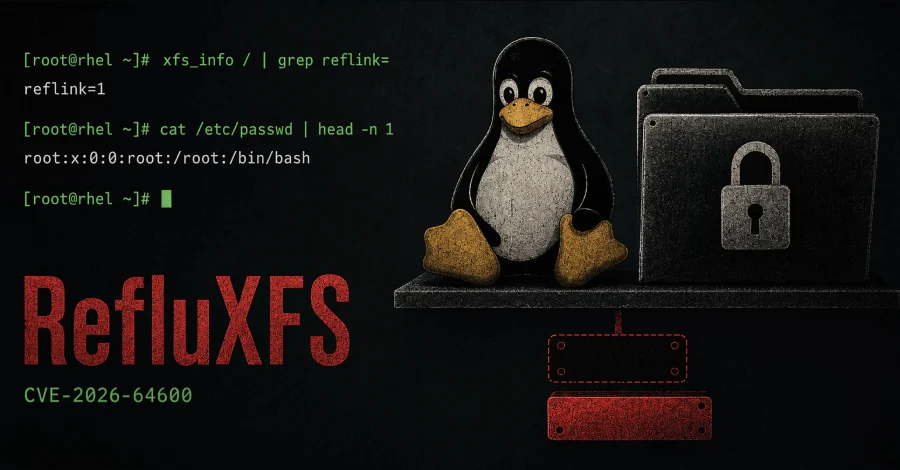
A newly unveiled critical vulnerability within the Linux kernel, dubbed RefluXFS and tracked as CVE-2026-64600, has sent ripples through the cybersecurity community, enabling an unprivileged local user to achieve persistent root access by overwriting root-owned files on XFS filesystems. Disclosed on July 22, this flaw exploits a race condition tied to the XFS reflink feature, a mechanism designed to optimize storage by allowing multiple file references to share the same underlying data blocks. Security research firm Qualys, responsible for the discovery and coordinated disclosure, has highlighted that default installations of several major Linux distributions, including Red Hat Enterprise Linux (RHEL) and its derivatives, Fedora Server, and Amazon Linux, are particularly susceptible to exploitation, underscoring the urgency for system administrators to apply patches and reboot affected systems.
Unpacking RefluXFS: The Mechanics of a Block-Layer Overwrite
At its core, RefluXFS represents a local privilege escalation (LPE) vulnerability that leverages a sophisticated race condition to bypass fundamental security controls. Qualys researchers demonstrated how an attacker can target critical system files, such as /etc/passwd or setuid-root binaries, to achieve their malicious objectives. The most alarming aspect of this vulnerability is its persistence: the overwrite occurs at the block layer of the filesystem, meaning it survives system reboots. Crucially, the target file’s ownership, permissions, timestamps, and setuid bit remain unaltered, ensuring that a modified setuid-root binary continues to execute with root privileges, effectively granting an attacker a backdoor that is both stealthy and resilient.
The vulnerability’s technical underpinning lies in a "stale mapping" error within the XFS copy-on-write (CoW) mechanism, specifically when handling reflink operations and concurrent O_DIRECT writes. Reflinks, introduced to XFS in Linux kernel 4.9, allow for efficient data sharing by creating new files that initially point to the same data blocks as an existing file. When a modification occurs, the CoW mechanism ensures that a new, distinct copy of the modified block is created, preserving the original file’s integrity while allowing the new file to diverge.
An attacker exploits this by first cloning a root-owned file into a scratch file using the FICLONE ioctl, which only requires read access to the source. This initial step causes both the original and the cloned file to reference the same physical disk blocks. The race condition then emerges when concurrent O_DIRECT writes are performed against the cloned file. The kernel, in its handling of xfs_reflink_fill_cow_hole(), reads the data-fork mapping under an inode lock. However, this lock is momentarily cycled to reserve transaction space. During this critical window, a second, precisely timed writer can complete its copy-on-write operation, causing the cloned file to be remapped to a new, distinct block. When the first writer reacquires the lock, it refreshes the copy-on-write fork but erroneously continues to use the old data-fork mapping.

This "stale address" now points directly to a block still owned exclusively by the original, protected root-owned file. XFS, mistakenly perceiving this block as unshared, permits the direct write operation to proceed. Consequently, data intended for the attacker’s disposable clone is inadvertently written into the target root-owned file. Because this bypasses the target inode entirely, none of the file’s metadata—ownership, permissions, or timestamps—are updated, and Qualys researchers confirmed that their tests produced no kernel warnings or log entries, making detection significantly more challenging. The upstream patch, merged on July 16, plainly states the issue: "the mappings are stale as soon as we reacquire the ILOCK." The fix involves snapshotting ip->i_df.if_seq before the lock is dropped and re-reading the data fork with xfs_bmapi_read() if the counter has changed, ensuring the mapping is current.
A Long-Standing Flaw: Tracing RefluXFS Back to 2017
The fix for CVE-2026-64600 was integrated into the Linux kernel on July 16, preceding its public disclosure by less than a week. Intriguingly, the patch itself traces the bug’s origin back to Linux kernel version 4.11, released in 2017. A Fixes: tag referencing commit 3c68d44a2b49 and a stable backport request marked # v4.11 indicate that this subtle race condition has been present in the kernel for approximately nine years. This discovery adds RefluXFS to a growing list of long-dormant kernel vulnerabilities that security researchers have unearthed in recent years, highlighting the deep complexity of operating system kernels and the ongoing challenge of identifying such elusive flaws.
The journey of RefluXFS from obscurity to public disclosure also features a remarkable aspect of modern cybersecurity research: the involvement of artificial intelligence. Qualys revealed that the vulnerability was discovered with the assistance of Anthropic’s restricted-access frontier model, Claude Mythos Preview. Researchers, seeking to validate the AI’s capabilities, reportedly "asked it to find a vulnerability similar to Dirty COW." Dirty COW (CVE-2016-5195), a notorious Linux kernel vulnerability discovered in 2016, also exploited a race condition in the kernel’s copy-on-write mechanism to achieve local privilege escalation. The AI model successfully located the RefluXFS race, proceeded to write a functional root exploit, and even drafted the initial advisory. Qualys researchers then meticulously reproduced the exploit on a stock Fedora Server 44 installation, verified the model’s reasoning, and coordinated the disclosure with upstream maintainers. This marks a significant milestone in the application of AI for vulnerability research, suggesting a future where AI-powered tools become increasingly integral to identifying complex, deep-seated flaws in critical software.
Exposure Landscape: Who is Affected?
Exploitation of RefluXFS hinges on three primary conditions, as outlined by Qualys:

- Local User Access: An unprivileged local user must be able to execute arbitrary code on the system. This could be through a shell, a Continuous Integration (CI) job, or a compromised service.
- XFS Filesystem with Reflink Enabled: The target filesystem must be XFS with the reflink feature enabled.
- Writable Directory Sharing Filesystem with Protected File: An attacker-writable directory must exist on the same XFS filesystem as a root-owned file targeted for overwrite.
Qualys’s advisory explicitly identifies several default installations that commonly meet these conditions. This includes Red Hat Enterprise Linux (RHEL), CentOS Stream, Oracle Linux, Rocky Linux, AlmaLinux, and CloudLinux versions 8, 9, and 10. Fedora Server versions 31 and later are also exposed, as are Amazon Linux 2023 and Amazon Linux 2 images from December 2022 onwards. It is important to note that RHEL 7 filesystems are generally not affected because they predate XFS reflink support.
Distributions like Debian, Ubuntu, SUSE Linux Enterprise Server (SLES), and openSUSE are typically less exposed by default, as they do not commonly use XFS for their root filesystems. However, these systems become vulnerable if an administrator specifically chose XFS with reflink enabled during installation for the root filesystem or any other mounted XFS volume that meets the criteria.
System administrators can easily verify if their XFS filesystems have reflink enabled by executing the command:
xfs_info / | grep reflink=
A result of reflink=1 confirms that the second condition for exploitation is met for the root filesystem. This check should be extended to any other mounted XFS volume where a protected file and an attacker-writable directory might coexist.
Vendor Responses and Patching Chronology
The coordinated disclosure process ensured that major Linux distribution vendors were informed of the vulnerability before the public announcement, allowing them to prepare and release patches. Red Hat, a primary maintainer of XFS and a significantly affected vendor, issued "Important"-rated kernel advisories across its RHEL 8, 9, and 10 streams. The errata began rolling out as early as July 14, eight days prior to the public disclosure. Specific advisories include RHSA-2026:39179 and RHSA-2026:39180 for RHEL 8, and RHSA-2026:39494 for RHEL 10, with extended-support and SAP streams receiving updates through July 17. This proactive release schedule means that organizations that applied these errata on time were protected before RefluXFS was publicly named. Administrators are advised to confirm that an advisory exists for their precise RHEL release and to verify patch dates to ascertain their exposure status. Red Hat’s bug tracker initially filed the flaw under the title "kernel: XFS data corruption using reflink," indicating an early understanding of the issue’s potential impact on data integrity.
Other distributions are also in various stages of patching. As of July 23, Debian’s security tracker listed the fix for trixie-security as kernel 6.12.96-1 and for unstable as 7.1.4-1. However, trixie’s base kernel 6.12.94-1 and forky’s 7.1.3-1 were still marked as vulnerable, as were older stable releases like bookworm and bullseye, including their respective security branches. This highlights a staggered rollout, where some users may still be vulnerable depending on their distribution, version, and update cadence.

Mitigation Challenges and Broader Implications
The nature of RefluXFS presents significant mitigation challenges. Qualys explicitly states that no practical temporary configuration change or mount option exists to disable XFS reflinks after a filesystem has been created. Furthermore, traditional security mechanisms often lauded for their ability to contain local exploits proved ineffective against RefluXFS in Qualys’s testing. SELinux in Enforcing mode, seccomp, kernel lockdown, and container boundaries all failed to prevent successful exploitation. This is attributed to the fact that RefluXFS is a block-layer write operation, not a memory corruption vulnerability, meaning memory protections like Kernel Address Space Layout Randomization (KASLR) and Supervisor Mode Execution Prevention (SMEP) do not apply.
One apparent limitation initially considered was that the race only fires if the target block starts unshared. This implies that a file an administrator had already reflink-copied might be immune. However, the advisory quickly dismisses this as a meaningful protection, noting that an unprivileged user can reset this condition by running a command like chsh. More importantly, critical setuid-root binaries are highly unlikely to have been reflinked in the first place, leaving them squarely in the crosshairs of this vulnerability.
The discovery of RefluXFS, following closely on the heels of other recent Qualys findings—such as a snap-confine flaw in Ubuntu Desktop (CVE-2026-8933) and a nine-year-old bug in the kernel’s ptrace checks—underscores a persistent trend. Aged kernel bugs, often subtle race conditions or logical flaws, continue to surface, demonstrating the immense complexity of maintaining a robust and secure operating system kernel. The fact that an AI model played a pivotal role in this discovery suggests a transformative shift in vulnerability research. While human expertise remains critical for verification and coordination, AI’s ability to sift through vast codebases and identify patterns indicative of vulnerabilities could accelerate the discovery of similar long-standing flaws.
While Qualys did not publish standalone exploit code, Red Hat’s bug tracker noted the availability of a public proof-of-concept on July 22, contained within the advisory posted to the oss-security mailing list. This document fully details the race condition and exploitation steps, making it accessible to those with sufficient technical understanding. At the time of writing, none of the tracking vendors had reported active exploitation of RefluXFS in the wild, providing a critical window for organizations to apply necessary updates.
The immediate call to action for all affected Linux users and administrators is clear: patch, then reboot. Installing the updated kernel package is a crucial first step, but it is insufficient on its own, as the running system will continue to use the vulnerable kernel in memory. A full system reboot is imperative to load the fixed kernel and ensure protection against RefluXFS. Failure to do so leaves systems exposed to a highly potent and persistent local privilege escalation attack that could severely compromise system integrity and data security. The ongoing vigilance and prompt action of the open-source community, security researchers, and distribution vendors remain the strongest defense against such sophisticated threats.

