
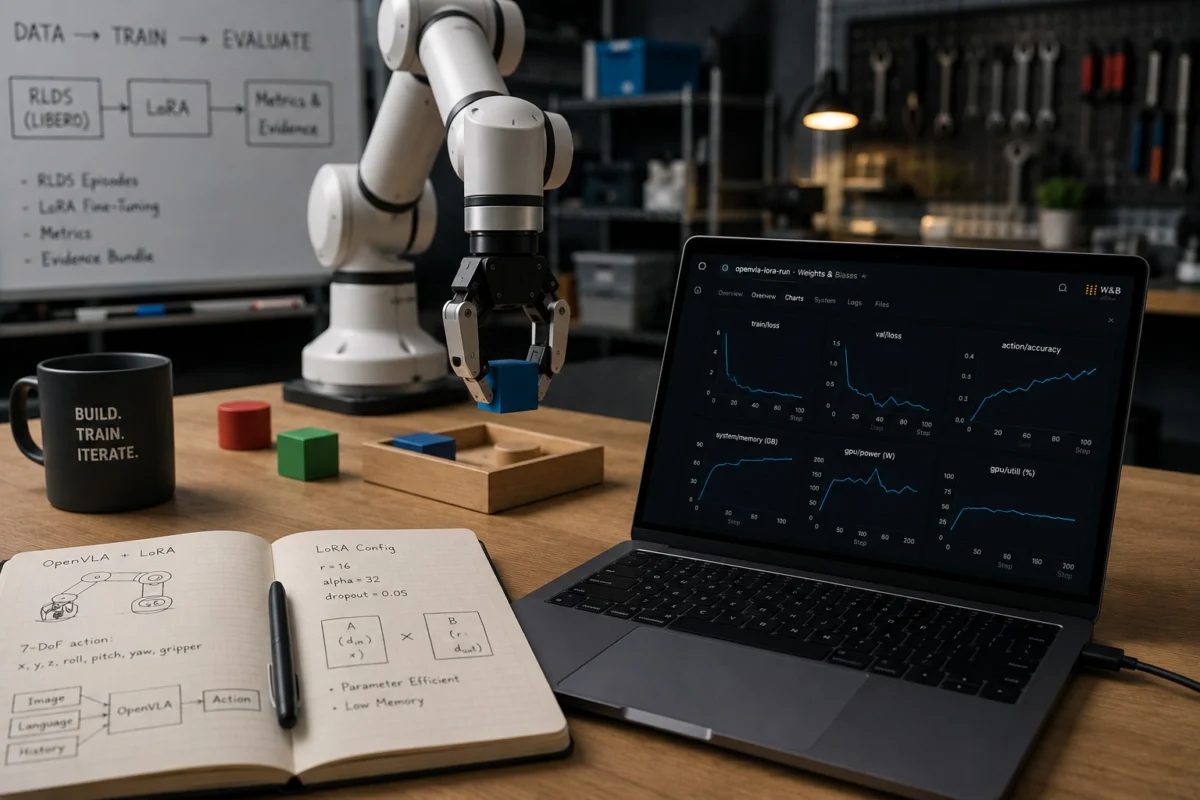
The rapid evolution of robotics foundation models has reached a critical juncture with the release of OpenVLA, a 7-billion-parameter vision-language-action (VLA) model. While the model represents a breakthrough in open-source robot control, the hardware requirements and complexity of fine-tuning such a massive architecture often present a significant barrier to entry for researchers and independent developers. To address these challenges, a new reproducible workflow has been established to demonstrate that OpenVLA fine-tuning is not only approachable but also verifiable within a standard cloud-based environment. By utilizing Low-Rank Adaptation (LoRA) on a Google Colab A100 High-RAM instance, this framework provides a transparent "smoke test" that confirms dataset integrity, GPU performance, and model weight updates before researchers commit to expensive, large-scale robot experiments.

The Rise of Vision-Language-Action Models
The OpenVLA model, introduced in mid-2024, is part of a broader movement toward general-purpose robot foundation models. Unlike traditional robotic controllers designed for specific tasks, a VLA model functions as a unified policy that processes high-dimensional inputs—typically camera imagery and natural-language instructions—to predict discrete action tokens. OpenVLA-7B was trained on a massive corpus of 970,000 real-world robot demonstrations, enabling it to generalize across various robotic platforms and environments.
The architecture is built upon a vision encoder and a large language model (LLM) backbone, specifically the Llama-based architecture, which has been adapted to output robot-specific actions. This scale allows the model to understand complex spatial relationships and follow nuanced instructions such as "place the bowl on the plate." However, the sheer size of the model—7 billion parameters—necessitates sophisticated fine-tuning techniques to adapt the general weights to specific robotic "embodiments" or new task families.

Addressing the Problem of Embodiment Shift
In robotics research, a primary motivator for fine-tuning is the "embodiment shift." This occurs when a pretrained model is deployed on a robot with a different camera angle, a new gripper type, or a different action scale than what was present in the original training data. Even minor changes in the workspace, such as different lighting or the introduction of novel objects, can degrade the performance of the base model.
Fine-tuning allows the model to learn these specific nuances by updating its internal weights based on a small set of targeted demonstrations. For OpenVLA, this involves mapping the visual input and the text instruction to a normalized seven-degree-of-freedom (7-DoF) end-effector command. These seven values represent the robot’s movement in 3D space (x, y, z), its orientation (roll, pitch, yaw), and the state of its gripper. By predicting these values accurately, the model can navigate new environments effectively.

Methodology: The Efficiency of Low-Rank Adaptation
To make fine-tuning viable on consumer-grade or mid-tier cloud hardware, the framework utilizes Low-Rank Adaptation (LoRA). Full fine-tuning of a 7B parameter model requires significant VRAM, often exceeding the capacity of a single GPU, as every weight in the network must be updated and stored. LoRA mitigates this by freezing the majority of the pretrained weights and only training a small set of rank-decomposition matrices injected into the model’s layers.
According to the OpenVLA research team, LoRA can match the performance of full fine-tuning while training only 1.4 percent of the total parameters. In this specific reproducible run, a LoRA rank of 32 was employed. This approach significantly reduces the memory footprint, allowing the 7B model to fit within the memory constraints of an A100 GPU while still producing a functional adapter checkpoint. This parameter-efficient fine-tuning (PEFT) is essential for rapid iteration in robotics, where researchers may need to test dozens of small task variations.

The LIBERO Dataset and RLDS Standards
The data used for this validation run is the libero_spatial_no_noops split, part of the LIBERO benchmark for language-conditioned robot manipulation. LIBERO focuses on spatial reasoning, requiring the robot to understand instructions that involve moving objects relative to one another. The dataset is stored in the Robot Learning Dataset Standard (RLDS) format, which has become a staple in modern robotics for organizing multi-modal episodes.
Each episode in the RLDS format consists of a sequence of timesteps. Every timestep includes:

- Observations: High-resolution camera images of the workspace.
- Language Instructions: Natural language commands (e.g., "pick up the black bowl").
- Actions: The recorded 7-DoF commands executed by the human demonstrator or the expert policy.
- Metadata: Step counts and task-success indicators.
The "no_noops" suffix in the dataset name indicates that "no-operation" steps—frames where the robot is stationary—have been removed. This focuses the training process on active movement, ensuring that the model learns the relationship between visual changes and physical actions more efficiently.
Chronology of the Reproducible Run
The workflow is designed to be executed in a single, continuous session on Google Colab. The chronology of the run is as follows:

- Environment Initialization: The system sets up two distinct Python environments. The first is a dedicated OpenVLA environment using Python 3.10 to manage specific dependency versions required by the model scripts. The second is a sync environment used to interface with Weights & Biases (W&B) for experiment tracking.
- Dataset Acquisition: The
libero_spatial_no_noopsdataset is automatically downloaded and staged in the local runtime. - Hardware Verification: The system confirms the presence of an A100 GPU and verifies high-RAM availability to prevent out-of-memory (OOM) errors during the loading of the 7B parameter base model.
- The Fine-Tuning Loop: The
vla-scripts/finetune.pyscript is executed viatorchrun. The run is set to 100 steps, acting as a "smoke test" to ensure all components are functioning. Hyperparameters include a batch size of 2 and gradient accumulation steps of 8, resulting in an effective batch size of 16. - Evidence Collection: Throughout the run, system telemetry (GPU power usage, VRAM consumption) and training metrics (loss, accuracy) are logged.
- Final Synchronization: Once the 100 steps are complete, the offline logs are synced to W&B, providing a permanent, inspectable record of the training run.
Data Analysis and Verification of Results
The primary goal of this 100-step run is not to achieve a state-of-the-art robot policy, but to provide an audit trail proving that training occurred. The metrics captured during the run showed a clear learning signal. Three primary indicators were tracked:
- Train Loss: This value measures the supervised training error. In the recorded run, the loss dropped sharply from approximately 11.0 to 3.4 within the first few dozen steps, indicating that the model was successfully minimizing the difference between its predictions and the ground-truth demonstrations.
- L1 Loss: This metric tracks the absolute error between the predicted continuous action values and the demonstrated actions. The L1 loss decreased from 0.46 to 0.22, suggesting the model’s spatial predictions were becoming more precise.
- Action Token Accuracy: This measures how often the model correctly predicts the discrete tokens representing the robot’s next move. Accuracy increased from roughly 9% to a peak of 35% during the short window.
Furthermore, system telemetry provided critical evidence of hardware engagement. The GPU power usage fluctuated between 165 and 195 watts, while GPU utilization remained steady at approximately 40%. This confirms that the notebook was performing sustained computational work rather than idling or encountering a silent failure.

Broader Impact and Implications for Robotics Research
The establishment of a reproducible, low-cost path for OpenVLA fine-tuning has significant implications for the field of robotics. Traditionally, large-model training was the exclusive domain of well-funded industrial labs. By demonstrating that a 7-billion-parameter model can be adapted using LoRA in a standard cloud environment for a nominal cost, the barrier to entry for academic researchers and small-scale labs is substantially lowered.
This approach also highlights a shift in how AI tutorials and research papers are evaluated. In an era of increasingly complex models, "black box" demonstrations are no longer sufficient. The use of experiment trackers like Weights & Biases as an "audit trail" allows other researchers to verify the authenticity of a training run, inspecting everything from the CLI commands used to the thermal performance of the GPU.

Future Directions
While this 100-step run serves as a vital integration test, it is only the first step in a longer pipeline. Future experiments will likely involve scaling these runs to thousands of steps and conducting "rollouts" in simulated environments like RoboSuite or MuJoCo. These simulations are necessary to verify that the improved metrics (lower loss and higher accuracy) actually translate into successful task completion in the physical world.
Moreover, the success of this LoRA-based framework suggests that similar parameter-efficient methods could be applied to even larger models as they emerge. As the robotics community moves toward larger and more capable foundation models, the ability to perform small, verifiable "smoke tests" will remain a cornerstone of responsible and efficient AI development.

Conclusion
The OpenVLA fine-tuning workflow described herein provides a robust foundation for anyone looking to enter the world of vision-language-action models. By prioritizing reproducibility and transparency, the framework ensures that before a single robot arm moves, the underlying software and hardware systems are proven to be in alignment. The lesson for the broader AI community is clear: the path to advanced robotic intelligence is built not just on massive data, but on the ability to prove that every step of the training process is real, measurable, and accessible.

