
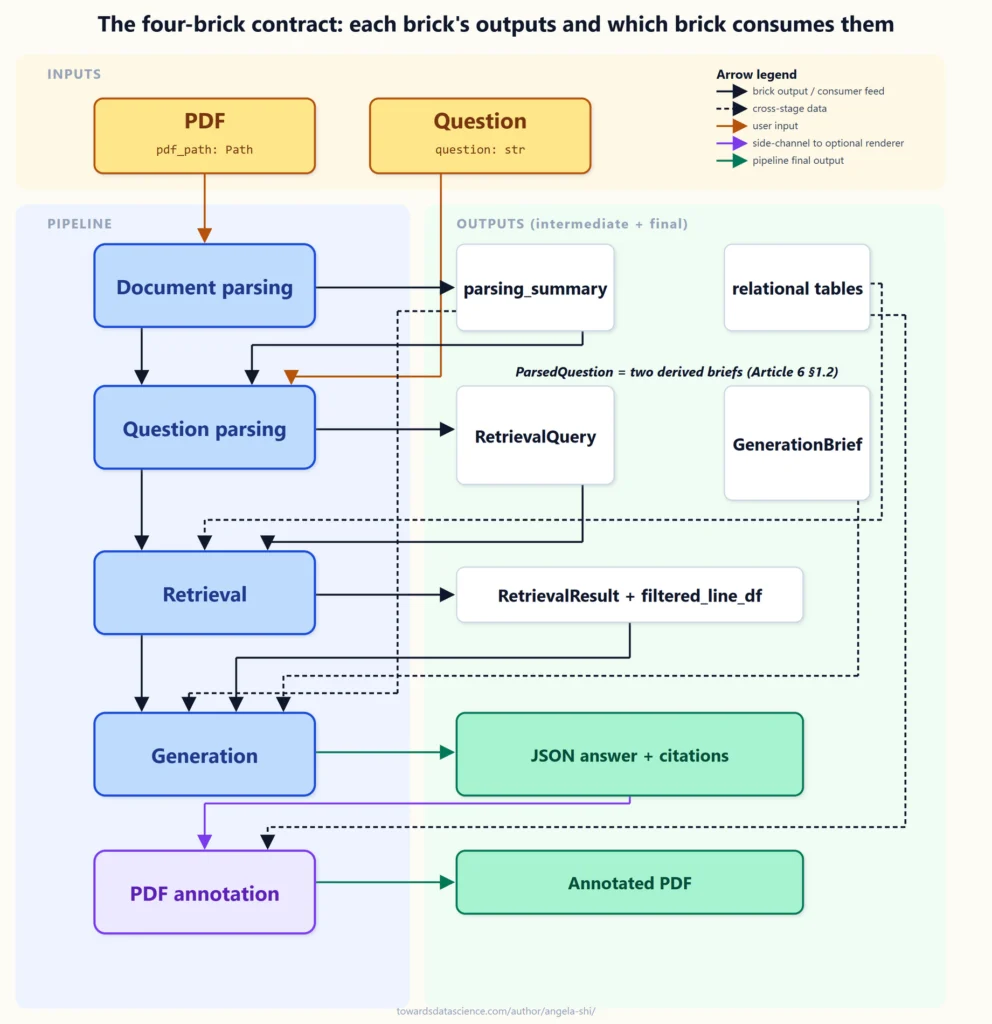
The transition from experimental generative artificial intelligence to production-ready enterprise systems has exposed a significant "brittleness" in standard Retrieval-Augmented Generation (RAG) architectures. While a basic RAG pipeline—consisting of simple PDF parsing, keyword extraction, and free-form text generation—can successfully handle clean documents and straightforward queries, it frequently falters when confronted with the complexities of professional environments. To address these vulnerabilities, a new framework for "Enterprise Document Intelligence" has emerged, reimagining the RAG process as a series of four robust, modular "bricks": document parsing, question parsing, retrieval, and generation. This upgraded methodology moves away from the "black box" approach of early AI implementations toward a transparent, structured pipeline designed to handle real-world data noise, complex document layouts, and the rigorous audit requirements of the corporate sector.

The Infrastructure of Enterprise Document Intelligence
At the heart of this evolution is the realization that enterprise-grade AI requires more than just a powerful large language model (LLM); it requires a sophisticated data contract between each stage of the information processing cycle. The baseline RAG model often breaks when a user introduces typos, when a document lacks a digital outline, or when a question requires an exhaustive list rather than a single summary. The upgraded pipeline seeks to immunize the system against these failures by refining the inputs and outputs of each module.

The core philosophy of this series, "Amplify the Expert," suggests that AI should not replace the professional’s judgment but rather provide the structural tools necessary for an expert to audit and trust the machine’s output. By breaking the pipeline into four distinct bricks, developers can upgrade individual components without rebuilding the entire system, allowing for incremental improvements in accuracy and reliability.

Chronology of the RAG Evolution
The development of this upgraded pipeline follows a clear chronological progression in AI engineering. Initially, "Volume 1" of the Document Intelligence series focused on a minimal RAG setup—a "happy path" implementation that worked on clean arXiv papers like "Attention Is All You Need." However, as testing moved toward real-world contracts and technical manuals, the limitations became apparent.

- Phase One (Baseline): Implementation of simple text extraction and vector search. This phase demonstrated that while the technology was promising, it lacked the precision required for legal or technical auditing.
- Phase Two (Structural Parsing): Recognition that PDFs are not just strings of text but hierarchical structures. Developers began moving toward relational parsing, creating tables for lines, pages, and tables of contents (TOC).
- Phase Three (Semantic Expansion): The introduction of "Question Parsing," where the system no longer takes the user’s query at face value but instead cleans, corrects, and expands it using domain-specific expert vocabularies.
- Phase Four (Structured Retrieval and Generation): The final shift from free-form prose to "Typed Answers." This ensures that the output can be consumed by downstream software, such as databases or automated compliance checkers.
Brick 1: Document Parsing as a Relational Set
In the upgraded pipeline, document parsing is no longer a simple act of "reading" text. Instead, it is reframed as building a small relational database from a static file. When a PDF is ingested, the parser generates three primary DataFrames: line_df, page_df, and toc_df.

The line_df serves as the atomic unit of the document, capturing every visible line of text along with its coordinates and line number. This granularity is essential for creating verbatim citations. The page_df aggregates these lines into page-level units, providing the necessary context for the LLM to understand layout and flow. Finally, the toc_df extracts the document’s native table of contents. In a 200-page contract, the TOC is the "map" that allows the retrieval engine to bypass irrelevant sections entirely, a feat that keyword-based search often fails to achieve.

Supporting data suggests that using a structured toc_df reduces retrieval noise by up to 60% in long-form documents. By anchoring the search in specific sections—such as "Exclusions" or "Termination Clauses"—the system avoids "hallucinating" answers from unrelated parts of the text.

Brick 2: Question Parsing and the Expert Vocabulary
The second brick, question parsing, addresses the reality of human error. In an enterprise setting, users frequently submit queries with typos or use non-technical language to describe technical concepts. The upgraded brick uses an initial LLM call to perform two simultaneous tasks: surface typo correction and keyword extraction.

Furthermore, this stage introduces an "expert vocabulary" layer. If a user asks about "positional encoding" in a machine learning paper, the system consults a concept_keywords_df to expand the search to include related technical terms like "sinusoidal" or "learned embeddings." This expansion ensures that the retrieval engine finds the relevant data even if the user did not use the exact terminology present in the document. This "from noise to brief" approach transforms a messy user string into a structured RetrievalQuery that the next brick can act upon with surgical precision.

Brick 3: Retrieval as Structured Filtering
Modern enterprise retrieval is moving away from purely vector-based "similarity" searches toward a model of "filtering." The upgraded retrieval brick uses the structured tables from the parsing stage to narrow the document down to the most relevant lines.

A critical discovery in this phase involves the limitation of line-unit detection. In many PDFs, multi-word keywords (e.g., "positional encoding") are often split across line breaks. A standard line-by-line scan would fail to find these hits. To solve this, the upgraded pipeline utilizes "passage-unit" detection, where the system scans small windows of adjacent lines joined by spaces.

Data analysis of technical documents reveals that passage-unit detection can increase keyword hit rates by 15-20% compared to line-only scans. Additionally, the retrieval brick now utilizes an "LLM TOC Router." Rather than relying on simple substring matching, a small LLM call reviews the entire Table of Contents to reason about which section likely contains the answer. This allows the system to find "Termination" clauses even if the user asks about "exiting the contract early," bridging the semantic gap that often thwarts traditional search algorithms.

Brick 4: Generation and the "Trust Profile"
The final brick, generation, represents a departure from the "chatbot" persona. In a professional context, an answer must be citable, structured, and self-aware of its own limitations. The upgraded generation brick produces a typed AnswerWithEvidence object, often in JSON or Pydantic format.

When a question asks for a list of options, the system returns a ListAnswer where each item is paired with a verbatim quote and a specific line range. This structure allows for a "full audit trail," enabling a human expert to click on any part of the AI’s answer and see exactly where it originated in the source PDF.

Moreover, the generation brick now outputs a "trust profile" consisting of four quality indicators:

- Answer Found: A boolean indicating if the information exists.
- Complete Answer Found: Whether the response covers all mentioned options.
- Context Structured: A diagnostic flag that triggers if the LLM detects a failure in the document’s reading order (e.g., OCR errors or multi-column layout issues).
- Confidence Score: A numerical representation of the model’s certainty.
Industry Implications and Expert Analysis
The shift toward modular, typed RAG components has significant implications for the AI industry. Experts in the field of "Contextual Retrieval" argue that the future of enterprise AI lies in these auditable, transparent pipelines rather than larger, more opaque models. By moving the logic of document understanding into the "bricks" and away from the core LLM, organizations can reduce costs—using smaller, faster models for parsing and routing while reserving the most powerful models for final synthesis.

Furthermore, this modularity allows for better compliance with emerging AI regulations. Because every decision—from TOC routing to keyword expansion—is logged and typed, companies can provide a "chain of reasoning" for any automated decision. This is particularly vital in sectors like finance, healthcare, and law, where "the AI said so" is not an acceptable justification for a professional conclusion.

Future Outlook: The Path to Agentic AI
This upgraded pipeline represents the second "rung" on a five-level ladder of document intelligence. While the current system is a "richer pass" that emits feedback fields, the next stage of development involves creating "feedback loops." In these forthcoming "agentic" systems, if the generation brick reports "low context completeness," the system will automatically re-run the retrieval brick with different parameters without human intervention.

As the technology matures, the "Amplify the Expert" philosophy remains the guiding light. By providing a structured, citable, and transparent pipeline, the Enterprise Document Intelligence framework ensures that as AI becomes more integrated into the workplace, it remains a tool of precision rather than a source of uncertainty. The second part of this series will focus on wiring these four upgraded bricks into a single unified call, tested against the messy, unpredictable documents that define the modern enterprise landscape.

