

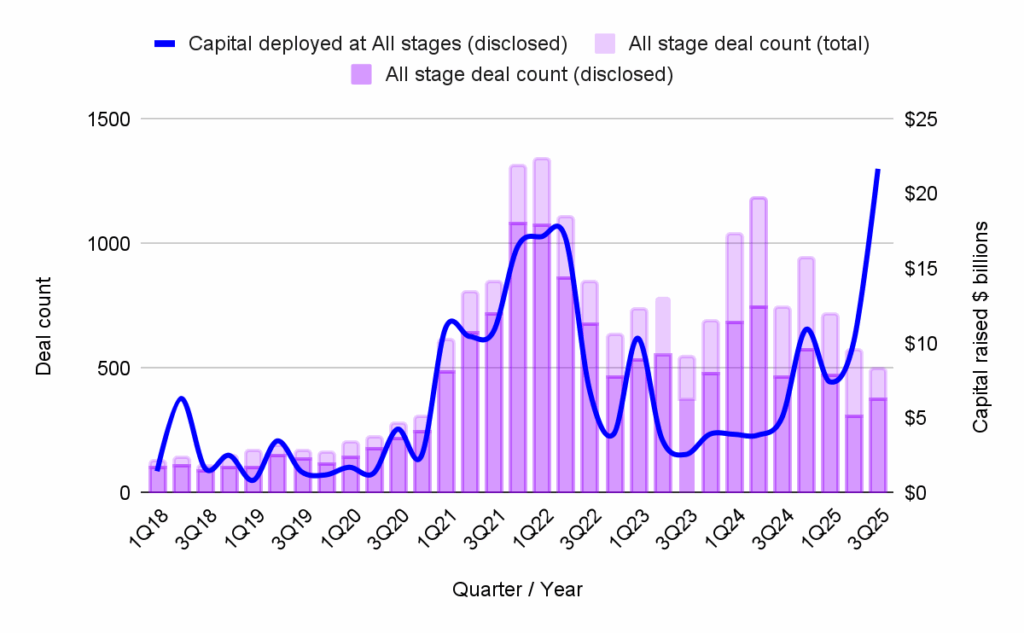
Web3 fundraising in the third quarter of 2025 reached an unprecedented cycle high, with nearly $22 billion deployed across all funding stages and 376 disclosed deals. This represents more than double the capital injected in the preceding quarter, though the increase in deals did not keep pace proportionally, indicating a surge in larger investment rounds rather than a broader expansion of activity. This trend continues the pattern observed in the first half of 2025, characterized by "conviction over coverage," but Q3 2025 introduces a significant distinction: the maturation of key institutional channels—including ETFs, Digital Asset Treasuries (DATs), tokenization, and settlement rails—from promising concepts to operational realities. This shift has directly influenced the flow of funding, concentrating capital within areas amenable to large-scale institutional deployment.
Market Overview: Capital Concentration and Institutional Pull
The third quarter of 2025 saw a remarkable 113% increase in capital deployed quarter-on-quarter, rising from $10.2 billion in Q2 2025 to $21.7 billion. While the number of disclosed deals saw a more modest 22% increase, from 309 to 376, the sheer volume of capital raised established a new record, surpassing even the peak of the 2021/2022 bull market, without a corresponding broadening of investor participation.
Messari’s analysis of Q3 2025 corroborates this trend, highlighting increased capital deployment, a lower deal count, and a significant skew towards larger transactions and public market routes, such as the listings of Bullish and Figure. The report further indicates that the ten largest raises accounted for approximately half of the total quarterly fundraising, underscoring that renewed capital inflows have not yet translated into a widespread recovery in venture appetite.
A noteworthy observation for Q3 2025 is its distinction as the only recent quarter where the number of disclosed deals increased while the total number of deals across all stages decreased. This divergence is significant because deal disclosure typically correlates with round size and maturity. Larger, later-stage funding rounds are more prone to public announcement, whereas smaller or earlier-stage deals often remain private. This pattern reinforces the concentration of capital in Q3 2025, making it more visible due to its consolidation.

The Institutional Architecture of Web3 Capital
The deepening of institutional infrastructure was a defining characteristic of Q3 2025. Messari’s "Crypto x TradFi" review revealed that ETH-focused ETFs attracted approximately $8.7 billion in Q3 2025, surpassing their BTC counterparts. The Assets Under Management (AUM) for ETH ETFs also saw a substantial increase, growing by around 170% quarter-on-quarter to reach $27.4 billion.
Concurrently, Digital Asset Treasuries (DATs) absorbed roughly 3.8% of the ETH supply during Q3 2025, signaling a notable shift in corporate treasury strategies. Enterprises, including banks and payment networks, began transitioning tokenization and settlement use cases from pilot phases to full production.
Illustrative examples of this institutional integration include JPMorgan’s Kinexys network, which went live for tokenized repurchase agreement settlement. SWIFT further expanded its tokenization trials, collaborating with major global custodians like BNY Mellon, Citi, Clearstream, Euroclear, and Northern Trust to test cross-network settlement of bonds and fund shares on-chain. Visa Direct also commenced processing cross-border payments using USDC. This robust institutional demand is a primary driver behind the larger investment tickets observed in later-stage projects and infrastructure rounds.
Policy Developments Affecting Web3 Venture Capital
Policy advancements in 2025 have further solidified the direction of Web3 capital flow. DBS’s "3Q25 Digital Assets Update" posits that the year marked a transition from consultation to execution in regulatory frameworks. The report highlights initiatives like the GENIUS Act and other official recommendations as catalysts for stablecoin and tokenization advancements within the banking and payments sectors. These regulatory shifts have demonstrably lowered the barriers to entry for institutional participation. However, policy is only one facet of the explanation for capital’s continued concentration in later-stage and compliance-ready infrastructure.
Large financial institutions operate under stringent return and governance mandates. Deploying capital across numerous small, early-stage ventures is operationally inefficient and deviates from their typical investment profiles. Institutional investors also adhere to shorter delivery horizons, requiring tangible business outcomes to be demonstrated relatively quickly. The inherent career risk associated with backing unproven, higher-risk startups further influences their decision-making.
One emerging solution to bridge this gap is the adoption of hybrid models that combine institutional capital with specialized early-stage expertise. Outlier Ventures’ partnership with Morgan Creek exemplifies this approach, enabling a traditional asset manager to gain structured exposure to early-stage Web3 and crypto ventures. This collaboration leverages Outlier Ventures’ due diligence capabilities, sector knowledge, and portfolio support infrastructure to mitigate risk for institutional investors, making participation in the venture layer more practical and scalable.
For early-stage founders in fields overlapping with traditional finance, this presents a structural challenge centered on designing product architectures, governance frameworks, and compliance pathways that render their projects institutionally digestible from inception. This proactive approach builds a foundation for accessing significant capital as the projects mature.
New Crypto/Web3 Venture Funds
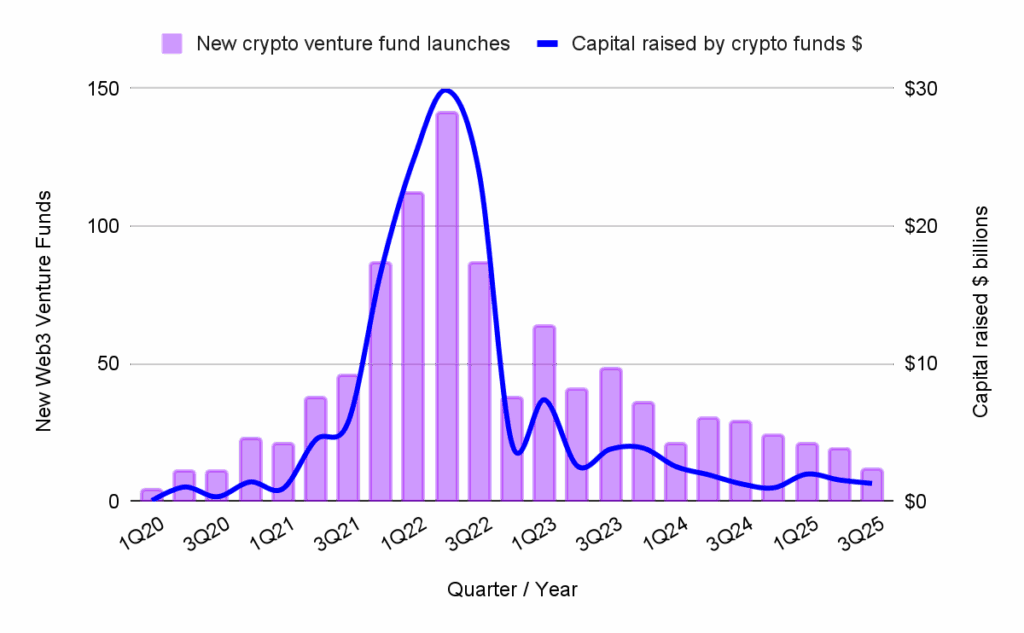
Fund formation in Q3 2025, while subdued in number, saw concentration by size. Only 11 new crypto venture funds were launched, collectively raising $1.3 billion, continuing a downward trend observed throughout the year. This pace of new fund launches mirrors the environment of mid-2020, a period marked by uncertainty and a temporary freeze in new fund creation. The similarity lies not in crisis, but in a prevailing caution. General partners are increasingly relying on the substantial "dry powder" within existing vehicles, while limited partners remain highly selective about committing to new mandates. PM Insights’ "3Q25 Secondaries Report" characterizes this as a "recycling phase," where capital circulates through secondary trades and exits rather than entering the market via new venture formations.
Early-Stage Deals in 3Q25
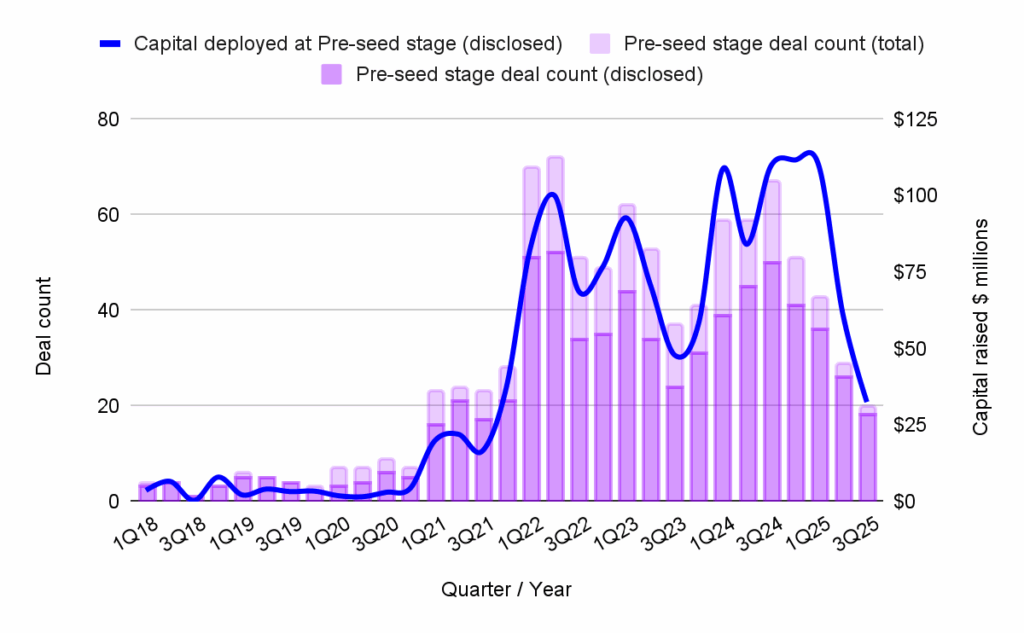
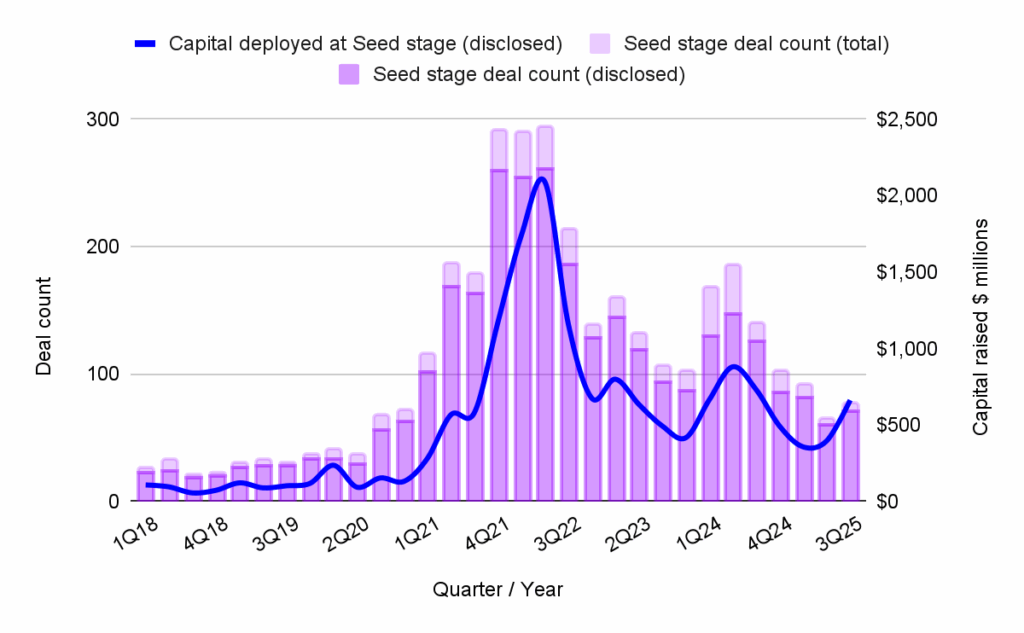
Early-stage activity did not mirror the headline dollar figures. Pre-seed funding reached multi-year lows in both capital raised and deal count. Seed-stage funding saw improvement in both deal count and capital raised. Series A also experienced modest growth in capital and deal count. The median round sizes, based on 12-month running figures, show seed rounds pushing to a new cycle high, Series A holding steady, and pre-seed edging downward. This indicates a funding market that rewards demonstrable traction and proof of concept over nascent potential, extending the selective bias noted in previous reports.
Pre-seed Stage Web3 Fundraising
The pre-seed stage recorded 18 disclosed rounds totaling $32.5 million, marking the weakest quarter for this stage in years. The 12-month running median dipped to just under $2.5 million. Messari also reported a pronounced drop in accelerator activity in Q3 2025, which likely contributes to the narrow funnel at the idea stage and a higher bar for admission.
Seed Stage Web3 Fundraising
Seed-stage fundraising in Q3 2025 reached 71 disclosed rounds totaling just under $663 million, representing a headline improvement over Q2 2025. However, this figure is heavily influenced by Flying Tulip’s substantial $200 million raise, which alone accounts for nearly a third of the total seed capital for the quarter. Excluding this outlier, aggregate seed investment would have remained broadly in line with previous quarters.
The Flying Tulip round was also unconventional in its structure, granting investors an on-chain redemption right that secures capital and yield exposure without surrendering upside potential. This model more closely resembles callable, yield-bearing capital than traditional equity. The project is not deploying the full amount as spendable balance-sheet capital; instead, it earns DeFi yield on its treasury to fund incentives and buybacks. This transaction highlights a growing preference among Web3 venture investors for liquid, capital-efficient instruments over the less liquid SAFEs and SAFTs that previously dominated early-stage fundraising.
Series A Stage Web3 Fundraising
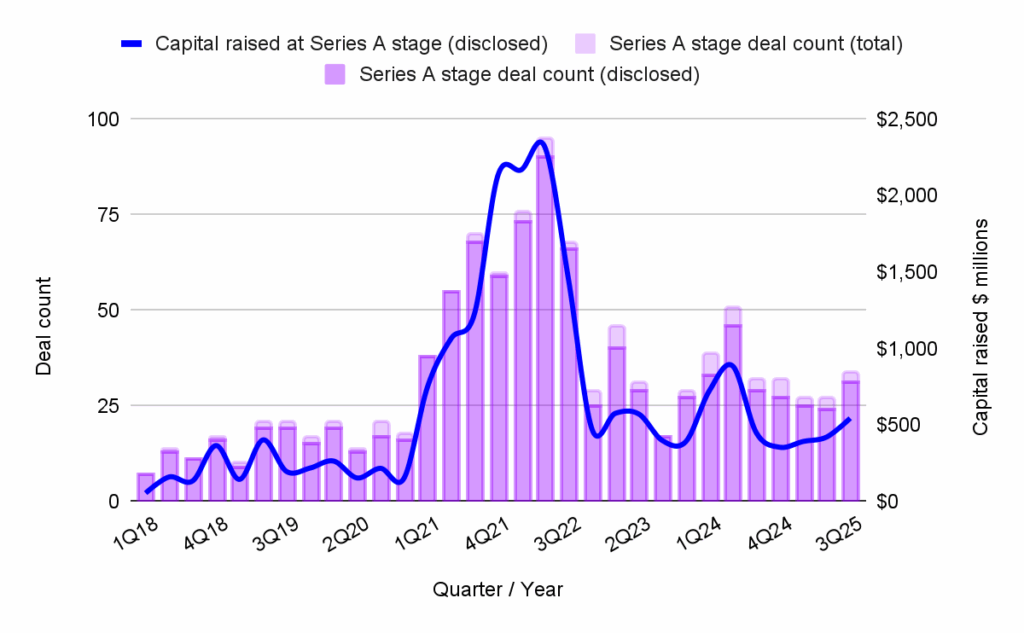
In Q3 2025, the Series A stage saw 31 disclosed rounds totaling almost $545 million, with the 12-month running median remaining steady around $16 million. A clear preference was observed for projects demonstrating alignment with institutional rails, such as payments, tokenization, data, or infrastructure services.
The stability of Series A round sizes, neither contracting nor expanding, may signal the nascent stages of a broader return of investor appetite for mid-stage ventures. While it is premature to declare a definitive trend shift, sustained resilience into Q4 2025 could indicate a gradual shift from investor caution to renewed confidence in scaling-stage opportunities.
Capital Investment Across All Stages by Category
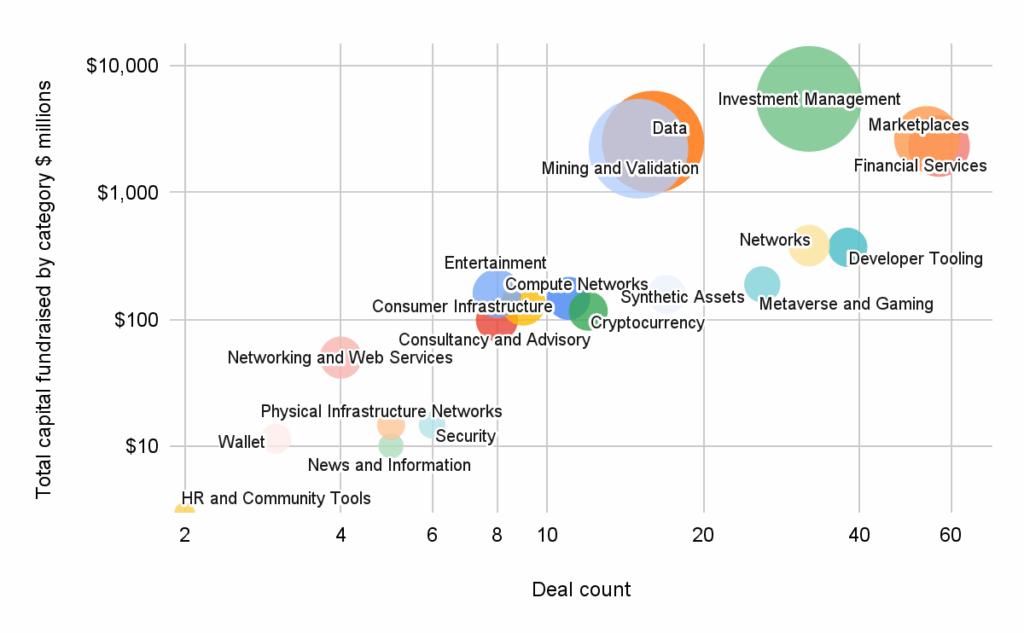
The composition of capital invested in Q3 2025 was unequivocally institutional. Investment Management, Marketplaces, Data, Financial Services, and Mining & Validation collectively absorbed approximately 70% of all deployed capital. These categories directly relate to issuance, custody, settlement, analytics, and blockspace supply—areas significantly amplified by ETF/DAT inflows, tokenization programs, and enterprise adoption.
Within Investment Management, exceptionally large rounds reflect the demand driven by ETFs, DATs, and other regulated access products that saw substantial growth in Q3 2025. According to Messari, ETH ETF inflows surpassed BTC ETF inflows, and ETF/DAT vehicles increased their share of held ETH and BTC. This structure creates a durable buyer base for related infrastructure and services, explaining the large ticket sizes evident in the data.
Data infrastructure also attracted significant capital with high median investments, consistent with late-stage and strategic funding for indexing, analytics, and AI-adjacent stacks. Grayscale’s sector report formalized AI-crypto as a distinct investable segment, contributing to the concentration of capital in scaled data platforms rather than a long tail of experimental "AI + chain" projects.
Financial Services and Marketplaces align with the tokenization and payments narrative. DBS highlights tokenization and stablecoins as 2025’s most dynamic institutional tracks. Regulated flows, settlement rails, and Real World Asset (RWA) marketplaces attracted more marginal dollars than consumer-facing projects. Consequently, categories like Metaverse & Gaming and Wallet/Security played peripheral roles in Q3 2025, with funding prioritizing infrastructure and enterprise solutions where revenue and compliance are more clearly defined.
Token Fundraising in 3Q25: Private vs Public
Token issuance in Q3 2025 saw a shift back towards public routes. Public token sales increased to 47 events, totaling $819 million, while private token sales declined to 7 events, raising $331 million. Periods of improved market depth and receding policy risk often see teams favor public distribution for price discovery and community alignment. CoinGecko’s Q3 2025 report indicates rising market capitalization and trading volumes, supporting this trend. Messari also notes a broader return of public market participation, with IPOs and listings re-emerging as indicators of market health. As Tiger Research points out, IPOs allow Web3 firms to leverage the listing process as a "regulatory-compliance certification mark" for institutional capital access.
For most early-stage founders, however, the prospect of an IPO remains distant, given the significant scale, maturity, and timing required. The reopening of the IPO window serves more as a marker of market sentiment—a signal that public markets are receptive to crypto exposure—rather than an immediate, attainable goal for most.
Private Retreat, Public Rebound
This trend marks a departure from early 2025, when private token sales had briefly emerged as a more stable institutional route to liquidity. Figure 7 illustrates a steady decline in private activity throughout the year, with both capital raised and deal count falling from Q1 2025 to Q3 2025.
Conversely, public token sales exhibited a sharper cyclical pattern. From Q1 2025 to Q2 2025, both capital raised and deal count experienced a significant drop, one of the steepest quarterly declines in recent years. CoinGecko attributes this mid-year slowdown largely to regulatory uncertainty in the United States and Europe, as several projects postponed launches pending clarity on token classification and exchange approvals. DBS’s Q3 2025 Digital Assets Update offers a complementary perspective: following the initial surge of activity post-ETF approvals, investors temporarily rotated capital into stablecoins and yield-bearing assets, reducing their risk exposure to new token issuances.
From Q2 2025 to Q3 2025, capital rebounded strongly without a corresponding increase in deal count, indicating a revival in public market value rather than breadth. This resurgence was driven by a handful of large, high-profile offerings rather than a widespread reopening of the token fundraising landscape.
Final Thoughts on Web3 Fundraising in 3Q25
Q3 2025 continued a discernible trend: capital flowed through narrower, deeper channels anchored to institutional adoption. Early-stage deals remained highly selective, while Series A funding proved accessible for teams with demonstrable traction and institutional adjacency. The largest investment checks were directed towards investment platforms, settlement rails, data infrastructure, and blockspace.
This dynamic is significant as the convergence of crypto and traditional finance is no longer a hypothetical scenario but a foundational assumption shaping capital allocation. ETFs and DATs are channeling substantial, sustained flows into the asset class, while tokenization and stablecoins provide enterprises with functional settlement rails. As a16z crypto noted in its "State of Crypto 2025" report, 2025 has been "the year crypto went mainstream."
However, this mainstreaming has primarily occurred at the infrastructure layer rather than the consumer layer. This trend, previously highlighted in Outlier Ventures’ report "Web3 Fundraising in Focus: The Truth Behind Consumer vs Infra Investment," indicates a growing emphasis on Web3 infrastructure projects since 2024, reshaping financial operations without visibly altering end-user interactions. While banks and payment providers adopt stablecoin rails and tokenized settlement layers, the customer experience often remains unchanged. This quiet integration, while perhaps less visually dramatic than mass crypto adoption, represents a sustainable path for blockchain’s embedding within the financial system. Consequently, capital is increasingly deployed towards projects with measurable utility and regulatory alignment, moving away from the speculative consumer experiments that characterized earlier cycles.
Challenges in Upcoming Quarters
Looking ahead, a critical question for founders is how to transition from the selective seed funding landscape of today to confident Series A rounds in the future. Investors are clearly seeking tangible products with demonstrated traction, including working deployments, user adoption, and verifiable integration into regulated or enterprise contexts. Proof points, not promises, will be the currency of the next wave of early-stage funding.
For Venture Capitalists, the challenge lies in ensuring fund design and follow-on strategies can effectively bridge the narrow pre-seed funnel into a more robust pipeline for 2026. For institutions, the question revolves around what changes are necessary to bring significantly more new capital back to early-stage projects. This might involve co-investment programs linked to corporate procurement or matched-grant schemes to de-risk go-to-market strategies. Eventually, this could evolve into novel equity-token hybrid frameworks that balance liquidity preferences with long-term alignment, a topic likely to gain prominence as investor preferences around capital structures continue to evolve.
The answers to these questions will determine whether the market in Q4 2025 and the first half of 2026 experiences continued concentration or begins to broaden, testing the ultimate reach of this cycle’s liquidity.

