

In the nascent stages of Web3, the digital wallet served a singular, utilitarian purpose: a secure vault for private keys, facilitating token storage and transaction signing. However, the landscape of the internet is undergoing a profound transformation, ushering in what is termed the "Post Web." In this emerging paradigm, the wallet is no longer a peripheral tool but has ascended to become the central nexus of the user experience. It is evolving into a sophisticated, "living interface" capable of managing not only digital assets but also user identity, granular permissions, access to resources, and even the orchestration of autonomous artificial intelligence (AI) agents. This evolution is detailed in Chapter 2 of "The Post Web Thesis," which posits the wallet as the foundational control center of the "Agentic Web," the primary coordination hub where human intent and intelligent systems converge.
From Cryptographic Custody to Digital Personhood
The early iterations of wallets, exemplified by pioneers like MetaMask and Ledger, were fundamentally built upon the principle of cryptographic custody: "own your keys, own your crypto." This model emphasized direct, unmediated control over digital assets through the secure management of private keys. While this approach laid the groundwork for decentralization and user ownership, it was inherently limited in scope, primarily functioning as a secure digital ledger.
The Post Web thesis argues that this foundational model is no longer sufficient. The contemporary evolution of wallets is steering them towards becoming robust frameworks for "self-sovereign identity." This means wallets are increasingly designed to anchor a user’s identity, reputation, and agency within a single, verifiable system. As stated in Chapter 2 of The Post Web Thesis, "Wallets are becoming the interface for digital personhood—anchoring identity, reputation, and agency in one verifiable system." This shift signifies a move from mere asset management to the comprehensive representation of an individual’s digital existence.
This transformation enables wallets to manage a multitude of interconnected digital attributes, including:
- Decentralized Identifiers (DIDs): Establishing a user’s unique, verifiable digital identity independent of centralized authorities.
- Verifiable Credentials: Storing and presenting proof of qualifications, affiliations, and other attestations in a cryptographically secure manner.
- Reputation Scores: Aggregating and displaying a user’s trustworthiness and standing within various digital ecosystems, built upon verifiable interactions and contributions.
- Access Permissions: Granularly controlling which applications and services can access specific data or functionalities associated with the user’s identity.
Consequently, the wallet is transcending its role as a mere digital vault to become a digital embodiment of the user—an anchor for their personhood, ownership, and the trust they cultivate across the digital realm.
The Wallet as a Command Center for Autonomous Agents
A significant driver of this wallet evolution is the rise of sophisticated AI agents. These agents, capable of performing complex tasks autonomously, necessitate a new paradigm for interaction and control. As outlined in the thesis, "smart agents" are becoming integral to the Post Web, and wallets are transforming into their dedicated "command consoles."
Exhibit 20 from "The Post Web Thesis" visually represents this symbiotic relationship, illustrating how a user’s wallet acts as the central hub for agent interaction, complete with intricate permission and verification loops. Each AI agent connects through the user’s wallet, which serves several critical functions:
- Authentication and Authorization: The wallet verifies the identity of the agent and grants specific permissions for its operation, ensuring that only authorized agents can act on behalf of the user.
- Execution Orchestration: It directs and manages the execution of agent tasks, ensuring they align with the user’s predefined goals and parameters.
- Transaction Management: The wallet facilitates and signs transactions initiated by agents, providing an auditable trail of their actions.
- Resource Allocation: It controls the allocation of resources, such as computational power or access to specific data, that agents require to function.
This architecture is designed to ensure that AI agents operate on behalf of users, not independently or outside their control. The wallet thus emerges as a crucial "governance layer for autonomy," providing a framework for users to delegate tasks to AI while retaining ultimate oversight and control.
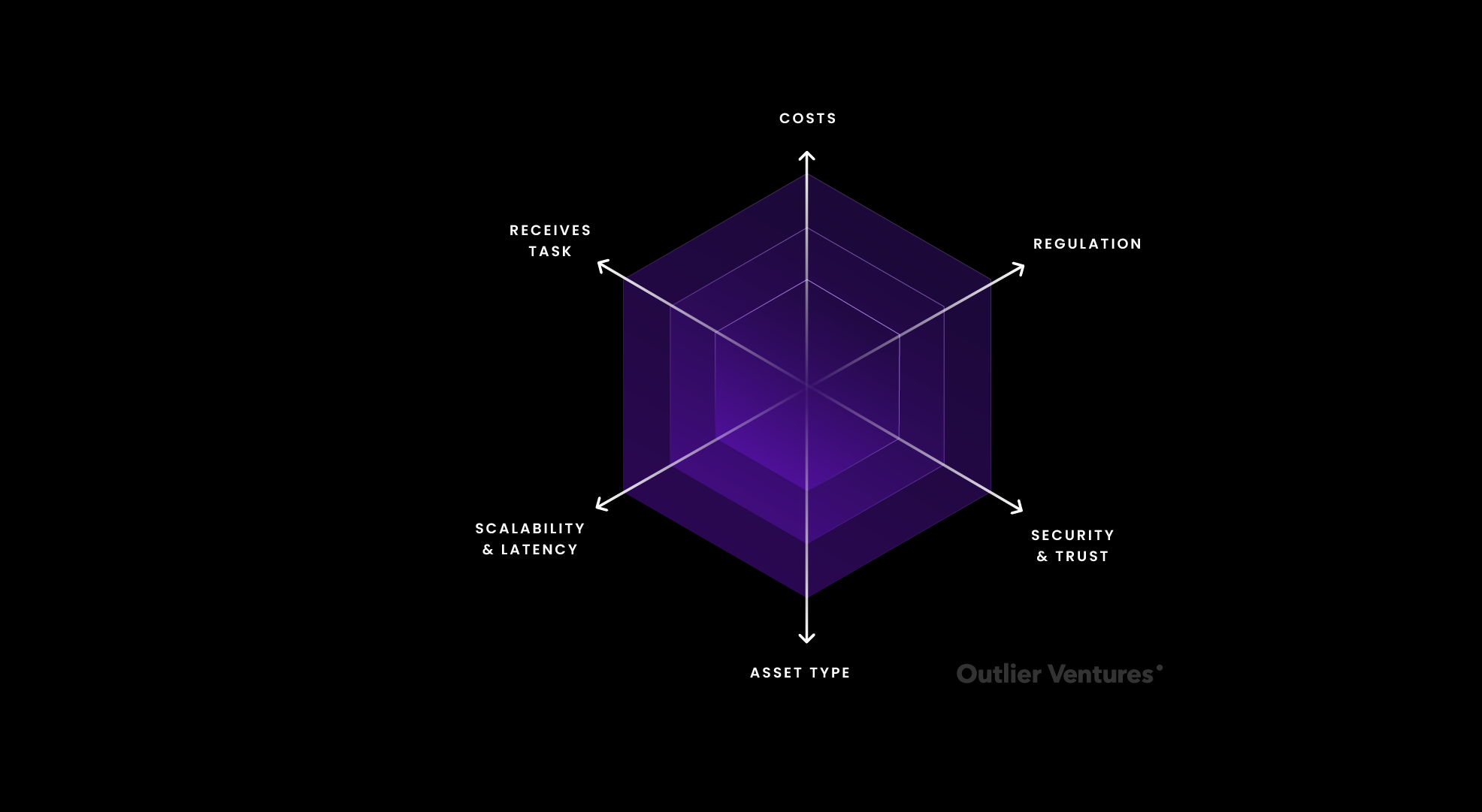
The decision-making process for when an AI agent’s transaction needs to interact with a distributed ledger technology (DLT) is also becoming a critical consideration, as highlighted in Exhibit 18. Factors such as the need for immutability, transparency, and verifiable consensus will dictate whether an agent’s action is recorded on-chain or managed through alternative protocols.
Resource Management and the Operating System for Autonomy
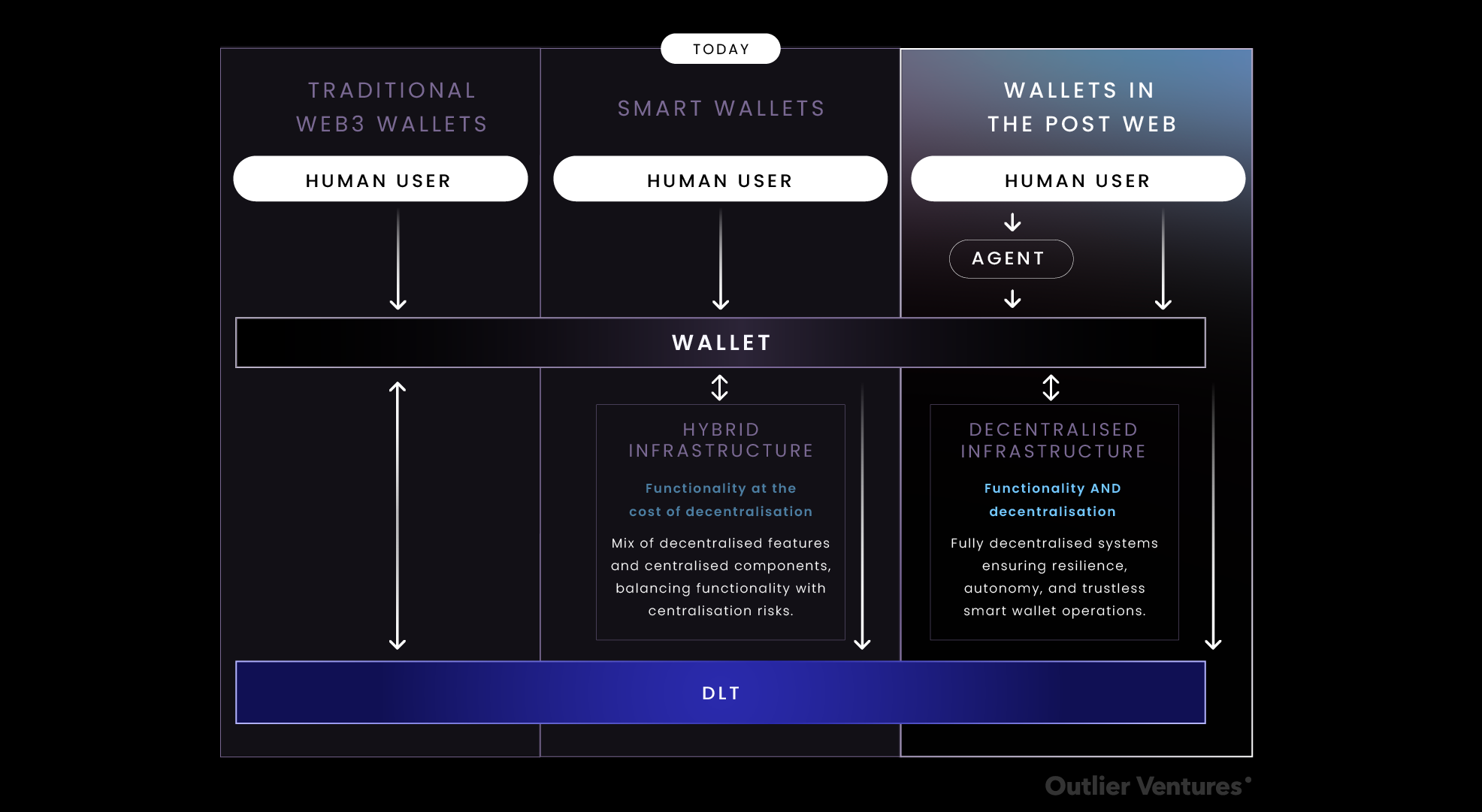
Beyond managing assets and controlling agents, the Post Web wallet is expanding its purview to orchestrate a broader spectrum of digital "resources," not merely financial "assets." This is illustrated in Exhibit 19, which depicts the wallet as the central interface for the Post Web.
The wallet will manage user access to:
- Decentralized Data Storage: Granting agents or applications permission to access specific datasets stored on decentralized networks.
- Computational Resources: Facilitating access to distributed computing power for agent processing.
- Network Access: Managing permissions for agents to interact with various decentralized networks and protocols.
- DePIN Infrastructures: Enabling agents to leverage decentralized physical infrastructure networks (DePIN) for tasks like data collection or service provision.
This comprehensive resource management capability transforms the wallet into an "operating system for autonomy," mediating complex interactions across a diverse ecosystem of networks, protocols, and decentralized infrastructures.
Privacy and Security in an Increasingly Agentic World
As wallets accumulate greater power and store more sensitive information—including behavioral data, credentials, and agent connections—privacy and security become paramount concerns. The Post Web thesis emphasizes that "privacy becomes mission-critical." To address these challenges, Post Web wallets are incorporating advanced cryptographic frameworks designed to maintain user trust and control:
- Zero-Knowledge Proofs (ZKPs): These allow for the verification of information without revealing the underlying data, enabling private and secure attestations and computations.
- Homomorphic Encryption: This advanced technique permits computations to be performed on encrypted data without decrypting it, safeguarding sensitive information during processing.
- Secure Multi-Party Computation (MPC): MPC enables multiple parties to jointly compute a function over their inputs while keeping those inputs private, facilitating secure collaboration and data analysis.
These technologies are foundational to implementing "privacy by design," ensuring that users remain in control of their data and digital interactions while enabling verifiable and autonomous operations.
Smart Wallets: The Present and Future of User Experience
For much of cryptocurrency’s history, wallets have presented significant usability hurdles, hindering mainstream adoption. Cumbersome onboarding processes, the risk of permanent fund loss due to mishandled seed phrases, and the complexity of tracking assets across multiple blockchains have all contributed to a suboptimal user experience.
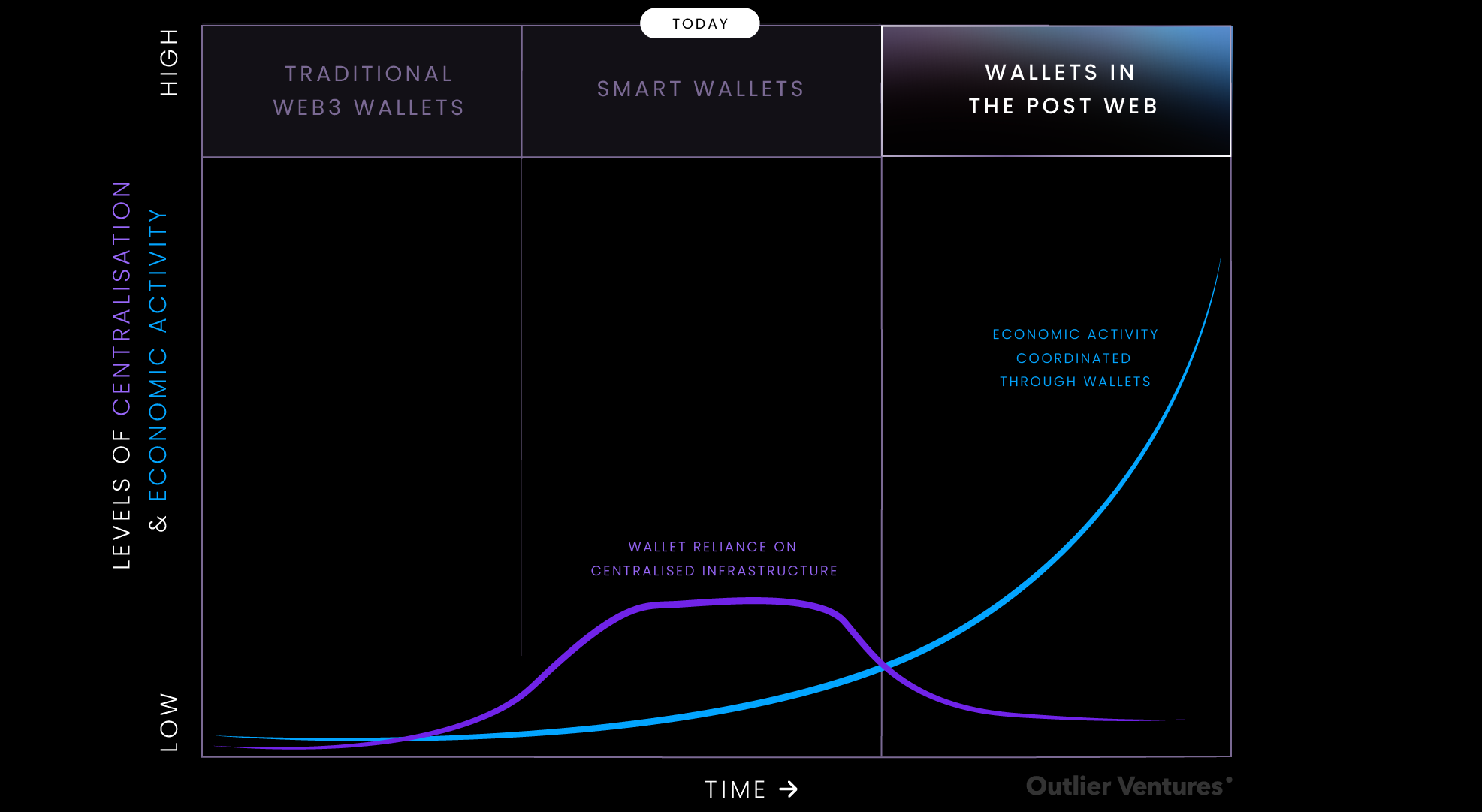
However, the advent of "smart wallets" is beginning to rectify these issues. Platforms like Safe are at the forefront, enhancing user experience and enabling the automation of user "intents." Smart wallets offer advanced customization features, including:
- Automated Transactions: Scheduling recurring payments or executing complex DeFi strategies automatically.
- Enhanced Security: Implementing features like spending limits, whitelists, and multi-signature requirements for increased protection.
- Seamless Protocol Integration: Streamlining interactions with decentralized finance (DeFi) protocols and other Web3 applications.
This shift from manual execution to intent-based interaction positions smart wallets as the critical interface between humans and AI agents, bridging user intentions with autonomous on-chain actions.
Interoperability and Intent: Redefining the Wallet’s Interface
As AI agents become more ubiquitous, the wallet is evolving to become the primary interface for expressing user "intent." Instead of requiring users to manually sign every individual transaction, the wallet will interpret and execute broader user goals. This could manifest as users or their agents articulating objectives such as:
- "Find the best yield strategy under 5% risk."
- "Vote on governance proposals aligned with sustainability goals."
The wallet will then be responsible for interpreting these intents, routing them across various protocols and networks, and verifying their execution. This fundamental shift from direct task execution to "intent negotiation" marks the wallet’s complete metamorphosis into an intelligent mediator, bridging human purpose with machine execution.
Closing Thoughts: The Wallet as the Ultimate Digital Manifestation
The Post Web fundamentally redefines the essence of a digital wallet. It is no longer merely a tool for cold storage but has transformed into a dynamic, adaptive interface that serves as the cornerstone for identity, assets, and autonomy. In this new paradigm, the wallet will transcend its traditional function of signing transactions to encompass a far broader range of capabilities:
- Managing Digital Identity and Reputation: Acting as a verifiable, self-sovereign representation of the user.
- Orchestrating AI Agents: Serving as the command center for autonomous digital assistants.
- Controlling Access to Resources: Mediating permissions for data, computation, and network interactions.
- Facilitating Intent-Based Interactions: Translating user goals into executable actions across decentralized ecosystems.
- Ensuring Privacy and Security: Employing advanced cryptography to protect user data and interactions.
In this profound evolution, the wallet becomes the true manifestation of digital selfhood, representing the nexus of ownership, identity, and agency within the burgeoning agentic economy.
Content derived from The Post Web Thesis; Chapter 2: "Turning the Web3 Tech Stack into the Post Web Stack," Outlier Ventures (2025). Cited pages 67–76.

