
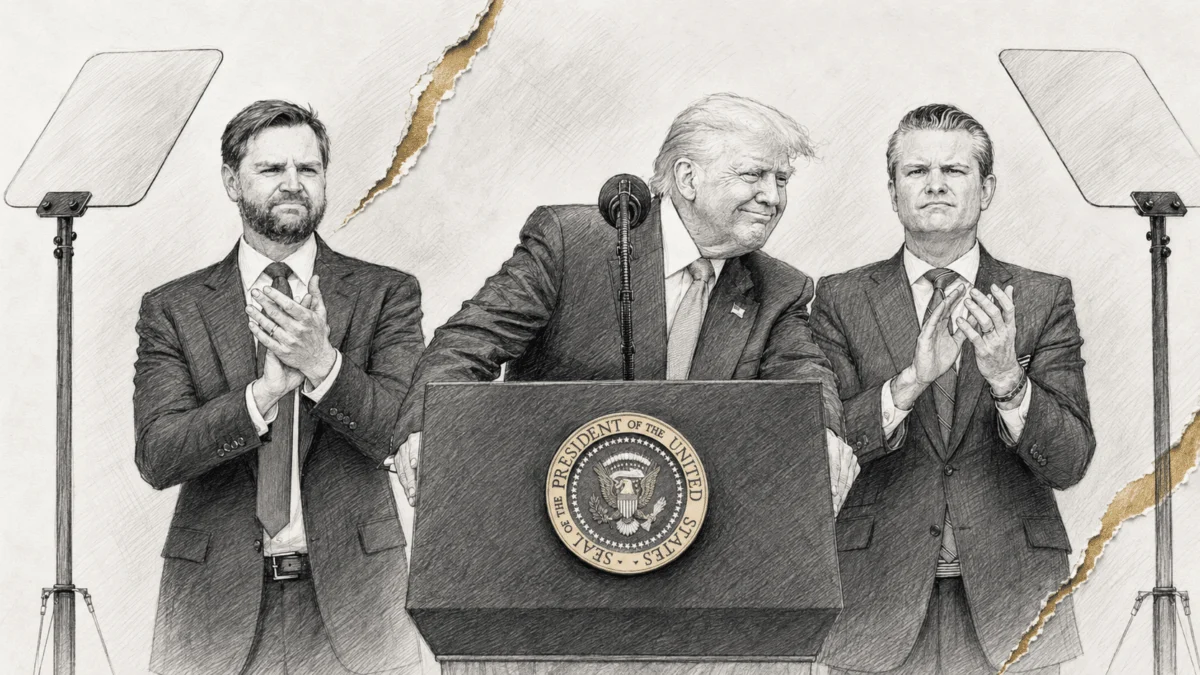
Gabriel Perez, the individual responsible for operating the teleprompter for the President of the United States since 2016, is reportedly engaged in settlement discussions with the Commodity Futures Trading Commission (CFTC). This development follows an internal flagging of his trading activities by Kalshi, a regulated prediction market. The investigation centers on allegations that Perez leveraged his privileged access to advance knowledge of presidential remarks to make profitable trades on the platform, potentially netting over $100,000.
Unprecedented Allegations Surface in Prediction Market Investigation
Sources familiar with a federal inquiry, as reported by ABC News, have detailed the nature of the allegations against Perez. He is accused of placing bets on the outcomes of more than a dozen presidential speeches over a three-month period. These speeches included significant addresses such as the State of the Union in February, a January appearance at the World Economic Forum in Davos, and remarks made at a Medal of Honor ceremony in March.
The wagers were placed on Kalshi’s "Mentions" market, a feature designed to allow users to bet on whether specific words or phrases would appear in publicly delivered speeches. Investigators have reportedly found evidence suggesting that Perez may have even exited positions mid-speech if President Trump deviated from the prepared remarks, a tactic that could indicate a sophisticated understanding of the teleprompter’s role and the potential for speech alterations.
Kalshi’s Role in Uncovering Alleged Misconduct
The prediction market platform, Kalshi, played a pivotal role in bringing these alleged transgressions to light. Its internal surveillance team detected unusual trading patterns associated with Perez’s account and subsequently referred the matter to the CFTC for further investigation. This proactive measure underscores the increasing sophistication of regulatory oversight within the burgeoning prediction market industry, particularly in efforts to prevent insider trading.
The CFTC, as the primary regulator of futures and options markets in the United States, has the authority to investigate and penalize violations of market integrity rules. The settlement talks suggest a desire by Perez to resolve the matter without prolonged litigation. Terms of such settlements typically involve returning ill-gotten gains and agreeing to refrain from similar activities in the future. While federal prosecutors in Manhattan have reportedly declined to pursue criminal charges, the regulatory ramifications remain significant.
The Prediction Market Landscape and Insider Trading Concerns
Kalshi operates in a relatively new and evolving financial landscape. Prediction markets, which allow individuals to bet on the outcome of future events, have garnered increasing attention from both regulators and lawmakers. The core appeal of these markets lies in their ability to aggregate diverse information and potentially offer insights into public sentiment and future occurrences. However, this very characteristic also presents fertile ground for insider trading if individuals with non-public information exploit it for financial gain.
The "Mentions" market, specifically, is designed to capitalize on the predictable nature of prepared speeches. By knowing in advance what specific phrases or words are slated for inclusion, an individual could theoretically place bets with a high degree of certainty. The alleged actions of Perez, if proven, represent a direct circumvention of the intended purpose of such markets and a potential abuse of his professional position.
Regulatory Efforts to Combat Insider Trading
In response to growing concerns about insider trading, platforms like Kalshi have been actively implementing stricter controls. Kalshi, along with other prominent prediction market operators such as Polymarket, has been working to enhance their compliance measures. These efforts include establishing robust surveillance systems to monitor trading activity and developing policies to prevent individuals from trading on material non-public information.
Indeed, Kalshi explicitly prohibits users from trading based on information obtained through their professional roles. The platform’s recent move to require users to disclose their employers is another step aimed at increasing transparency and accountability, making it more challenging for individuals to conceal conflicts of interest or the misuse of privileged information. These proactive measures are crucial for building trust and demonstrating to regulators, such as the CFTC and Congress, that prediction markets can operate with integrity.
The Broader Context: A Pattern of Prediction Market-Related Cases
The case involving Gabriel Perez is not an isolated incident and appears to be part of a growing trend of investigations into insider trading related to prediction markets. Previously, federal authorities have pursued cases involving individuals who allegedly used insider information to profit. These include a special forces soldier accused of betting on the capture of Venezuelan President Nicolás Maduro, and a Google employee who allegedly traded based on confidential internal data concerning search trends.
These cases highlight the challenges regulators face in adapting existing frameworks to new financial instruments and the evolving nature of information access. The CFTC’s involvement in the Perez case, as well as its previous actions in other prediction market-related investigations, signals a commitment to policing these markets for illicit activities.
Timeline of Alleged Activities and Investigation
While the precise start date of Perez’s alleged trading is not fully detailed, the investigation reportedly covers a three-month period. This period encompassed several high-profile presidential addresses, suggesting a sustained pattern of activity.
- Pre-2016: Gabriel Perez begins his role as a technical assistant to the President, eventually taking on the responsibility of operating the presidential teleprompter.
- 2016-Present: Perez continues to operate the presidential teleprompter, gaining extensive experience and intimate knowledge of the presidential communication process.
- Specific Three-Month Period (Undisclosed but encompassing February, January, and March): Alleged trading activity by Perez on Kalshi’s "Mentions" market. This period included bets on speeches such as the State of the Union, the World Economic Forum in Davos, and a Medal of Honor ceremony.
- Following the Speeches: Perez allegedly places bets on whether specific words or phrases would be included in the speeches. Investigators claim he sometimes exited positions mid-speech if the President deviated from the script.
- During or After Trading Period: Kalshi’s surveillance team detects suspicious trading patterns associated with Perez’s account.
- Referral to CFTC: Kalshi flags the trades and refers the matter to the Commodity Futures Trading Commission.
- Federal Investigation: The CFTC initiates an inquiry into Perez’s trading activities.
- Current Stage: Perez is reportedly in settlement talks with the CFTC.
- White House Response: The White House announces that Perez has been placed on unpaid administrative leave.
- Prosecutorial Decision: Federal prosecutors in Manhattan decline to open a criminal case.
Implications for the White House and Prediction Markets
The allegations against Perez carry significant implications for both the White House and the broader prediction market industry. For the White House, the involvement of a staff member in an alleged insider trading scheme, regardless of the platform, raises questions about security protocols and the vetting of individuals with access to sensitive information. The immediate placement of Perez on unpaid administrative leave suggests a swift response to mitigate reputational damage and demonstrate accountability.
For prediction markets, this incident underscores the ongoing challenge of balancing innovation and accessibility with the imperative of maintaining market integrity. While platforms like Kalshi are striving to implement robust compliance measures, high-profile cases like this can fuel skepticism among regulators and the public. The successful resolution of such cases through regulatory settlements, rather than criminal prosecutions, may be seen as a sign of the CFTC’s intent to regulate rather than stifle the nascent industry.
Analysis of Market Mechanics and Potential Violations
The "Mentions" market operates on a simple premise: users bet on the occurrence of specific keywords or phrases within a given text or speech. For example, a contract might be created that pays out if the word "economy" is mentioned in a presidential address. If Perez, through his role, knew that a particular phrase was definitively scheduled to be included or, conversely, was likely to be omitted, he would possess a significant informational advantage over other traders.
This advantage could be considered material non-public information, the exploitation of which forms the basis of insider trading allegations. The ability to withdraw from a trade mid-speech is particularly telling, as it suggests an awareness of real-time deviations from the planned remarks, a detail not available to the general public or even most other traders on the platform.
Official Statements and Reactions
As of the reporting date, direct statements from Gabriel Perez or his legal representatives have not been publicly released. However, his engagement in settlement talks with the CFTC indicates an acknowledgement of the seriousness of the allegations and a willingness to resolve the matter.
The White House has confirmed that Perez has been placed on unpaid administrative leave, a standard procedure in such circumstances pending the outcome of investigations.
The CFTC, as is customary in ongoing investigations and settlement negotiations, has not provided specific commentary on the case. Their mandate, however, is clear: to ensure the integrity of commodity and futures markets, which includes prediction markets that fall under their regulatory purview.
Kalshi, having flagged the suspicious trades, has effectively discharged its responsibility under its own rules and in cooperation with regulatory bodies. The platform’s commitment to combating insider trading is a crucial element in its ongoing efforts to maintain its operating license and build confidence in its market.
The Future of Prediction Markets and Regulatory Oversight
The ongoing scrutiny of prediction markets, exemplified by the case of Gabriel Perez, signals a critical juncture for this emerging industry. While the potential for these markets to provide valuable insights and innovative trading opportunities is significant, the risk of abuse through insider trading remains a paramount concern.
The CFTC’s active role in investigating and pursuing settlements in such cases demonstrates a proactive approach to regulation. The industry’s own efforts to self-regulate, through enhanced surveillance and stricter user policies, are equally important. The success of prediction markets in the long term will likely depend on their ability to navigate this delicate balance between innovation and integrity, ensuring that they are viewed as legitimate and fair platforms for all participants. The outcome of Perez’s settlement talks with the CFTC will undoubtedly be closely watched as a precedent for future cases involving similar allegations.

