

The debate surrounding user authentication and digital privacy has reached a critical juncture as cryptographers and security researchers grapple with the implications of widespread identity verification mandates. For over a year, privacy advocates and technology experts have warned that the rapid proliferation of government-backed age-verification laws, combined with the automated surveillance capabilities of modern artificial intelligence, threatens to usher in a restrictive privacy dystopia. As online platforms increasingly require real-world identities to access user-generated content, the fundamental architecture of internet security is undergoing a profound transformation.
The Problem of User Authentication in the Modern Era
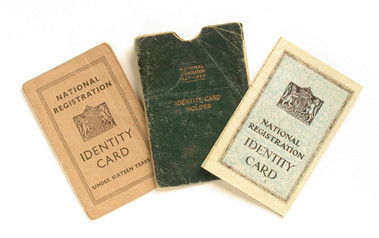
User authentication has historically formed the bedrock of computer security, governing how individuals prove their authorization to access servers, websites, and digital resources. In the early decades of the consumer internet, security protocols operated on a relatively casual paradigm. Platforms typically permitted pseudonymous participation, requiring little more than a basic anti-bot measure, a long-lived cookie, or a simple CAPTCHA to deter automated abuse.
However, this permissive environment has steadily deteriorated over the past decade. Driven primarily by the commercial incentives of the data-broker and advertising ecosystems, technology companies have aggressively pursued granular user profiling. More recently, this commercial motivation has been reinforced by a sweeping global legislative push for strict age-assurance frameworks. Across at least 25 U.S. states and dozens of foreign jurisdictions, newly enacted statutes compel platform operators to verify the chronological age of users before displaying restricted content.
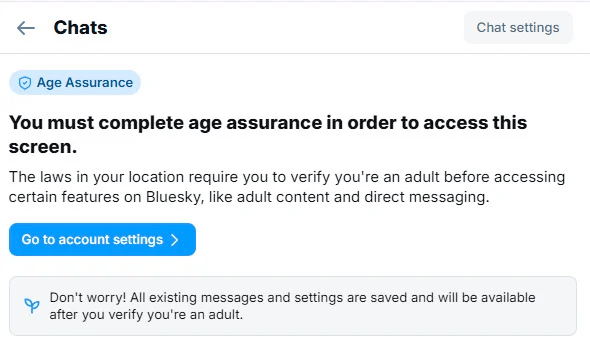
Although these laws were ostensibly designed to shield minors from harmful material, civil liberties organizations accurately predicted their broader systemic consequences. Routine identity checks have expanded rapidly from adult-oriented sites to mainstream social media networks, including Facebook, X, BlueSky, and Discord. Even reference platforms like Wikipedia have found themselves pressured by regulatory frameworks such as the United Kingdom’s Online Safety Act, which challenges traditional models of anonymous readership and contribution.
The Implication of Routine Government ID Checks
The widespread adoption of mandatory age verification carries severe implications for digital civil liberties. When platforms are forced to verify users through physical government-issued identification—such as driver’s licenses or passports—they inadvertently lay the groundwork for comprehensive, citizen-level transcripts of everyday internet activity.
While certain legislative proposals encourage data minimization by permitting platforms to discard personal information immediately following verification, such practices are rarely mandated universally. Furthermore, advertising-driven platforms face immense financial incentives to retain real-world identity records. In a digital landscape increasingly saturated by monetizable AI bots, precise human identity holds extraordinary commercial value. Consequently, security experts face a formidable paradox: how to sustain necessary authentication standards, particularly anti-bot and age-verification checks, without entirely sacrificing user privacy.
Historical Context: David Chaum and the Birth of Anonymous Credentials
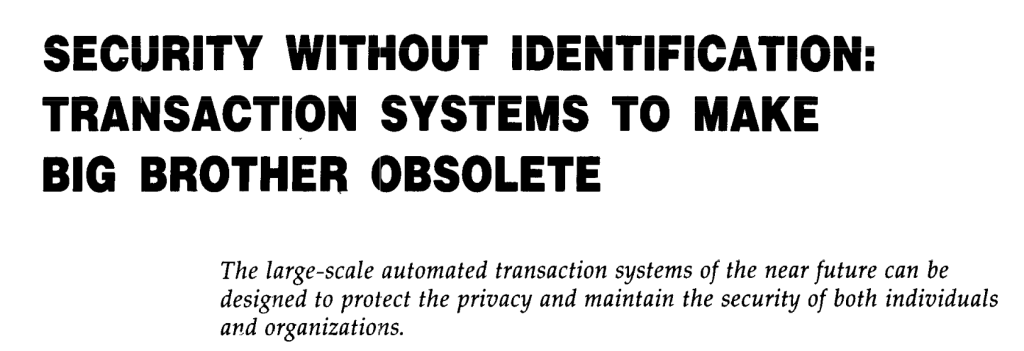
To understand the technological solutions available today, researchers often look back to foundational cryptographic concepts developed in the 1980s. Long before the advent of the modern web or smartphones, cryptographer David Chaum recognized that digital societies would eventually require citizens to present electronic credentials to navigate daily life. Anticipating the resulting privacy risks, Chaum proposed the concept of the anonymous credential.
In a conventional, non-anonymous authentication model, a user must present a credential tied directly to their real-world identity every time they access a resource. For example, purchasing a subscription with a credit card or verifying an age with a driver’s license establishes a permanent linkage between the user and the accessed resource. Advertising networks can subsequently correlate these interactions across multiple sites to build detailed behavioral profiles.
Chaum’s innovative framework sought to sever the cryptographic link between the issuance of a credential and its subsequent usage. Under this model, an issuing authority—such as a government agency or a trusted third party—verifies a user’s real-world identity during the initial issuance phase. However, when the user presents that credential to a resource provider, the verifier learns only that a valid credential has been presented by an authorized entity. The resource provider cannot determine the specific identity of the user, nor can it correlate multiple interactions to trace an individual’s browsing habits. This mechanism effectively allows users to hide within a broad anonymity set composed of all individuals who received similar credentials.
The Challenge of Digital Copying and Credential Cloning
Implementing anonymous credentials introduces significant technical hurdles, primarily stemming from the inherent differences between physical and digital objects. In the physical world, tangible credentials—such as a stamped wristband received at a nightclub entrance—are difficult to duplicate. In contrast, digital files can be copied effortlessly.
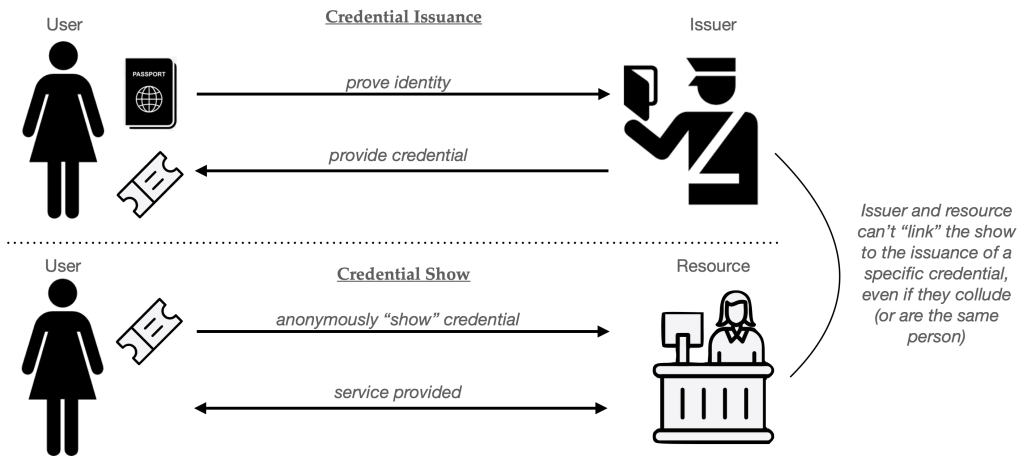
If an anonymous credential were simply a static digital file distributed identically to every user, a security breach could yield catastrophic consequences. A malicious actor who successfully steals a single valid credential could duplicate it infinitely, deploying an army of bot accounts or distributing access codes to unauthorized individuals.
In traditional non-anonymous systems, platforms mitigate credential theft through continuous authentication and monitoring techniques. Algorithms actively scan for anomalous behavior, such as a single account simultaneously logging in from geographically disparate locations. However, true anonymous credentials preclude these tracking methods by design, as every valid presentation of a credential looks identical to the next. Preventing widespread abuse without compromising privacy therefore requires sophisticated cryptographic mechanisms designed to limit duplication.
Single-Use Credentials and Blind Signatures

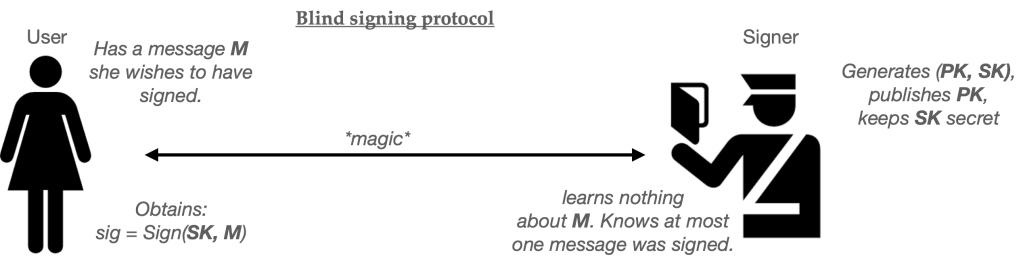
To combat the threat of cloning, early anonymous credential systems relied on single-use credentials powered by blind signature schemes. Developed as an extension of standard digital signatures, a blind signing protocol allows a user to obtain a cryptographic signature on a message from a server without the server ever learning the contents of that message.
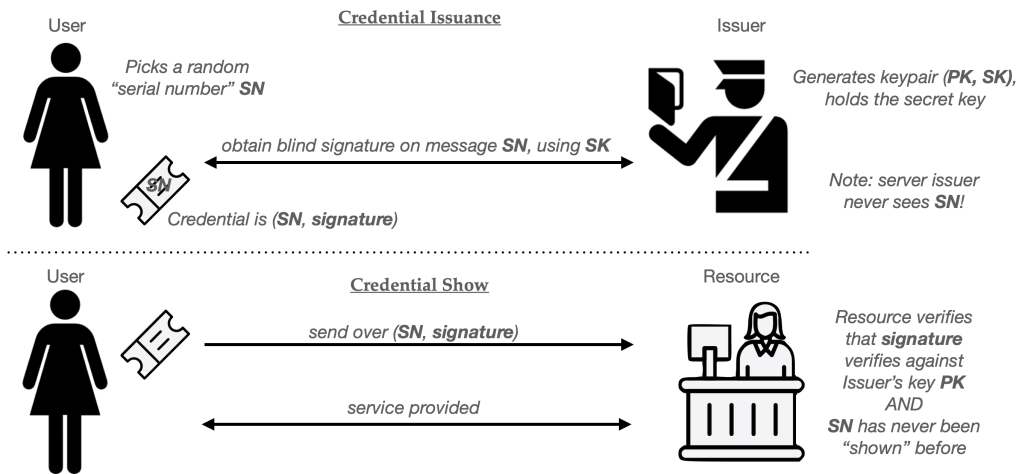
Within this framework, a user generates a random serial number, blinds it, and interacts with an issuer to receive a valid signature. When presenting the credential to a resource, the user submits the serial number alongside the signature. The resource verifies the signature against the issuer’s public key and checks a local database to ensure the serial number has not been used previously.
While effective, single-use credentials present distinct challenges regarding efficiency and expressiveness. Users who access digital resources frequently would be forced to obtain and expend thousands of single-use credentials daily. Furthermore, basic Chaumian credentials carry limited information, typically functioning like a binary flag indicating whether a specific condition has been met.

Zero-Knowledge Proofs and Expressive Credentials
Modern cryptography addresses the limitations of single-use credentials through the application of zero-knowledge (ZK) proofs. Non-interactive zero-knowledge proofs (NIZKs) allow a prover to demonstrate to a verifier that a secret statement is true without revealing any information beyond the validity of the statement itself.
By combining structured, digitally signed credentials—such as a cryptographic driver’s license—with zero-knowledge proofs, users can make complex, expressive assertions. For instance, a user can prove they are a resident of a specific jurisdiction and over a certain age without exposing their home address, legal name, or date of birth. Furthermore, zero-knowledge proofs enable the reuse of a single credential across multiple interactions without establishing a linkable trail between them.
Mitigating Clone Wars: N-Time Use and Revocation Strategies
While re-usable credentials offer significant efficiency gains, they reintroduce the vulnerability of credential theft. If a re-usable zero-knowledge credential is compromised, malicious actors could potentially exploit it indefinitely. To mitigate this risk, cryptographers have developed mechanisms that limit the lifespan and utility of individual credentials.
One prominent approach utilizes pseudorandom functions (PRFs) embedded within the credential during the issuance phase. By binding the credential to a secret key known only to the user, the system forces the generation of unique, deterministic serial numbers for each authorized use. If a credential is designed to permit a maximum of N uses, any attempt to exceed this threshold inevitably forces the repetition of a serial number, exposing the fraudulent activity when checked against the verifier’s database.
Additional security layers include expiration timestamps integrated directly into the zero-knowledge proof logic, ensuring credentials automatically become invalid past a designated date. Furthermore, advanced revocation protocols allow administrators to maintain banlists of compromised serial numbers. Users periodically prove via zero-knowledge proofs that their credentials do not correspond to any entry on the active banlist, thereby enabling platform moderation without sacrificing user anonymity.
Industry Implications and Future Outlook
As regulatory bodies globally continue to press for aggressive age-assurance and identity-verification frameworks, the tension between regulatory compliance and digital privacy will intensify. Traditional non-anonymous verification methods risk normalizing systemic online surveillance, transforming routine web browsing into an identifiable audit trail.

Ongoing technological developments—such as standards-based protocols like PrivacyPass and emerging proposals from major technology ecosystems to integrate zero-knowledge credentials with secure hardware elements—demonstrate that technical alternatives exist. Implementing these cryptographic frameworks effectively will require balancing performance, hardware security across heterogeneous device ecosystems, and regulatory acceptance. As the debate moves forward, the adoption of anonymous authentication standards may well determine whether the future of the internet preserves fundamental privacy rights or succumbs to pervasive digital tracking.

