
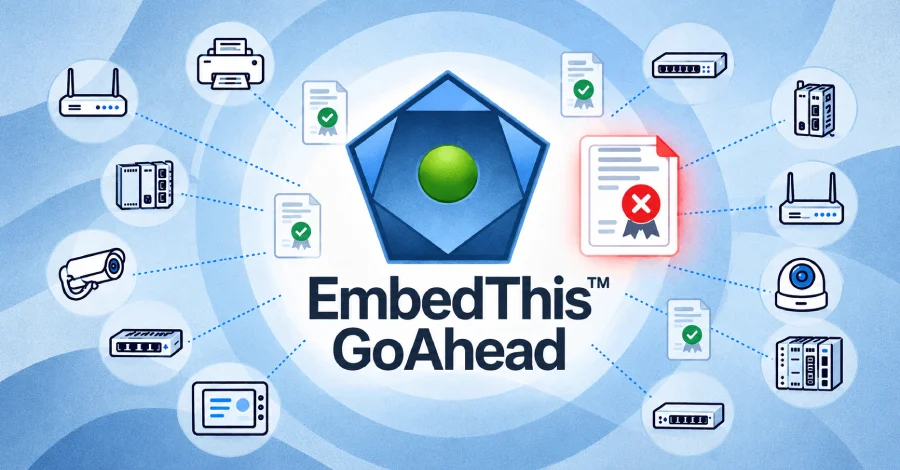
The GoAhead embedded web server, a ubiquitous software component found in hundreds of millions of industrial and consumer electronics, has been found to harbor a series of critical security vulnerabilities within its Transport Layer Security (TLS) implementations. The most significant of these flaws allows revoked client certificates to be silently accepted by the server, potentially granting unauthorized access to secured management interfaces on routers, printers, industrial controllers, and network gateways. These vulnerabilities, discovered by researcher Sébastien Féry of the cybersecurity firm FoxIO, were addressed by the vendor, EmbedThis, in the version 6.1.1 release, which began its rollout to device manufacturers on August 2, 2026, followed by a public disclosure on October 12, 2026.
The Scope of the Vulnerability
GoAhead is widely considered one of the world’s most popular embedded web servers. Its compact footprint and efficiency make it the engine of choice for manufacturers such as HP, Oracle, Siemens, Canon, Rockwell, D-Link, and Comcast. Because the software is bundled directly into the firmware of these devices, it functions as the silent administrator of countless network environments.
The primary flaw, identified as CVE-2026-115881, resides in the OpenSSL backend when configured for mutual-TLS (mTLS). In a secure mTLS environment, both the server and the client must present valid certificates to verify their identities. When an operator configures a Certificate Revocation List (CRL) to block compromised or retired certificates, the GoAhead server correctly loads the list into memory at startup without reporting errors. However, due to a failure in the logic that enforces these checks, the server ignores the CRL entirely. Consequently, a device using a stolen or revoked certificate can complete the TLS handshake, appearing entirely legitimate to the system. With a severity rating of 9.1, the vulnerability represents a significant risk to high-security environments where certificate-based authentication is the primary defense against unauthorized access.
Chronology of Discovery and Remediation
The timeline of this security incident highlights the complexities of patching embedded systems, which often lack the rapid, over-the-air update mechanisms found in desktop or mobile operating systems.

- August 2, 2026: EmbedThis releases GoAhead version 6.1.1 to its registered device manufacturing partners. This internal release serves as the primary remediation phase, allowing manufacturers to begin the process of integrating the patch into their proprietary firmware.
- October 12, 2026: EmbedThis issues a public advisory, making the details of the vulnerabilities available to the broader security community.
- October 26, 2026: Security researcher Sébastien Féry of FoxIO publishes a comprehensive technical breakdown of the three identified TLS bugs, providing the industry with the necessary context to assess their own exposure.
- October 27, 2026: As of this date, the assigned CVE identifiers for these vulnerabilities have not yet been fully propagated into the National Vulnerability Database (NVD), though the vendor has initiated the registration process.
Technical Analysis of the TLS Flaws
Beyond the certificate revocation failure, the research conducted by FoxIO identified two additional, backend-specific vulnerabilities that demonstrate the fragile nature of managing multiple TLS libraries within an embedded environment.
The second vulnerability affects builds using the legacy LibreSSL verifier. Under specific conditions—where client certificates are required but issuer checking is disabled—the server fails to enforce a 10-certificate limit on the certificate chain. An attacker can present a maliciously crafted, overly long chain that circumvents authentication, effectively bypassing the server’s identity verification. This issue, tracked as CVE-2026-115884, carries a severity rating of 7.4.
The third issue, which remains without a formal CVE designation, affects the Mbed TLS backend. A technical oversight—a length-calculation error—results in the server transmitting a 1-byte Diffie-Hellman (DH) value instead of the required 2048-bit value. While modern, robust clients (such as standard browsers or Java-based systems) will reject such a weak handshake and terminate the connection, less sophisticated embedded clients may accept it. If a client accepts the weak key exchange, a passive observer recording the network traffic could decrypt the session, exposing administrative credentials or sensitive configuration data. This flaw is rated 5.9 by the vendor.
The Challenge of Patching Embedded Infrastructure
The central problem in this disclosure is the "firmware gap." Unlike a standard server application that can be patched with a simple package update, GoAhead is integrated into the proprietary firmware of hardware devices. A patch from EmbedThis is only the first step in a long supply chain.
Once EmbedThis releases the update, the original equipment manufacturer (OEM) must test the new firmware, ensure it is compatible with their specific hardware, and distribute it to end-users. In many cases, these devices are installed in "set and forget" industrial settings, where updates are rarely performed. Because the choice of TLS backend and configuration settings is made at compile-time by the manufacturer, it is virtually impossible for an end-user to determine if their specific device is vulnerable without specialized testing or documentation from the manufacturer.

FoxIO has made efforts to assist in identifying these vulnerabilities by providing fingerprints through their JA4Scan tool. This tool allows security administrators to scan their networks to identify which GoAhead backend is being utilized. However, the tool provides only a fingerprint of the build, not a confirmation of vulnerability, leaving a significant burden on the user to verify their actual exposure.
A Secondary Critical Threat: The Login Bypass
While the TLS flaws have garnered significant attention, the 6.1.1 update also addresses a separate, equally concerning vulnerability: a login bypass affecting users utilizing the Blowfish password format. Introduced in version 6.1.0, the implementation of this format contains a logic error that allows an attacker to authenticate with any password, provided they have identified a valid username. Given that form-based login is the default configuration for most GoAhead-powered administration pages, this flaw represents a trivial entry point for unauthorized actors. EmbedThis has strongly advised users to rotate all administrative passwords following the application of the 6.1.1 patch to invalidate any credentials potentially compromised by this bypass.
Broader Implications for Industrial Security
The GoAhead security incident serves as a stark reminder of the risks associated with the proliferation of embedded systems in critical infrastructure. The reliance on diverse TLS backends (OpenSSL, LibreSSL, Mbed TLS) creates an expansive surface area for vulnerabilities, where a flaw in one library may not exist in another, yet all remain under the banner of the same web server.
As of late October 2026, there have been no confirmed reports of these vulnerabilities being actively exploited in the wild. This "quiet" release period is consistent with the coordinated disclosure process championed by EmbedThis. However, the presence of proof-of-concept code and the widespread availability of scanning tools significantly lowers the barrier to entry for malicious actors.
The security of millions of devices now depends on the responsiveness of manufacturers. For industrial operators and network administrators, the directive is clear: check the firmware version of all management interfaces, monitor manufacturer portals for updates, and, where possible, restrict access to management pages to trusted internal networks only. The vulnerability of the GoAhead server underscores the reality that in the modern interconnected world, the security of the enterprise is only as strong as the smallest, most overlooked device on the network. As organizations continue to integrate more IoT devices, the need for standardized, rapid, and transparent patching processes becomes not just a best practice, but a requirement for operational stability.
