
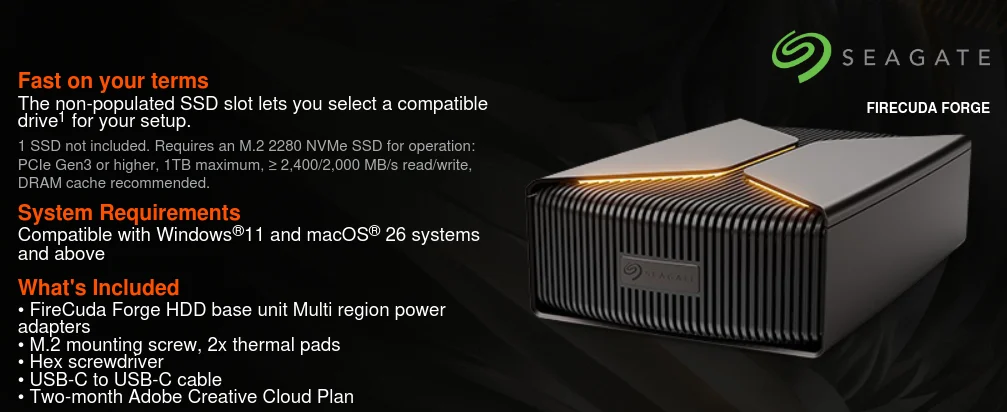
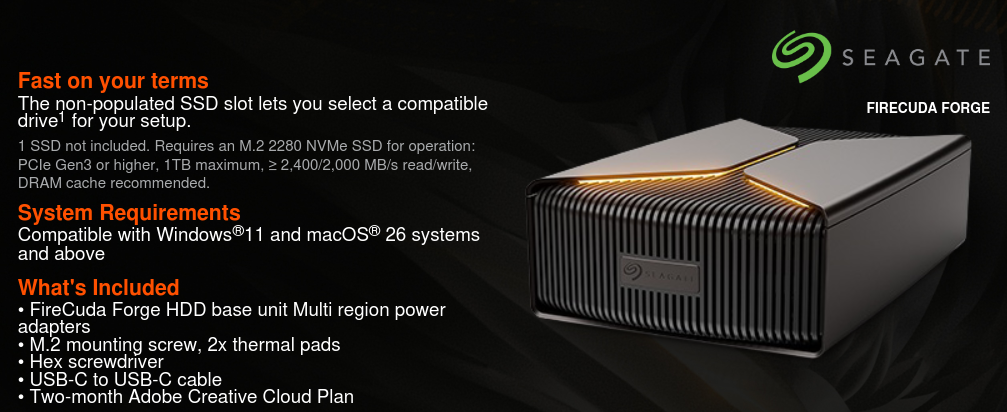
Seagate has officially unveiled its new FireCuda Forge storage line, a move that signals a surprising return to hybrid drive technology in a market long dominated by pure solid-state storage. By pairing high-capacity mechanical hard disk drives (HDDs) with user-provided NVMe SSDs, the company is attempting to address the surging costs of storage that have plagued the industry throughout 2026. This hybrid solution, powered by the newly developed Alkemi intelligent storage platform, represents a strategic pivot aimed at balancing the massive capacity requirements of modern data libraries with the high-performance needs of contemporary computing.
The FireCuda Forge is available immediately via Seagate’s online storefront. The hardware is sold as a standalone enclosure containing the mechanical drive, with the consumer responsible for supplying a compatible M.2 2280 NVMe SSD. The product is launching in two distinct configurations: an 8TB model priced at $699 and a 20TB flagship model priced at $899.
Technical Specifications and Hardware Requirements
The technical requirements for the user-supplied SSD are specific, reflecting the high-performance targets Seagate has set for the FireCuda Forge. To ensure compatibility, users must utilize a PCIe Gen3 or higher M.2 2280 NVMe drive. While the system can manage an SSD capacity of up to 1TB, the performance ceiling is heavily dependent on the quality of the flash memory installed.
Seagate recommends an SSD equipped with onboard DRAM cache to maintain responsiveness. The drive must meet a minimum performance threshold of 2,400MB/s for read operations and 2,000MB/s for write operations. When correctly configured, Seagate claims the combined system will deliver a sustained throughput of 2,500MB/s read and 2,000MB/s write. The system leverages USB4 connectivity for high-speed data transfer and maintains native compatibility with modern operating systems, including Windows 11 and macOS 26 and later.
The Macroeconomic Context of Storage Pricing
The return of the hybrid drive is not merely a product development decision; it is a direct response to the volatile storage market of 2026. The widespread integration of generative artificial intelligence and large-scale data processing has placed unprecedented pressure on the global supply chain for NAND flash and high-density magnetic storage.
As reported by industry analysts and corroborated by price tracking services like Tom’s Hardware, the cost per terabyte for solid-state storage has experienced a significant inflationary surge. In many instances, the retail price of consumer-grade SSDs has reached levels two to three times higher than the historical lows observed in the early 2020s. Mechanical storage has faced similar upward pressure. Data from PCServerParts indicates that enterprise-grade mechanical drives, such as the Seagate Exos 24TB, saw their retail pricing shift from approximately $298.99 in the summer of 2025 to $699.99 by August 2026. In this economic climate, the hybrid model—which utilizes a cheaper, high-capacity mechanical core—offers a more accessible entry point for users requiring massive storage footprints.
Historical Context: The Rise and Fall of Fusion Drives
To understand the industry’s skepticism regarding the FireCuda Forge, one must look back at the "hybrid" era of the mid-2010s. The most prominent example was Apple’s Fusion Drive, introduced in 2012 for the Mac mini. The concept was conceptually identical: a mechanical HDD and a smaller SSD combined into a single logical volume managed by software.
The primary utility of the Fusion Drive was to automatically move frequently accessed files ("hot data") to the faster SSD, while keeping cold data on the HDD. However, these systems were notoriously fragile. Because the volume was created as a striped or concatenated logical set, the failure of either physical component usually resulted in the total loss of the logical volume. Recovering data from a failed Fusion Drive was a complex task, often requiring professional data recovery services. As NAND prices fell significantly toward the end of the decade, the industry largely moved toward all-flash configurations, rendering the hybrid concept obsolete for most consumer applications.
Alkemi: A New Intelligence Platform
Seagate claims the Alkemi platform is designed to overcome the limitations of previous hybrid technologies. Unlike the Apple Fusion Drive, which relied on macOS-level tiering, Alkemi performs its management at the enclosure level. According to the company’s internal documentation, Alkemi utilizes an adaptive learning algorithm to monitor file access patterns, ensuring that high-demand content remains on the SSD, while the HDD handles long-term storage of growing libraries.
Despite these claims, Seagate has been notably sparse on technical details regarding the architecture of the Alkemi system. The company describes it as a "two-tier storage system," but it remains unclear whether the platform utilizes traditional caching, intelligent block-level migration, or a combination of both. Furthermore, the company has yet to clarify how the system handles the "first-boot" scenario—specifically, whether new data is written exclusively to the SSD until the 1TB capacity is reached, or if the algorithm immediately begins distributing files based on predicted usage.
Critical Implications and Unanswered Questions
The most pressing concern for potential adopters is the question of system reliability. Seagate’s press release does not specify the fault-tolerance protocols of the Alkemi platform. In traditional RAID configurations, data parity is used to protect against drive failure, but hybrid drives typically lack the overhead for standard parity-based protection without sacrificing the very speed they aim to provide.

If the Alkemi system functions similarly to Intel’s legacy Smart Response Technology (SRT), it might mirror data to provide a safety net, but that would necessitate a larger SSD or a lower effective capacity. If it functions as a tiered system, the failure of the mechanical HDD could still render the data on the SSD inaccessible or inconsistent, effectively repeating the risks of the 2012 era.
The lack of published technical documentation regarding data recovery and failure handling suggests that the FireCuda Forge is positioned as a consumer-convenience product rather than an enterprise-grade reliability solution. While it offers a bridge between the capacity of HDDs and the speed of NVMe, the user assumes a level of risk that has not been present in the all-flash era.
Future Outlook
Seagate’s move to resurrect the hybrid drive is a calculated risk. If the Alkemi platform proves to be as robust as the company claims, the FireCuda Forge could become a popular solution for content creators, gamers, and professionals who need massive, high-speed storage without the exorbitant cost of high-capacity SSD arrays. Conversely, if the system suffers from the same reliability issues that plagued earlier hybrid solutions, it may face stiff resistance from a user base that has grown accustomed to the relative simplicity and durability of modern flash storage.
As the product reaches the retail market, the industry will be watching closely to see how the Alkemi platform performs in real-world, high-load environments. The answers to the fundamental questions of data integrity, recovery, and long-term endurance will determine whether the FireCuda Forge is a viable evolution of storage technology or an artifact of a bygone era that simply cannot compete with the reliability standards of the modern age. For now, the FireCuda Forge stands as an interesting, albeit unproven, attempt to solve the 2026 storage crisis with a technology that has yet to shed its historical reputation for complexity.
