

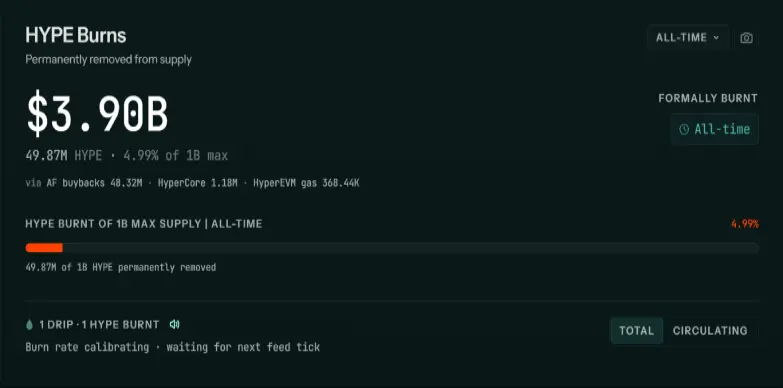
The native cryptocurrency of the Hyperliquid decentralized exchange, HYPE, has experienced a significant market rally, climbing more than 16% over the past 24 hours to reach a trading price of $92. This upward trajectory follows a landmark announcement involving the Intercontinental Exchange (ICE)—the parent organization of the New York Stock Exchange—and fintech developer trade[XYZ]. The two entities have confirmed a collaborative effort to construct a U.S.-regulated, 24/7 perpetual futures market leveraging Hyperliquid’s underlying blockchain architecture. Beyond the institutional validation provided by this partnership, HYPE has benefited from an aggressive deflationary mechanism that has successfully removed roughly 5% of the total token supply from circulation, creating a scarcity-driven tailwind for investors.
Institutional Synergy: Bridging Wall Street and Decentralized Finance
On October 29th, the Intercontinental Exchange formally solidified its strategic alliance with trade[XYZ] to develop a domestic derivatives platform built on blockchain technology. This initiative aims to provide retail investors in the United States with access to 24-hour continuous futures contracts, provided that the necessary regulatory approvals are obtained. By utilizing Hyperliquid as the settlement layer, the project intends to bring the efficiency of decentralized infrastructure to the traditional finance sector.
The technical foundation of this venture is the Hyperliquid Improvement Proposal 3 (HIP-3), a protocol update specifically engineered to accommodate permissioned, regulated application layers on top of public blockchain systems. This architecture allows for a critical separation of duties: while the decentralized layer facilitates high-speed matching and settlement, the deployment entity retains control over user access. By integrating an on-chain allowlist managed directly by the operator, institutions can implement rigorous Know-Your-Customer (KYC) and Anti-Money Laundering (AML) protocols without sacrificing the performance benefits of a blockchain-based matching engine.
The strategic importance of this development is underscored by the involvement of prominent macro investor Stan Druckenmiller, who has provided support for the project. Furthermore, ICE’s decision to make a strategic equity investment in trade[XYZ] signals a high level of institutional commitment. Analysts suggest that this structural design serves as a "walled garden" approach; the platform will operate as a distinct, permissioned U.S. deployment, while the existing trade[XYZ] offshore markets—which operate under standard, permissionless HIP-3 parameters—will continue to function independently. This dual-track approach allows the organization to capture the benefits of innovation while remaining fully compliant with local, sovereign regulatory frameworks.
Deflationary Dynamics: The Impact of Token Incineration
The bullish momentum in the HYPE market is not solely driven by the ICE partnership; it is equally supported by a fundamental shift in the asset’s supply-demand dynamics. Data from the Hyperliquid network indicates that the protocol has permanently removed 49.87 million HYPE tokens from its maximum supply of 1 billion. This represents a 4.99% reduction in total token count, a move that has historically signaled confidence to the market and reinforced the value proposition of the token.

This deflationary pressure is the direct result of the network’s programmatic monetization strategy. As a decentralized exchange, Hyperliquid generates revenue through transaction fees, a portion of which is channeled into an automated smart contract buyback engine. Over the past 24-hour verification window, the network processed approximately $1.69 million in daily protocol fees, which were subsequently used to acquire and incinerate an additional 19,700 HYPE tokens. With cumulative lifetime revenue for the protocol estimated at roughly $1.38 billion, the platform has demonstrated a sustainable model for value accrual that benefits long-term token holders.
The market capitalization of HYPE, currently hovering around $3.89 billion, reflects both the success of this transaction-driven revenue model and the growing institutional interest in the network’s high-throughput capabilities.
Technical Analysis and Market Trajectory
From a technical perspective, the price of HYPE has shown remarkable resilience. Over the past five days, the asset has rebounded from a local low of $76.24 to a high of $91.14, representing a total appreciation of 19.5%. This movement has effectively neutralized the overhead resistance previously identified at $88.11, allowing the price to move above the 20-day and 50-day exponential moving averages (EMAs).
Market participants view the reclamation of these EMAs as a bullish indicator, suggesting that the prevailing sentiment has shifted from consolidation to accumulation. If the current support levels hold—particularly in the wake of the initial media attention surrounding the ICE-trade[XYZ] announcement—technical analysts posit that the asset could see an additional 18.75% upside. Such an increase would place the token at a price point of approximately $108.20, potentially challenging the resistance trendline of a long-term channel pattern. While market conditions remain fluid, the combination of institutional-grade infrastructure, a robust fee-generation model, and consistent deflationary activity provides a solid floor for the current valuation.
Chronology of Development and Strategic Alignment
The recent market activity is the culmination of several months of quiet infrastructure development within the Hyperliquid ecosystem. The rollout of HIP-3 was a pivotal moment, as it signaled the protocol’s intent to move beyond the constraints of permissionless, purely retail-focused decentralized finance. By allowing developers to launch dedicated, independent perpetual exchanges, the Hyperliquid team effectively positioned the network to serve as a "layer one for derivatives," rather than just an application.
The following timeline highlights the progression of this transition:
- Initial Protocol Development: Hyperliquid establishes its reputation as a high-speed, decentralized matching engine.
- Introduction of HIP-3: The network adopts the Hyperliquid Improvement Proposal 3, enabling permissioned application layers.
- Regulatory Alignment: Developers and institutional stakeholders begin testing the integration of KYC-enabled layers on top of the public chain.
- Strategic Partnership Announcement (Oct 29): ICE and trade[XYZ] publicly commit to using the infrastructure for a regulated U.S. perpetuals market.
- Market Realignment: Following the news, HYPE experiences a surge in volume, leading to the rapid burning of tokens via the network’s automated buyback mechanism.
Broader Implications for Decentralized Finance
The partnership between ICE and trade[XYZ] represents a significant milestone in the convergence of traditional finance (TradFi) and decentralized finance (DeFi). For years, the barrier to institutional entry in the cryptocurrency derivatives space has been the perceived lack of compliance infrastructure and the absence of clear regulatory oversight. By embedding compliance rules directly into the blockchain’s settlement layer, the Hyperliquid model offers a blueprint for how regulated entities might safely participate in on-chain markets.
Industry observers note that this development may catalyze a broader trend where major exchanges look to adopt high-performance, distributed ledger technology to modernize their settlement cycles. If the U.S.-regulated platform succeeds in launching, it will likely provide a validation point for other decentralized protocols, potentially leading to increased demand for "permissioned-friendly" blockchain architectures.
Furthermore, the success of Hyperliquid’s fee-driven deflationary model offers a counter-narrative to projects that rely solely on inflationary token emissions to attract liquidity. By tying token supply reduction directly to the volume of transactional activity, Hyperliquid has created a system where the growth of the platform directly enhances the scarcity of its native token. This alignment of interests—between the protocol, its developers, and its token holders—is increasingly being recognized by the market as a key differentiator in the competitive landscape of decentralized exchanges.
Concluding Outlook
As the market digests the implications of the ICE partnership, attention will likely shift toward the regulatory timeline for the U.S. platform. The ability of the project to clear legal hurdles will be the primary catalyst for further institutional adoption. Meanwhile, the consistent removal of tokens from circulation will continue to act as a supportive force, potentially mitigating downside volatility should market sentiment cool.
Investors are currently focused on whether HYPE can sustain its position above the $90 support level. With the combination of institutional validation and a demonstrably successful revenue model, the asset is currently viewed as a significant player in the evolution of digital asset trading. Whether the projected 18% price appreciation is realized remains subject to broader macroeconomic conditions and the continued execution of the technical roadmap, but the current momentum suggests that the market has responded favorably to the promise of regulated, blockchain-based derivatives trading.
