
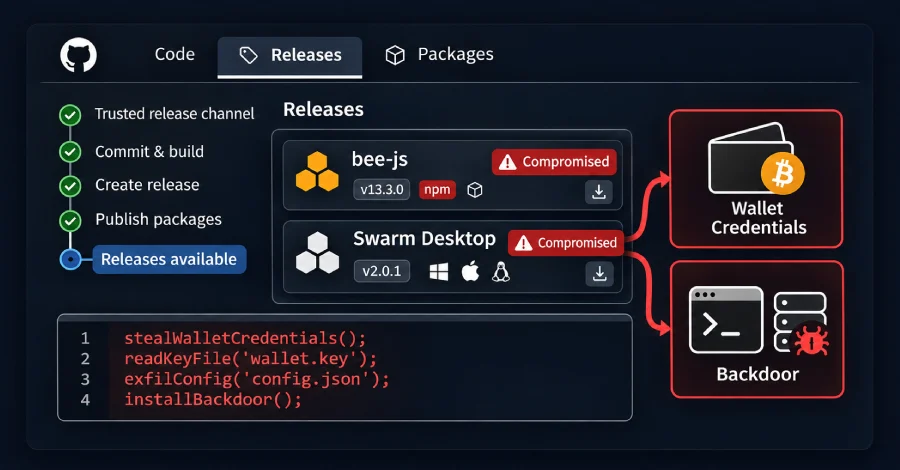
In a significant security breach affecting the decentralized storage ecosystem, attackers successfully compromised the Ethersphere project’s automated release pipeline, leading to the distribution of malicious versions of two core tools: the bee-js JavaScript library and Swarm Desktop. The incident, which unfolded over several hours, exposed users of the Swarm network to sophisticated malware capable of exfiltrating sensitive wallet credentials and establishing persistent backdoors on Windows, macOS, and Linux systems.
The breach, identified by supply chain security firm Socket, highlights the increasing vulnerability of automated CI/CD (Continuous Integration/Continuous Deployment) pipelines. By gaining unauthorized access to Ethersphere’s automated release credentials, the attackers bypassed traditional code review processes, effectively weaponizing the project’s own infrastructure to deliver tainted software to unsuspecting users.
The Anatomy of the Breach
The compromise centered on two specific releases published through the compromised automation workflow: bee-js version 13.3.0 and Swarm Desktop version 0.56.2.
The bee-js package, a critical JavaScript library that serves as the backbone for the Swarm Desktop application and the swarm-cli command-line tool, was tainted and published to the npm registry. The malicious version remained live for approximately 75 minutes, from 00:09 to 01:25 UTC. Because the malicious code was embedded within a postinstall script, it executed automatically upon installation, requiring no interaction from the user beyond the initial npm install command.
Simultaneously, the Swarm Desktop 0.56.2 release was pushed to GitHub. This version was particularly dangerous as it utilized the application’s built-in auto-updater. According to incident analysis, the malicious binary was pushed at 00:36 UTC and remained active for approximately 8.5 hours. During this window, the application’s update mechanism automatically served the compromised version to Windows x64 and Apple Silicon-based macOS users, significantly widening the attack surface.

Malware Functionality and Exfiltration Tactics
The payload deployed in both instances was a highly targeted loader designed to strip users of their digital assets. Upon execution, the malware would scan the local machine for specific configuration files associated with the Swarm Desktop node, specifically targeting config.yaml and the encrypted swarm.key file.
The danger of this combination cannot be overstated. While swarm.key is an encrypted Ethereum keystore, Swarm Desktop historically stored the required decryption password in plain text within the config.yaml file. By harvesting both files, the attackers gained the ability to decrypt the wallet, providing them full access to the victim’s xDAI, xBZZ tokens, chequebook funds, and any staked assets within the Swarm network.
Beyond financial theft, the malware functioned as a persistent backdoor. On macOS and Linux, it installed a Go-based remote shell dubbed "evjawbreaker." This tool was designed to masquerade as a background service or launch agent, effectively granting the attackers persistent remote access to the host machine. On Windows, the malware took a different approach, surreptitiously installing a legitimate, signed instance of the ConnectWise ScreenConnect remote access client. By leveraging a signed, reputable tool, the attackers were able to bypass standard security heuristics and establish a reliable command-and-control channel.
Chronology of the Incident
The timeline of the attack reveals a coordinated effort to maximize reach while minimizing detection time:
- Pre-event: Attackers likely compromised CI/CD secrets or developer credentials belonging to the Ethersphere team.
- 00:09 UTC: The malicious bee-js 13.3.0 is published to the npm registry via an automated script.
- 00:36 UTC: The malicious Swarm Desktop 0.56.2 is published to GitHub, triggering the auto-update mechanism for Windows and Apple Silicon users.
- 01:25 UTC: The compromised bee-js 13.3.0 is removed from the npm registry.
- 08:27 UTC: By this time, Swarm Desktop 0.56.2 had reached approximately 65 installations, according to tracking data.
- 09:00 UTC (approx): The Ethersphere maintainers officially withdraw the malicious 0.56.2 release and publish a clean version, 0.56.3.
Industry Response and Remediation
The Ethersphere team acted to remediate the situation by releasing version 0.56.3, which essentially reverted the software to the known-good state of version 0.56.1 while utilizing a newly issued Developer ID certificate to restore the chain of trust for macOS users. However, project maintainers and security analysts have issued stark warnings: the simple act of updating to the clean version does not remove the backdoors already installed by the malicious 0.56.2.
Security firms including Socket and SafeDep have advised that any machine that had the malicious software installed must be treated as fully compromised. This entails a complete wipe of the system, rotation of all cryptographic keys associated with the node, and an audit of all stored sensitive information.

Broader Implications for Decentralized Projects
This incident serves as a sobering case study on the risks associated with modern software supply chains. By exploiting "provenance," the attackers were able to give the malicious packages an air of legitimacy. Because the malicious code was built by the project’s own infrastructure, it carried valid signatures and records, which can trick both automated security scanners and human developers into believing the package is authentic.
The connection to previous attacks, specifically the "SleepyDuck" malware campaign discovered in the Open VSX marketplace, suggests a well-resourced actor or group. The overlap in infrastructure—specifically the use of Ethereum smart contracts to update command-and-control server addresses and the use of the ScreenConnect tool—indicates a shift in tactics toward targeting developers and users of Web3 infrastructure.
The Future of CI/CD Security
The Ethersphere breach has prompted an immediate review of security policies within the project. Moving forward, the maintainers have implemented strict requirements for signing jobs, which now mandate approval from the DevOps team and are restricted to specific branches of the codebase.
This event underscores a critical reality: the decentralization of storage does not automatically equate to the decentralization of security. As long as projects rely on centralized CI/CD pipelines to distribute code, those pipelines will remain the "crown jewels" for attackers. The industry is now facing a reckoning regarding the trust placed in automated systems. Experts are increasingly calling for the adoption of "Reproducible Builds," where multiple independent entities build the same source code to verify that the final binary is identical, thereby ensuring that a compromise of one pipeline does not automatically result in the distribution of malicious code.
For users of the Swarm network, the immediate takeaway is one of vigilance. The reliance on automated updates, while convenient, must be balanced with the understanding that even trusted software can be weaponized in the blink of an eye. The era of blind trust in package managers and auto-updaters is closing, replaced by a new requirement for deep, continuous verification of the software supply chain. As of the latest reports, no widespread theft of funds has been confirmed, but the potential for long-term damage remains significant given the persistent nature of the backdoors deployed during this brief but impactful window of exposure.
