
The Federal Reserve’s decision on Wednesday to maintain the federal funds rate within the target range of 3.75% to 4.00% has underscored a period of profound uncertainty for global financial markets, with the digital asset sector navigating a particularly precarious landscape. While the decision to hold rates steady was largely anticipated by institutional investors, the underlying volatility within the Federal Open Market Committee (FOMC) has signaled that the era of "easy money" is effectively concluding. For the cryptocurrency market, specifically Bitcoin, this hawkish macro environment has created a ceiling on speculative growth, leaving the leading digital asset anchored near the $79,500 threshold as investors weigh the rising opportunity cost of capital against the prospect of continued inflationary pressure.
The Anatomy of the October FOMC Decision
The most significant takeaway from the October session was not the maintenance of current rates, but the emergence of a rare and pronounced internal fracture within the FOMC. The committee voted 10-2 to maintain the status quo, yet the presence of two dissenting votes—Fed Governor Lisa Cook and Cleveland Fed President Beth Hammack—sent a ripple of apprehension through bond and equity markets. Both officials advocated for an immediate 25-basis-point increase, arguing that the persistent nature of U.S. inflation, currently hovering near 3.7%, necessitates more aggressive intervention than the committee’s majority suggests.
Fed Chairman Kevin Warsh characterized the deliberations as a "heck of a family fight," a candid acknowledgment of the intellectual tug-of-war occurring within the halls of the central bank. The core of this conflict lies in the divergence between economic data and policy outcomes. Despite months of restrictive monetary policy, the U.S. economy has displayed surprising resilience in labor and consumer sectors, keeping inflation well above the Fed’s stated long-term objective of 2%. The dissenters argue that this resilience is a signal that the current rates are not yet restrictive enough to fully dampen consumer demand, thereby necessitating further tightening.
Operational Overhauls and Future Policy Constraints
Beyond the immediate interest rate decision, Chairman Warsh unveiled a significant restructuring of the Federal Reserve’s calendar, a move intended to shift the focus from reactive, short-term adjustments to long-term structural stability. Starting in the fall of 2027, the frequency of active rate-setting meetings will be reduced to seven annually, with a further reduction to six meetings scheduled for 2028. Future sessions not dedicated to rate setting will focus exclusively on long-term monetary policy, effectively signaling to markets that the Federal Reserve intends to move away from the high-frequency volatility that has characterized the post-pandemic era.
For the cryptocurrency sector, this shift carries profound implications. Historically, digital assets have thrived in environments defined by high liquidity and rapid shifts in monetary policy. By restricting policy moves to broader ranges and less frequent intervals, the Federal Reserve is effectively removing the potential for "dovish pivots" that traders have come to rely on for price discovery. Risk assets will likely remain under a persistent cycle of macroeconomic strain, where the lack of timely, targeted rate reductions forces capital to remain in more traditional, yield-bearing instruments like short-term Treasury bills.
The Opportunity Cost of Capital and Institutional Appetite
The primary headwind for Bitcoin and the broader altcoin market is the sustained attractiveness of risk-free yields. With short-term Treasury yields holding at approximately 4%, the opportunity cost of allocating capital to digital assets—which carry higher volatility and regulatory risk—has increased significantly. Institutional investors, who have been the primary drivers of Bitcoin’s price appreciation over the past two years, are increasingly finding that the risk-adjusted returns of traditional fixed-income products are competitive with the growth potential of crypto-assets.
This shift in sentiment is clearly reflected in market liquidity. While Bitcoin has maintained a baseline of support near $79,500, the broader altcoin market has experienced a significant liquidity drought. Capital is increasingly concentrating within the Bitcoin ecosystem, reinforcing its dominance as a "digital gold" proxy while simultaneously leaving speculative altcoins vulnerable to sharp corrections. This trend suggests that until there is a clear roadmap for interest rate cuts, the market will likely see a continued bifurcation between the largest, most liquid assets and the remainder of the digital asset space.
Market Chronology: A Path to the December FOMC
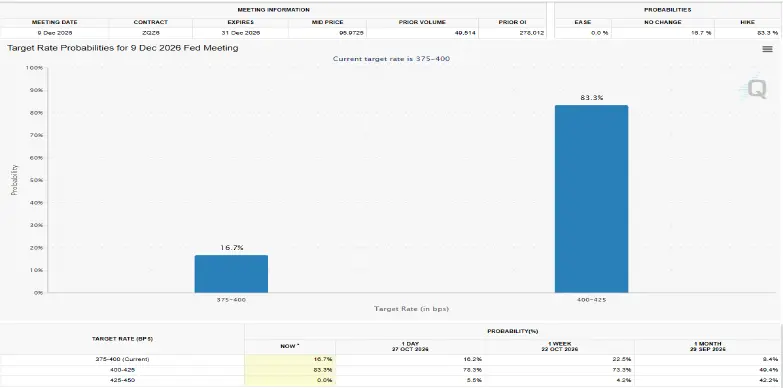
The market’s attention has pivoted almost instantaneously toward the December meeting. Current data from the CME FedWatch Tool indicates an 82% probability of a 25-basis-point rate hike in December, a reflection of the market’s growing belief that the FOMC’s hawkish wing will eventually command a majority.
The following timeline highlights the progression of market expectations:
- Late Q3 2026: Markets begin to price in a "higher-for-longer" interest rate environment as inflation data remains stubbornly elevated.
- Early October 2026: Anticipation of the FOMC meeting leads to a period of consolidation, with Bitcoin trading in a tight range.
- October 28, 2026: The FOMC announces a rate hold with a 10-2 split, confirming internal disagreements regarding future policy.
- Current Period: Market participants are monitoring consumer spending and employment indicators to gauge the likelihood of the anticipated December hike.
The consensus is that if economic data remains "hot"—specifically if employment numbers remain strong and consumer spending does not crater—the Federal Reserve will feel emboldened to raise rates, regardless of the potential for short-term market volatility.
Technical Analysis: The Bull Flag Conundrum
From a technical perspective, the current price action of Bitcoin presents a classic, albeit fragile, setup. The $79,500 support level is currently acting as the bottom of a "bull flag" pattern, a technical formation typically associated with a period of consolidation followed by a significant move upward. The formation consists of a long "pole," representing the recent recovery, and a "flag," which is the current sideways movement observed since the FOMC announcement.
If Bitcoin can successfully defend the $79,500 level, analysts suggest a potential rebound of approximately 8.25%, which would test the flag’s resistance at $86,100. A breach of this resistance could act as a catalyst for a further climb toward the $98,000 level. Conversely, should the asset fail to maintain the $79,500 support, the technical breakdown could lead to an accelerated correction, potentially testing the $75,000 floor. This level is viewed as a critical psychological and technical threshold; a failure to hold would likely signal a more prolonged bear cycle for the crypto market.
Broader Implications for the Financial Ecosystem
The macroeconomic environment of late 2026 represents a structural change for the digital asset industry. The "cheap money" era, which provided the liquidity necessary for the 2020-2021 bull market, is firmly in the rearview mirror. For crypto-native firms, this necessitates a shift in business strategy. Profitability and sustainable cash flow are becoming as important as growth, as the era of easy venture capital funding has been curtailed by the same rising rates that have impacted Bitcoin’s price.
Furthermore, the increased focus on long-term policy by the Federal Reserve suggests that investors should expect a more predictable, albeit more restrictive, environment. While this reduces the likelihood of the erratic, policy-driven price spikes that defined the early years of the crypto industry, it also introduces a period of maturity. Assets that can provide utility and clear value propositions will be better positioned to survive in a high-rate environment than those relying solely on speculative fervor.
Concluding Outlook
As the final quarter of 2026 progresses, the cryptocurrency market finds itself at a crossroads. The Federal Reserve’s decision to hold rates has provided a temporary, if uneasy, stability, but the underlying inflationary pressures and the internal discord within the FOMC suggest that further tightening is on the horizon. Bitcoin’s ability to remain within its current technical channel will be the primary indicator of market health in the coming weeks. For traders and investors alike, the prevailing reality is one of caution: the market is no longer driven by the expectation of an immediate return to zero-bound interest rates, but by the necessity of adapting to a high-rate, lower-liquidity future. Whether Bitcoin can break through its current resistance levels or succumb to the macro-economic weight of the Fed’s tightening cycle will depend heavily on the incoming data and the committee’s resolve in the final, and potentially most consequential, meeting of the year in December.
