
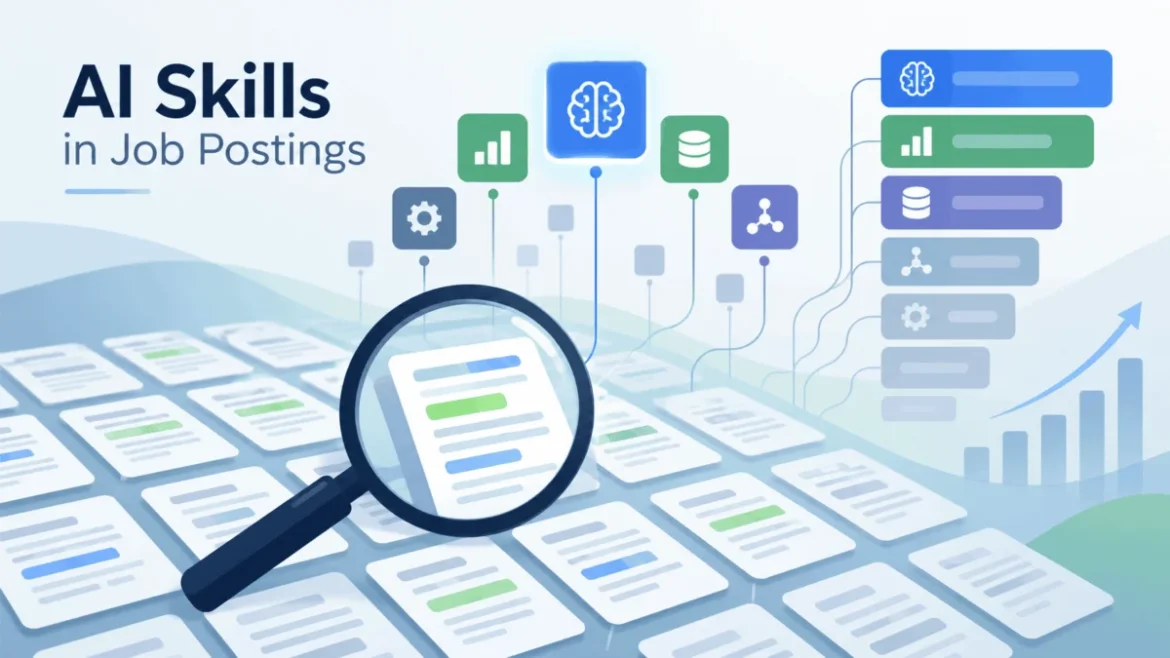
The modern professional landscape is undergoing a rapid, technology-driven metamorphosis. A cursory review of major employment platforms reveals that artificial intelligence has transitioned from a niche technical requirement to a pervasive expectation across virtually every sector. However, a significant discrepancy persists between the vague inclusion of AI as a catch-all keyword in job descriptions and the actual, measurable competencies employers are screening for during the interview process. As we move through 2026, the imperative for professionals is clear: the goal is to cultivate high-value, marketable skills that integrate AI into existing workflows rather than simply appending the term to a resume.
Data synthesized from over 360,000 job postings collected between late 2025 and mid-2026 confirms that AI has solidified its position as the second most requested skill across all industries, trailing only fundamental communication skills. This ranking places AI expertise ahead of traditional pillars of the digital economy, including Python, SQL, and cloud computing certifications such as AWS.
The Chronology of Rapid Adoption
The velocity of this transition is unprecedented. In January 2024, AI-related skill requirements appeared in approximately 15% of U.S. tech job postings. By mid-2026, that figure had climbed to a staggering 75%, according to extensive analysis by Dice. This 60-percentage-point increase in less than three years represents one of the fastest shifts in labor market requirements in recent history.
Supporting this trend, data from Lightcast, as cited by the Bipartisan Policy Center, indicates that postings explicitly requiring AI-related skills surged by 144% year-over-year. For professionals in data and analytics, the trend is even more pronounced, with AI proficiency appearing in nearly 45% of all active job listings. This trajectory suggests that AI literacy is rapidly moving from a competitive differentiator to a baseline expectation, leaving a narrow window for those currently attempting to upskill.
Categorizing the Demand for AI Competencies
The demand for AI skills is not monolithic; it is segmented into four distinct categories, each requiring a different level of technical depth and professional focus.
1. AI Literacy and Prompt Engineering
This category represents the broadest requirement for the general workforce. It encompasses the ability to understand the functional boundaries of AI models, execute effective prompt engineering, and critically evaluate machine-generated outputs. Prompt engineering, in particular, has seen a 253% increase in demand year-over-year. LinkedIn’s 2026 labor market report further corroborates this, showing a 70% growth in U.S. job postings requiring these literacy-based skills.
Industry analysts emphasize that employers are not seeking dedicated "prompt engineers" as standalone roles. Instead, they are prioritizing "prompting plus" candidates—professionals who possess deep domain expertise in fields like finance, marketing, or law, and use AI to amplify their core output.
2. Agentic AI and Workflow Automation
While AI literacy is for the masses, agentic AI is currently the fastest-growing category by rate of adoption. Stanford’s 2026 AI Index reports that the share of job postings mentioning agentic AI—systems capable of performing sequences of actions autonomously—rose from 0.69% to 18.9% in a single year. Demand for these specific competencies, including familiarity with retrieval-augmented generation (RAG) and agent orchestration frameworks, saw a 587% increase in the same period. For non-technical staff, the requirement here is conceptual: understanding how agentic workflows can be integrated into existing operational pipelines to reduce human toil.
3. Machine Learning Foundations
Machine learning remains the bedrock of technical hiring. However, the nature of these requests has become increasingly granular. Where 2024 postings might have requested general "machine learning" knowledge, 2026 postings specify expertise in model evaluation, fine-tuning, and Machine Learning Operations (MLOps). Furthermore, data engineering has emerged as the most critical bottleneck. Platforms like SignalHire report that demand for data engineering skills currently outpaces both AI engineering and data science, as companies realize that robust AI deployment is impossible without clean, well-architected data pipelines.
4. AI Governance and Responsible AI
Though often discussed in boardrooms, governance and ethics appear in only about 1.5% of public job postings. Despite this low frequency, the requirement is becoming a decisive factor for senior and principal-level roles. Analysis by Qarera suggests that AI skill requirements appear in nearly 40% of principal-level postings, double the average for entry-level roles. This indicates that as organizations move from experimentation to enterprise-scale deployment, the need for professionals who can navigate compliance, bias, and strategic oversight is reaching a critical inflection point.
Sectoral Penetration and Economic Impact
The impact of AI is no longer confined to the technology sector. Data from Lightcast shows that 51% of job postings requiring AI skills exist outside of IT and computer science, with significant concentrations in healthcare, finance, and human resources.
Product management leads this non-technical surge, with AI skills appearing in 37% of postings. Design roles follow at 23%, and business analyst positions at 19%. This shift signals a fundamental change in the definition of a "knowledge worker": employers are increasingly looking for professionals who can act as the bridge between business objectives and AI capabilities.
The economic implications for workers are tangible. Data across multiple hiring platforms indicates that job postings requiring AI skills offer a salary premium of approximately 28% compared to similar roles without these requirements. For non-technical professionals who successfully integrate AI into their existing skill sets, the reported salary uplift ranges from 35% to 43%. In the U.S. market, roles at the intersection of data infrastructure and AI command mid-point salaries exceeding $150,000, reflecting both the high value of these skills and the ongoing scarcity of qualified talent.
Strategic Implications for Professionals
The current market data effectively debunks three prevailing myths regarding AI careers:
- The Coding Requirement: Many of the most in-demand AI skills—such as literacy, prompt engineering, and governance—do not require a background in software development. Research indicates that foundational AI literacy can be attained through 30 hours of focused study.
- The Credential Myth: A standalone certificate in AI is rarely sufficient. Employers are prioritizing candidates who can demonstrate the "plus one" model: where AI is a tool that enhances a pre-existing, high-value professional discipline.
- The Gradual Adoption Fallacy: The rapid shift from 15% to 75% in technical job postings demonstrates that the market is not waiting for the workforce to catch up. The "grace period" for professionals to develop these competencies is closing rapidly.
Conclusion and Future Outlook
For the professional looking to future-proof their career, the data offers a clear mandate. Technical professionals should prioritize building skills in MLOps, RAG, and agentic framework orchestration. Meanwhile, business-side professionals should focus on AI literacy and the ability to define value propositions within their specific domains.
The ultimate takeaway for the 2026 job seeker is that AI is not a replacement for expertise—it is a force multiplier. As noted by industry educators and hiring experts, the most successful candidates are those who can provide measurable evidence of how AI has reduced time-to-market or improved output quality. In the current economic climate, the ability to translate technical AI capabilities into concrete business outcomes is the single most valuable asset a professional can possess. As the World Economic Forum estimates that 22% of jobs will shift structurally by 2030, the ability to adapt to these AI-augmented workflows will likely determine the trajectory of professional careers for the next decade.
