• Home
  • About Us
  • Contact Us
  • Cookies Policy
  • Disclaimer
  • DMCA
  • Privacy Policy
  • Terms and Conditions
Dr Crypton
Secure Your Future in Crypto
Bitcoin & Altcoins

The Ethereum Foundation Announces Strategic Reorganization and Significant Staff Reductions

by admin September 15, 2026
written by admin

The Ethereum Foundation (EF), the non-profit organization primarily responsible for the development and stewardship of the Ethereum ecosystem, has officially concluded a months-long organizational restructuring effort. This transition, which aligns with the previously announced Ethereum Foundation Mandate and the new Treasury Management Policy, marks a significant shift in the organization’s operational architecture. As part of this realignment, the Foundation has confirmed the departure of 54 employees, representing approximately 20% of its total workforce.

This development follows a period of introspection within the organization regarding its long-term sustainability and its core responsibilities to the decentralized network. By tightening its internal focus, the EF aims to streamline its efforts in critical areas such as protocol security, user access, and institutional engagement, ensuring that the organization remains resilient against market volatility while continuing to advance the foundational promise of Ethereum.

Chronology of the Reorganization

The restructuring is not an isolated event but the culmination of a deliberate, multi-month process. Earlier in June 2025, the Foundation published its updated Treasury Management Policy, which signaled a shift toward more disciplined financial stewardship. This policy was designed to ensure that the EF possesses the longevity required to support Ethereum’s development over multi-year cycles, regardless of fluctuations in the price of ETH or broader crypto-market conditions.

Throughout the summer and autumn of 2025, leadership conducted internal reviews of all departments, assessing which activities were essential to the core mission—defined as maintaining the censorship resistance, privacy, and security of the Ethereum protocol—and which were auxiliary. This process concluded this week with the formal implementation of the new structural model, resulting in the separation of the 54 team members.

The New Operational Architecture

The EF has transitioned from its previous organizational model to a refined structure consisting of seven distinct clusters. Each cluster is designed to handle a specific domain of work, with specialized accountability metrics.

The "Protocol Layer" remains the bedrock of the Foundation’s mission. This cluster is tasked with the foundational technical work required to harden the Ethereum network. Its objectives are strictly focused on maintaining the protocol’s integrity, including the development of post-quantum security measures, advancements in zkEVM technology, and the mitigation of "toxic" MEV (Maximal Extractable Value) within the transaction pipeline.

The "Access Layer" focuses on the practical application of self-sovereignty. The EF has identified that as users rely more on automated agents to interact with the blockchain, the risks of centralization increase. This cluster is dedicated to ensuring that users can read the chain, transact, and prove data without relying on unverifiable intermediaries.

The "User Layer" and "Community Layer" serve as the bridge between the technical protocol and the global ecosystem. The User Layer will conduct research into user personas and failure modes, ensuring that protocol decisions are grounded in real-world utility rather than purely theoretical gains. Meanwhile, the Community Layer will manage the Foundation’s public image and external partnerships, aiming to distance Ethereum from "zero-sum" financial speculation and align it with broader movements in open-source software, cryptography, and civil liberties.

Finally, the "Institutional Layer" marks a proactive shift in how the EF engages with the legacy world. This team will develop standards and reference architectures for enterprises, governments, and academic institutions, aiming to showcase how Ethereum can be used to improve transparency and data portability without compromising the core principles of the network.

Supporting the Transition

The decision to reduce the workforce by 20% has been described by leadership as a difficult but necessary measure to ensure the Foundation’s future viability. To support those departing, the EF has implemented a comprehensive severance and transition package. The Foundation is offering the higher of one month’s salary for every year of service or the amount required by local labor laws, mirroring the benefits provided to employees who left the organization earlier this year.

The EF’s new structure

In addition to financial compensation, the Foundation is providing career transition support, including grants earmarked for career coaching or professional development. Many of the departing staff members are expected to remain active within the broader Ethereum ecosystem, shifting their contributions to other development firms, decentralized autonomous organizations (DAOs), or independent projects.

Data and Financial Context

The Ethereum Foundation holds a substantial portion of its treasury in ETH, which necessitates a sophisticated approach to risk management. According to previous financial disclosures, the Foundation has historically maintained a conservative spending profile, but the volatility of the crypto markets necessitates occasional belt-tightening to ensure multi-decade endurance. By reducing its headcount, the Foundation lowers its "burn rate," allowing it to sustain its core research and development teams through extended periods of market stagnation.

This restructuring is also a response to the growing complexity of the ecosystem. As Ethereum moves from its initial phase of rapid scaling toward a more mature state, the needs of the network have evolved. The shift from a generalist operational model to a specialized, cluster-based approach reflects a move toward institutional maturity, a common progression for major open-source foundations as they reach a certain scale.

Broader Implications and Industry Reactions

The reduction in force at the Ethereum Foundation is viewed by market analysts as a signal of a maturing crypto industry. While some observers may interpret the layoffs as a sign of financial distress, internal documents and statements from the EF suggest the move is motivated by efficiency and focus.

"The goal is not to be a product studio, but to ensure that the core protocol remains defensible," said an anonymous source familiar with the internal discussions. The focus on "zero-option" paths—ensuring that for every intermediated service, there exists an accessible, permissionless alternative—demonstrates that the EF is doubling down on its original ideological roots: neutrality and censorship resistance.

Industry experts note that the Institutional Layer’s focus on governments and universities could significantly influence the adoption of Ethereum in the public sector. By providing clear, standards-based documentation and reference architectures, the EF is lowering the barrier for institutional entry, which could lead to a broader integration of Ethereum-based cryptographic proofs in legal and governmental systems.

However, the departure of 54 individuals represents a loss of institutional knowledge. The challenge for the EF in the coming year will be to maintain its velocity in research and development while integrating the new structural changes. The Foundation has signaled that it will provide further details on how the ecosystem can engage with the new clusters in the coming months, indicating that the transition is an ongoing, iterative process.

Future Outlook

The "leaner and more focused" version of the EF, as described by leadership, is expected to operate with greater agility. By clarifying the mandates of each cluster, the organization aims to reduce the bureaucratic friction that often accompanies the growth of large, mission-driven nonprofits.

For the Ethereum community, the next few months will be a period of adjustment. Developers and stakeholders will be watching closely to see if the new structure successfully delivers on its promises: hardening the protocol against systemic risks, providing verifiable access for all users, and effectively bridging the gap between decentralized principles and institutional adoption.

As the Foundation moves forward, its success will be measured not by its size or headcount, but by the resilience of the Ethereum network itself. The pivot to a specialized, cluster-based organization underscores the EF’s long-term commitment to maintaining the blockchain as a neutral, secure, and self-sovereign global infrastructure, regardless of the shifting economic tides within the broader digital asset market. The Foundation remains a central pillar of the ecosystem, and its ability to adapt will undoubtedly set the tone for the next era of Ethereum’s development.


September 15, 2026 0 comment
0 FacebookTwitterPinterestEmail
Bitcoin & Altcoins

LuLu Financial Holdings Revolutionizes Cross-Border Remittances Through Strategic Adoption of USDC and Circle Mint

by admin September 15, 2026
written by admin

The landscape of global cross-border payments is undergoing a profound transformation as LuLu Financial Holdings (LFH) reports significant operational improvements following its integration of USDC and Circle Mint. By shifting its liquidity management and settlement infrastructure to a blockchain-based framework, the global financial services provider has successfully circumvented the traditional inefficiencies that have long plagued the remittance industry. As of August 26, 2026, LFH announced that this technological pivot has yielded a 25% to 30% reduction in cross-border settlement costs, alongside a 40% surge in settlement volume, signaling a paradigm shift in how international financial institutions manage liquidity across the GCC, MENA, and APAC regions.

The Inherent Friction of Traditional Banking Systems

For decades, the global remittance industry has relied upon the legacy correspondent banking model to move money across international borders. While the end-users—migrant workers, families, and small businesses—require 24/7 access to financial services, the underlying plumbing of the global financial system remains tethered to the constraints of traditional business hours.

In the conventional model, a cross-border transaction often involves a series of intermediary banks, each operating within its own specific time zone, regulatory jurisdiction, and internal clearing cycle. This chain of custody frequently results in "foreign exchange friction," where the value of a transaction is eroded by multiple conversion fees, and "time-zone latency," where funds are held in transit for days as they move through a fragmented banking network. Furthermore, manual reconciliation processes—often necessitated by the lack of real-time visibility across these disparate banking ledgers—introduce operational overhead that drives up costs for both the remittance provider and the consumer.

For LuLu Financial Holdings, which maintains a vast network of branches and digital infrastructure serving millions across the Middle East, North Africa, and Asia-Pacific, these delays were not merely inconveniences; they were structural hurdles. The need to hold large amounts of pre-funded capital in various banking accounts across different time zones created an inefficient use of working capital, limiting the firm’s agility and its ability to provide immediate credit to beneficiaries.

A Chronology of the Strategic Partnership

The collaboration between Circle and LuLu Financial Holdings is not a spontaneous development but rather the culmination of a long-term strategic roadmap aimed at digitizing the "plumbing" of international finance.

The foundation for this transition was laid in December 2024, when the two entities first announced a formal partnership. At that time, the primary objective was to establish a high-efficiency payment corridor connecting the Middle East with key markets in Asia and Europe. This announcement coincided with a broader expansion of Circle’s footprint in the Abu Dhabi Global Market (ADGM), providing the regulatory and operational clarity necessary for institutional-grade digital asset integration.

Following the initial announcement, the intervening months were spent building out the technical infrastructure, integrating Circle Mint—a platform specifically designed for institutional entities to mint and redeem USDC—into LFH’s internal treasury systems. By mid-2026, the transition had reached a state of full operational maturity, allowing the firm to report the significant performance gains that have recently come to light. This timeline reflects a methodical approach to financial innovation, prioritizing regulatory compliance and technical stability before scaling to the high-volume corridors that define LFH’s business model.

The Mechanics of the Digital Dollar Treasury

The efficacy of the LFH and Circle integration lies in the use of USDC as a high-speed, programmable liquidity layer. Unlike retail-focused cryptocurrency applications, LFH utilizes Circle Mint to conduct one-to-one conversions between fiat US dollars and USDC.

The operational flow is streamlined: LFH converts its US dollar reserves into USDC, which acts as a digital representation of the dollar on the blockchain. This USDC is then transmitted near-instantaneously to partner wallets across the globe. Because these transactions occur on-chain, they are entirely decoupled from the opening and closing times of traditional commercial banks. Upon receipt, partner institutions can either hold the USDC as working liquidity for immediate payout or convert it back into local fiat currency through established banking channels.

While the "last mile" of the transaction—the actual crediting of funds into a beneficiary’s bank account—may still be subject to the processing times of local banking systems, the "settlement layer" (the movement of funds between LFH and its payout partners) is now continuous. This effectively eliminates the "dead time" previously associated with moving treasury funds between global partners.

Quantifiable Operational Gains and Transparency

The data released by LFH provides a clear window into the benefits of this digital transformation. Beyond the 25% to 30% reduction in costs, the 40% increase in settlement volume highlights the scalability of the blockchain-based approach. Perhaps most importantly, LFH noted that beneficiary crediting now occurs in less than a minute once the settlement is completed.

A critical, yet often overlooked, advantage of this shift is the enhanced visibility provided by distributed ledger technology. In the traditional banking system, tracking a payment often requires manual inquiries, "SWIFT trace" requests, and reconciliation across multiple bank statements. With the integration of USDC, LFH’s operations teams can monitor the status of a transaction in real-time on the blockchain. This transparency minimizes the likelihood of errors and drastically reduces the headcount required to manage manual reconciliation, allowing the firm to reallocate resources toward growth and customer experience initiatives.

Official Perspectives and Institutional Sentiment

Joseph Cleetus, Head of Business Transformation at LuLu Financial Holdings, has been a vocal proponent of the transition. In the company’s internal case study, Cleetus remarked, "We weren’t just dealing with technical delays. These gaps directly hit our settlement efficiency and our ability to move liquidity when it was needed most."

The sentiment from the institutional side is clear: digital assets are no longer speculative instruments but are instead being treated as vital infrastructure for the future of global treasury management. By adopting USDC, LFH has effectively turned the US dollar into a "programmable" asset, allowing it to move with the speed of information rather than the speed of traditional clearinghouses.

The Future Roadmap: CCTP and Beyond

Looking ahead, LuLu Financial Holdings is not resting on the efficiencies already achieved. The firm is currently evaluating the broader adoption of Circle’s wallet infrastructure and the Cross-Chain Transfer Protocol (CCTP).

CCTP represents the next frontier in blockchain interoperability. It allows for the native transfer of USDC across different blockchain networks, eliminating the need for "wrapped" tokens—which can introduce security risks and liquidity fragmentation. For a remittance provider, the ability to move liquidity seamlessly across diverse blockchain ecosystems without relying on centralized bridges or intermediary tokens would provide even greater flexibility and security.

Broader Implications for the Global Remittance Industry

The success of the LuLu Financial Holdings and Circle partnership serves as a case study for the modernization of the global financial system. It demonstrates that the most effective path toward financial inclusion and efficiency is not necessarily to discard the traditional currency systems that have served the world for decades, but rather to modernize the infrastructure through which those currencies move.

By leveraging a stablecoin as a settlement layer, LFH has proven that traditional remittance providers can maintain their regulatory standing and fiat-based customer interfaces while benefiting from the speed, transparency, and 24/7 availability of blockchain technology. As other financial institutions observe the measurable gains in cost reduction and settlement volume, it is highly probable that the "digital dollar" will become an increasingly standard component of international treasury management.

This transition effectively bridges the gap between the rigid, time-zone-dependent world of legacy banking and the hyper-connected, 24/7 demands of the modern global economy. For the millions of individuals who rely on remittances to support their families, this shift represents more than just a technological upgrade—it is a pathway to faster, cheaper, and more reliable financial services. As the adoption of such infrastructure continues to proliferate, the global financial system stands to become more equitable and significantly more efficient, marking a definitive evolution in the history of international payments.

September 15, 2026 0 comment
0 FacebookTwitterPinterestEmail
FinTech Innovations

American Express Expands Business Banking Ecosystem with High-Yield Savings and Integrated Payroll Solutions

by admin September 15, 2026
written by admin

American Express is aggressively expanding its footprint in the small-to-medium enterprise (SME) banking sector, marking a significant shift in its strategy from a card-centric powerhouse to a comprehensive financial operating system for businesses. The latest move, headlined by the introduction of a high-yield Business Savings account, signals the company’s intent to deepen its relationships with business owners by consolidating banking, savings, and administrative workflows into a single, cohesive platform.

The New Product Suite: A Strategic Overview

The cornerstone of today’s announcement is the launch of the American Express Business Savings account. Designed to cater to the liquidity management needs of SMEs, the account offers an annual percentage yield (APY) of 2.95%. Crucially, the account is structured to reduce barriers to entry; it requires no minimum balance to maintain the account and imposes no monthly maintenance fees.

The integration of this savings product is designed to create a seamless liquidity loop for existing customers. Users can initiate transfers to and from their American Express Business Checking accounts instantly, bypassing the friction typically associated with inter-bank transfers. This capability is managed through the company’s web portal and the Amex mobile application, ensuring that business owners can manage cash flow on the go.

Beyond the savings vehicle, American Express is introducing enhancements to its card-reward architecture. Later this year, holders of the Graphite Business Cash Unlimited card—which currently offers a 2% rewards rate on all transactions—will gain the ability to convert their reward dollars directly into deposits within their Business Checking accounts. By closing the loop between credit spending and cash savings, American Express is providing a tangible incentive for businesses to remain within its proprietary ecosystem.

Scaling Through Strategic Partnerships: The Gusto Integration

Perhaps the most significant development in terms of operational utility is the forthcoming integration of a Gusto-powered payroll solution. Scheduled for release early next year, this feature represents a tactical pivot toward embedding back-office management directly into the banking interface.

Payroll processing is frequently cited by small business owners as one of the most time-consuming and compliance-heavy aspects of their operations. By partnering with Gusto, a leader in cloud-based payroll and HR software, American Express is positioning its Business Checking account as the central hub for administrative tasks. The integration will allow users to enroll, manage, and execute payroll disbursements without leaving the Amex environment. Furthermore, the inclusion of AI-powered insights—leveraging Gusto’s data-processing capabilities—will provide users with predictive analytics regarding their labor costs and cash flow requirements.

The Competitive Landscape: Banking as an Operating System

The move by American Express to "rebundle" financial services is a direct response to the intensifying competition in the fintech sector. Over the past decade, a wave of digital-first competitors—including Mercury, Brex, and Bluevine—has fundamentally altered the expectations of business banking customers.

These competitors successfully challenged traditional institutions by offering a unified "financial operating system." Rather than treating banking as a siloed activity, these platforms bundled expense management, corporate cards, accounting software integrations, and real-time cash flow visibility into a single product.

For American Express, the challenge has been to leverage its historical dominance in the credit card market to capture the "operating account" share of its clients. Historically, a business might hold an Amex card for its robust rewards and global acceptance but maintain a separate business checking account at a legacy commercial bank. By adding savings, payroll, and deeper accounting integrations, American Express is now creating an "all-in-one" value proposition that makes it increasingly difficult for business owners to justify the administrative burden of maintaining multiple, disconnected financial providers.

Strategic Rationale and Market Positioning

Eva Reda, Executive Vice President of Global Commercial Services at American Express, underscored the strategic intent behind these updates. "Businesses are looking for more value from their banking services, including competitive returns and simple tools that help them automate processes and fit seamlessly into how they operate," Reda stated.

The focus on automation and integration is not accidental. In the current macroeconomic climate, where interest rate volatility and labor costs remain top-of-mind for entrepreneurs, the ability to automate mundane financial tasks provides a measurable return on investment. By reducing the number of external systems a business owner must reconcile, American Express is positioning itself as a productivity partner, not just a service provider.

Chronology of Expansion: The Path to Comprehensive Banking

The current expansion follows a deliberate, multi-year progression for American Express:

  • Initial Entry: American Express established its reputation in the B2B space through its corporate and small business card programs, focusing on travel benefits and spend management.
  • Checking Account Launch: The company successfully launched its Business Checking account, proving that it could transition from a lender to a depository institution.
  • Integration Phase: The company began integrating accounting software, allowing for better synchronization between transaction data and bookkeeping systems.
  • Current Pivot (2025-2026): The launch of high-yield savings and payroll solutions represents the "embedded finance" phase, where the banking interface becomes the primary dashboard for all business operations.

Implications for the Financial Services Sector

The implications of this shift are twofold. First, for the SME segment, this represents a significant increase in the quality of banking tools available. The democratization of high-yield savings and integrated payroll means that smaller businesses can now access a level of financial infrastructure that was once reserved for larger corporations.

Second, for traditional financial institutions, the "Amex model" serves as a warning. The trend toward rebundling suggests that the future of banking will be defined by the "stickiness" of the platform. If a customer uses their bank for payroll, savings, card rewards, and expense management, the cost of switching becomes prohibitively high.

Data from the broader fintech industry suggests that SMEs are increasingly prioritizing integration over standalone features. A study conducted by industry analysts indicates that businesses using a unified platform for their financial operations save an average of 10 to 15 hours per month on manual data entry and reconciliation. By capitalizing on this pain point, American Express is effectively raising the barrier to entry for smaller players and forcing traditional banks to accelerate their own digital transformation efforts.

Looking Ahead: The Future of the Amex Ecosystem

As American Express continues to roll out these features, the focus will likely shift to scalability and security. The integration of AI-powered payroll insights is a notable development, suggesting that the company is looking to utilize its massive repository of transaction data to provide actionable financial advice to its business clients.

While the 2.95% APY on the new savings account is competitive, it is the ecosystem—the ability to move money instantly, the connection to payroll, and the integration of rewards—that will ultimately determine the success of this initiative. For American Express, the objective is clear: to ensure that when a business owner starts their day, the first screen they open is the American Express dashboard.

By systematically eliminating the friction between different financial functions, the company is not just competing on interest rates; it is competing for the primary financial relationship of the American small business owner. Whether this approach can successfully displace deeply entrenched legacy banking relationships remains to be seen, but the trajectory of the company’s recent product roadmap indicates that the era of the "all-in-one" business bank is well underway.

September 15, 2026 0 comment
0 FacebookTwitterPinterestEmail
FinTech Innovations

Thatch Secures $108 Million in Series C Funding to Reach $1 Billion Valuation as Consumer-Led Health Benefits Gain Momentum

by admin September 15, 2026
written by admin

The corporate health benefits landscape is undergoing a structural transformation, catalyzed by mounting frustration with traditional group insurance models and a growing demand for personalization. In a striking validation of this shift, Thatch announced on Tuesday, September 15, 2026, that it has successfully raised $108 million in a Series C funding round. The substantial capital injection elevates the health benefits platform’s valuation to the coveted $1 billion threshold, officially granting the enterprise unicorn status. This milestone financing round features participation from a strategic mix of both new and existing investors, signaling robust institutional confidence in Thatch’s consumer-directed approach to employee healthcare coverage.

Moving Beyond the One-Size-Fits-All Group Health Plan

For decades, the standard procedure for United States employers procuring health benefits has relied on traditional group health plans. In this conventional paradigm, human resources and corporate leadership departments select a single health insurance plan—or a tightly restricted menu of options—to cover their entire workforce. While this approach historically offered administrative simplicity, it has increasingly proven misaligned with the diverse medical needs, financial priorities, and life stages of modern employees. Furthermore, runaway premium inflation has placed a severe financial strain on both businesses and workers.

Thatch was engineered to disrupt this rigid architecture by facilitating a transition toward a consumer-directed model. Rather than forcing employees into a pre-selected corporate policy, Thatch empowers employers to establish a defined, tax-free health benefits budget. Employees are then given the autonomy to use these allocated funds to select an individual health insurance plan tailored precisely to their personal circumstances.

Crucially, any remaining funds from the employer-provided budget do not simply vanish at the end of the coverage cycle. Instead, employees can allocate these residual tax-free dollars toward a wide array of eligible healthcare expenses that traditional insurance policies routinely overlook, ranging from specialized treatments and wellness products to out-of-pocket copays and prescriptions.

Infrastructure and Seamless Integration

The primary historical hurdle preventing widespread adoption of consumer-directed health models has been administrative friction. Managing individual health insurance policies for an entire workforce historically created an unsustainable compliance, payroll, and record-keeping burden for employers. Thatch addresses this critical pain point through its proprietary technological infrastructure and robust distribution network.

The platform functions as a sophisticated bridge connecting employers, employees, and individual insurance carriers. Thatch integrates seamlessly with major health insurance providers, foundational payroll processors, and established enterprise benefits platforms. This technological interoperability allows businesses to transition away from group plans without needing to dismantle or completely rebuild their existing human resources and financial infrastructure. By automating compliance, premium payments, and fund disbursement, Thatch reduces administrative overhead to a level comparable with—or even lower than—legacy group plans.

Rapid Growth and Market Trajectory

The timing of Thatch’s $108 million raise underscores a period of hyper-growth for the enterprise. Over the preceding twelve months, the company’s revenue has surged nearly sevenfold, reflecting accelerating demand across a diverse spectrum of industries and corporate sizes. To date, the platform has surpassed 5,000 corporate employers utilizing its infrastructure to manage employee healthcare.

This trajectory represents a rapid expansion for a company that has methodically built its market presence over recent years. The progression of Thatch’s funding rounds highlights its accelerating momentum within the competitive FinTech and HealthTech sectors:

  • April 2025: Thatch secures $40 million in a Series B funding round, capturing industry attention and validating its early-stage value proposition regarding employee healthcare choice and leftover funds utilization.
  • September 2026: The company closes its $108 million Series C funding round, spearheaded by prominent venture capital firms, bringing its total valuation to $1 billion.

During the announcement of its Series B funding in early 2025, company leadership shared critical utilization data illustrating the tangible benefits of the model for individual workers. Metrics from the platform revealed that approximately half of Thatch members accumulated an average of $250 in leftover funds each month. This financial cushion provided workers with essential liquidity to absorb medical costs that fall outside the restrictive parameters of standard health insurance policies.

Leadership Perspectives and Investor Insights

Reflecting on the philosophy driving the company’s expansion, Thatch Co-Founder and Chief Executive Officer Chris Ellis emphasized the fundamental shift in consumer psychology that the platform aims to unlock.

“For too long, healthcare has been the one major purchase in someone’s life they never actually got to make,” Ellis stated in the official company release. “Give people control over their own healthcare dollars, and the first thing they do is ask what something actually costs. That’s the behavior change this round is built to scale.”

Investors backing the Series C round see Thatch not merely as an insurance navigation tool, but as the foundational layer for a complete overhaul of how healthcare is consumed, managed, and financed at the individual level. Jahanvi Sardana, a partner at Index Ventures—one of the key institutional backers driving the latest investment round—highlighted the long-term technological vision for the platform.

“Thatch is rebuilding the healthcare market around the individual,” Sardana remarked. “With AI, the end state is bigger than shopping: an agent that knows you, holds your wallet and can find, book and pay for the right care. The magic is that you stop navigating healthcare and start being taken care of.”

Broader Industry Implications and Future Outlook

The rise of billion-dollar valuations among consumer-directed health platforms points toward a broader macroeconomic shift in the United States labor and benefits market. As employers continuously grapple with the soaring costs of healthcare and employees demand greater autonomy and financial flexibility, the traditional group health insurance model is facing unprecedented pressure.

Platforms like Thatch are well-positioned to capitalize on this shifting sentiment by leveraging modern technological stacks, API integrations, and artificial intelligence to remove the friction that once made individual health coverage impractical for corporate adoption. By shifting financial agency directly to the worker, the company is attempting to introduce free-market consumer behavior into an industry historically insulated from transparent pricing and competitive market forces.

With $108 million in fresh capital now secured, Thatch plans to accelerate its product development roadmap, expand its engineering and distribution teams, and scale its operations to meet the accelerating demand from employers seeking alternatives to legacy group plans. As the platform looks toward the horizon, its success will serve as a bellwether for whether the future of American healthcare benefits lies firmly in the hands of the individual consumer.

September 15, 2026 0 comment
0 FacebookTwitterPinterestEmail
NFT & Digital Assets

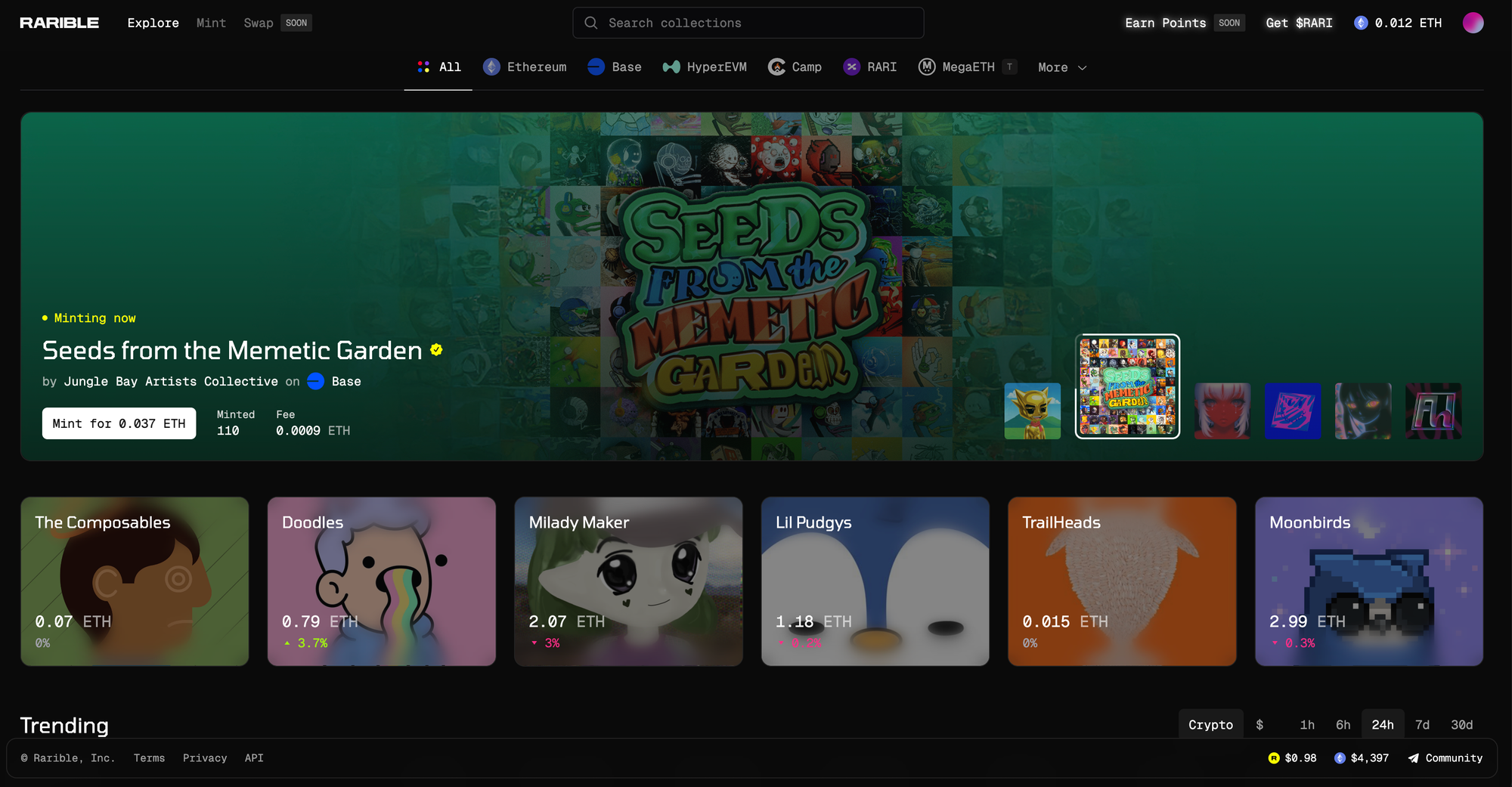
Meet the New Rarible: Lightspeed Trading & Cross-Chain Rewards

by admin September 15, 2026
written by admin

NFT marketplace pioneer Rarible has officially transitioned its primary platform out of beta, introducing a newly re-engineered infrastructure designed to deliver high-speed trading and a novel cross-chain rewards ecosystem. Following a six-month development cycle that tested network capabilities under heavy traffic, the platform aims to redefine onchain commerce by blending multi-network accessibility with a liquidity-focused incentive model.

The overhaul follows a period of rigorous public experimentation. The underlying architecture of the new Rarible.com was first stress-tested through its experimental interface, RaribleFUN, which launched in April 2025. According to platform metrics, that beta phase processed more than 62 million mints and engaged approximately 19 million users, providing the developer team with the necessary telemetry to scale the platform for mainstream adoption.

Meet the New Rarible: Lightspeed Trading & Cross-Chain Rewards

With the official public rollout, Rarible is positioning itself as a high-performance venue capable of keeping pace with the rapid proliferation of layer-2 networks and emerging app-chains. As of September 2nd, standard domain traffic to Rarible.com automatically redirects to the new interface, while the legacy platform remains temporarily accessible via an archival portal ahead of its eventual deprecation.

Technical Architecture and Lightspeed Trading Capabilities

At the core of the newly launched marketplace is a stripped-down, performance-optimized user interface engineered specifically to minimize latency. Industry benchmarks within the updated ecosystem reveal transaction execution speeds up to 30 percent faster than competing marketplaces on select networks, with settlement times dropping below one second on the industry’s most performant layer-1 and layer-2 protocols.

The platform launches with native support for 11 distinct blockchain ecosystems. This multichain strategy allows collectors to interact with both established networks—such as Ethereum and Base—and newly emerging ecosystems. Notably, Rarible has secured early access positioning for several nascent networks, enabling users to explore and acquire digital assets prior to their broader mainnet deployments. Networks such as MegaETH and Camp Network are available exclusively on the Rarible protocol at launch, offering an early window into nascent developer communities.

Meet the New Rarible: Lightspeed Trading & Cross-Chain Rewards

The initial mainnet lineup supported for trading, listing, and bidding activities includes Ethereum, Base, HyperEVM, LightLink, Somnia, RARI Chain, Camp Network, and Arena-Z, among others. This broad deployment underlines the protocol’s ambition to function as a unified hub for fragmented liquidity across the expanding web3 landscape.

Restructuring Incentives: The RARI Foundation Cross-Chain Rewards Program

Alongside the technical overhaul, Rarible has rolled out a comprehensive cross-chain rewards initiative managed independently by the RARI Foundation. Unlike conventional marketplace incentive structures that often fall prey to artificial volume inflation or circular trading—commonly known as wash trading—Rarible’s new points program introduces a structural safeguard designed to reward genuine market participation and depth.

The mechanism fundamentally alters how incentives are distributed following the execution of a trade. Rather than routing points exclusively to the immediate buyer and seller involved in a transaction, the protocol distributes points dynamically to the twenty closest competing active orders within that specific market. Market analysts note that this approach incentivizes tighter bid-ask spreads and encourages continuous, competitive order placement rather than isolated, high-value point-farming transactions.

Meet the New Rarible: Lightspeed Trading & Cross-Chain Rewards

The rewards program is directly funded through marketplace trading fees collected across the platform. Traders can monitor their standing via a unified, cross-chain leaderboard that aggregates activity across all supported networks, fostering public competition for top-tier rankings. Accumulated points are subsequently convertible into $RARI tokens through the RARI Foundation, with user claims processed natively via the Base network.

Chronology of the Re-Engineering Process

The debut of the revamped marketplace represents the culmination of a strategic pivot executed over the past two years by Rarible’s leadership. The timeline of this transformation highlights a deliberate move toward vertical integration and technological agility:

  • April 2025: Rarible launches the RaribleFUN beta environment to test high-throughput infrastructure under real-world conditions, ultimately accumulating over 62 million mints and 19 million unique interactions.
  • Mid-2025: The company accelerates its expansion strategy by acquiring Flipp, a mobile-first crypto trading application known for its streamlined user experience and rapid onboarding capabilities.
  • September 2, 2025: Rarible officially sunsets its legacy marketplace infrastructure for primary routing, transitioning all main domain traffic to the new high-speed, multichain platform. Simultaneously, the RARI Foundation activates the cross-chain rewards program.

Strategic Implications for the NFT and Onchain Commerce Sector

The launch arrives at a critical juncture for the digital asset sector. As liquidity continues to fracture across an ever-growing array of layer-2 rollups, app-chains, and alternative execution environments, marketplaces face mounting pressure to offer unified cross-chain discovery without sacrificing execution speed.

Meet the New Rarible: Lightspeed Trading & Cross-Chain Rewards

By combining sub-second settlement times with exclusive early-access integrations for upcoming networks like MegaETH and Camp, Rarible is attempting to position itself as the primary discovery layer for nascent digital assets. Furthermore, the integration of the Flipp mobile application into its broader corporate umbrella signals an intent to bridge the gap between complex web3 infrastructure and consumer-friendly mobile interfaces.

Industry observers suggest that the success of the new marketplace will hinge on its ability to sustain deep liquidity across its 11 supported chains while maintaining the integrity of its anti-wash-trading reward distribution model. If the novel order-book incentive system successfully deters exploitative behavior while attracting organic market makers, it could establish a new benchmark for loyalty and incentive design within decentralized finance and NFT commerce.

As the platform continues to onboard additional networks and roll out planned feature upgrades through its public roadmap, users and developers alike will be closely monitoring whether the high-speed infrastructure can maintain its performance metrics under sustained, enterprise-scale demand. For now, market participants can access the new interface directly at Rarible.com to engage with the updated trading environment and participate in the inaugural leaderboard cycle.

September 15, 2026 0 comment
0 FacebookTwitterPinterestEmail
Tech & Startup News

Revolutionizing Meal Planning: How AI and Smart Apps Are Reshaping the Modern Kitchen

by admin September 15, 2026
written by admin

The modern culinary landscape is defined by an unprecedented paradox: home cooks have access to more recipes than at any point in human history, yet deciding what to make for dinner remains a nightly source of stress. Across platforms like TikTok, Instagram Reels, Pinterest, and countless food blogs, inspiring dishes are constantly being published, bookmarked, screenshot, and swiftly forgotten. This digital accumulation has created a new kind of modern clutter—a chaotic repository of scattered URLs, camera roll screenshots, and bookmarked videos that rarely translate into actual meals. To address this friction between digital inspiration and daily execution, a new wave of artificial intelligence-powered culinary tools has emerged, aiming to bridge the gap between saving a recipe and serving it. Among these, platforms like ReciBites are attempting to redefine how households organize their kitchens, turning disparate digital snippets into cohesive meal plans, nutritional insights, and streamlined grocery shopping lists.

The Evolution of Recipe Management: From Index Cards to the Cloud

For generations, family recipes lived in wooden boxes filled with handwritten index cards, clipped newspaper columns, and dog-eared pages of beloved cookbooks. As the internet matured, these physical collections migrated to bookmarks folders, Pinterest boards, and desktop bookmarking tools. However, the proliferation of short-form video content on social media platforms over the past decade drastically accelerated the fragmentation of culinary inspiration.

Today, a single week of scrolling might yield a pasta recipe saved from a TikTok video, a dessert tutorial found on Instagram Reels, a slow-cooker meal discovered via Pinterest, and a traditional family recipe preserved as a blurry snapshot of a grandmother’s notebook. While these platforms make discovering food effortless, they are not designed for organization. They lack the structural framework necessary to turn a ten-second video into a step-by-step cooking guide, let alone a weekly grocery list.

Recognizing this operational inefficiency, software developers have increasingly turned to machine learning and artificial intelligence to parse unstructured content. Modern recipe management applications no longer require users to manually type out ingredients and instructions. Instead, advanced Optical Character Recognition (OCR) and computer vision allow apps to ingest screenshots, handwritten notes, and video links, automatically extracting text, ingredient measurements, and cooking steps. This technological leap represents a fundamental shift in how digital data is translated into physical, real-world utility.

Streamlining the Culinary Workflow: Features and Functionality

At the core of platforms designed to combat recipe clutter is automated ingestion and intelligent organization. Users can seamlessly import content from virtually any digital medium—including major social networks like Facebook, YouTube, and TikTok, alongside traditional websites and physical media. To prevent these imported collections from devolving into a digital mirror of a cluttered kitchen drawer, built-in duplicate detection algorithms scan repositories to identify and merge identical or near-identical recipes.

Beyond simple storage, the integration of artificial intelligence allows for deep nutritional analysis. Once a recipe is imported, the software breaks down the ingredients to calculate precise calorie counts, macronutrients, and key dietary indicators. This capability caters to a growing demographic of consumers who track their nutritional intake for fitness, medical, or lifestyle reasons. Furthermore, smart dietary alert systems flag ingredients that conflict with user-specified preferences, such as allergens, religious dietary restrictions like halal, or specific nutritional goals such as high-protein or low-sugar diets. In cases where a recipe contains a restricted or disliked ingredient, the system can suggest personalized substitutions, adapting the dish on the fly without compromising its core flavor profile.

The utility of these platforms extends past individual recipe optimization into macro-level household management. By connecting saved recipes directly to an automated weekly meal planner, users can map out their culinary schedule days in advance. Once the weekly menu is established, the application generates a consolidated grocery list. This feature addresses one of the most tedious aspects of meal preparation by automatically merging duplicate ingredients across multiple recipes—such as combining the garlic requirements of three different dinners—and organizing the final shopping list by supermarket aisle. Additional tools, such as serving-size scalers, measurement converters, and interactive step-by-step cooking modes, ensure that the transition from planning to cooking remains seamless.

Addressing Food Waste and Community Cooking

In addition to organizing existing recipes, modern culinary applications are increasingly incorporating generative AI to tackle the perennial question of what to cook when the refrigerator is nearly empty. By inputting a list of miscellaneous leftover ingredients, users can utilize built-in AI cooking assistants to generate customized recipes on demand. This functionality not only reduces cognitive fatigue at the end of a long workday but also plays a tangible role in mitigating household food waste—a significant economic and environmental challenge globally.

Moreover, developers are recognizing the inherently social nature of food. While traditional recipe blogs often feature comment sections filled with strangers, newer platforms emphasize peer-to-peer connectivity. Users can add friends and family members to their network, allowing them to view what their social circle is saving, planning, and cooking. This shifts the inspiration paradigm from algorithmic feeds populated by internet personalities to trusted recommendations from people within one’s own social sphere.

Economic Context and Market Accessibility

As the market for productivity and lifestyle software matures, companies are exploring various monetization models, ranging from recurring monthly subscriptions to lifetime access licenses. Promotional pricing structures, such as temporary discounts reducing lifetime access fees from higher retail valuations down to more accessible entry points (such as ReciBites Plus being offered at $39.99 compared to its standard $360 baseline), reflect the competitive nature of the software-as-a-service (SaaS) landscape. These pricing strategies are designed to lower the barrier to entry for consumers hesitant to commit to perpetual subscription fees, fostering wider user adoption in a crowded market of digital organization tools.

Broader Implications for the Home Economy

The proliferation of AI-driven meal planning tools carries broader implications for household economics and time management. In an era marked by rising grocery costs and busy work schedules, efficient meal planning is no longer merely a hobbyist pursuit; it is a vital strategy for financial and nutritional health.

When consumers fail to plan their meals, they are statistically more likely to resort to last-minute dining out, expensive food delivery services, or the purchase of redundant grocery items that ultimately spoil. By streamlining the entire lifecycle of a meal—from discovery and nutritional analysis to automated grocery shopping and preparation—smart kitchen apps offer measurable utility. They reduce financial waste at the supermarket, minimize food spoilage at home, and reclaim valuable hours that would otherwise be spent manually organizing recipes or wandering supermarket aisles without a structured list.

As artificial intelligence continues to mature and integrate deeper into daily domestic routines, the boundary between digital media and physical household tasks will continue to blur. What began as a chaotic influx of social media food videos is steadily being transformed into an organized, quantifiable, and efficient component of modern household management. Whether through automated grocery consolidation, smart nutritional tracking, or AI-assisted leftover cooking, these technological solutions signify a permanent evolution in how society interacts with food in the digital age.

September 15, 2026 0 comment
0 FacebookTwitterPinterestEmail
Artificial Intelligence & Tech

How Google Opal’s New Agent-Driven Workflows Are Redefining No-Code AI Development

by admin September 15, 2026
written by admin

The evolution of Google’s no-code AI prototyping tool, Opal, has taken a significant leap forward with the introduction of agent-based workflows, signaling a departure from static, instruction-heavy automation toward dynamic, decision-making applications. Originally unveiled by Google Labs in July 2025 as a streamlined interface for building AI mini-apps atop the Breadboard framework, Opal has quickly matured from an experimental sandbox into a more robust developer-facing utility. The recent integration of the "Agent" step into the platform’s core architecture marks a fundamental shift in how creators interact with Large Language Models (LLMs), moving from rigid, linear prompts to goal-oriented, multi-step reasoning processes.

More AI Automations with Google Opal

A Chronology of Rapid Development

The trajectory of Opal since its inception has been characterized by an aggressive release cadence, reflecting Google’s broader strategy to democratize AI application development. In its initial form, Opal allowed users to string together fixed, manual sequences: an input node, a generation step utilizing a specific model like Gemini or Imagen, and a final output. This required developers to pre-configure every potential branch of an application’s logic.

By February 2026, Google introduced the Agent step, a feature that allows the system to autonomously determine the most efficient path toward a defined goal. This update did not arrive via a traditional product launch announcement; rather, it appeared as a quiet update within the Opal interface, reflecting the agile, iterative nature of the Google Labs experimental environment. Shortly thereafter, the platform was migrated to the official Google for Developers portal, a transition widely interpreted by industry analysts as a sign of the company’s long-term commitment to the tool and its underlying Breadboard architecture, originally conceived by Google engineer Dimitri Glazkov.

More AI Automations with Google Opal

The Technical Mechanics of Agent-Driven Automation

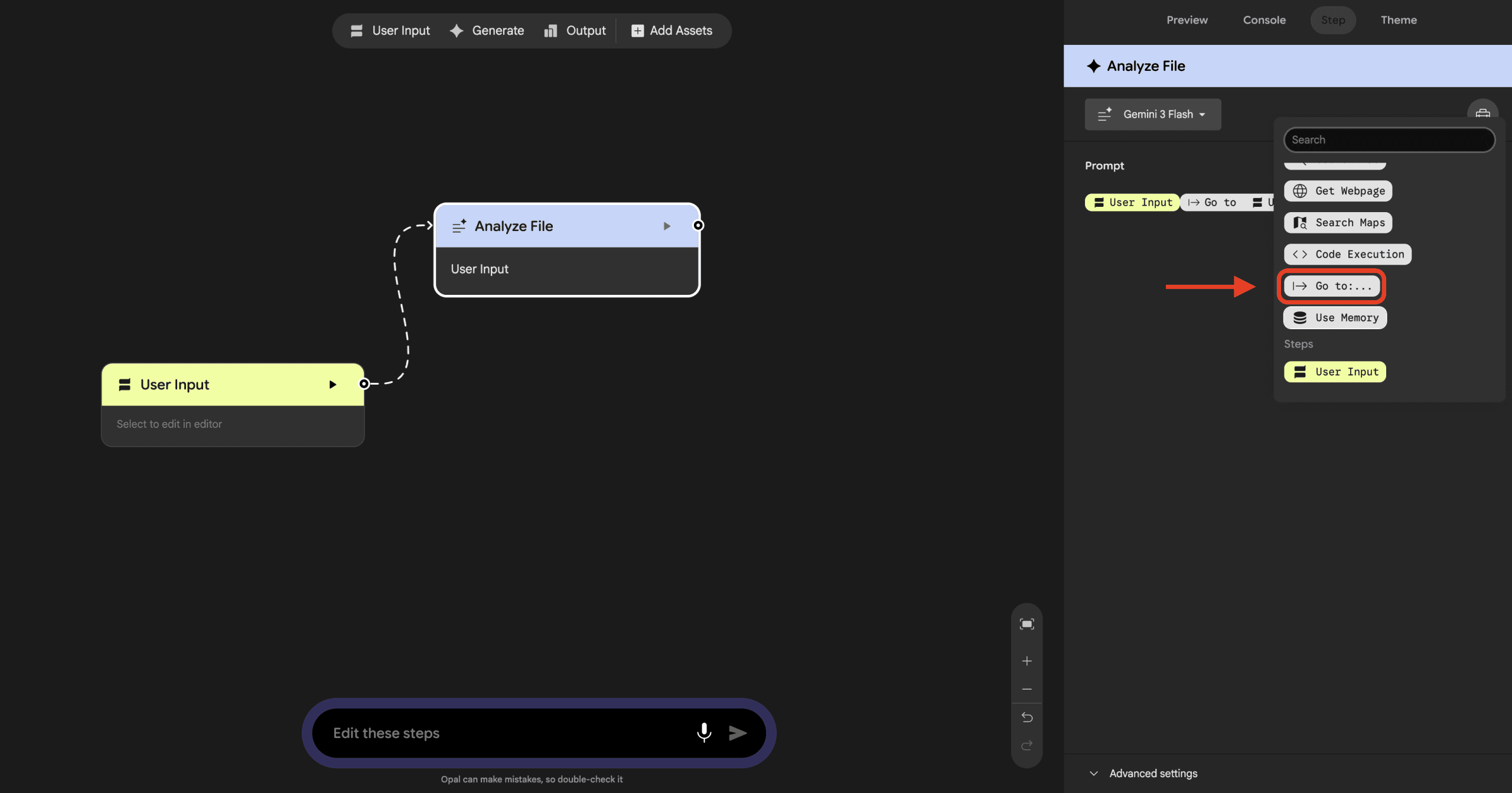
The core innovation of the Agent step lies in its ability to handle "dynamic routing." Unlike the legacy Generate step, which requires the user to specify a model—such as Gemini Pro for reasoning or Veo for video—the Agent step acts as a meta-orchestrator. When a user inputs a goal, the Agent analyzes the request at runtime to determine the optimal sequence of tools.

This autonomy is supported by three primary functional pillars integrated into the platform:

More AI Automations with Google Opal
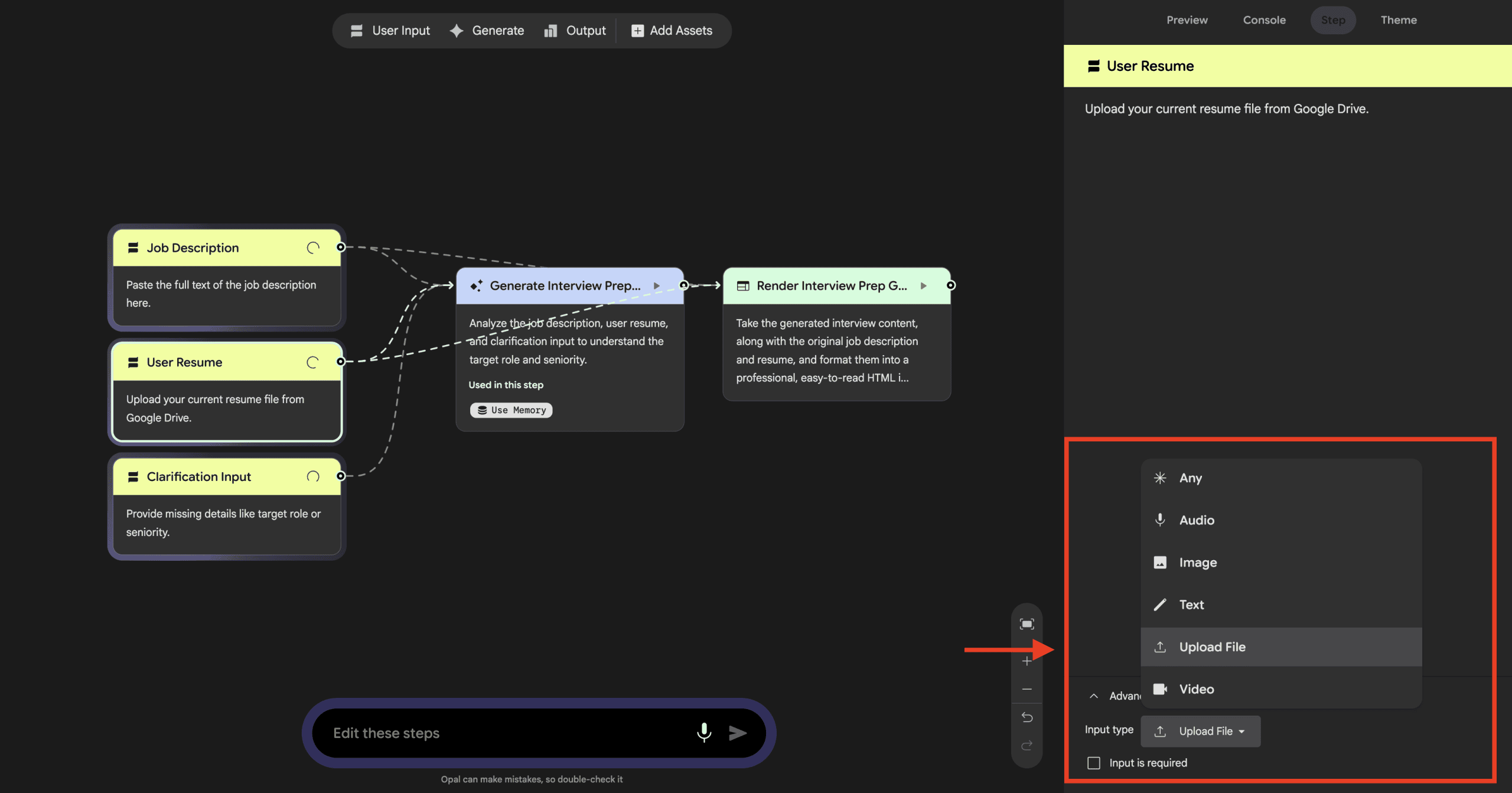
  1. Dynamic Memory: The system now retains user-specific context across sessions, allowing applications to "remember" past inputs and preferences, thereby reducing the need for repetitive data entry.
  2. Dynamic Routing: The agent evaluates the necessary resources for a task in real-time. If an application requires current, real-world data, the agent can independently trigger a web search module without the developer having to hard-code a search node into the workflow.
  3. Interactive Chat: The agent can recognize ambiguity in a user’s prompt and initiate a clarifying dialogue, effectively pausing the execution of the workflow until sufficient information is gathered.

This shift mirrors the broader industry trend toward "agentic AI," where the focus is moving away from the capabilities of a single model and toward the efficacy of a system that can utilize multiple models and tools in concert.

Expanding the Model Ecosystem

As the capabilities of the Agent step have grown, so too has the roster of specialized models available within the Opal ecosystem. The platform’s model picker now reflects a more granular approach to AI tasks. The current lineup includes:

More AI Automations with Google Opal
  • Gemini Flash & Pro: Dedicated to high-speed reasoning and complex logic, respectively.
  • Nano Banana & Nano Banana Pro: Optimized for sophisticated image generation and text-within-image accuracy.
  • AudioLM & Lyria 2: Providing specialized capabilities for text-to-speech and instrumental music generation.
  • Veo: Retained for high-fidelity video synthesis.

The presence of this expanded catalog allows the Agent to function as a sophisticated traffic controller, delegating specific tasks to the model best suited for the job, rather than relying on a general-purpose model for every stage of a process.

Case Study: Engineering a Complex Interview Coach

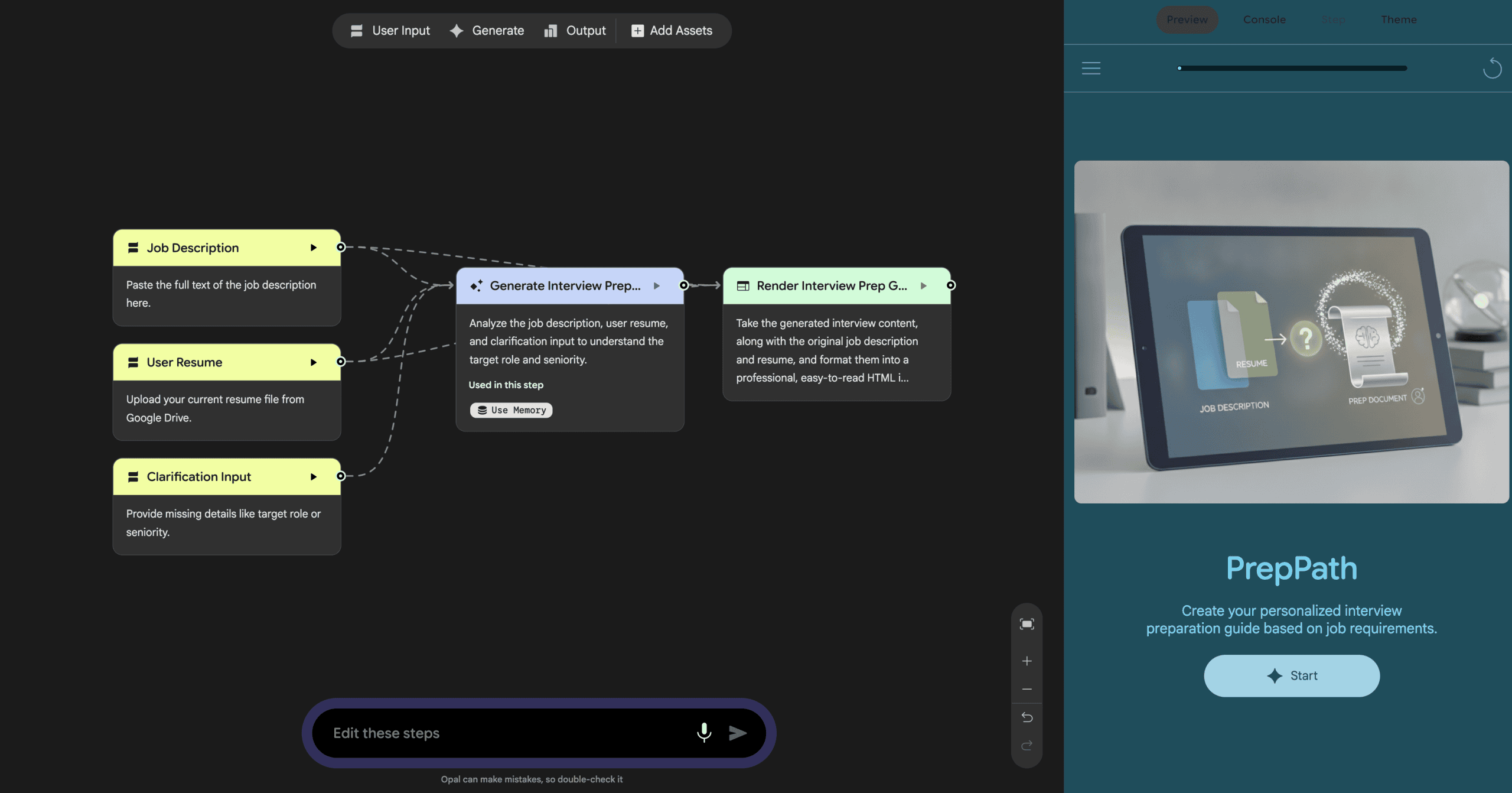
To demonstrate the practical application of these features, developers can now build tools that were previously impossible in the no-code environment. An "AI Interview Prep Coach," for instance, exemplifies the power of these new capabilities. By combining a job description and a resume, the app utilizes the Agent step to:

More AI Automations with Google Opal
  • Identify missing information (e.g., seniority level or target role).
  • Engage in a live conversation to solicit those details.
  • Perform autonomous web research on the target company to tailor questions.
  • Generate a personalized preparation document in Google Docs.

This workflow highlights the difference between static and agentic design. In a static app, the sequence would be linear and brittle. In the agentic version, the app adapts its behavior based on the specific inputs provided by the user, skipping research steps if the model already possesses the necessary information, or pausing to request data when the resume is insufficient.

Implications for Enterprise and Production

Despite the platform’s rapid advancement, observers note that Opal remains an experimental product. While its migration to the Google for Developers site suggests a trajectory toward broader enterprise adoption, several critical gaps remain for those considering large-scale deployment.

More AI Automations with Google Opal

Currently, there is no official pathway to export an Opal-built prototype into a production-ready application. Developers looking to move beyond the experimental phase are encouraged to utilize the Gemini API directly. Furthermore, the absence of documented rate limits, enterprise-grade audit logging, and Single Sign-On (SSO) integration suggests that, for the time being, Opal is best positioned as a rapid prototyping and conceptualization tool rather than a foundation for mission-critical software.

Future Outlook and Industry Impact

The rapid evolution of Opal over the last seven months—moving from a rudimentary flow-builder to an agentic platform available in over 160 countries—reflects Google’s strategic push to lower the barrier to entry for complex AI development. By abstracting the complexities of model selection and logic routing, Google is effectively shifting the burden of "coding" from syntax to intent.

More AI Automations with Google Opal

As the platform continues to iterate, the primary benefit for developers is the reduction in development time for proof-of-concept projects. The ability to build, test, and share a fully functional, agent-driven app in a matter of hours is a significant value proposition for small teams and individual creators. While the current lack of enterprise controls limits its use in corporate environments, the pace of innovation suggests that Opal is likely to become a central component of the modern developer’s toolkit, provided that Google continues to provide the necessary support and infrastructure to bridge the gap between prototype and production.

For now, the transition to agentic workflows represents a definitive turning point. Developers who adapt to this model-agnostic, goal-oriented style of building will likely find themselves better prepared for a future where AI development is defined by orchestrating intelligent agents rather than writing scripts for fixed models. The "quiet" updates seen in Opal are likely a preview of a broader shift in the software industry, where the distinction between "code" and "prompt" continues to blur.

September 15, 2026 0 comment
0 FacebookTwitterPinterestEmail
Artificial Intelligence & Tech

Building AI to accelerate science and improve lives

by admin September 15, 2026
written by admin

The Evolution of Linguistic and Technical Reach

The journey to supporting 300 languages is rooted in a long-term strategy to overcome the "digital divide" that has historically marginalized non-English speaking populations. By leveraging advancements in multilingual models, Google has effectively lowered the barrier to information access for billions of users. This expansion is not solely about translation; it is about enabling AI systems to comprehend nuance, regional dialects, and cultural context.

Historically, AI development was tethered to high-resource languages. The current achievement, however, reflects a shift toward low-resource language support, allowing for more inclusive digital participation. This technical feat is complemented by the newly released AI & Economy ATLAS, an interactive suite of insights designed to map how global populations are integrating these tools into their daily workflows, ranging from small-scale agricultural planning in developing economies to advanced professional services in metropolitan hubs.

Building AI to accelerate science and improve lives

A Chronology of Scientific Integration

The integration of AI into scientific research has accelerated significantly over the past three years. This trend is best understood through a timeline of key milestones:

  • 2020–2021: Foundational Breakthroughs: Initial deployments of AI models began to show utility in protein structure prediction, culminating in successes that solved decades-old biological puzzles.
  • 2022: Educational Pivot: In response to declining global learning outcomes reported by the OECD, researchers shifted focus toward AI-assisted tutoring and pedagogical tools.
  • 2023–2024: Climate Resilience: The development of predictive models for floods, wildfires, and extreme weather events moved from academic research to real-world, localized deployment.
  • 2025: Global Scale: The reach of AI-enabled services expanded to cover 300 languages, ensuring that the "feedback loop" described by economists like Joel Mokyr could be accessed by a truly global audience.

The Four Pillars of AI-Driven Impact

Google’s current strategy focuses on four specific domains where the gap between potential and reality is bridged by machine intelligence: healthcare, disaster resilience, education, and economic empowerment.

Healthcare and Disease Mitigation

The ambition in the health sector is to move from reactive treatment to proactive prevention. AI models are currently being refined to analyze medical imagery and genomic data at speeds and accuracies that exceed human manual review. By identifying patterns in physiological data that precede the onset of chronic diseases, researchers aim to turn diagnostics into a preventative science. The focus remains on making these tools accessible to frontline healthcare workers in under-resourced regions, rather than restricting them to elite research hospitals.

Building AI to accelerate science and improve lives

Disaster Resilience and Environmental Intelligence

Natural disasters represent an increasing threat to global economic stability. By utilizing satellite imagery combined with historical climate data, AI-driven prediction systems now offer earlier warnings for floods and severe storms. The challenge lies in the translation of physical earth models into actionable local intelligence. By improving the granularity of these predictions, communities are better positioned to protect infrastructure and, more importantly, human life.

Expanding the Reach of Education

The global education sector faces a crisis of quality and access. With 90% of primary-aged children enrolled in schools, the bottleneck has shifted from access to the effectiveness of instruction. AI, when deployed as an "assistant" rather than a replacement for teachers, offers a way to personalize learning at scale. The recent partnership with ISTE and ASCD—aimed at providing AI literacy training to 6 million educators in the U.S.—serves as a template for how human-centric design can mitigate risks such as academic integrity concerns and learning loss.

Economic Opportunity and Productivity

The economic implications of AI are often debated through the lens of automation, but the broader potential lies in productivity amplification. Small and medium-sized enterprises (SMEs) represent the backbone of the global economy, yet they often lack the R&D budgets of multinational corporations. AI tools that provide market analysis, language translation, and administrative automation allow these businesses to operate on a global stage, potentially leveling the playing field for entrepreneurs in emerging markets.

Building AI to accelerate science and improve lives

The Mandate for Responsible Design

Technological progress without governance is increasingly viewed as a liability. The approach to AI at Google is anchored by a "bold and responsible" framework, which acknowledges the dual-use nature of modern models. This includes proactive measures to prevent the misuse of AI in sensitive areas, such as chemical, biological, radiological, and nuclear (CBRN) contexts.

However, the industry faces a nuanced dilemma: the "risk of missed use." This concept posits that failing to deploy life-saving technologies in vulnerable communities can be as harmful as the risks associated with the technology itself. Balancing these competing concerns requires rigorous oversight, safety protocols, and a commitment to transparency that remains an ongoing, multi-stakeholder effort.

Research Collaboration and Institutional Support

The acceleration of science is not a solitary endeavor. Since 2006, Google has directed over $1 billion in funding to more than 1,700 research institutions worldwide. This capital has supported the collaborative ecosystem necessary to turn theoretical breakthroughs into practical, public-good applications. These partnerships with academia, national laboratories, and NGOs are essential to ensuring that AI development remains tethered to empirical evidence and societal needs.

Building AI to accelerate science and improve lives

Analysis: The Path Forward

The implications of this current wave of AI integration are profound. If the "positive feedback loop" of scientific progress—where technology enables better science, which in turn creates better technology—continues at its current pace, we are likely to see a shift in the standard of living for millions.

However, success is not guaranteed by the technology alone. The integration of AI into society necessitates a robust framework of AI literacy, equitable infrastructure, and continuous ethical auditing. The shift from "what is possible" to "what is beneficial" is the core challenge for the next decade. By focusing on language inclusivity and scientific acceleration, the industry is setting a trajectory that aims to make the benefits of the digital age a universal, rather than exclusive, reality.

As the global community looks toward the next phase of development, the focus will likely remain on the intersection of human intent and machine precision. If managed with the caution and collaboration that current initiatives suggest, the progress made to date may well be remembered as the beginning of a transformative era for both human health and economic, social, and environmental resilience. The tools are ready; the success of this endeavor will now depend on the ability of governments, researchers, and citizens to harness them in ways that prioritize long-term, sustainable impact over short-term gain.

September 15, 2026 0 comment
0 FacebookTwitterPinterestEmail
Cryptocurrency News

MEXC Releases September 2026 Proof of Reserves Audit Conducted by Hacken Highlighting Robust Bitcoin Backing and Multi-Million Dollar Insurance Funds

by admin September 15, 2026
written by admin

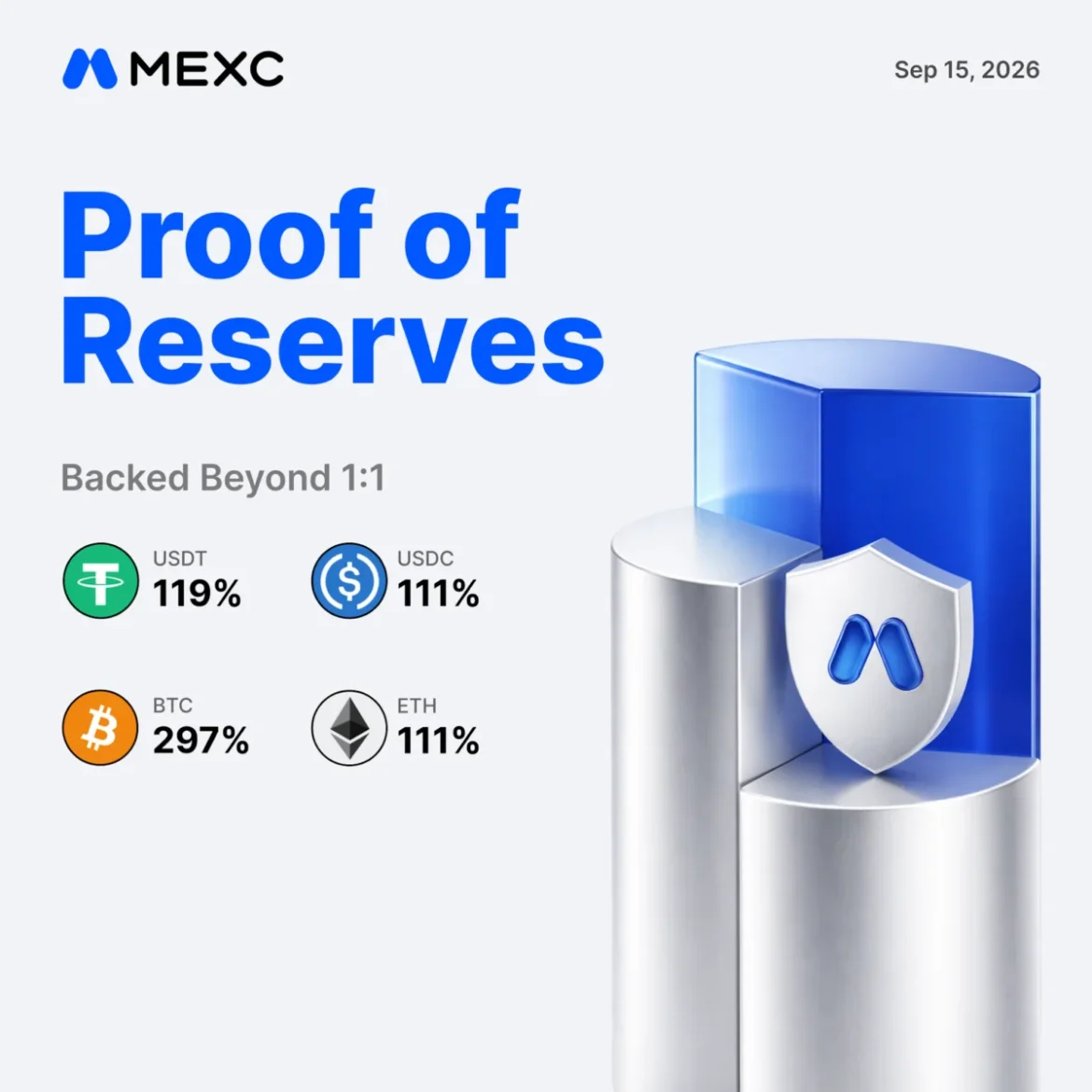
Mutsamudu, Comoros — MEXC, a prominent global digital asset trading platform known for its zero-fee spot trading model, has officially published its Proof of Reserves (PoR) report for September 2026. Audited by the prominent blockchain security firm Hacken, the report reveals that user assets across major cryptocurrencies remain fully backed at ratios significantly exceeding the standard 1:1 requirement. According to the data finalized from a September 10 snapshot, the exchange’s Bitcoin (BTC) reserve ratio notably climbed to 297%, marking a substantial increase from the 288% reported in August.

The monthly publication of verified reserve data forms a cornerstone of MEXC’s ongoing strategy to bolster transparency, reassure retail and institutional traders, and establish higher accountability benchmarks across the cryptocurrency exchange sector. By utilizing advanced cryptographic verification mechanisms such as Merkle Trees, the platform allows individual users to independently verify that their specific account balances are accurately accounted for within the aggregate reserve totals, all while safeguarding user privacy.

Detailed Breakdown of the September 2026 Reserve Ratios

The comprehensive audit conducted by Hacken evaluated multiple core operational layers, encompassing Proof of Liabilities, Proof of Ownership, rigorous reserves calculation methodologies, and an overall PoR assessment. The findings confirm that MEXC maintains substantial over-collateralization across its primary liquid asset classes.

As outlined in the September 2026 audit report, the asset-by-asset backing breakdown is as follows:

  • Bitcoin (BTC): The reserve ratio stands at an impressive 297%. Total reserves of 12,202.13 BTC comfortably cover the aggregate user holdings of 4,106.57 BTC.
  • Tether (USDT): The reserve ratio is recorded at 119%. Total holdings of 1,818,202,910.24 USDT back the total user liability of 1,526,526,878.38 USDT.
  • USD Coin (USDC): The stablecoin maintains a reserve ratio of 111%, with total reserves amounting to 299,925,929.77 USDC against user liabilities of 269,894,125.25 USDC.
  • Ethereum (ETH): The Ethereum reserve ratio also sits at 111%, backed by 58,917.60 ETH in reserves covering 53,243.98 ETH in user assets.

Hacken’s verification process confirms that the exchange holds more than sufficient capital to fulfill 100% of withdrawal requests simultaneously under standard operating conditions, offering a strong financial cushion against unexpected market movements.

Leadership Perspective on Accountability and Trust

In the wake of historical industry-wide liquidity crises and exchange failures, digital asset platforms have faced mounting pressure from regulators and retail participants alike to prove their solvency beyond mere verbal assurances. MEXC’s executive leadership has consistently framed monthly transparency reports as a mandatory operational duty rather than a voluntary marketing exercise.

MEXC’s September 2026 Proof of Reserves Reaffirms Full Backing of User Assets, BTC Reserve Ratio Increases to 297%

Vugar Usi, Chief Executive Officer of MEXC, emphasized the critical importance of verifiable solvency in modern digital finance: "Protecting user assets and earning their trust are fundamental responsibilities, not optional commitments. In an industry where confidence has been tested time and again, transparency must be demonstrated through actions that users can independently verify. That is why we publish verifiable Proof of Reserves every month, giving users the ability to validate their asset data at any time rather than simply relying on our assurances. Our commitment is to continue raising the standard for transparency, accountability, and asset protection, and to build the kind of trust that is earned consistently over time."

Risk Mitigation and Specialized Insurance Funds

Beyond standard reserve audits, MEXC maintains multiple specialized financial safety nets designed to absorb systemic shocks, protect against extreme market volatility, and compensate users in the unlikely event of platform-related operational discrepancies.

The exchange operates a dedicated Futures Insurance Fund designed to absorb shortfalls and negative balances resulting from rapid liquidations during high-volatility events across derivatives markets. As of the September report, this fund maintained a robust balance of approximately 798 million USDT.

Additionally, MEXC manages The Guardian Fund, a dual-reserve structure denominated in a combination of USDT and BTC. Established to provide comprehensive compensation coverage for platform-related issues, The Guardian Fund held $101 million at the time of the September snapshot. Exchange roadmap disclosures indicate active plans to scale this specialized fund to $500 million over the next two years, further insulating the ecosystem against unforeseen black swan events.

Background and Evolution of Proof of Reserves Standards

The practice of publishing cryptographic Proof of Reserves gained widespread momentum across the centralized cryptocurrency exchange ecosystem following the systemic collapses of late 2022. Prior to this regulatory and cultural shift, crypto traders largely relied on traditional third-party audits or trusted-entity assertions, which often lacked real-time verifiability.

The adoption of Merkle Tree cryptography transformed this landscape by allowing cryptographic proofs to link individual user balances to a master root hash published on a public ledger or audit report. This cryptographic architecture ensures that an exchange cannot manipulate liabilities without detection, as any omission or inflation of user balances would invalidate the mathematical tree structure. MEXC’s consistent monthly reporting cycle places it among a select group of major global trading venues that subject their ledger balances to regular third-party cryptographic scrutiny.

Broader Market Implications and Regulatory Context

As global regulatory frameworks for digital assets continue to mature—exemplified by the implementation of comprehensive guidelines in jurisdictions such as the European Union under the Markets in Crypto-Assets (MiCA) regulation—the standard for centralized exchange transparency is shifting from a self-regulatory luxury to a mandatory compliance requirement.

MEXC’s September 2026 Proof of Reserves Reaffirms Full Backing of User Assets, BTC Reserve Ratio Increases to 297%

By maintaining high over-collateralization ratios (such as nearly 300% backing for Bitcoin liabilities) and partnering with respected cybersecurity and auditing entities like Hacken, exchanges aim to preemptively satisfy upcoming international compliance benchmarks. For retail investors navigating an increasingly complex macroeconomic environment, regular PoR disclosures serve as a primary quantitative metric for evaluating counterparty risk before depositing capital onto trading venues.

About MEXC

Founded in 2018, MEXC has developed into a prominent global multi-asset trading platform catering to millions of registered participants across more than 170 international markets. Positioned as a zero-fee gateway to a diverse array of financial instruments, the platform provides simplified, high-performance access to spot cryptocurrency trading, digital asset derivatives, tokenized assets, and emerging traditional finance (TradFi) linked opportunities through a unified account infrastructure.

With an emphasis on deep liquidity, broad asset coverage, and zero trading fees, MEXC continues to focus on lowering barriers to entry for retail and professional traders alike. The platform’s ongoing publication of monthly audited reserve reports aligns with its stated corporate mission to foster a transparent, accountable, and secure global trading environment.

Users, analysts, and market participants wishing to review the full September 2026 Hacken audit report and examine individual Merkle Tree verification parameters can access the data directly through the official MEXC Proof of Reserves portal.


Disclaimer: This article is presented for informational and educational purposes only and does not constitute financial, investment, or legal advice. Digital asset markets and derivatives trading involve substantial risk of loss. Investors should conduct thorough independent research and consult with qualified financial professionals before engaging in any cryptocurrency or traditional financial trading activities.

September 15, 2026 0 comment
0 FacebookTwitterPinterestEmail
Blockchain Technology

The Final Draft of the CLARITY Act Faces Uncertain Senate Future Amidst Growing Criticism Regarding Ethics and Oversight

by admin September 15, 2026
written by admin

The U.S. Senate is bracing for a high-stakes legislative showdown this Tuesday as it prepares for a cloture vote on the "final draft" of the Digital Asset Market Structure legislation, commonly referred to as the CLARITY Act. The 635-page document, released by Senate Republicans late Sunday, represents the culmination of months of intense negotiation and lobbying. However, despite assertions from the bill’s primary architects that it incorporates significant concessions to Democratic demands, the legislation remains caught in a crossfire of partisan skepticism, industry concern, and unresolved ethical debates.

To pass the cloture vote, the bill requires a minimum of 60 votes. With 53 Republican senators, the bill’s success hinges on securing support from at least seven Democrats. Even if it clears this procedural hurdle, the path to final enactment remains perilous, particularly as the Congressional calendar contracts, leaving little room for the extensive revisions that many stakeholders are now demanding.

Chronology of the Legislative Standoff

The current iteration of the CLARITY Act follows an intense period of debate that intensified after a report from the Associated Press on Sunday suggested that President Donald Trump had signaled approval for roughly 80% of the ethics-related language demanded by Senate Democrats. This language was intended to curb the ability of public officials to profit from cryptocurrency ventures while in office, a matter of significant public interest following reports that the President realized over $1 billion in earnings from crypto-linked products last year.

Senator Cynthia Lummis (R-WY), a vocal proponent of the bill, argued that the inclusion of over 120 specific Democratic demands should be sufficient to garner bipartisan support. "They got what they wanted; now they need to take ‘yes’ for an answer," Lummis stated, characterizing the provisions as "unprecedented ethics restrictions." Despite this, the legislative trajectory has been marred by a lack of trust between the two parties, with many Democrats questioning whether the proposed guardrails provide substantive enforcement or merely a veneer of reform.

The Ethics Gap: Loopholes and Enforcement

Central to the Democratic opposition is the assertion that the current language creates "enforcement-proof" scenarios. Critics, including Senator Elizabeth Warren (D-MA), have argued that the bill fails to address the involvement of the immediate family members of public officials. Under the proposed text, while spouses are subject to new restrictions, the children of public officials—who are often integral to the management of family-linked crypto ventures—remain largely outside the scope of the bill’s reach.

Furthermore, the legislation mandates a divestment of significant financial interests in crypto projects unless those assets are placed into a "qualified blind trust." Skeptics argue that such trusts could be managed by close associates or family members, effectively neutralizing the spirit of the reform.

Equally contentious is the role of the U.S. Attorney General (USAG). Under the new draft, the power to launch enforcement actions against public officials remains centralized within the Department of Justice. Democrats have pushed for the preservation of state-level prosecutorial authority, fearing that a politically aligned USAG might be reluctant to pursue cases against the administration. While the bill attempts a compromise by authorizing state Attorneys General to initiate injunctive relief against "digital asset intermediaries," it does not provide them with the power to pursue the public officials themselves.

The situation is further complicated by the status of the Office of Government Ethics (OGE). The administration has operated without a Senate-confirmed OGE director for 18 months, relying instead on a series of "acting directors" who do not require confirmation. This has fueled concerns that the ethics office itself has been effectively neutralized, and since the CLARITY Act prohibits enforcement actions if the supervising ethics office provides a legal opinion that an activity is permissible, the lack of an independent director remains a critical vulnerability.

Economic Implications and the "Stablecoin War"

Beyond ethics, the CLARITY Act faces heavy resistance from the banking sector, particularly regarding the intersection of stablecoins and traditional commercial banking. Small community banks have consistently raised the alarm over "deposit flight"—the phenomenon where customers withdraw funds from traditional interest-bearing accounts to move capital into digital asset platforms that offer higher yields via stablecoin staking or incentive programs.

The bill attempts to address this with a "circuit breaker" mechanism, which would allow the Treasury Secretary to restrict stablecoin yields if they are found to be causing a "substantial detrimental impact" on community bank deposits. Treasury Secretary Scott Bessent has publicly committed to using these tools to protect the community banking sector. However, the American Bankers Association (ABA) and other regional banking groups remain unimpressed, arguing that a reactive circuit breaker is insufficient. They contend that the bill’s current language allows for "creatively structured incentives" that would enable issuers to bypass these protections entirely.

Decentralized Finance and Criminal Liability

The revised draft also introduces significant changes to the Blockchain Regulatory Certainty Act (BRCA) section, which concerns the classification of DeFi developers. While the bill clarifies that developers of non-custodial platforms are not "money transmitters," it simultaneously removes references to Section 1960 of Title 18, which previously offered a degree of protection against criminal liability.

Advocacy groups like Coin Center have expressed disappointment, noting that this change exposes developers to potential prosecution if their code is utilized by third parties for illicit activities. Rep. Tom Emmer (R-MN), a co-author of the original BRCA, has voiced skepticism regarding the removal of this "safe harbor," warning that it could invite state Attorneys General to weaponize the law against developers.

Tribal Sovereignty and Prediction Markets

Finally, the bill has drawn the ire of the Indian Gaming Association (IGA). Tribal gaming operators are demanding explicit language to ensure that federal commodities law does not pre-empt state or tribal gaming regulations, particularly as prediction markets (designated contract markets) begin offering event contracts that mirror sports betting. IGA chairman David Bean has stated that without such protections, the CLARITY Act represents an existential threat to tribal sovereignty. Senator Lummis has contested the IGA’s claims of being ignored, but the public dispute highlights the complexity of reconciling federal crypto policy with existing, well-established gaming laws.

Conclusion and Future Outlook

As the Senate approaches Tuesday’s vote, the legislative landscape is increasingly defined by the tension between the push for market innovation and the need for robust institutional oversight. The Democratic caucus remains largely unified in its opposition, with many members preparing counter-proposals that prioritize stricter ethics and consumer protection.

Even if the CLARITY Act survives the procedural hurdle of the cloture vote, it faces a long road of negotiations. The bill is not merely a piece of technical financial regulation; it is a flashpoint for deeper debates regarding the concentration of power, the role of federal agencies in the digital age, and the extent to which public officials should be held accountable for their financial entanglements. Whether the bill can be salvaged through further amendments or whether it will be stalled by the persistent friction between its supporters and its detractors remains one of the most significant questions in the current Congressional session.

September 15, 2026 0 comment
0 FacebookTwitterPinterestEmail
Newer Posts
Older Posts

Recent Posts

  • EF Protocol Cluster Releases Unified Tier List for Hegotäel Upgrade
  • Kraken Expands Its Digital Asset Offerings With the Official Launch of KOR Protocol Token Trading
  • Zcash Ecosystem Faces Pivotal Week with Network Upgrade 7 and Landmark Governance Restructuring
  • Navigating the Digital Identity Crisis: An Illustrated Primer on Anonymous Authentication in the Age of AI and Age-Verification Laws
  • Verifone Integrates Visa Featurespace Adaptive AI to Revolutionize Global Fraud Detection and Payment Security

Recent Comments

No comments to show.
  • Facebook
  • Twitter

@2021 - All Right Reserved. Designed and Developed by PenciDesign


Back To Top
Dr Crypton
  • Home
  • About Us
  • Contact Us
  • Cookies Policy
  • Disclaimer
  • DMCA
  • Privacy Policy
  • Terms and Conditions

We are using cookies to give you the best experience on our website.

You can find out more about which cookies we are using or switch them off in .

Dr Crypton
Powered by  GDPR Cookie Compliance
Privacy Overview

This website uses cookies so that we can provide you with the best user experience possible. Cookie information is stored in your browser and performs functions such as recognising you when you return to our website and helping our team to understand which sections of the website you find most interesting and useful.

Strictly Necessary Cookies

Strictly Necessary Cookie should be enabled at all times so that we can save your preferences for cookie settings.