• Home
  • About Us
  • Contact Us
  • Cookies Policy
  • Disclaimer
  • DMCA
  • Privacy Policy
  • Terms and Conditions
Dr Crypton
Secure Your Future in Crypto
Cryptocurrency News

Uniswap Founder Proposes Broad Protocol Fee Expansion, Igniting Core DeFi Value Debate

by admin July 18, 2026
written by admin

Hayden Adams, the visionary founder of Uniswap, has initiated a pivotal proposal aimed at expanding protocol fees across Uniswap v4 and various network deployments, thereby reigniting one of decentralized finance’s (DeFi) most enduring and contentious governance debates. This move thrusts the fundamental question of how DeFi protocols should capture and distribute value to the forefront of market discussion, impacting UNI token holders, liquidity providers, and the broader ecosystem.

The Genesis of the Debate: Uniswap’s Enduring Infrastructure Role

Uniswap stands as an undisputed titan within the DeFi landscape, serving as the largest decentralized exchange (DEX) by trading volume and a critical piece of infrastructure. Since its inception, Uniswap has been instrumental in pioneering the automated market maker (AMM) model, which democratized access to trading and liquidity provision in the nascent crypto economy. Its evolution through successive versions—from the simple v1 to the capital-efficient v3 with concentrated liquidity, and now the anticipated v4 with its modular "hooks"—reflects a continuous drive for innovation and market leadership. The protocol processes billions of dollars in trading volume monthly across numerous assets and chains, positioning it as a core liquidity venue for a vast array of tokens.

Despite its immense utility and market dominance, the question of whether this vast usage should directly translate into economic value for the protocol itself, and by extension, for UNI governance token holders, has been a perennial point of contention. For years, the UNI token’s primary utility has revolved around governance rights—allowing holders to vote on key protocol parameters and strategic directions. However, many investors and community members have consistently argued for a more direct value capture mechanism, one that aligns the token’s economic performance more closely with the protocol’s operational success. This tension between governance utility and direct economic value has formed the bedrock of the protocol fee debate.

Unpacking the Latest Proposal: Targeting V4 and Multi-Chain Deployments

The new proposal, formally submitted through Uniswap’s robust governance forum, specifically advocates for the activation of protocol-level fees across multiple critical deployments. Central to this initiative are the forthcoming Uniswap v4 pools, which are designed to offer unparalleled flexibility and customizability through their "hook" architecture, allowing developers to build custom functionalities directly into liquidity pools. This modularity potentially enables a more granular and adaptable approach to fee implementation.

Crucially, the proposal also targets newly launched and expanding network deployments, prominently featuring the Robinhood Chain. Robinhood’s venture into its own blockchain ecosystem signifies a growing trend of established financial entities exploring decentralized technologies, and Uniswap’s presence on such chains underscores its ambition for pervasive multi-chain integration. By proposing fee activation across these diverse environments, Adams and his supporters aim to establish a broad-based mechanism for value accrual, moving beyond isolated instances to a more systemic approach.

For the extensive community of UNI holders and DeFi participants, this is far from a mere technical adjustment. It delves into the very philosophical core of how decentralized protocols, particularly those acting as foundational infrastructure, should monetize their immense utility and incentivize their stakeholders. It directly addresses the long-standing critique that while Uniswap is vital, its native token hasn’t always mirrored that importance in direct economic terms.

Why Protocol Fees Matter: Bridging Usage and Token Value

The historical disconnect between Uniswap’s ubiquitous usage and the direct economic value reflected in the UNI token has been a major point of discussion within the crypto community. While the protocol’s total value locked (TVL) often hovers in the billions of dollars, and daily trading volumes frequently exceed hundreds of millions, the UNI token’s value has often been more susceptible to broader market sentiment and speculative trading than to a clear, direct correlation with protocol activity. Governance rights, while powerful, have not always satisfied investors seeking a more tangible return on their holdings.

Protocol fees offer a potential solution to this conundrum. If activated, a predetermined portion of the trading fees—which currently flow almost exclusively to liquidity providers (LPs) as an incentive—would be rerouted. This rerouted capital could then be directed towards various protocol-controlled mechanisms. These might include bolstering the protocol’s treasury, funding grants for ecosystem development, executing token buybacks that reduce supply and potentially increase price, or facilitating token burns that permanently remove UNI from circulation. Each of these mechanisms would aim to create a clearer, more direct economic link between the exchange’s vibrant activity and the underlying value proposition of the UNI token.

However, the implementation details are paramount. The specific fee rates, the particular pools and asset pairs affected, the selection of chains for fee activation, and the precise methods for collection and distribution are all critical variables. These factors will significantly influence the responses of all stakeholders: traders, who seek efficient and low-cost execution; liquidity providers, who weigh returns against risk; and token holders, who are keen on seeing their investment generate tangible value. The core challenge for Uniswap governance lies in meticulously balancing the imperative of value capture with the necessity of maintaining competitive liquidity and attractive trading conditions. Overly aggressive fees could trigger a migration of liquidity to competing DEXs, while excessively conservative fees might fail to deliver the desired economic impact for token holders.

The Multi-Chain Paradigm: Adding Layers of Complexity

The DeFi landscape has evolved dramatically beyond its Ethereum-centric origins, and Uniswap has been at the forefront of this expansion. The protocol is no longer confined to the Ethereum mainnet; it operates across a multitude of layer-2 solutions and alternative blockchains, including Arbitrum, Optimism, Polygon, BNB Chain, and Base, in addition to newer integrations like the Robinhood Chain. This multi-chain footprint, while creating vast opportunities for growth and user reach, simultaneously introduces significant complexities into governance, particularly concerning fee structures.

Each blockchain ecosystem possesses unique characteristics: different user demographics, varying gas fee environments, distinct liquidity profiles, and diverse competitive pressures from other decentralized applications. A fee model that proves successful and sustainable on Ethereum, for instance, might not translate effectively to a high-throughput, low-fee environment like Polygon or an emerging chain like Robinhood Chain. These differences necessitate a nuanced and adaptive approach to fee implementation.

The current proposal acknowledges this multi-chain reality, highlighting that fee collections would be routed into specialized "TokenJars" and then subsequently claimed for burning through UNI bridging to the Ethereum mainnet. This intricate cross-chain accounting and collection mechanism underscores the sophisticated evolution of DeFi governance. Fee activation in a multi-chain world is no longer a simple on/off switch; it involves complex engineering, secure bridging solutions, and careful coordination across disparate networks. The more networks Uniswap supports and integrates, the more critical these underlying mechanics become for efficient and transparent value capture.

Stakeholder Perspectives: What UNI Holders, LPs, and Traders Will Be Watching

The outcome of this proposal will be closely scrutinized by various stakeholders, each with their distinct priorities and concerns.

UNI Holders: For UNI governance token holders, the primary focus will undoubtedly be on whether the proposal successfully creates a clearer and more credible path for token value appreciation. While an immediate repricing of UNI is unlikely, given the time required for governance proposals to pass and for implementations to take effect, the directional shift is profoundly significant. A well-designed and cleanly executed fee mechanism could substantially strengthen the investment case for UNI, transforming it from a purely governance token into one with a more direct economic stake in the protocol’s success. The narrative around "real yield" in DeFi has gained considerable traction, and UNI holders are keen for their token to align with this trend.

Liquidity Providers (LPs): LPs, who are the lifeblood of any AMM, will approach this proposal with a degree of caution. Their core concern revolves around the potential reduction of their share of trading economics. Currently, LPs earn the vast majority of trading fees as compensation for providing liquidity and bearing impermanent loss risk. If a portion of these fees is diverted to the protocol, LPs will need to assess whether their net returns remain competitive. DeFi liquidity is inherently mobile and permissionless; if LPs perceive that another decentralized exchange offers more attractive returns or a better risk-reward profile, they can swiftly migrate their capital. Uniswap’s governance must therefore carefully calibrate fee rates to avoid cannibalizing its own liquidity base.

Traders/Users: For the end-users—the traders who execute swaps on Uniswap—the primary concern will be the quality of execution. They will be watching to see if fee activation leads to reduced liquidity, wider bid-ask spreads, or overall worse pricing, which could negatively impact their trading experience. If the fee changes are minimal and strategically implemented to preserve market competitiveness, users may barely notice the change. However, any significant degradation of liquidity or pricing efficiency could prompt traders to explore alternative venues. The balance between value capture and maintaining a superior trading experience is delicate.

Broader Implications: DeFi’s Shift from Growth to Value Capture

This Uniswap protocol fee proposal is more than an isolated governance event; it signals a broader, maturing trend within the DeFi ecosystem. The early phases of DeFi, often characterized by the "DeFi Summer" of 2020, were largely focused on aggressive growth: expanding liquidity, onboarding new users, integrating across various platforms, and maximizing Total Value Locked (TVL). The emphasis was on innovation, market share, and establishing foundational infrastructure.

However, as the sector has matured, a new, more existential question has emerged for established protocols: how does this immense activity and utility translate into sustainable, long-term economics? Uniswap, given its scale and scrutiny, serves as a prime example of this paradigm shift. If a protocol of its magnitude, arguably the most important DEX in existence, struggles to establish a credible and sustainable value-capture model, it will undoubtedly raise difficult questions for investors and developers across the entire decentralized finance sector regarding the long-term viability and investment case for governance tokens.

Consequently, the debate surrounding Uniswap’s protocol fees resonates far beyond its immediate community. Other prominent DeFi protocols are closely observing this development, grappling with similar challenges: how to effectively reward their users, retain crucial liquidity, satisfy the economic expectations of their governance token holders, and navigate an increasingly complex regulatory landscape. Protocol fees sit precisely at the intersection of these multifaceted pressures.

For the immediate future, this proposal provides the market with a compelling reason to pay renewed attention to UNI governance. While it may not definitively resolve the long-standing value-capture debate overnight, it undoubtedly propels the discussion into a more concrete and actionable phase. Should the proposal gain approval and be implemented with precision and efficiency, it has the potential to become one of the most significant and influential DeFi governance developments of the year, potentially setting a precedent for how decentralized infrastructure protocols can evolve towards sustainable economic models.

This article is based on information presented in the Uniswap governance forum and general knowledge of the decentralized finance industry.

July 18, 2026 0 comment
0 FacebookTwitterPinterestEmail
Blockchain Technology

Latest Blockchain News, BSV Insights, and AI Web3 Trends from CoinGeek

by admin July 18, 2026
written by admin

Papua New Guinea is embarking on a significant acceleration of its digital transformation agenda, marked by comprehensive efforts to strengthen cybersecurity frameworks, deepen technological integration across its economy, and foster a citizen-centric digital government through strategic collaborations. These initiatives underscore the nation’s commitment to harnessing digital advancements for economic growth, improved public services, and enhanced national security, positioning it as a rapidly evolving digital player in the South Pacific region.

Strengthening Digital Defenses: Revamping the Cybercrime Code Act

At the forefront of this digital push is the Marape administration’s resolve to update the nation’s primary digital offense legislation, the Cybercrime Code Act of 2016. Prime Minister James Marape’s government this week announced ambitious plans to revamp the Act, specifically targeting emerging threats posed by artificial intelligence (AI) to safeguard citizens more effectively from technology-facilitated crimes. The original Cybercrime Code Act, enacted eight years ago, established the legal framework for combating digital offenses within Papua New Guinea. It addressed a range of illicit activities including hacking, online fraud, intellectual property infringement, and cyberbullying, providing a foundational deterrent against the misuse of digital platforms. However, the rapid evolution of technology, particularly the advancements in AI, has necessitated a critical re-evaluation of its scope and enforcement mechanisms.

The urgency for this legislative overhaul is underscored by several factors. Papua New Guinea’s internet penetration has witnessed substantial growth, breaching 2.57 million users, representing a significant portion of its population gaining access to the digital realm. While this expansion brings immense opportunities, it also exposes a larger segment of the populace to digital vulnerabilities. Concurrently, there has been a dramatic escalation in cybercrime across Asia and the South Pacific. Interpol reported an alarming figure of over 6.5 billion cyber threats in 2024 alone across this region, highlighting a pervasive and escalating digital risk landscape. These threats range from sophisticated phishing campaigns and ransomware attacks to the burgeoning menace of AI-generated content used for malicious purposes.

The proposed amendments to the Cybercrime Code Act are specifically designed to address these contemporary challenges. Acting Information and Communications Technology Minister Peter Tsiamalili Jr. outlined that the revised regulations would criminalize individuals found utilizing AI for illicit activities such as deepfakes, voice cloning, and digital impersonation. These technologies, while possessing legitimate applications, have become potent tools for misinformation, fraud, and reputation damage, capable of creating highly convincing but entirely fabricated audio and visual content. Beyond direct perpetrators, the updated legislation will also hold accountable individuals who upload, share, or monetize illegal AI material, ensuring a broader net of responsibility. Crucially, digital platforms and AI service providers will also face accountability under the new framework, pushing for greater corporate responsibility in preventing the misuse of their technologies. This multi-pronged approach aims to create a more secure digital environment for all Papua New Guineans.

Despite the stringent measures envisioned, Minister Tsiamalili Jr. assured the public of a balanced approach, emphasizing the government’s commitment to integrating AI across various industries for national development while mitigating its risks. This reflects a global trend where nations grapple with fostering innovation in AI while simultaneously establishing robust ethical and legal guardrails. The Department of Information and Communications Technology (DICT), in collaboration with the National Information and Communications Technology Authority (NICTA) and the Department of Justice (DOJ), is currently finalizing the guidelines for these reforms, with the aim of introducing the updated legislation to Parliament by November. This timeline indicates a swift and determined effort to adapt the nation’s legal infrastructure to the rapidly changing technological landscape.

Bolstering Identity Assurance through SevisPass and Telco Collaboration

Parallel to its cybersecurity enhancements, Papua New Guinea is making significant strides in strengthening digital identity assurance across its economy. A crucial initiative involves local telecommunications networks collaborating to reinforce identity verification processes. Spearheaded by the DICT, a recent workshop in the capital, Port Moresby, brought together major local telco companies including Digicel, Vodafone, and Telikom, alongside NICTA. The primary objective of this collaboration is to integrate the country’s national digital ID, SevisPass, into SIM self-registration processes.

SevisPass represents a cornerstone of Papua New Guinea’s digital transformation vision. It is designed to be a verifiable digital identity for citizens, streamlining access to government services, financial inclusion, and other digital transactions. By integrating SevisPass into SIM self-registration, the government aims to achieve several critical objectives. DICT Secretary Steven Matainaho highlighted that this move would help unify standards, thereby preventing inconsistent data, enhancing operational efficiency, and ensuring that telcos align with the government’s broader digital pivot. Currently, varying standards for SIM registration can lead to data discrepancies, making it challenging to verify user identities accurately and creating vulnerabilities for fraudulent activities. The standardized approach, anchored by SevisPass, is expected to provide a more robust and secure method for identity verification, critical in an era of increasing digital interactions.

The implications of this integration are far-reaching. For citizens, it promises a more streamlined and secure process for acquiring and managing mobile services, potentially reducing the incidence of identity theft and associated crimes. For telcos, while requiring initial investment in technology and process changes, it will ultimately lead to more reliable customer data, reduced fraud, and compliance with government regulations. The initiative also plays a vital role in financial inclusion, as a robust digital identity is often a prerequisite for accessing digital banking services and other financial products, particularly for populations in remote areas.

While telcos are actively developing implementation timelines and vendor support guidelines in preparation for the rollout of SevisPass-linked self-registration services, the government is simultaneously drafting a comprehensive legal framework. This framework will encompass verifiable credentials, trusted digital transactions, and secure data exchange protocols. This foundational legal structure is essential to underpin the entire digital identity ecosystem, ensuring privacy, data protection, and the legal validity of digital interactions. It signifies a holistic approach to digital identity, recognizing that technology must be supported by robust policy and legal safeguards to build public trust and ensure widespread adoption.

Strategic Partnerships for Innovation: The Queensland University of Technology Collaboration

Recognizing that comprehensive digital transformation requires external expertise and capacity building, the Marape administration remains proactive in forging strategic international partnerships. A significant recent development is the agreement with Australia’s Queensland University of Technology (QUT). This collaboration is designed to create a robust framework for innovation and research, with a specific focus on strengthening Papua New Guinea’s digital workforce and fostering the development of citizen-centric digital solutions.

The partnership with QUT is strategically important given Australia’s close ties with PNG and QUT’s reputation as a leading institution in technology, research, and innovation. The collaboration will primarily concentrate on expanding the utility and reach of SevisPass, further enhancing its capabilities and integration into various public services. Beyond SevisPass, the partnership will also drive the development of new digital solutions tailored to the unique needs and challenges of Papua New Guineans. This could encompass areas such as e-health initiatives, digital education platforms, smart agriculture solutions, and improved e-governance tools, all designed to enhance service delivery and improve the quality of life for citizens.

Minister Tsiamalili Jr. emphasized that while this partnership opens doors for significant technological advancement and capacity building, all projects undertaken within the collaboration will be subject to stringent government approvals and strict adherence to local regulations. This ensures that technological advancements are aligned with national priorities and legal frameworks, maintaining national sovereignty and ensuring that solutions are culturally appropriate and sustainable. The QUT partnership is expected to provide valuable expertise in areas such as digital literacy training, curriculum development for digital skills, cybersecurity research, and the ethical deployment of AI. By empowering the local workforce with advanced digital skills, PNG aims to reduce its reliance on foreign expertise in the long run and build a self-sustaining digital economy.

Broader Implications and the Vision for a Digital Papua New Guinea

The confluence of these initiatives signals a pivotal moment in Papua New Guinea’s development trajectory. The Marape administration’s vision extends beyond mere technological adoption; it aims for a fundamental transformation of governance, economy, and society. By addressing cybersecurity threats, establishing a robust digital identity system, and fostering international research partnerships, PNG is laying the groundwork for a secure, inclusive, and innovative digital future.

The economic implications are substantial. A more secure digital environment and a reliable digital identity system can unlock significant opportunities for e-commerce, digital payments, and the growth of a local tech industry. Enhanced digital literacy and a skilled digital workforce, bolstered by collaborations like the one with QUT, can attract foreign investment and create new employment pathways for PNG’s youthful population. Moreover, improved digital government services promise greater transparency, efficiency, and accessibility, particularly for citizens in remote areas who have historically faced barriers to accessing essential services.

However, the path to comprehensive digital transformation is not without its challenges. Significant investments in digital infrastructure, particularly in expanding reliable and affordable internet connectivity across the country’s diverse and often challenging geography, remain critical. Addressing digital literacy gaps among the broader population will also be crucial for ensuring equitable access and adoption of new technologies. Furthermore, building public trust in digital systems, especially concerning data privacy and security, will be paramount for the success of initiatives like SevisPass.

Papua New Guinea’s proactive stance in regulating AI, bolstering digital identity, and engaging in strategic partnerships demonstrates a clear understanding of the opportunities and risks inherent in the digital age. These concerted efforts reflect a national commitment to leveraging technology as a powerful catalyst for sustainable development, ultimately aiming to create a more connected, secure, and prosperous future for all its citizens. As the reforms are introduced and partnerships deepen, the international community will be closely observing Papua New Guinea’s journey as it navigates the complexities and promises of the 21st-century digital landscape.

July 18, 2026 0 comment
0 FacebookTwitterPinterestEmail
Blockchain Technology

DMarket Ascends to Top Spot in Daily NFT Sales Amidst Shifting Market Dynamics

by admin July 18, 2026
written by admin

The non-fungible token (NFT) market witnessed a significant reshuffle in its daily sales rankings on Tuesday, with DMarket, a prominent Mythos Chain-based collection, securing the top position. Recording a daily sales volume of US$636,958, DMarket’s ascent marked a notable shift from its third-place standing the previous day. This performance highlights the dynamic and increasingly competitive nature of the digital collectibles space, where established giants contend with emerging platforms and utility-driven projects.

A Day of Significant Shifts in NFT Daily Sales

Tuesday’s market activity presented a compelling narrative of both consolidation and disruption within the NFT ecosystem. DMarket’s achievement, while representing a slight dip from its Monday sales of US$663,200, was sufficient to propel it to the summit as other leading collections experienced more pronounced fluctuations. This demonstrates a growing investor interest in platforms that offer tangible utility, particularly within the burgeoning Web3 gaming sector, where DMarket has carved out a significant niche. The platform, built on the Mythos Chain, specializes in digital assets for gaming, enabling players to trade in-game items and virtual goods, thereby integrating NFTs into a functional economic model rather than purely speculative collectible status.

The Mythos Chain itself is a relatively newer entrant in the blockchain landscape, designed to facilitate decentralized gaming ecosystems. Its underlying architecture often leverages existing robust frameworks, providing developers with scalable and cost-effective solutions for deploying blockchain-based games and marketplaces. DMarket’s success on this chain underscores the potential for specialized blockchain solutions to capture market share by catering to specific industry verticals, such as gaming, which demands high transaction throughput and low fees. The Mythos Chain’s focus on gaming infrastructure, supported by entities like Mythos Foundation, aims to empower players and creators, ensuring true ownership and interoperability of digital assets across various games and metaverses. This strategic alignment between DMarket’s offerings and the Mythos Chain’s capabilities has evidently resonated with a segment of the NFT market seeking more than just profile picture (PFP) projects.

The Evolving Landscape of Top-Tier Collections

The immediate aftermath of DMarket’s rise saw a significant realignment among the perennial frontrunners of the NFT world. CryptoPunks, a collection often regarded as the genesis of modern NFTs, experienced a considerable shift, dropping to the second spot with US$582,783 in daily sales. This was a stark contrast to its dominant performance on Monday, where it led the market with an impressive US$1.6 million. The fluctuations in CryptoPunks’ daily volume, while significant, do not diminish its long-term standing. Its all-time sales volume currently stands at an astounding US$2.87 billion, positioning it as the third-most valuable NFT collection in industry history, a testament to its pioneering status and enduring cultural significance.

Following CryptoPunks, the Bored Ape Yacht Club (BAYC) secured the third position with a total sales volume of US$550,919. Like CryptoPunks, BAYC is a flagship collection from Yuga Labs, the dominant entity in the PFP NFT space. BAYC has consistently been a top performer, known for its vibrant community, extensive ecosystem, and significant utility, including exclusive access to events, intellectual property rights for holders, and the associated ApeCoin cryptocurrency. With an all-time sales volume of US$3.18 billion, BAYC holds the distinction of being the second best-selling NFT collection of all time, illustrating its sustained market appeal and strong brand equity. The consistent high performance of both CryptoPunks and BAYC, despite daily fluctuations, underscores the resilience and foundational role of these blue-chip NFTs in the broader market.

Further down the rankings, Solana Monkey Business (SMB), a prominent collection native to the Solana blockchain, also saw a notable decrease in its daily sales. Its volume fell to US$529,880.64 on Tuesday, a considerable drop from the previous day’s US$900,626. This decline caused SMB to move from the second position to the fourth. SMB represents the strength and unique characteristics of the Solana NFT ecosystem, which offers faster transactions and lower fees compared to Ethereum, attracting a distinct segment of collectors and traders. The project is celebrated for its distinctive pixel art and strong community presence within the Solana network.

Rounding out the top five was Guild of Guardians Heroes, an Immutable-based collection, which recorded a daily sales volume of US$476,588. Guild of Guardians is a prime example of a play-to-earn (P2E) blockchain game, where in-game assets are tokenized as NFTs, allowing players true ownership and the potential to earn rewards through gameplay. Its performance highlights the burgeoning interest in the intersection of gaming and NFTs, a sector that ImmutableX, an Ethereum Layer-2 scaling solution, is specifically designed to support. ImmutableX provides gas-free and instant transactions, making it an attractive platform for game developers seeking to integrate blockchain technology without burdening players with high network fees. The presence of both DMarket and Guild of Guardians in the top five underscores a significant pivot in market sentiment towards NFTs with explicit utility, particularly within the gaming metaverse.

Blockchain Performance: Ethereum’s Enduring Dominance and Emerging Challengers

Amidst these shifts in individual collection rankings, Ethereum continued to assert its dominance as the leading blockchain network for NFT sales. On Tuesday, Ethereum-based NFTs accounted for over US$4.27 million in daily sales, significantly outpacing other networks. This enduring lead can be attributed to several factors: Ethereum’s first-mover advantage, its robust security and decentralization, and the vast developer ecosystem that has built the majority of high-value NFT projects, including CryptoPunks and Bored Ape Yacht Club. The network benefits from deeply entrenched infrastructure, liquidity, and a broad user base familiar with its ecosystem.

However, the success of DMarket on Mythos Chain, Solana Monkey Business on Solana, and Guild of Guardians Heroes on ImmutableX demonstrates the growing viability and specialization of alternative blockchains and Layer-2 solutions. Solana has gained traction due to its high throughput and low transaction costs, appealing to projects that prioritize speed and accessibility. ImmutableX, as an Ethereum Layer-2, offers a scalable solution for gaming and other applications that require frequent, gas-free transactions, effectively addressing some of Ethereum’s inherent scaling challenges. The Mythos Chain, while newer, is clearly demonstrating its capacity to support successful projects by focusing on specific industry needs. This diversified landscape suggests a future where multiple blockchains coexist, each catering to different use cases and user preferences, rather than a single chain dominating all aspects of the NFT market.

All-Time Sales Volume: A Glimpse into NFT History

The long-term perspective of NFT sales volumes offers critical context to the daily fluctuations. While DMarket’s daily surge is noteworthy, the all-time figures reveal the enduring power of established collections. As mentioned, Bored Ape Yacht Club stands as the second best-selling NFT of all time with US$3.18 billion in aggregate sales, closely followed by CryptoPunks at US$2.87 billion. The top position for all-time sales is often held by projects like Axie Infinity, which pioneered the play-to-earn model and generated immense transaction volumes through its in-game economy. These historical figures underscore the significant capital that has flowed into the NFT space since its inception and highlight the long-term value appreciation of foundational projects, despite their susceptibility to daily market swings.

Industry Reactions and Expert Perspectives

The daily shifts in NFT sales are closely watched by market participants and industry analysts, prompting various inferred reactions from related parties. A representative from DMarket, or the Mythos Foundation, might express satisfaction with the platform’s performance, emphasizing their strategic focus on utility-driven NFTs in the gaming sector. "Our position at the top of daily sales validates our commitment to building a robust, player-centric ecosystem on the Mythos Chain," an official might state. "We believe the future of NFTs lies in tangible utility and seamless integration into vibrant digital economies, and DMarket is proud to lead that charge."

Meanwhile, spokespersons from Yuga Labs, the creators of CryptoPunks and Bored Ape Yacht Club, would likely reiterate their long-term vision for their expansive ecosystem. While acknowledging daily market dynamics, they might emphasize the foundational strength of their brands and the ongoing development of their metaverse projects, such as Otherside. "The NFT market is inherently dynamic, and daily volumes can fluctuate," a Yuga Labs representative might comment. "However, the enduring value of CryptoPunks and BAYC is rooted in their cultural significance, community strength, and the continuous innovation within the Yuga Labs ecosystem. Our focus remains on building lasting value and utility for our holders."

From the ImmutableX side, the performance of Guild of Guardians Heroes would likely be hailed as further proof of concept for their Layer-2 solution tailored for Web3 gaming. An ImmutableX executive might note, "Guild of Guardians’ consistent presence in the top sales charts demonstrates the immense potential of gas-free, scalable blockchain gaming. We are empowering developers and players alike to engage with true digital ownership without the friction of high transaction costs, paving the way for mass adoption of Web3 games."

Market analysts, observing these trends, often highlight the maturing nature of the NFT space. "These daily fluctuations are a natural progression as the NFT market moves beyond its initial speculative phase," stated one inferred blockchain analyst. "We’re seeing a clear trend towards utility-driven projects, particularly in gaming and decentralized applications. While blue-chip PFPs like CryptoPunks and BAYC maintain their long-term value, the market is increasingly rewarding innovation and real-world application." Another analyst might add, "The rise of specialized blockchains and Layer-2 solutions for specific use cases, like gaming, is a critical development. It signifies a diversification of the ecosystem and an attempt to solve specific pain points, ultimately leading to a more robust and accessible NFT landscape."

Broader Implications for the NFT Ecosystem

The events of Tuesday carry several broader implications for the future trajectory of the NFT ecosystem. Firstly, the strong performance of DMarket and Guild of Guardians underscores the increasing importance of utility-focused NFTs. The market appears to be shifting from a sole emphasis on speculative collectibles and profile pictures towards digital assets that offer tangible benefits, whether in gaming, metaverse experiences, or other decentralized applications. This trend suggests a more sustainable growth model for the NFT space, rooted in functional value rather than purely hype-driven speculation.

Secondly, the performance across various blockchains highlights the ongoing competition and innovation in the underlying infrastructure. While Ethereum remains the dominant force, the success of projects on Solana, ImmutableX, and the Mythos Chain demonstrates that alternative networks are carving out significant niches by offering specialized solutions. This multi-chain future is likely to foster greater efficiency, lower costs, and enhanced user experiences, ultimately benefiting the broader adoption of Web3 technologies. Developers now have more choices, allowing them to select the blockchain that best fits their project’s technical requirements and target audience.

Finally, the daily volatility, even among top-tier collections, serves as a reminder of the inherent risks and rapid shifts within nascent markets. Investors are becoming more discerning, evaluating projects not just on their aesthetics or hype, but on their technological foundation, community strength, and long-term roadmap. The ability of a project like DMarket to ascend to the top spot, even with slightly reduced sales, signals that market leadership can be fluid, rewarding agile platforms that adapt to evolving user demands. The NFT market, still in its relatively early stages, is continuously evolving, promising further innovation and unexpected leadership changes as it matures. The ongoing integration of NFTs into broader Web3 applications, gaming, and digital identity will likely continue to drive this evolution, solidifying their place as a fundamental component of the digital economy.

July 18, 2026 0 comment
0 FacebookTwitterPinterestEmail
Blockchain Technology

OKX Launches AI Marketplace for Autonomous Agents, Pioneering the "Agent Economy" with On-Chain Payments and Reputation Systems

by admin July 18, 2026
written by admin

The global cryptocurrency exchange OKX has officially launched OKX AI, a groundbreaking marketplace designed to enable artificial intelligence agents to autonomously find work, pay for services, and build verifiable, on-chain reputations. This initiative marks a significant strategic pivot for OKX, positioning it as a key infrastructure provider for what it terms the "agent economy," a future where AI agents increasingly interact and transact not just with humans, but with each other. The marketplace, which opened to developers on Tuesday following a successful closed beta involving 50 early AI service providers, leverages technology previously developed by OKX to equip AI agents with digital wallets, facilitate stablecoin payments, and establish persistent digital identities.

The move comes amidst a burgeoning interest in advanced AI applications, particularly the development of autonomous agents capable of performing complex tasks with minimal human oversight. These agents require robust financial and reputational infrastructure to operate effectively in an interconnected digital landscape. OKX’s bet is that this future is arriving faster than many anticipate, and the company aims to be at the forefront of building the necessary rails for this emerging ecosystem.

The Dawn of the Agent Economy: A Paradigm Shift

The concept of an "agent economy" envisions a future where AI entities become active economic participants, interacting in marketplaces, providing services, and consuming resources. This evolution is driven by rapid advancements in large language models (LLMs) and autonomous AI systems, which are increasingly capable of independent decision-making and task execution. However, for such an economy to flourish, several fundamental challenges must be addressed: trust, secure payment mechanisms, and reliable discovery systems.

Traditionally, financial infrastructure has been built with human users in mind, featuring conventional banking systems, fiat currencies, and established legal frameworks for dispute resolution. AI agents, by their very nature, require a different paradigm. They need systems that can handle micropayments efficiently, operate 24/7 without human intervention, provide immutable records of transactions, and enable the formation of reliable reputations without subjective human bias. This is precisely the gap OKX AI seeks to fill by integrating blockchain technology.

Star Xu, founder and CEO of OKX, articulated this vision, telling TechCrunch, "The coming decade will be defined by one-person companies that generate over a million dollars in annual revenue – because every individual effectively gains an unlimited workforce. Traditional financial infrastructure was built for humans. The agentic economy needs infrastructure designed for autonomous software. That is why we built OKX.AI." This statement underscores a profound belief in the transformative power of AI agents to amplify human productivity and redefine entrepreneurial capabilities.

OKX’s Strategic Vision and the OKX AI Marketplace

With over 150 million users globally, OKX is aggressively expanding beyond its core cryptocurrency trading business to become a broader fintech powerhouse. The launch of OKX AI is a significant stride in this direction, signaling the company’s intent to serve not just individual and institutional traders, but also the next generation of customers: autonomous AI agents. This strategy aligns with a broader industry trend where major crypto platforms are diversifying into Web3 infrastructure, decentralized finance (DeFi), and now, AI-driven economies.

The OKX AI marketplace provides a suite of functionalities critical for an agentic ecosystem:

  • Agent Hiring: A platform where AI agents can discover and contract other AI agents for specific tasks or services.
  • Autonomous Payments: Integration of stablecoins and blockchain technology to enable seamless, real-time settlement of transactions, including the low-value micropayments that are expected to characterize the agent economy.
  • Portable On-Chain Reputations: A system where an AI agent’s performance, reliability, and transactional history are recorded on a blockchain, creating a transparent and immutable reputation score that can be carried across different platforms. This addresses the critical need for trust in an autonomous, decentralized environment.

The underlying technology for OKX AI builds upon the company’s previous innovations, which allowed AI agents to manage their own digital wallets and establish persistent, verifiable identities. This foundational work has been crucial in enabling the marketplace’s advanced features.

Building Trust and Transactions: The Role of Blockchain

The integration of blockchain technology is central to the OKX AI proposition. Unlike traditional financial systems that often involve intermediaries and can be slow or costly for small transactions, blockchain offers a decentralized, transparent, and efficient alternative.

  • Micropayments: The ability to settle transactions using stablecoins on a blockchain allows for near-instant, low-cost micropayments. This is essential for AI agents that might perform numerous small tasks, each requiring a fractional payment. Conventional payment rails would render such micro-transactions impractical due to high fees and processing times.
  • Immutable Records: Every transaction and interaction between agents on the OKX AI marketplace is recorded on a blockchain. This immutability provides a tamper-proof audit trail, fostering transparency and accountability.
  • On-Chain Reputation: By linking an agent’s performance and transactional history to a persistent on-chain identity, OKX AI creates a robust reputation system. This allows other agents and human users to assess the trustworthiness and reliability of a service provider based on verifiable data, mitigating risks associated with autonomous interactions.
  • Dispute Resolution: Recognizing that even autonomous systems can encounter disagreements, the marketplace integrates dispute-resolution infrastructure. GenLayer, a launch partner, is providing a "digital court system" to help AI agents resolve contractual disagreements, further enhancing trust and operational integrity within the ecosystem. Albert Castellana, co-founder and CEO of GenLayer Labs, emphasized this necessity to TechCrunch, stating, "What we’re building is essentially a digital court system. The challenge for us is distribution. OKX already has that."

Haider Rafique, OKX’s chief marketing officer and global managing partner, stated that the company is applying the same rigorous fraud detection, compliance systems, and internally developed infrastructure that underpin its cryptocurrency exchange to the new AI marketplace. This commitment to security and regulatory adherence is crucial for fostering confidence in an emerging and largely unregulated domain.

Industry Voices and Early Adopters

The marketplace is initially aimed at crypto developers building AI applications and solo entrepreneurs seeking to automate parts of their businesses with AI agents. OKX anticipates that these developers will create a vibrant ecosystem of AI-powered tools and services that other users can access without needing to build them from scratch.

Early partners and builders on the OKX AI marketplace highlight the diverse applications already taking shape:

Crypto exchange OKX wants AI agents to hire and pay each other
  • CertiK: A blockchain security firm, CertiK is offering a service that allows AI agents to assess the security of a crypto wallet or token before executing a transaction. This integration of security checks directly into agent workflows is vital for safe autonomous operations.
  • CoinAnk: This partner provides live market data on a pay-per-query basis, demonstrating how AI agents can access and monetize real-time information, fueling data-driven decision-making within the agent economy.
  • GenLayer: As mentioned, GenLayer is bringing dispute-resolution infrastructure to the marketplace, a critical component for establishing trust and ensuring fair outcomes in an autonomous contractual environment.

These early applications showcase the immediate utility and potential for specialization within the OKX AI ecosystem, ranging from security and data analytics to governance and conflict resolution.

A Trillion-Dollar Horizon? Market Projections and Economic Impact

The vision for the agent economy extends far beyond niche applications. Haider Rafique projected that "agentic commerce" could become a trillion-dollar market over the next five years, driven by the proliferation of micropayments and autonomous software. This ambitious forecast aligns with broader industry predictions regarding the exponential growth of AI and automation.

According to various market research firms, the global AI market is projected to reach well over a trillion dollars by the early 2030s, with significant segments dedicated to AI services and software. The convergence of AI with blockchain, particularly in areas like decentralized autonomous organizations (DAOs) and Web3 applications, is seen as a major growth driver. OKX’s strategy taps directly into this confluence, aiming to capture a substantial share of the financial infrastructure for this new digital frontier.

The economic implications are vast. The agent economy could lead to:

  • Hyper-efficiency: Businesses and individuals can delegate routine and complex tasks to AI agents, dramatically increasing operational efficiency and reducing costs.
  • New Business Models: The ability for AI agents to autonomously contract and pay for services opens up entirely new models for digital commerce and collaboration.
  • Democratization of Automation: Solo entrepreneurs and small businesses can leverage an "unlimited workforce" of AI agents, leveling the playing field against larger corporations.
  • Enhanced Innovation: By automating foundational tasks, developers and innovators can focus on higher-level problem-solving and creative endeavors.

Leveraging Reach and Infrastructure: OKX’s Competitive Edge

OKX’s biggest advantage in this emerging market is not solely its technological prowess but its expansive global reach and existing infrastructure. With over 150 million users and a robust network of crypto developers, the company is uniquely positioned to seed the OKX AI marketplace with both supply (AI service providers) and demand (users seeking AI-powered solutions).

Developers access the marketplace through Onchain OS, OKX’s comprehensive toolkit designed for connecting AI agents to blockchain-based services. This platform is designed for broad compatibility, supporting popular AI coding tools such as Claude Code, Codex, Hermes, and OpenClaw. Crucially, the company states that no OKX account is required to get started, lowering the barrier to entry for developers and fostering broader adoption. This open approach, combined with OKX’s established brand and security infrastructure, provides a significant head start over potential competitors.

Global Ambitions: The India Focus and Regulatory Landscape

A key component of OKX’s global strategy for the AI marketplace is a strong focus on India. The country has rapidly emerged as one of the world’s largest and most vibrant hubs for AI and blockchain developers. This community represents a critical demographic for seeding the OKX AI ecosystem with innovative applications and services.

This focus is particularly strategic given OKX’s recent history in the region. In 2024, OKX suspended its services in India as it navigated the country’s evolving regulatory requirements for crypto exchanges. However, Rafique emphasized that India remains one of the company’s highest-priority markets. He highlighted that developer products like OKX AI generally face fewer regulatory hurdles than spot crypto trading services. This allows OKX to re-engage with India’s robust builder ecosystem sooner and establish a foothold in a market known for its technological talent and rapid digital adoption, even as it continues to work towards a broader return for its crypto trading business. This phased re-entry strategy underscores OKX’s agility in adapting to diverse regulatory environments while pursuing long-term growth.

The Broader Fintech Evolution

The launch of OKX AI is not an isolated venture but part of a larger, cohesive strategy to "modernize markets" and "modernize money." This broader ambition was underscored in March when Intercontinental Exchange (ICE), the parent company of the New York Stock Exchange, invested approximately $200 million in OKX, valuing the exchange at $25 billion.

Rafique explained that the partnership with ICE is geared towards modernizing traditional markets through tokenization – the process of representing real-world assets on a blockchain. Concurrently, OKX AI represents the company’s parallel effort to "modernize money" for an era increasingly defined by autonomous software. This two-pronged approach positions OKX at the intersection of traditional finance, blockchain technology, and cutting-edge artificial intelligence, aiming to redefine how value is created, exchanged, and managed in the digital age.

Challenges and Future Outlook

While the vision for the agent economy is compelling, challenges remain. Widespread adoption will depend on the ease of use for developers and end-users, the scalability of the underlying blockchain infrastructure, and the continuous evolution of regulatory frameworks globally. The nascent nature of AI agent technology also means that security vulnerabilities and ethical considerations will need ongoing attention and robust solutions.

Despite these hurdles, OKX’s proactive move with the AI marketplace demonstrates a clear understanding of the convergence between AI and blockchain. By providing the foundational infrastructure for autonomous transactions and verifiable reputations, OKX AI is poised to play a pivotal role in shaping the future of digital commerce and human-AI collaboration, potentially unlocking unprecedented levels of automation and economic efficiency in the coming decade.

July 18, 2026 0 comment
0 FacebookTwitterPinterestEmail
Decentralized Finance (DeFi)

The Evolution of Prop Trading: Onchain Platforms Confront Legacy Conflicts with Transparency

by admin July 18, 2026
written by admin

In August 2023, the U.S. Commodity Futures Trading Commission (CFTC) initiated enforcement action against MyForexFunds, a Toronto-based proprietary trading firm, freezing over $310 million in assets amassed from more than 135,000 customers. The CFTC’s complaint was not a broad challenge to the legality of prop trading firms, but rather a specific accusation that MyForexFunds had engaged in deceptive practices. The firm allegedly misrepresented its operational model, telling customers they were trading against third-party liquidity providers when, in reality, MyForexFunds itself served as the counterparty for substantially all trades. Furthermore, the CFTC claimed the firm utilized proprietary software to manipulate customer order fills, pushing them to worse prices, and would often close winning accounts under fabricated technicalities. Essentially, MyForexFunds was accused of operating as a "bucket shop" disguised as a legitimate prop firm, profiting directly from customer losses through illicit means.

This pivotal case serves as an essential starting point for understanding the burgeoning landscape of onchain prop firms. The very conflict MyForexFunds was accused of concealing – acting as the house betting against its own customers – is precisely what many new onchain entrants now explicitly declare in their public documentation. While the inherent conflict of interest has not vanished, the veil of secrecy surrounding it has been lifted. Moreover, the critical element MyForexFunds merely faked, a genuine route to a real market, is now becoming a tangible reality for traders who qualify within these transparent, blockchain-based ecosystems.

The onchain prop firm category, as of mid-June 2026, is a dynamic and rapidly evolving space, roughly six months old. Many of its most credible players are still in their alpha or early launch phases, meaning key metrics such as token valuations, fee structures, and the total count of funded traders are subject to significant flux. Consequently, the specifics outlined here should be considered a snapshot of a nascent industry, not a settled state.

The Fundamental Business Model of Prop Firms: A Paid Examination

Stripped of aspirational marketing rhetoric about "funding the next generation of traders," the core offering of a modern prop firm is a paid examination with a potential payout. Aspiring traders pay a one-time fee, which can range from $50 to several thousand dollars depending on the desired account size, to participate in a simulated trading challenge. During this phase, they trade a demo account against a predefined set of rules. The objective is typically to hit a profit target, often around 10%, without breaching a maximum drawdown limit. Successful completion of this evaluation leads to being declared "funded." From that point onward, the trader receives a share of their generated profits, commonly 80%, with the firm retaining the remaining portion.

The fees collected from these evaluations constitute the most visible and substantial revenue stream for prop firms. Industry leader FTMO, based in Prague, reported an impressive $329 million in revenue in 2024, managing over 2.3 million open accounts. Over its ten-year operational history, FTMO has distributed more than $450 million to successful traders. FundedNext, a formidable challenger from the UAE, is estimated to have cleared over $100 million in 2024. The total addressable market for these evaluation fees is estimated to be in the low billions annually, underscoring the scale and profitability of this industry, which largely operates on a consistent funnel model.

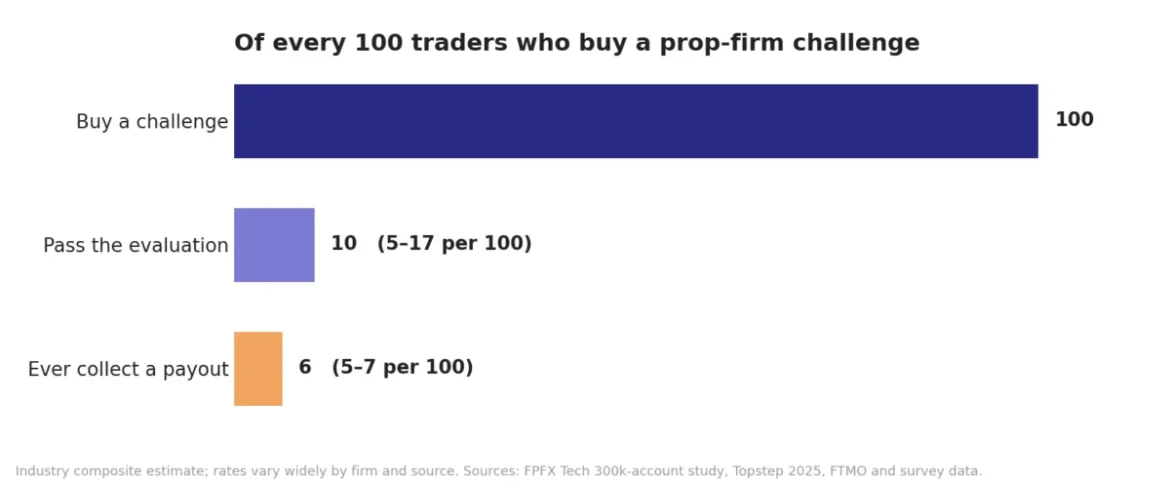
This funnel’s efficacy hinges on a stark reality: a vast majority of participants do not pass. While audited data is scarce, as most firms do not publish such figures, credible estimates consistently show low success rates. These estimates typically address two distinct questions: the percentage of traders who pass the initial evaluation, and the even smaller percentage who ever actually collect a payout.

Industry data, compiled from various sources including firm-published statistics, community estimates, and third-party platform analyses, paints a clear picture. For forex-focused firms, roughly 5-10% of entrants successfully pass the evaluation phase, with a mere 5-7% ever collecting a payout. Futures trading, often more rule-driven, shows slightly higher, though still challenging, success rates. For instance, FTMO community estimates suggest approximately 8% pass Phase 1, with around 7% of all entrants ever collecting a payout. Topstep, a firm-published statistic, showed 16.8% passing their 2025 Combine, but only 33% of funded traders (a much smaller pool) ever collected a payout. A third-party FPFX Tech study of 300,000 accounts found only 7% collected a payout, while the CEO of The Funded Trader stated 1-2% of all clients ever received a payout. The widely cited headline that "1 in 20 traders pass" is generally accurate for forex firms, illustrating the challenging odds faced by buyers.

Therefore, the underlying economics are straightforward: most customers fail their evaluations, making their initial fee largely gross margin for the firm. The small minority who succeed are paid from the much larger pool of fees generated by the failures. As long as the cumulative fees from unsuccessful attempts exceed the payouts to winners, the firm generates significant profits. This fee-based funnel, rather than any sophisticated trading strategy, forms the bedrock of the prop trading business model.

The Hidden Layer: The B-Book Controversy

Beyond the evaluation fees, a second, often opaque, layer of profit exists, conspicuously absent from marketing materials. The initial challenge phase is, by design, a simulation; orders placed during this period do not interact with real markets. The critical question arises after a trader is declared "funded." Even then, their trades frequently do not reach a live market. Instead, the firm "internalizes" them, a practice known as "B-booking." If the funded trader loses, which statistically is the most common outcome, the firm directly retains those losses, adding to its profits beyond the initial evaluation fee. This B-book mechanism is identical to a practice retail forex brokers have employed for decades, proving profitable for prop firms precisely because most accounts ultimately incur losses. It acts as an additional profit stream, complementing the fee funnel rather than replacing it.

Conversely, an "A-book" strategy involves the firm passing a trader’s orders directly to a real market venue, earning only a spread or commission. Firms typically A-book traders they believe will be consistently profitable, thus avoiding exposure to their potential gains. They B-book traders deemed likely to lose, directly collecting their losses. The strategic decision of assigning a trader to either the A-book or B-book is paramount. It is also where the most significant conflict of interest resides: a firm that B-books a trader has a direct financial incentive for that trader to lose. The documented failure mode, exemplified by the CFTC’s charges against MyForexFunds, involves a firm B-booking a winning trader and then fabricating a rule violation to close the account before having to disburse substantial payouts.

Historically, this B-book operation has been a closely guarded secret within the industry. Firms either outright denied its existence or simply omitted any mention of it. However, the emerging onchain entrants are adopting a radically different approach. They explicitly describe their A/B booking engine in their public documentation, with one notable instance even open-sourcing the classifier code that determines a trader’s book assignment. The inherent conflict of interest has not been eliminated, but its existence has been brought into the public domain.

The Onchain Migration: Drivers and Timing

The fundamental technological substrate enabling this shift to onchain prop firms is Hyperliquid. A successful prop trading operation demands several key capabilities: deep liquidity across a diverse range of markets, rapid execution speeds, and a robust, programmatic system for settling trades and issuing payouts. Hyperliquid addresses the first two requirements through its innovative onchain order book and extensive perpetuals markets. Furthermore, its builder-deployed framework allows external teams to deploy custom markets and tooling atop its infrastructure without needing to rent or build proprietary infrastructure. A prop firm leveraging Hyperliquid gains access to substantial liquidity, particularly in major crypto assets, without the prohibitive cost and complexity of building its own matching engine. Crucially, it inherently inherits the chain’s transparency, making every trade, every rule, and every payout a potentially verifiable onchain event.

Beyond technological innovation, there’s a significant defensive rationale driving the timing of this onchain migration. The traditional prop trading industry has long relied heavily on MetaTrader, a widely used trading platform. In 2024 and 2025, a stringent licensing crackdown by MetaQuotes, the platform’s vendor, reportedly forced an estimated 80 to 100 firms out of business – representing approximately one-eighth of the global total. This episode highlighted a critical structural vulnerability: a business whose core trading infrastructure can be unilaterally disabled by a software licensor faces existential risk. An onchain venue, with settlements recorded on a public blockchain that no single entity can revoke or control, offers an explicit counter-narrative to this fragility.

This last point forms the core value proposition of onchain prop firms. They aim to address three historical areas where prop firms have been able to operate with opacity and ambiguity: the rulebook, payout reliability, and the identity of the counterparty. By moving these elements onchain, they are dragged into the open, albeit to varying degrees of verifiability.

It’s important to maintain a nuanced perspective. While elements like payout reserves and rulebooks can be genuinely verifiable onchain, the routing of any single trade may not be fully provable. The fact that a firm can A-book to Hyperliquid does not automatically provide irrefutable proof that a specific trader’s fill was mirrored there rather than internally B-booked. Similarly, the exact promotion threshold for a trader to move from the B-book to the A-book might not always be public. Therefore, "disclosed" is often a more accurate term than "verifiable" when discussing the A/B decision specifically. Nevertheless, the act of explicitly disclosing this conflict represents a fundamental departure from the practices of firms like MyForexFunds, and it is a critical aspect to consider within this emerging category.

Key Players in the Onchain Prop Firm Arena

The onchain prop trading landscape is nascent but already shows signs of consolidation and significant interest. A notable development occurred outside the immediate crypto-native sphere in September 2025, when Kraken, a major cryptocurrency exchange, acquired Breakout. Breakout, a Tampa-based crypto prop firm, had already issued over 20,000 funded accounts since 2023. This acquisition marked Kraken as the first major crypto exchange to directly enter the funded trading space, signaling that prop trading is evolving into a desired feature for large exchanges, rather than remaining a fringe experiment. Two newer entrants, both built natively on Hyperliquid, represent the clearest expressions of the pure onchain model.

Propr, developed by XBorg and supported by SwissBorg, officially launched in early 2026. It offers funding for traders up to $100,000 to trade perpetuals across a diverse range of assets, including crypto, equities, and commodities, alongside prediction markets and Solana memecoins. Traders operate on an 80/20 profit split, with onchain payouts. Propr’s most distinctive innovation is its commitment to transparency, pushing it to its logical conclusion: it open-sources its A/B booking classifier, making the actual code that determines a trader’s book assignment publicly auditable. Its API documentation is also openly published. Propr successfully raised a $1.5 million seed round at a $17.5 million Fully Diluted Valuation (FDV), and its native $PROPR token is slated for a full unlock at a Token Generation Event (TGE) in August 2026. XBorg is also pursuing a "license the prop firm OS" business model, selling its underlying stack to other operators, which indicates where it perceives the highest profit margins within this ecosystem.

Hypernova launched its closed alpha on May 1, 2026, and secured $3 million in a pre-seed funding round led by Lemniscap, with participation from CMS Holdings, Very Early Ventures, Pivot Global, and a roster of prominent Hyperliquid-ecosystem angels. Hypernova employs a split architecture: its smart contracts, user accounts, and payout mechanisms reside on Arbitrum, settling in USDC, while liquidity and pricing are sourced from Hyperliquid’s extensive offering of over 110 perpetuals, covering crypto, US equities, commodities, and indices. The team boasts a strong pedigree, with experience from RockawayX and Coinbase. Notably, CEO Anar Bayramov was an early backer of Breakout during his time at RockawayX, prior to its acquisition by Kraken. As of late May, the alpha program had onboarded approximately 250 traders, funded over 20, and disbursed more than $30,000 in payouts, supported by a $1 million onchain payout reserve carved out from its funding round.

Beyond these three leading entities, a growing long tail of onchain prop firms is emerging, including names like HyperPnL, Upscale Trade, GT Funded, Solana Funded, and Carrot Funding. These are tracked by aggregators such as onchainprop.wtf, though users are advised to exercise caution and verify information directly from primary sources, as discrepancies (e.g., profit split percentages) can occur. One builder involved in selling the underlying tech stack has boldly predicted the emergence of over 100 onchain prop firms within a year. Regardless of whether this specific number materializes, the trajectory is clear: this category is expanding rapidly, attracting significant institutional capital, and moving beyond a handful of cloned projects.

  Breakout (Kraken) Propr Hypernova
Stage Live; acquired by Kraken Sept 2025 Live since early 2026 Closed alpha (launched May 1, 2026)
Venue Kraken infrastructure Hyperliquid Arbitrum settlement + Hyperliquid liquidity
Instruments Crypto Perps (crypto, equities, commodities), prediction markets, memecoins 110+ perps (crypto, US equities, commodities, indices)
Account size Up to $200K $10K–$100K $5K–$200K
Profit split Up to 90% 80% Up to 80%
Evaluation Challenge → funded 1-step or 2-step → funded 1-step assessment, 10% target
A/B booking Not disclosed Open-sourced classifier (public repo) Dynamic by trader quality; confirmed by CEO
Token None $PROPR, TGE Aug 2026 Planned (raise had token warrants)
Funding Acquired by Kraken $1.5M seed @ $17.5M FDV $3M pre-seed, led by Lemniscap

Figures are drawn from each firm’s documentation and public coverage as of mid-June 2026. Account sizes and fees vary by tier, and alpha numbers, in particular, are subject to change. Breakout, now under Kraken ownership, is included as a centralized contrast to highlight industry consolidation rather than as a direct onchain peer.

Onchain Prop Firms: The House Edge, On the Table

The B-Book, Now on the Record: A Shift in Posture

Perhaps the most significant philosophical shift within this emerging category is not merely technological but cultural. The A/B booking conflict, the very issue MyForexFunds was charged for obscuring, is now often presented as a key differentiator and even a marketing point.

Anar Bayramov, CEO of Hypernova, articulated this mechanism to The Block without euphemism. He explained that when a trader is A-booked, the firm routes their trades to the real market and incurs a loss if the trader loses. Conversely, when a trader is B-booked—either due to insufficient data or an assessment of their trading performance as weak—the firm keeps those trades in-house and directly profits from their losses. The implication is clear: unproven or struggling traders are internalized, while consistently strong traders are routed to live markets. Bayramov framed this as a solution to the malpractice of legacy firms that B-book all traders and then arbitrarily ban successful ones, a scenario mirroring the MyForexFunds allegations.

Propr takes this transparency a step further by open-sourcing its classifier code. This allows for external auditability of the logic that sorts traders, moving beyond mere assertion. In both approaches, the underlying premise remains consistent: a conflict of interest that is openly acknowledged, and in Propr’s case, inspectable line by line, is inherently safer than one shrouded in secrecy and requiring blind trust in a support desk. There is merit to this argument. A B-book breach that can be verified against an immutable onchain rulebook is far more difficult to fabricate than one adjudicated within a private, centralized dashboard. While the firm still profits when a B-booked trader loses, it is theoretically prevented from retroactively altering the rules to ensure that outcome.

The honest assessment is that onchain prop firms have not fundamentally resolved the conflict of interest inherent in B-booking. Instead, they have made it legible. Furthermore, they have made the A-book a real possibility for qualifying traders, as opposed to MyForexFunds’s mere pretense. This constitutes a genuine improvement over the MyForexFunds model on two crucial fronts: explicit disclosure and actual trade routing. However, neither of these equates to perfect alignment of interests. A B-booked trader is still trading against a house that benefits from their losses. The crucial difference now is the ability to ascertain which side of that dynamic one occupies.

What Onchain Genuinely Fixes and What Persists

It is important to delineate the aspects that are structurally enhanced by onchain implementation from those that remain fundamentally the same business, albeit with improved optics.

Genuinely Improved: Payout reliability and rule integrity stand out as areas of significant structural enhancement. The most frequent and severe complaints against legacy prop firms revolve around payout issues, ranging from sluggish withdrawals to manufactured rule breaches or even outright firm disappearances. An immutable onchain rulebook and a publicly auditable payout reserve directly address these concerns. When a firm like Hypernova’s reserve balance is readily queryable on a block explorer, the question of "are they solvent enough to pay me?" transforms from an act of faith into a verifiable fact. Similarly, when breach conditions are embedded within a smart contract, "did I actually break a rule?" ceases to be a subjective judgment call and becomes an objective, onchain event. For the customer, this increased certainty and transparency represent a substantial and non-trivial value proposition.

Not Improved, and Arguably Sharpened: The underlying base-rate economics of prop trading remain unchanged. Whether onchain or off, the model’s profitability still hinges on the majority of traders failing their challenges. The drawdown limits, essential for the firm’s solvency, are the very same limits that typically lead to the washout of most accounts, often due to a single adverse trading day. The success funnel for onchain firms is unlikely to differ structurally from its legacy counterparts, where approximately 5-17% pass the evaluation and an even smaller fraction (5-7%) ever collect a payout. This is because the same profit target and drawdown mathematics drive both. While transparency fosters trust, it does not inherently improve a trader’s odds of success. A 10% profit target within a 6% drawdown limit remains a challenging examination, regardless of whether it’s enforced by a smart contract or a human compliance team.

The Same Old Risk, Now in Plain Sight: The solvency of the payout reserve presents a familiar risk, now rendered transparent. Legacy firms typically paid winners from a general corporate balance sheet, and when funds ran low, many simply vanished, defaulting on trader obligations. An onchain firm, however, pays from a specifically named, finite reserve. Hypernova’s $1 million reserve, for instance, is seeded from its fundraising and intended to be replenished through revenue. While adequate for a small funded book, a finite reserve acts as a hard ceiling in a way a general balance sheet does not. A cluster of simultaneous winning traders, or a highly successful A-booked cohort, can directly and rapidly deplete this reserve. The risk of insolvency itself is not new; what is novel is the ability to monitor the reserve’s depletion in real-time. Hypernova’s daily payout cap during its alpha phase, $10,000 of profit per user per day, serves as a visible pressure-release valve designed to manage precisely this constraint. Transparency, in this context, cuts both ways: when the reserve is public, a rapid draw-down or "run" on it becomes a publicly observable event.

The Nuanced Lesson of MyForexFunds

It would be a facile interpretation to view the MyForexFunds case as definitive proof that the entire prop trading model is inherently flawed, or that moving onchain is merely a tactic to evade regulators by operating offshore. Such a reading misrepresents both the specifics of the case and the actual regulatory risks.

The CFTC’s legal theory was highly specific. The actionable conduct centered on deliberate misrepresentation (telling customers they faced third-party liquidity while the firm was the counterparty), intentional manipulation of execution quality, and the pretextual closing of winning accounts. The CFTC did not argue that "being the counterparty" in itself was illegal, nor that "running a challenge" was prohibited. A firm that accurately discloses its counterparty, routes verified flow to legitimate venues, and enforces breaches through transparent, onchain logic effectively neutralizes the majority of the CFTC’s original complaint. In this narrow, crucial sense, the onchain design offers a more robust answer to the CFTC’s actual concerns than the "offshore-and-hope" posture adopted by many legacy firms.

Furthermore, the MyForexFunds case took an unexpected turn that complicates easy conclusions. In May 2025, the case collapsed. Following a recommendation from a court-appointed Special Master, who found that the CFTC had taken "deliberate steps down a path of obfuscation and avoidance," a federal judge dismissed the case with prejudice. The agency was ordered to pay the defendants’ legal fees for the sanctions motion, and four CFTC lawyers along with an investigator were placed on administrative leave. The very enforcement action that significantly shaped the perceived risk profile of this industry did not merely stall; it was entirely dismissed, with sanctions leveled against the regulator itself. This outcome does not condone the underlying conduct alleged against MyForexFunds, but it strongly suggests that the regulatory boundary is drawn around deception and execution abuse, rather than the prop trading model itself. This is precisely the line an ethically designed onchain firm is best positioned to respect.

The more challenging regulatory question is similar to those raised by HIP-4 for prediction markets or the "onchain forex gap" for FX: can a permissionless, no-KYC, offshore onchain venue truly scale beyond a niche, or will it be structurally excluded from the regulated institutional flow that larger players can access? Kraken’s acquisition of Breakout represents a strategic bet on the latter: that the compliant, exchange-backed version of prop trading is the one destined for mainstream adoption and scale.

Uncomfortable Questions for the Future

As the onchain prop firm category matures, several uncomfortable questions warrant careful consideration:

  • If transparency is the core product, why does the A/B booking logic often remain partly opaque? Propr’s decision to open-source its classifier is the strongest articulation of the transparency promise. However, if other firms like Hypernova describe the logic but do not publish the specific data thresholds that promote a trader from B-book to A-book, a gap in true verifiability remains. While disclosing the engine in plain language is an improvement over MyForexFunds, "trust our classifier" is not synonymous with "verify how it was applied to me." On a closed classifier, individual application cannot be independently checked onchain. The long-term credibility of this category depends on closing this transparency gap.

  • Is the payout reserve a feature or a fuse? A public, finite payout reserve is undeniably more honest than an opaque corporate balance sheet, but it is also inherently more fragile. Legacy firms that failed often did so quietly. An onchain firm whose public reserve visibly drains towards zero during a particularly profitable month for its A-booked traders faces a unique transparency problem that its predecessors never had to manage: a public run on its reserves.

  • Does placing the conflict onchain make it acceptable, or merely visible? A B-booked trader fundamentally remains in a position where they are trading against a house that profits from their losses. Disclosure, while vital, does not equate to alignment of interests. The open question is whether sophisticated traders, once they can clearly see they’ve been B-booked, will simply exit the platform. Such an exodus could leave firms primarily with the losing flow that makes the B-book profitable, thus exacerbating the very selection problem that could push firms towards MyForexFunds-style behavior in the first place.

  • Who ultimately wins as the category consolidates? Kraken, with its established distribution network and regulatory licenses, holds a powerful position. XBorg’s strategy of selling its underlying stack to other operators suggests a play for infrastructure dominance. The independent onchain firms sit in a middle ground, offering greater transparency than incumbents but facing scale challenges against exchange-backed behemoths. The vision of "100 onchain prop firms" and the reality of "one major exchange owns it" are not necessarily compatible.

The Core Takeaway

The onchain prop firm model represents a genuinely improved answer to the core problem MyForexFunds exemplified. The issue was never whether a firm could be the counterparty, but whether it should be allowed to hide that fact and cheat its customers upon exit. Immutable rules, publicly auditable payouts, and a transparently identified counterparty are significant advancements. The most credible iteration, exemplified by Propr’s open-sourcing of its A/B classifier, meaningfully raises the bar for industry standards.

However, the fundamental conflict of interest remains. Most traders continue to pay a fee and ultimately lose. Firms still profit from this losing flow and route winning traders to external markets. The drawdown limits, while ensuring firm solvency, are the same mechanisms that inevitably wash out the majority of participants. Onchain technology does not alter this basic arithmetic; it merely conducts it in public. For the individual purchasing a challenge, the expected value remains negative: a fee paid for a sub-10% chance of ever collecting a payout. A transparent negative-expected-value product is undoubtedly more honest than an opaque one, but it is not, by definition, a "better deal" in terms of probabilities.

The most clear-eyed perspective on this entire category is that it represents a form of gambling with an audit trail. This is an improvement over gambling without one, but it remains gambling. What is genuinely novel extends beyond marketing claims: the A-book is now a real pathway for traders who earn it, not merely a fiction; the rulebook cannot be arbitrarily rewritten after a win; and the payout reserve is a tangible asset that can be publicly monitored. The inherent conflict has not been solved; it has simply been relocated to a place where everyone can observe it.

July 18, 2026 0 comment
0 FacebookTwitterPinterestEmail
Cybersecurity & Hacking

Cybersecurity Startup IRIS C2 Run by Convicted Felons Jack Burkman and Jacob Wohl, Known for Conspiracy Theories and Fraud

by admin July 18, 2026
written by admin

A cybersecurity startup, IRIS C2, that publicly advertises multi-million dollar payouts for zero-day security vulnerabilities in popular software, has been revealed to be operated by a pair of individuals with a documented history of promoting far-right conspiracy theories, engaging in fraudulent schemes, and accumulating multiple felony convictions. Jack Burkman, 60, and Jacob Wohl, 28, are the figures behind IRIS C2, a company that claims to be based in McLean, Virginia, and specializes in offensive cybersecurity capabilities. Their most recent ventures prior to IRIS C2 included orchestrating fake intelligence operations and an AI-based lobbying platform, LobbyMatic, which they ran under assumed names. The revelation casts a shadow of skepticism over IRIS C2’s legitimacy and raises serious questions about its operational ethics, given the sensitive nature of the zero-day exploit market.

IRIS C2: Public Face and Bold Claims

The public face of IRIS C2 is its X/Twitter account, @C2IRIS, which has garnered over 4,000 followers since its inception in January 2025. This account frequently posts about security vulnerabilities, artificial intelligence, and software exploits, positioning IRIS C2 as a key player in the offensive cybersecurity space. The company’s business model, as articulated in a pinned post on its X account, is to "Attract the very best vulnerability researchers and exploit developers in the world to join our company. This mostly revolves around junior engineers with raw talent/extremely high IQ. We don’t care if they have a college degree/industry experience."

The website linked in their profile, irisc2[.]com, reinforces these claims, actively recruiting for various open positions. Recent posts on its LinkedIn page boast of an "overwhelming number of applications" from potential employees, suggesting a robust interest in their offers. IRIS C2 explicitly states its objective to acquire "zero-day exploits, individual primitives, partial chains, and full capabilities across all major platforms," promising substantial payouts ranging from $10,000 to an astounding $7 million. These figures, they claim, are determined by the target’s criticality, the exploit’s reliability, and its overall operational value. The visual representation of these potential earnings, displayed prominently on their website, serves as a powerful lure for aspiring and experienced vulnerability researchers alike.

Further investigation into the company’s structure reveals that irisc2[.]com is operated by Calvexa Group LLC, a business registered in Virginia. This connection was identified through the government contracting portal g2exchange.com, which lists Calvexa Group LLC as the operator. Curiously, the "contact" link on Calvexa Group’s own website, calvexagroup[.]com, redirects visitors directly to irisc2[.]com, solidifying the link between the two entities. While Calvexa Group LLC is registered as a federal contractor, g2exchange.com indicates no active direct government contracts, which contrasts with later claims made by Wohl regarding government work.

The Troubling History of Jack Burkman and Jacob Wohl

The individuals at the helm of IRIS C2, Jack Burkman and Jacob Wohl, are far from newcomers to public scrutiny. A search of the Arlington, Virginia, address listed in the incorporation records for Calvexa Group LLC leads directly to a property occupied by Jack Burkman, the 60-year-old founder and managing partner of the lobbying firm Burkman & Associates. When questioned about IRIS C2, Burkman deferred all inquiries to his longtime associate, 28-year-old Jacob Wohl. Their combined history paints a vivid picture of a career built on controversy, misinformation, and legal challenges.

Felons, Fraudsters Flog Offensive Cybersecurity Startup

Jacob Wohl’s Early Forays into Finance and Fraud:

Before his entanglement with cybersecurity, Jacob Wohl cultivated an image as a financial prodigy, earning the moniker "Wohl of Wall Street." By the age of 17, he had already launched multiple investment firms, even making an appearance on Fox News in 2015 to discuss his hedge funds. However, this early success was quickly overshadowed by accusations of fraud. In 2017, the Arizona Corporation Commission charged Wohl and his investment funds with 14 counts of securities fraud, ordering him to pay $35,000 in restitution. This was followed by a 2019 conviction in California, where Wohl pleaded guilty to four felony counts of selling unregistered securities, resulting in a two-year probation sentence. These early financial misdeeds established a pattern of questionable business practices and legal skirmishes that would define much of his public career.

A Partnership in Deception: Burkman and Wohl’s Conspiracy Ventures:

The collaboration between Burkman and Wohl truly began to garner national attention through a series of elaborate and often bizarre hoaxes and conspiracy theories. Their modus operandi frequently involved creating fake intelligence companies to lend an air of legitimacy to their fabricated claims.

  • Targeting Public Figures: Their targets were often high-profile political figures. In a particularly egregious example, they concocted fabricated sexual assault claims against then-FBI Director Robert Mueller during the height of the Russia investigation. They also aimed similar false accusations at Pete Buttigieg, then mayor of South Bend, Indiana, and a Democratic presidential candidate.
  • False Allegations of Extramarital Affairs: In 2019, Burkman and Wohl held press conferences to spread false allegations of extramarital affairs against prominent Democratic politicians, including Senator Elizabeth Warren (D-Mass.) and then-2020 presidential candidate Kamala Harris. These events were widely debunked and ridiculed, further cementing their reputation as purveyors of disinformation. Their tactics often involved enticing individuals with financial incentives to make false statements, only for these schemes to unravel under scrutiny.

The Robocall Schemes and Extensive Legal Repercussions:

The most severe legal consequences for Burkman and Wohl stemmed from their activities surrounding the 2020 U.S. presidential election. In an effort to influence the election outcome, they orchestrated a massive robocall campaign targeting residents in battleground states, particularly in predominantly Black communities.

  • Vote Suppression Efforts: Following the 2020 election, Wohl and Burkman were prosecuted by multiple U.S. states for making thousands of robocalls that disseminated false claims about mail-in ballots. A key aim of these calls was to suppress the Black vote in Detroit, a critical demographic in Michigan.
  • Indictments and Sentencing: In Cleveland, Ohio, they were indicted on a staggering 15 felony counts for orchestrating this robocall scheme. After their appeals to dismiss the charges were rejected, they were sentenced in late 2025 to probation. This marked a significant legal defeat, highlighting the serious criminal nature of their activities.
  • Plea Deals and Civil Penalties: In 2022, both Wohl and Burkman pleaded guilty to a single felony charge of telecommunications fraud in Ohio. Their sentence included a fine, probation, and community service, underscoring the ongoing legal fallout from their actions. The repercussions extended beyond criminal courts. In March 2023, a judge in a New York civil case ruled that Burkman and Wohl had violated federal and state civil rights laws through their robocall campaigns. They subsequently agreed to pay a substantial $1 million settlement.
  • FCC Fine: The financial penalties continued to mount. In June 2023, the Federal Communications Commission (FCC) imposed a colossal $5.1 million fine against Wohl and Burkman for their illicit robocall campaigns. At the time, this represented the largest fine ever sought by the FCC under the Telephone Consumer Protection Act, emphasizing the unprecedented scale and impact of their unlawful activities.

LobbyMatic: Operating Under Pseudonyms:

Even amidst their mounting legal troubles, Burkman and Wohl continued their pattern of deceptive ventures. In September 2024, Politico reported on their now-defunct company, LobbyMatic, which purported to use artificial intelligence to assist in political lobbying efforts. The investigation revealed that the pair were operating LobbyMatic using pseudonyms: Wohl adopted the name "Jay Klein," while Burkman went by "Bill Sanders." This strategy was seemingly designed to obscure their identities from employees and potential clients. Politico’s report highlighted that two former LobbyMatic employees resigned after discovering the true identities of their employers, while others only learned of the deception after leaving the company. This incident further illustrates their consistent use of misdirection and assumed identities to conduct their business.

Felons, Fraudsters Flog Offensive Cybersecurity Startup

IRIS C2’s Operational Model and Wohl’s Self-Proclaimed Expertise:

The cybersecurity market for previously undisclosed vulnerabilities, known as zero-days, is a complex and often opaque ecosystem. It is populated by a diverse group of individuals, from ethical researchers and academics to charlatans and those deeply embedded in cybercrime communities. However, the segment of this market that sells offensive security services to government entities typically operates with extreme circumspection. Most government contractors involved in this space recruit vulnerability researchers discreetly and acquire exclusive rights to novel exploits without the kind of brazen public advertising seen from IRIS C2. This open approach immediately raised red flags within the cybersecurity community.

KrebsOnSecurity became aware of IRIS C2 when an attendee at a regional cybersecurity conference reported that Wohl and Calvexa Group representatives were actively "pestering" individuals about selling their vulnerability research. This direct, public solicitation is highly unusual for a company operating in such a sensitive domain, particularly one that claims to work with federal government contracts.

In an interview with KrebsOnSecurity, Jacob Wohl provided further insights into IRIS C2’s operations, albeit with characteristic self-aggrandizement and evasiveness. Wohl stated that Jack Burkman was not involved in the day-to-day operations of IRIS C2, attempting to distance the company from Burkman’s direct association. Wohl explained that IRIS C2 initially began as a penetration testing company but had recently shifted its focus to "selling phone-hacking services to the government." Throughout the interview, Wohl repeatedly mentioned working on federal government contracts, yet when pressed for specifics, he claimed he was "not at liberty to speak publicly about them," a common tactic to avoid verifiable details.

Despite having no formal education or training in computer science or information security, Wohl proudly declared his expertise. "I know more about tech than anyone," Wohl boasted. "My background has always been extremely technical, and I’ve always been deeply into tech. People know me as someone who is able to create spectacularly exquisite capabilities that would make your head spin." This self-taught narrative, while not impossible in the tech world, stands in stark contrast to the professional credentials typically expected in high-stakes cybersecurity roles, especially those involving government contracts.

Wohl detailed IRIS C2’s process for acquiring vulnerabilities, stating that security researchers bring the company unique findings "on a regular basis." However, he noted that these findings are often preliminary. "Let’s say someone finds a flaw in a media decoder on a phone," Wohl explained. "A lot of times what we receive is an exploit primitive, where the idea is there but the [execution] needs work. You need that exploit to be stable and reliable, and that’s what we do." This description suggests IRIS C2 aims to refine raw vulnerability data into fully functional and reliable exploits.

Wohl claimed IRIS C2 employs approximately 40 individuals, but with a significant caveat: none of them are permitted to list their employment on LinkedIn due to "operational security reasons." This secrecy, combined with the founders’ history of operating under pseudonyms, raises concerns about transparency and the potential for employees to be unaware of the true identities and checkered pasts of their employers. A post from the IRIS C2 account on X in May further fueled these suspicions, with the author mentioning his girlfriend had no idea what he did for a living, implying a deeply concealed operational environment.

Broader Implications and Ethical Concerns:

Felons, Fraudsters Flog Offensive Cybersecurity Startup

The emergence of IRIS C2, led by individuals with such a notorious history, presents a unique and troubling intersection of disinformation, fraud, and the sensitive realm of national security cybersecurity.

  • Risk to Researchers: The promise of multi-million dollar payouts might attract talented, but perhaps naive, junior engineers or researchers seeking a breakthrough. However, aligning with a company founded by convicted felons known for deception could severely damage a researcher’s reputation and potentially entangle them in future legal or ethical quandaries. The opaque nature of "operational security" could also leave employees vulnerable to being unwitting participants in questionable activities.
  • Integrity of the Zero-Day Market: The zero-day exploit market is already fraught with ethical debates, given that these vulnerabilities can be used for both defensive and offensive purposes, by nation-states, law enforcement, and criminal organizations alike. The entry of operators with a history of exploiting public trust for personal gain or political manipulation introduces an unprecedented level of risk and diminishes the overall integrity of this critical sector.
  • Government Contracting Concerns: While IRIS C2 claims to be involved in federal government contracts, the lack of verifiable direct contracts for Calvexa Group LLC, combined with the founders’ criminal records, raises significant questions about how such a company could secure or maintain clearances for sensitive work. The U.S. government typically has stringent vetting processes for contractors involved in national security, making Burkman and Wohl’s involvement highly improbable for legitimate, sensitive operations.
  • Blurring Lines Between Cyber and Disinformation: The founders’ background in spreading false claims and engaging in political manipulation adds another layer of concern. A company specializing in offensive cyber capabilities, run by individuals who previously weaponized information, could potentially leverage their technical access for purposes beyond legitimate defense or intelligence, including further disinformation campaigns or political interference.

Latest Developments: Involvement with a Cryptocurrency Fraudster

The pattern of questionable associations for Burkman and Wohl continued to unfold. An update from a March 31 publication by journalist Molly White brought to light another concerning development. White reported that Burkman and Wohl were paid a substantial $300,000 retainer by a Canadian cryptocurrency fraudster. This individual is wanted by the United States and several other countries for allegedly stealing $65 million from the crypto platforms KyberSwap and Indexed Finance, though he has not yet been convicted. According to White’s report, the purpose of this retainer was for Burkman and Wohl to pursue a "presidential pardon to avert a miscarriage of justice" on behalf of the accused hacker.

This latest revelation further solidifies the founders’ willingness to engage in high-stakes, ethically dubious ventures, even extending to the realm of international criminal defense for individuals accused of massive financial fraud. It suggests that IRIS C2 might be just one facet of a broader network of operations designed to leverage influence, technical capabilities, or legal loopholes for controversial clients, underscoring the deep ethical quagmire surrounding their activities.

Conclusion:

The emergence of IRIS C2, a cybersecurity startup promising lucrative payouts for zero-day exploits, under the leadership of Jack Burkman and Jacob Wohl, is a deeply unsettling development within the cybersecurity landscape. Their extensive and documented history of fraud, conspiracy theories, and multiple felony convictions, coupled with their consistent use of deception and pseudonyms, casts severe doubt on the legitimacy and ethical foundation of IRIS C2. While the zero-day market is inherently complex, the public and brazen nature of IRIS C2’s recruitment, juxtaposed with the founders’ past, stands as an anomaly. It serves as a stark reminder for researchers and the wider cybersecurity community to exercise extreme caution and due diligence when engaging with entities that operate in the shadows, particularly when those shadows are cast by individuals with such a problematic and legally challenged past. The ongoing scrutiny of IRIS C2 and its controversial leadership is imperative to ensure transparency and accountability in a domain critical to national and global security.

July 18, 2026 0 comment
0 FacebookTwitterPinterestEmail
Cybersecurity & Hacking

Vite Ecosystem Under Siege: Advanced Blockchain-Backed Supply Chain Attack Unveils Sophisticated Malware Campaign

by admin July 18, 2026
written by admin

Cybersecurity researchers have uncovered a new wave of highly sophisticated software supply chain attacks targeting the widely-used Vite frontend tooling ecosystem, leveraging a novel multi-tiered blockchain-based command-and-control (C2) infrastructure. This campaign, dubbed "ViteVenom" by Checkmarx, represents a significant escalation and expansion of the previously identified "ChainVeil" operation, attributed to the persistent threat actor known as SuccessKey. The attack involves a cluster of seven malicious npm packages designed to compromise developer environments, enabling a range of nefarious activities from credential harvesting to persistent backdoor injection, posing a substantial threat to the integrity of modern web development pipelines.

A Deep Dive into ViteVenom: Evolution of a Potent Threat

The "ViteVenom" campaign, meticulously detailed by Checkmarx, specifically targets developers who rely on Vite, a next-generation frontend build tool known for its speed and efficiency in modern JavaScript development. The attackers’ strategy involves publishing seemingly legitimate npm packages that, upon integration into a project, introduce a Remote Access Trojan (RAT) into the developer’s system. This RAT is equipped with formidable capabilities, including the establishment of a reverse shell, exfiltration of sensitive credentials, arbitrary file exfiltration, and the insidious injection of persistent backdoors, ensuring long-term access for the attackers.

What sets ViteVenom apart, and indeed its predecessor ChainVeil, is the unprecedented and highly resilient four-tier blockchain-based C2 infrastructure. This complex system spans multiple prominent blockchain networks, specifically Tron, Aptos, and Binance Smart Chain (BSC). By leveraging the decentralized and immutable nature of these blockchains, the threat actor significantly complicates efforts by cybersecurity professionals and law enforcement to disable or dismantle the C2 network, making it "extremely difficult," as Checkmarx researcher Pavan Gudimalla highlighted in a recent analysis. This innovative approach to C2 operations marks a critical evolution in software supply chain attack methodologies, signaling a growing sophistication among threat actors.

Chronology of a Calculated Compromise

The timeline of the SuccessKey operations, encompassing both ChainVeil and ViteVenom, reveals a calculated and patient approach to compromising the software supply chain:

  • February 27, 2026: Evidence suggests the earliest signs of malicious activity, with the activation of cryptocurrency wallets linked to the ViteVenom campaign. This indicates a preparatory phase long before the actual deployment of malicious packages.
  • Prior to June 2026: The "ChainVeil" campaign is identified, targeting a broader range of popular npm libraries through typosquatting. This initial phase likely served as a testing ground or an earlier wave of attacks by SuccessKey.
  • June 29 – July 3, 2026: The seven malicious npm packages associated with ViteVenom are published. These packages specifically masquerade as legitimate components within the Vite ecosystem, demonstrating a refined targeting strategy.
  • June 2026 (Published "Last Month"): Checkmarx publishes its initial analysis on ChainVeil, outlining the innovative blockchain C2 infrastructure and the RAT capabilities. This analysis likely predates or coincides with the initial stages of the ViteVenom discovery.
  • July 17, 2026: The current reporting date, highlighting the ongoing nature and expansion of the threat with the formal identification and naming of "ViteVenom."

This chronology underscores the persistent nature of the SuccessKey threat actor and their continuous efforts to evolve their tactics and expand their reach within the software development ecosystem.

The Modus Operandi: A Tale of Two Campaigns

While sharing a common architect and a sophisticated C2 backbone, ViteVenom distinguishes itself from ChainVeil through its refined targeting and obfuscation techniques.

Seven Malicious Vite npm Packages Use Blockchain C2 to Deliver a RAT

ChainVeil’s Broad Net: The initial ChainVeil campaign employed a less specific typosquatting strategy. It targeted widely used development libraries and tools, masquerading as packages for popular frameworks like Tailwind, preprocessors like Sass, Object-Relational Mappers (ORMs), and rate-limiting utilities. Examples included unscoped package names such as "rate-limit-flexible," designed to trick developers into installing a malicious look-alike of a common utility. This approach aimed for a broader attack surface, hoping to catch unsuspecting developers searching for generic functionalities.

ViteVenom’s Surgical Precision: In contrast, ViteVenom exhibits a more targeted approach, focusing exclusively on the Vite frontend tooling ecosystem. The malicious packages in this campaign were published between June 29 and July 3, 2026, and crucially, they adopted scoped package names. By attempting to impersonate the "@vitejs/*" namespace, the attackers lent a deceptive veneer of legitimacy to their malicious offerings. For instance, a developer looking for an official Vite plugin might be more inclined to trust a package under the "@vitejs/" scope, believing it to be officially sanctioned or maintained. This tactic exploits the inherent trust developers place in scoped packages, which are often used by organizations or projects to group related functionalities under a single, verifiable namespace.

Shared Deception and Execution Stealth: Despite these surface-level differences, the core malicious payload delivery and execution mechanisms remain consistent between the two campaigns. Both ViteVenom and ChainVeil utilize the same shared Tier-2 infrastructure for delivering the RAT. This consistency includes the use of identical Tron wallet and Aptos account addresses, which ultimately trace back to the same Binance Smart Chain (BSC) transaction responsible for deploying the malware.

A critical aspect of their stealth is the timing of the malicious code execution. Unlike many conventional malware packages that execute at the installation stage, the code embedded in ViteVenom and ChainVeil packages activates at "import time." This means the malicious payload is triggered only when a developer explicitly imports the compromised library into their project’s code. This delay tactic is highly effective in evading many endpoint security solutions and automated scanners that typically monitor for suspicious activity during the package installation process. By the time the malicious code is imported and executed, it may have bypassed initial security checks, allowing the RAT to establish itself more effectively.

The Blockchain Advantage: A Resilient Command-and-Control Network

The most striking and concerning innovation of the SuccessKey campaigns is their sophisticated use of blockchain technology for command and control. Traditional C2 infrastructures typically rely on centralized domain names or IP addresses. These are vulnerable points that can be identified, blocked, and ultimately seized by law enforcement or cybersecurity agencies, effectively neutralizing the attacker’s ability to communicate with and control compromised systems.

SuccessKey, however, has circumvented this vulnerability by storing payload pointers as transaction data on public blockchains. This multi-tiered C2 architecture provides unprecedented resilience:

  1. Decentralization and Immutability: Blockchains like Tron, Aptos, and Binance Smart Chain are inherently decentralized and immutable. Once data is recorded on these ledgers, it cannot be altered or removed, making the C2 configuration and payload delivery instructions permanent and globally accessible.
  2. Redundancy and Obfuscation: The four-tier structure, utilizing multiple distinct blockchain networks, creates a highly redundant system. If one blockchain network were to experience issues or come under scrutiny, the attackers have multiple fallback options. This also adds layers of obfuscation, making it harder for defenders to map out the entire C2 infrastructure.
  3. Payload Pointer Retrieval: When the malicious package is imported and executed, it acts as a loader. Instead of connecting to a conventional web server, it reaches out to the blockchain infrastructure to obtain the "next-stage" instructions. This involves querying specific blockchain addresses or transaction data to retrieve pointers to the actual malware payload or further C2 configuration.
  4. Takedown Resistance: As Pavan Gudimalla explains, "The attacker stores payload pointers as transaction data on public blockchains rather than on domain names that can be seized, making the infrastructure nearly impossible to take down." This fundamental characteristic of blockchain technology poses a significant challenge for incident response and threat intelligence efforts, as there is no central server or domain to "sinkhole" or shut down.
  5. Robust Fallback Mechanisms: The attackers have also engineered robust fallback mechanisms. Should the primary Tron-based payload retrieval method fail, the malware automatically attempts to use Aptos as a backup. Furthermore, a critical safety net exists: if all blockchain-based retrieval methods are unsuccessful, the malware can directly fetch the RAT from a C2 server over HTTP, completely bypassing the blockchain. This layered approach ensures maximum operational resilience for the attackers, even in the face of partial disruption or network issues.

This innovative application of blockchain technology fundamentally alters the landscape of C2 infrastructure, providing threat actors with a robust, censorship-resistant, and incredibly difficult-to-disrupt platform for their malicious operations.

Implications and Broader Impact on Software Development

The ViteVenom campaign, and the broader SuccessKey operations, carry profound implications for the software development ecosystem, impacting individual developers, organizations, and the broader cybersecurity landscape.

Seven Malicious Vite npm Packages Use Blockchain C2 to Deliver a RAT

For Developers: The immediate risk for developers is the unwitting compromise of their development environments. Integrating a seemingly innocuous package can lead to credential theft, intellectual property exfiltration, and the establishment of persistent backdoors, effectively turning a developer’s machine into a launchpad for further attacks. This erosion of trust in public package registries like npm is a severe blow, forcing developers to adopt increasingly stringent verification processes for every dependency they introduce. The widespread adoption of Vite, with millions of downloads weekly, means a vast potential attack surface.

For Organizations: For businesses and enterprises, a compromise originating from a developer’s machine can have catastrophic consequences. Stolen credentials could grant access to internal systems, source code repositories, cloud environments, and sensitive customer data. The injection of persistent backdoors could lead to long-term surveillance, data breaches, or even the deployment of ransomware. The integrity of an organization’s software products could be undermined if malicious code is inadvertently introduced into production builds, leading to supply chain attacks downstream for their own customers. The cost of incident response, remediation, and reputational damage can be immense.

Evolving Threat Landscape: The SuccessKey campaigns represent a significant evolution in software supply chain attacks. The shift towards blockchain-based C2 infrastructure signals a new frontier where traditional defense mechanisms are less effective. This trend highlights the need for cybersecurity solutions that can analyze package behavior at runtime, monitor network traffic for suspicious blockchain interactions, and conduct deep supply chain analysis beyond static code scanning. The level of sophistication suggests a well-resourced threat actor, potentially a nation-state or an advanced persistent threat (APT) group, with the technical prowess to innovate and maintain such complex infrastructure.

Challenges for Defenders: The compartmentalization strategy employed by SuccessKey, characterized by "surface-level differences – different package names, different maintainer accounts, different Tier-1 wallets, different malicious file paths – are consistent with how a single operator would compartmentalize multiple distribution tracks to limit exposure," as noted by Checkmarx. This makes attribution and comprehensive disruption incredibly challenging, as taking down one component does not necessarily dismantle the entire operation. Defenders must contend with a dynamic, multi-faceted adversary capable of adapting and diversifying its attack vectors.

Recommendations and Mitigation Strategies

In light of the sophisticated nature of the ViteVenom and ChainVeil campaigns, immediate action and long-term strategic changes are imperative for developers and organizations alike:

Immediate Actions for Potentially Affected Users:

  • Remove Malicious Packages: Immediately identify and remove any of the identified malicious packages from your projects and development environments.
  • Audit Dependencies: Conduct a thorough audit of all project dependencies, especially those recently added or updated, to ensure no other compromised packages are present.
  • Rotate All Credentials: Assume compromise and immediately rotate all sensitive credentials, including API keys, access tokens, SSH keys, and passwords, particularly those used in development environments or tied to build systems.
  • Inspect System Files: Scrutinize critical system configuration files like .bashrc, .zshrc, and .profile for any unauthorized modifications or suspicious entries that could indicate persistent backdoor injections.

Best Practices for Proactive Defense:

  • Verify Package Authenticity: Always verify the authenticity and reputation of npm packages before integrating them. Prioritize official packages, check maintainer history, and look for strong community support. Be wary of new, sparsely documented, or infrequently downloaded packages, especially those mimicking popular ones.
  • Implement Software Composition Analysis (SCA): Utilize SCA tools (e.g., Checkmarx SCA, Snyk, Mend) to automatically scan dependencies for known vulnerabilities and malicious code. These tools can help identify suspicious patterns or indicators of compromise.
  • Pin Dependency Versions: Avoid using broad version ranges (e.g., ^1.0.0) in your package.json to prevent automatic updates to potentially compromised versions. Pin exact versions to ensure reproducibility and reduce the risk of unexpected malicious updates.
  • Least Privilege Principle: Apply the principle of least privilege to build systems and developer workstations. Limit network access and permissions to only what is strictly necessary for their function.
  • Runtime Monitoring: Implement runtime application self-protection (RASP) or other behavioral monitoring tools that can detect anomalous process behavior, outbound connections to suspicious IP addresses or blockchain networks, and unauthorized file modifications.
  • Static and Dynamic Analysis: Employ static application security testing (SAST) to analyze source code for vulnerabilities and dynamic application security testing (DAST) to test applications in a running state.
  • Developer Education: Continuously educate developers on the risks of supply chain attacks, common social engineering tactics, and the importance of vigilance when installing or updating packages.
  • Supply Chain Security Frameworks: Organizations should adopt comprehensive software supply chain security frameworks, integrating security practices throughout the entire software development lifecycle (SDLC), from code conception to deployment and maintenance.
  • Incident Response Planning: Develop and regularly rehearse incident response plans specifically tailored for software supply chain compromises, ensuring a swift and effective reaction to potential breaches.

The ViteVenom campaign serves as a stark reminder of the ever-evolving nature of cyber threats and the increasing sophistication of adversaries targeting the software supply chain. The innovative use of blockchain technology for command and control represents a significant leap forward for attackers, presenting new challenges for defenders. As the digital ecosystem becomes increasingly interconnected and reliant on open-source components, vigilance, proactive security measures, and a collaborative approach to threat intelligence are paramount to safeguarding the integrity of software worldwide. The battle for the software supply chain is intensifying, demanding a continuous adaptation of defense strategies to counter these advanced and persistent threats.

July 18, 2026 0 comment
0 FacebookTwitterPinterestEmail
Cybersecurity & Hacking

7-Zip Releases Version 26.02 to Address Critical Remote Code Execution Vulnerability in XZ Processing

by admin July 18, 2026
written by admin

7-Zip, one of the most widely deployed open-source archive utilities globally, has issued version 26.02 to mitigate a critical remote code execution (RCE) vulnerability. This flaw, if exploited, could allow malicious actors to execute arbitrary code on a user’s system simply by convincing them to open a specially crafted compressed file. The vulnerability specifically targets 7-Zip’s handling of XZ-compressed data, a common compression format known for its high compression ratios and widespread use, particularly in Unix-like operating systems and software distribution.

The vulnerability was brought to light through the diligent work of Lunbun researcher Landon Peng and subsequently detailed in an advisory from the Zero Day Initiative (ZDI), a prominent program that rewards security researchers for responsibly disclosing zero-day vulnerabilities. According to ZDI’s advisory, identified as ZDI-26-444, the core issue stems from a heap-based buffer overflow. This type of memory corruption error occurs when a program attempts to write more data into a fixed-size block of memory on the heap than it was allocated for, leading to an overwrite of adjacent memory. Such an overflow can be meticulously engineered by an attacker to overwrite crucial program control data, ultimately redirecting the program’s execution flow to malicious code injected by the attacker. In the context of 7-Zip, this means a specially crafted XZ archive could trigger the overflow during decompression, potentially granting the attacker arbitrary code execution privileges under the context of the user running 7-Zip. The severity of a heap-based buffer overflow leading to RCE is typically rated as critical, often scoring 9.8 out of 10 on the Common Vulnerability Scoring System (CVSS), underscoring the urgent need for users to update their software.

While the 7-Zip developer has not yet released a detailed technical explanation of the flaw, an analysis of the source code changes introduced in version 26.02 provides strong indications of its nature. The modifications primarily revolve around how 7-Zip manages and tracks available memory space during the decompression of XZ data. Specifically, the patch introduces additional checks to ensure that the XZ decoder cannot write beyond the allocated boundaries of its output buffer. This preventative measure directly addresses the heap-based buffer overflow by rigorously enforcing memory safety, thereby preventing the malicious overwrite that could lead to RCE. The requirement for user interaction, such as visiting a malicious webpage hosting the archive or directly opening a booby-trapped compressed file, highlights the importance of user vigilance and security awareness alongside software updates.

Understanding Heap-Based Buffer Overflows and XZ Compression

To fully appreciate the gravity of this vulnerability, it is essential to delve deeper into the technical concepts involved. A heap-based buffer overflow is a particularly insidious type of software bug. Unlike stack-based overflows, which occur in a region of memory used for function calls, heap overflows happen in the "heap," a region of memory used for dynamic memory allocation. Programs request chunks of memory from the heap as needed, and if they write past the end of an allocated chunk, they can corrupt adjacent data structures or even other allocated memory blocks. This corruption can be leveraged by an attacker to manipulate program state, trigger crashes, or, most critically, achieve arbitrary code execution by altering pointers or function addresses within the process’s memory space. The attacker’s carefully constructed input (the malicious XZ file) dictates what data gets written beyond the buffer, allowing them to precisely control the outcome.

The XZ compression format, which is at the heart of this vulnerability, is an open-source data compression format utilizing the LZMA2 algorithm. It is renowned for its very high compression ratio, often outperforming older formats like GZIP and BZIP2, especially for large files. XZ is widely used in various contexts, including packaging software for Linux distributions (e.g., .tar.xz files), system archives, and embedded systems. Its efficiency makes it a popular choice, but its complexity also means that parsers and decompressors can be intricate, increasing the potential for subtle memory management bugs. The fact that 7-Zip, a multi-format archiver, had a flaw in its XZ processing implementation underscores the challenges in securely handling diverse and complex data formats, particularly when dealing with low-level memory operations. The patch’s focus on "tracking available space" during decompression directly addresses the dynamic nature of memory allocation and deallocation involved in handling XZ data streams.

Discovery, Disclosure, and the Role of Zero Day Initiative

The discovery of this vulnerability by Landon Peng of Lunbun Research exemplifies the crucial role independent security researchers play in enhancing global cybersecurity. These researchers dedicate their expertise to uncovering flaws before malicious actors can exploit them, often under challenging conditions. The subsequent disclosure through the Zero Day Initiative (ZDI) further illustrates a mature approach to vulnerability management. ZDI operates as the world’s largest vendor-agnostic bug bounty program, acquiring zero-day vulnerabilities from researchers and then coordinating their disclosure with affected vendors. This coordinated vulnerability disclosure (CVD) process typically involves:

Update now: 7-Zip fixes RCE flaw exploitable with malicious archives
  1. Discovery: A researcher identifies a vulnerability.
  2. Reporting to ZDI: The researcher submits the vulnerability to ZDI.
  3. Validation and Acquisition: ZDI validates the vulnerability and, if confirmed, acquires it, paying the researcher.
  4. Vendor Notification: ZDI privately notifies the affected vendor (in this case, the 7-Zip developer) with technical details, allowing them time to develop a patch.
  5. Patch Development: The vendor works on fixing the issue.
  6. Public Disclosure: Once a patch is available, ZDI publishes an advisory detailing the vulnerability, often after a pre-agreed disclosure deadline, ensuring users can update their software immediately.

This structured approach ensures that users are protected as quickly as possible while giving developers adequate time to implement and test fixes, preventing premature public disclosure that could give attackers an unfair advantage. The absence of publicly available detailed technical write-ups from the developer is common in such scenarios, as it limits the information available to potential attackers for reverse-engineering the patch and developing exploits.

7-Zip’s Ubiquity: A Prime Target for Cyberattacks

7-Zip’s immense popularity and widespread deployment elevate the significance of any security flaw affecting it. As a free and open-source file archiver, 7-Zip is a staple on millions of Windows systems globally, often preferred over built-in archiving tools or commercial alternatives like WinRAR due to its superior compression ratios, support for a vast array of archive formats (including ZIP, GZIP, BZIP2, TAR, ISO, ARJ, LZH, CHM, Z, CPIO, RPM, DEB, and NSIS), and robust AES-256 encryption capabilities. Beyond Windows, its command-line version, p7zip, is extensively used in Linux and macOS environments for scripting and server-side operations. This pervasive presence across individual workstations, enterprise networks, and critical server infrastructure makes 7-Zip an exceptionally attractive target for threat actors.

Archive utilities, by their very nature, handle user-supplied, potentially untrusted data. They are often the first programs to interact with files downloaded from the internet or received via email. A vulnerability in such a fundamental utility provides a perfect gateway for attackers to gain initial access to a system. Exploiting a flaw in 7-Zip means bypassing traditional security perimeters that might focus on web browsers or email clients, allowing malware to execute at a deeper system level. Given that many users may not actively think about the security of their file archiver, these vulnerabilities can remain unpatched on systems for extended periods, creating a vast attack surface.

The Manual Update Imperative: User Responsibility in Patching

A critical aspect of this security advisory, and a recurring challenge with 7-Zip, is the absence of an automatic update feature. Unlike many modern applications that seamlessly download and install security patches in the background, 7-Zip requires users to manually initiate the update process. This places the onus entirely on the end-user or system administrator to proactively monitor for security releases and take action.

For individual users, this means navigating to the official 7-Zip website (7-zip.org), downloading the latest installer (version 26.02), and manually running it to replace the older, vulnerable version. For large organizations, this manual update requirement presents a significant logistical challenge. IT departments must manage patch deployment across hundreds or thousands of endpoints, often relying on enterprise software deployment tools (like Microsoft SCCM/Intune, Tanium, or other patch management solutions) to distribute the update efficiently. Even with these tools, the lack of an inherent auto-update mechanism in 7-Zip itself necessitates custom deployment packages and careful scheduling, adding to the operational overhead of maintaining a secure IT environment. This characteristic of 7-Zip means that even after a patch is released, a substantial portion of its user base could remain vulnerable for weeks or even months, until they become aware of the update and take the necessary steps.

Historical Context: A Pattern of Exploitation in Archive Utilities

The exploitation of vulnerabilities in widely used archive utilities is not an isolated incident; it represents a persistent and effective vector for cyberattacks. The current 7-Zip vulnerability follows a clear historical pattern, with several high-profile incidents demonstrating how threat actors leverage these flaws. The original article mentions two critical examples from early and later 2025 that underscore this trend:

Update now: 7-Zip fixes RCE flaw exploitable with malicious archives
  1. 7-Zip Mark of the Web (MotW) Bypass (Early 2025): Earlier in the same year, a separate 7-Zip vulnerability was actively exploited as a zero-day by Russian state-sponsored hackers, specifically targeting entities in Ukraine. This vulnerability allowed malware to bypass Windows’ "Mark of the Web" (MotW) security feature. MotW is a crucial security mechanism in Windows that flags files downloaded from the internet with an alternate data stream, prompting security warnings or restricting their execution by default. By bypassing MotW, the attackers could distribute malicious archives that, once opened, would execute their payload without the typical security prompts, effectively tricking users into running untrusted code. The attribution to state-sponsored actors and the target (Ukraine) highlight the use of sophisticated zero-day exploits in geopolitical conflicts, underscoring the severe implications of such flaws. This incident demonstrated how attackers can chain vulnerabilities or exploit subtle interactions between software components and operating system security features to achieve their objectives.

  2. WinRAR CVE-2025-8088 Exploitation by RomCom Hackers (Later 2025): Later that year, another prominent archive utility, WinRAR, was targeted by a Russian hacking group known as RomCom. This group exploited CVE-2025-8088 through widespread phishing attacks to install their RomCom malware. RomCom is typically associated with espionage and data exfiltration, often targeting government entities, defense contractors, and critical infrastructure organizations. The attack vector involved sending meticulously crafted phishing emails containing malicious WinRAR archives. When a user opened these archives, the vulnerability would be triggered, leading to the installation of the RomCom backdoor, granting the attackers persistent access to the compromised system. This incident reinforced that archive vulnerabilities are a favored tool for initial access in sophisticated, targeted campaigns, leveraging social engineering to trick victims into executing the initial payload.

Beyond these specific examples, archive utilities have historically been a rich source of vulnerabilities. Flaws in the handling of formats like ACE, ZIP, and even older RAR versions have led to various exploits, from directory traversal attacks (where an attacker can write files to arbitrary locations on a system) to remote code execution. The sheer volume and complexity of code required to parse and decompress diverse archive formats inevitably introduce opportunities for bugs, making them a constant focus for both security researchers and malicious actors. The current 7-Zip vulnerability, while not yet reported as actively exploited, fits perfectly into this established pattern, serving as a stark reminder of the ongoing threat landscape.

Broader Implications and Proactive Cybersecurity Measures

While there are currently no reports of active exploitation for this newly disclosed 7-Zip vulnerability, its potential impact is substantial. If exploited, an attacker could achieve remote code execution, leading to:

  • Data Breach: Accessing and exfiltrating sensitive information from the compromised system.
  • Ransomware Deployment: Encrypting user files and demanding a ransom for their release.
  • System Compromise: Establishing a persistent backdoor, allowing the attacker long-term control over the system.
  • Network Propagation: Using the compromised system as a pivot point to attack other machines within a network.
  • Supply Chain Attacks: If compromised systems belong to software developers or critical infrastructure, the impact could extend to their customers or operations.

The "user interaction" requirement, while a mitigating factor, does not diminish the severity. Social engineering tactics, such as phishing emails with compelling attachments, deceptive links on malicious websites, or poisoned downloads, are highly effective in convincing users to perform the necessary interaction. Therefore, user education and awareness remain paramount.

Beyond immediate patching, organizations and individuals should adopt a multi-layered cybersecurity strategy:

  • Security Awareness Training: Regularly train employees to recognize and report phishing attempts and suspicious files. Emphasize the dangers of opening attachments from unknown senders or clicking dubious links.
  • Endpoint Detection and Response (EDR): Implement EDR solutions to monitor endpoints for malicious activity, detect unusual process behavior, and respond to threats in real-time, even if an initial exploit bypasses traditional defenses.
  • Network Segmentation: Divide networks into smaller, isolated segments to limit the lateral movement of attackers if a single endpoint is compromised.
  • Principle of Least Privilege: Ensure users and applications operate with the minimum necessary permissions. If a 7-Zip vulnerability is exploited, the damage would be limited by the user’s privileges.
  • Application Whitelisting: Restrict the execution of unauthorized applications, which can prevent malicious code from running even if it successfully bypasses an archive utility’s defenses.
  • Sandboxing/Virtualization: For handling untrusted or potentially malicious files, consider opening them within a sandbox environment or a virtual machine, which can contain any potential exploits and prevent them from affecting the host system.
  • Regular Backups: Maintain frequent, encrypted, and offsite backups of critical data to facilitate recovery in the event of a successful ransomware attack or data corruption.

Conclusion: Vigilance in an Evolving Threat Landscape

The release of 7-Zip version 26.02 to address a critical remote code execution vulnerability serves as a potent reminder of the persistent and evolving nature of cyber threats. While 7-Zip remains an indispensable tool for countless users and organizations, its lack of an automatic update mechanism places a significant responsibility on its user base. The historical context of archive utility exploits underscores the urgent need for proactive security measures. Users are strongly advised to update to version 26.02 immediately by downloading it from the official 7-zip.org website. System administrators should prioritize the deployment of this patch across their environments. By combining timely patching with robust cybersecurity practices and continuous user education, the risks posed by such critical vulnerabilities can be significantly mitigated, fostering a more secure digital ecosystem. The collaborative effort between security researchers, developers, and vigilant users is the cornerstone of defending against an ever-more sophisticated threat landscape.

July 18, 2026 0 comment
0 FacebookTwitterPinterestEmail
Bitcoin & Altcoins

Ethereum Foundation Publishes Essential Guide for Governments and Institutions on Decentralized Digital Infrastructure

by admin July 18, 2026
written by admin

The Ethereum Foundation’s Global Policy Strategy (GPS) team has released a comprehensive new report, "Ethereum for Governments and Institutions," aimed at providing public sector and institutional leaders with a foundational understanding of the Ethereum blockchain and its potential as a neutral, programmable digital infrastructure. The document, available for download, addresses the growing need for shared digital systems that operate independently of any single controlling entity, a need underscored by the increasing fragmentation and inherent risks within current centralized digital frameworks.

This initiative arrives at a pivotal moment, as global economies and governance structures grapple with the vulnerabilities exposed by over-reliance on proprietary and centralized digital services. The report seeks to demystify Ethereum, explaining its core functionalities, governance mechanisms, comparative advantages over alternative systems, and existing real-world applications. The publication directly confronts the critical questions surrounding the necessity of neutral digital infrastructure and Ethereum’s suitability to fulfill this role, offering a non-technical primer for decision-makers navigating complex policy and deployment landscapes.

The Imperative for Neutral Digital Infrastructure

Modern societies are increasingly dependent on digital systems for fundamental functions, including financial transactions, identity management, record-keeping, and public registries. However, the current ecosystem is characterized by fragmentation and a concentration of power within a limited number of intermediaries. This reliance on proprietary systems introduces significant risks, including single points of failure that can cripple entire networks in the event of cyberattacks, regional outages, or natural disasters.

Furthermore, the use of these centralized systems necessitates an inherent trust in intermediaries and their governing rules. These entities possess the unilateral power to modify terms, de-platform participants, or alter previously agreed-upon protocols, often under external pressure. The report highlights that as more value and critical functions migrate online, the cracks in this fragile digital foundation are becoming increasingly apparent. Recent years have witnessed disruptive cloud outages impacting government services, the weaponization of financial systems across international borders, and significant breaches of major identity providers, leading to privacy invasions and erosion of business confidence. These incidents are not isolated anomalies but rather predictable consequences of infrastructure tethered to centralized control.

The Ethereum Foundation argues that merely patching existing systems with improved regulations will not adequately address these systemic vulnerabilities. The only sustainable solution, they propose, lies in the adoption of credibly neutral infrastructure where rules are enforced by the protocol itself, free from human discretion or external influence. This principle forms the bedrock of Ethereum’s design and its suitability for this critical role.

Evaluating Blockchains Through Objective Metrics

The report emphasizes that not all blockchains are created equal. They exist on a broad spectrum, differing fundamentally in their technical architecture and governance. At one end are truly decentralized protocols, characterized by their open, ownerless nature, functioning akin to public utilities like the internet, which are widely used but not controlled by any single entity. At the other end are systems that operate more like corporate products, governed by a company or a select group of insiders who dictate the rules.

This distinction is paramount for policymakers and regulators. A blockchain’s underlying structure determines its capacity to serve as enduring, neutral public infrastructure. Systems that are susceptible to capture or coercion by a central authority must be treated as corporate products, subject to the inherent accountability and systemic risks associated with such entities.

The "Ethereum for Governments and Institutions" report aims to equip stakeholders with the knowledge to critically evaluate blockchains based on objective metrics. It references a recent OpenZeppelin report that identified key differentiators among Layer 1 blockchains. While specific data points from March 2026 are cited, the core message revolves around understanding the architectural and governance characteristics that qualify a blockchain for public infrastructure roles. These include the degree of decentralization in consensus mechanisms, the robustness of the developer community, the transparency of governance processes, and the resilience against censorship and control.

For instance, a truly decentralized blockchain like Ethereum typically boasts a diverse and global network of validators, making it highly resistant to single points of failure or control. Its open-source nature allows for widespread scrutiny and development, fostering innovation and security. In contrast, a more centralized blockchain might have its consensus controlled by a small number of entities, making it vulnerable to collusion or external pressure.

Implications for Governments and Institutions

The report posits that the prevailing discourse often reduces Ethereum to its financial applications, overlooking its broader potential as an open, neutral, and programmable infrastructure for any scenario requiring coordination among multiple parties without a trusted intermediary. This encompasses a wide array of applications beyond finance, including:

  • Trade Settlement: Facilitating secure and efficient cross-border transactions.
  • Asset Issuance: Enabling the creation and management of digital representations of real-world assets.
  • Identity Management: Empowering individuals with control over their digital identities.
  • Registries and Public Records: Ensuring the immutability and accessibility of vital information.
  • Supply Chain Provenance: Tracking goods and materials throughout their lifecycle to combat fraud and ensure authenticity.
  • Tokenized Markets: Creating new models for ownership and exchange of various forms of value.

Several governments and institutions have already begun to harness Ethereum’s capabilities. Bhutan, for example, has anchored its decentralized digital identity system on the blockchain, allowing citizens to manage their personal data and control who has access to it. Similarly, the city of Buenos Aires has implemented Ethereum-based solutions for digital identity. In India, Ethereum has been utilized to manage land records, enhancing transparency, combating fraud, and ensuring the integrity of public data through immutable records.

The report identifies two pressing priorities for governments and institutional stakeholders in this evolving landscape:

  1. Selecting Neutral Infrastructure: The crucial decision of choosing digital infrastructure that facilitates inter-party coordination while preserving individual and national sovereignty.
  2. Governing New Infrastructure Models: Developing appropriate regulatory frameworks for a category of infrastructure that does not neatly fit into existing regulatory paradigms.

These two priorities are intrinsically linked. A genuinely neutral network, free from a single controlling party susceptible to capture or coercion, enables a unique class of public-sector deployments that necessitate distinct regulatory approaches compared to systems that inherently carry such risks. The report argues that understanding Ethereum’s decentralized nature is key to designing effective governance and regulatory strategies.

The "Ethereum Basics for Governments and Institutions" report is presented as a vital resource to inform these critical decisions. By elucidating the intricacies of the Ethereum blockchain and its fundamental differences from both traditional intermediated systems and other blockchain implementations, the Ethereum Foundation aims to empower leaders with the knowledge required to build a more secure, equitable, and resilient digital future. The publication is now available for download, marking a significant step in fostering informed adoption of decentralized technologies within the public sector.

July 18, 2026 0 comment
0 FacebookTwitterPinterestEmail
Bitcoin & Altcoins

Kraken Launches Bitcoin and Ether Options to Broaden Institutional Access to Digital Asset Derivatives

by admin July 18, 2026
written by admin

Kraken, a prominent cryptocurrency exchange, has officially launched a new suite of European-style, cash-settled options contracts for Bitcoin (BTC) and Ether (ETH). This significant development aims to cater to a wider array of professional and institutional clients, providing them with access to a burgeoning segment of the digital asset derivatives market that Kraken anticipates will experience substantial growth in the coming years. The introduction of these options marks a strategic move to bridge the perceived gap between the maturity of traditional financial markets and the evolving landscape of cryptocurrency derivatives.

Bridging the Gap: The Evolving Crypto Derivatives Market

In traditional financial markets, options contracts are a cornerstone of sophisticated trading strategies, playing a pivotal role in hedging, speculation, and income generation. They represent a contract that gives the buyer the right, but not the obligation, to buy or sell an underlying asset at a specific price on or before a certain date. Historically, the cryptocurrency derivatives market has been dominated by futures contracts, which obligate the parties involved to buy or sell an asset at a predetermined price on a future date. While futures have facilitated price discovery and risk management for digital assets, options offer a more nuanced approach, allowing traders to tailor their risk exposure and capitalize on a wider range of market conditions, including volatility.

Currently, crypto options constitute a relatively small fraction of the overall crypto derivatives activity when compared to their established presence in traditional finance. Kraken’s strategic initiative directly addresses this disparity, reflecting a belief that this gap will narrow as institutional capital increasingly flows into the digital asset space. The exchange’s new offering is meticulously designed to accommodate a broader spectrum of traders, moving beyond the niche structures that have characterized much of the crypto options market to date.

Contract Details and Accessibility: A Phased Rollout

The newly launched options contracts are European-style, meaning they can only be exercised on their expiration date. They are also cash-settled, with all premiums, profits, and losses denominated in U.S. dollars, simplifying the settlement process and aligning with familiar financial practices. Initially, eligible clients can access these contracts through a request-for-quote (RFQ) system on Kraken Pro. This approach allows for larger, customized trades to be negotiated directly with the exchange.

At launch, the available expiries for both BTC/USD and ETH/USD options include weekly, monthly, quarterly, and semi-annual periods. This range of expiries caters to various trading horizons, from short-term tactical plays to longer-term strategic positioning.

Kraken has indicated that broader accessibility, including for European clients, is slated for the latter half of 2026, contingent upon regulatory approvals. This phased rollout underscores Kraken’s commitment to operating within regulatory frameworks and ensuring compliance as it expands its derivatives offerings.

Meeting Demand for Familiarity: Dollar-Settled Structures and Professional Investor Needs

For much of the past decade, the crypto options market has been largely the domain of a select few platforms, often catering to a crypto-native trading base with unique contract structures. However, the landscape began to shift significantly with the introduction of regulated Bitcoin ETF options in late 2024. This development served as a clear indicator of the substantial latent demand among professional investors for options exposure to digital assets within a familiar, dollar-settled framework.

Kraken’s new offering is specifically engineered to meet this demand. By providing direct exposure to BTC and ETH through a structure that professional investors readily recognize and trust, the exchange is lowering the barrier to entry for a significant segment of institutional and high-net-worth clients. This approach acknowledges that while the underlying assets are novel, the financial instruments used to trade them can and should leverage established market conventions to foster adoption.

The advent of Bitcoin ETFs themselves, and subsequently their options, signaled a maturation of the digital asset ecosystem, attracting traditional financial players and demanding more sophisticated trading tools. Kraken’s move is a direct response to this evolving market dynamic, aiming to be at the forefront of providing these advanced instruments.

Linear, USD-Settled Contracts with Integrated Portfolio Margin

A key feature of Kraken’s new options offering is the adoption of linear, USD-settled contracts. This means that the value of the option and its resulting profit or loss are directly proportional to the price movement of the underlying asset and are settled in U.S. dollars. This simplifies the calculation of risk and reward compared to some non-linear or crypto-settled contracts, making it more accessible for a broader range of traders.

Furthermore, Kraken has implemented portfolio margin as a default for all eligible clients, rather than requiring an opt-in to a specific tier. This is a significant advantage for sophisticated traders managing complex positions. Portfolio margin allows for margin requirements to be calculated based on the net risk of an entire portfolio of positions, rather than on individual positions in isolation. This can lead to substantially reduced margin requirements, freeing up capital and enhancing trading efficiency. Offsetting positions, such as a long call option and a short put option on the same underlying asset, can significantly reduce the overall margin needed.

The integration of spot, futures, and options within a single, unified wallet on Kraken Pro is another crucial aspect of this launch. This consolidation streamlines the trading experience, allowing clients to seamlessly move capital between different asset classes and derivative types without the need for multiple wallets or complex transfers. Moreover, clients can post collateral in over 30 different currencies, leveraging the same multi-collateral pool that already supports Kraken’s existing robust derivatives offering. This flexibility in collateral management further enhances the appeal to a global client base.

Alexia Theodorou, Director of Derivatives at Kraken, commented on the strategic significance of the launch. "Crypto options activity is still a fraction of what it is in traditional markets, but the gap is closing as professional and institutional capital continues to move into digital assets," Theodorou stated. "The existing options market in crypto has been built for a narrow slice of the trader base. Our offering broadens access through a straightforward, dollar-settled contract design that tracks the underlying asset directly, in the same account clients already use for spot and futures." This statement highlights Kraken’s focus on usability, accessibility, and integration within its existing platform.

The Road Ahead: Platform Expansion and Global Reach

The current launch represents the initial phase of Kraken’s ambitious expansion into the crypto options market. While the initial offering is RFQ-only, future phases are planned to include the introduction of a public order book. A public order book would enable more dynamic price discovery as trading volumes increase, fostering deeper liquidity and a more transparent market.

Kraken also aims to broaden its geographic access, with European availability a key priority for the latter half of 2026. This expansion will be subject to ongoing regulatory assessments and confirmations in those jurisdictions. The exchange’s strategy suggests a methodical approach to global market penetration, prioritizing regulatory compliance and client trust.

Theodorou further elaborated on the long-term vision: "Options are central to how sophisticated investors take positions on price, volatility, and time. Bringing this capability to Kraken Pro continues the build-out of a comprehensive derivatives platform alongside spot and futures, giving clients a single venue to express directional views and manage risk." This vision positions Kraken Pro as a holistic trading hub for digital assets, catering to both retail and institutional needs for sophisticated trading strategies.

The addition of options contracts to Kraken Pro signifies a significant step in the platform’s evolution. By integrating options with its existing spot and futures offerings in a unified, portfolio-margined wallet, Kraken is providing a powerful and convenient environment for traders to manage their digital asset portfolios and express a wide range of market views. Eligible clients can now access these advanced trading instruments via RFQ, with further platform enhancements and broader geographical availability anticipated in the coming years. The move is poised to contribute to the increasing sophistication and institutional adoption of the cryptocurrency derivatives market.

July 18, 2026 0 comment
0 FacebookTwitterPinterestEmail
Newer Posts
Older Posts

Recent Posts

  • How native transaction assertions could enforce a transaction’s final outcome
  • Kraken Officially Lists NEXO Token, Expanding Access to the Digital Asset Wealth Platform Ecosystem
  • Crypto.com and OG.com Revolutionize US Derivatives Market with Regulated Crypto Perpetual Contracts
  • Beyond the Seed Phrase: How Smart Wallets and AI Agents Are Redefining Digital Personhood in the Post Web
  • Why Artificial Intelligence Might Make Software Too Secure for Law Enforcement Surveillance

Recent Comments

No comments to show.
  • Facebook
  • Twitter

@2021 - All Right Reserved. Designed and Developed by PenciDesign


Back To Top
Dr Crypton
  • Home
  • About Us
  • Contact Us
  • Cookies Policy
  • Disclaimer
  • DMCA
  • Privacy Policy
  • Terms and Conditions

We are using cookies to give you the best experience on our website.

You can find out more about which cookies we are using or switch them off in .

Dr Crypton
Powered by  GDPR Cookie Compliance
Privacy Overview

This website uses cookies so that we can provide you with the best user experience possible. Cookie information is stored in your browser and performs functions such as recognising you when you return to our website and helping our team to understand which sections of the website you find most interesting and useful.

Strictly Necessary Cookies

Strictly Necessary Cookie should be enabled at all times so that we can save your preferences for cookie settings.