

This article delves into the practical implementation of anonymous credentials, building upon the foundational concepts introduced in the previous installment. It examines the widely adopted Privacy Pass protocol, exploring its technical underpinnings, widespread adoption by major technology firms, and its implications for user privacy and online security. The discussion will also touch upon emerging proposals for more advanced anonymous credential systems, setting the stage for future developments in this critical area of digital identity.
The Evolution of Anonymous Credentials: From Theory to Ubiquitous Deployment
Anonymous credential systems, designed to empower users to authenticate themselves without compromising their privacy, have transitioned from theoretical constructs to integral components of the modern internet. At their core, these systems involve three key parties: an Issuer, responsible for verifying a user’s identity and issuing credentials; Resources, such as websites, that accept these credentials for access; and Users, who possess and present these credentials. The critical innovation lies in the "showing" process, where the credential can be presented to a Resource in a way that prevents any party, including the Issuer, from linking the presentation back to the specific user or the initial issuance.
The journey from abstract cryptographic principles to tangible applications has been marked by the development of specific features crucial for effective anonymous credential systems. These include issuer anonymity, preventing the Issuer from linking a presented credential to its original issuance; unlinkability, ensuring that a Resource cannot connect multiple credential presentations from the same user; and attribute privacy, allowing users to selectively reveal only necessary information within a credential.
Privacy Pass: The De Facto Standard in Anonymous Authentication
Privacy Pass has emerged as the most extensively deployed anonymous credential standard globally, demonstrating the real-world impact of these privacy-preserving technologies. Initially conceived by researchers to circumvent CAPTCHAs and mitigate online abuse, its adoption has expanded significantly, with major technology players integrating it into their services. Cloudflare, a pioneer in this space, collaborated on the development of the standard, enabling millions of users to bypass frustrating challenges.
The reach of Privacy Pass extends beyond Cloudflare. Apple has integrated a similar protocol under the name "Private Access Tokens," while Google utilizes "Private State Tokens." The Brave browser also leverages this technology, and even Microsoft has incorporated it into its Edge browser, highlighting its broad acceptance across the digital ecosystem. This widespread adoption underscores the growing demand for solutions that balance security with user privacy.

At its heart, Privacy Pass is remarkably simple, embodying the concept of single-use "wristband" credentials. Each credential essentially signifies "I possess a valid credential," offering a straightforward yet effective mechanism for authentication. The underlying cryptographic techniques are rooted in foundational research from the 1980s, specifically building upon David Chaum’s seminal work on blind signatures, augmented with clever optimizations for performance. The true innovation lies not in the novelty of the cryptography itself, but in its successful and large-scale implementation. The protocol is standardized through a series of IETF RFCs, including RFC 9576, RFC 9577, and RFC 9578, which outline various deployment options while preserving the core functionality.
The Mechanics of Privacy Pass: Blind Signatures in Action
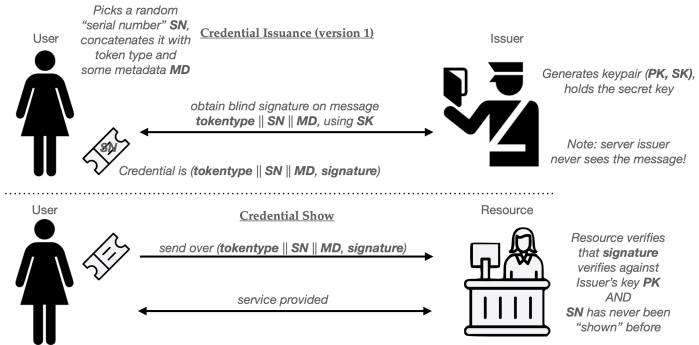
The fundamental operation of Privacy Pass relies on blind signatures, a cryptographic primitive that allows a user to obtain a signature from an Issuer on a message without the Issuer learning the content of the message being signed. This process is crucial for maintaining user anonymity.
The credential itself is typically represented as a four-tuple: tokentype, MD, SN, sig.
- tokentype: This field indicates the type of token being used, potentially differentiating between various issuance protocols or credential types.
- MD (Metadata): This is an optional but significant field that allows for binding credentials to specific applications or contexts. For instance, a user might request a credential bound to "nyt.com" and a specific date. The Issuer does not see this metadata; it is chosen by the User and, once set, cannot be altered. This feature enables Resources to enforce policies, such as requiring tokens valid only for a particular website or within a defined time frame.
- SN (Serial Number): This is a unique identifier for the credential, often derived from the message being signed.
- sig (Signature): This is the blind signature generated by the Issuer.
To "show" this credential to a Resource, the User presents the tokentype, MD, SN, and sig. The Resource then verifies the signature using the Issuer’s public key and checks if the MD and SN meet its requirements. If all checks pass, access is granted.
A key application of the MD field is the implementation of "session-specific credentials." In this model, the User obtains a credential not before visiting a website, but rather after initiating a session with a Resource protected by Privacy Pass. This flow involves:
- Requesting a Session Token: The User, after interacting with a Resource, requests a temporary session token from the Issuer.
- Issuing a Blinded Credential: The User then uses this session token to blind a new credential request, which is sent to the Issuer.
- Signing the Blinded Credential: The Issuer signs this blinded credential without knowing its content.
- Unblinding and Presenting: The User unblinds the signature, effectively creating a credential tied to the specific session. This credential is then presented to the Resource.
This mechanism ensures that each credential is valid only for the particular session for which it was issued, preventing its reuse in future sessions or for different purposes. This real-time issuance model offers advantages for services like Cloudflare, allowing for granular control over real-time access.
However, this approach introduces certain challenges. The most significant is the dependency on the Issuer’s continuous availability. If the Issuer experiences an outage, users may be unable to obtain fresh credentials, potentially leading to widespread access denial for the Resource. Another concern is the potential for "timing correlation attacks." By comparing the timestamps of messages exchanged between the Resource and the Issuer, an attacker might theoretically be able to link a user’s session to their credential issuance request. This risk is particularly pronounced when the Issuer and Resource are operated by the same entity, as is the case with Cloudflare’s implementation. While Cloudflare’s massive transaction volume may mitigate this risk in practice, it remains a theoretical vulnerability.
Cryptographic Underpinnings: RSA vs. Oblivious MACs
The choice of cryptographic primitives for implementing the blind signatures in Privacy Pass is a critical engineering decision, leading to two standardized "issuance protocols":
-
Publicly Verifiable Tokens: These utilize blind RSA signatures, closely mirroring Chaum’s original protocol. The advantage here is that the Resource can verify the token using the Issuer’s public key, meaning the Issuer and Resource do not need to share any secret cryptographic material. However, RSA signatures are known for their size and computational cost. Achieving approximately 112-bit symmetric-equivalent security requires RSA keys of at least 2048 bits, resulting in relatively large signatures and a slower signing process.
-
Privately Verifiable Tokens: For deployments prioritizing speed, Privacy Pass defines an alternative using an oblivious Message Authentication Code (MAC) based on an oblivious pseudorandom function. These tokens leverage efficient elliptic-curve (EC) primitives. While significantly faster to create and verify, the drawback is that the verifier (the Resource) must possess the Issuer’s secret key to validate the credential. This requirement introduces a tighter coupling between the Issuer and the Resource, which may not be desirable in all scenarios. Notably, Privacy Pass does not currently support elliptic-curve-based blind signatures due to the lack of mature and widely adopted protocols in this area.
Implications and Future Directions
Privacy Pass represents a significant achievement in the practical deployment of anonymous credential systems. Its ubiquitous use by major technology companies underscores the growing importance of privacy-preserving authentication. However, its "get token, use token" model, while efficient, offers limited functionality beyond basic access control. It does not inherently address more complex scenarios like age verification without continuous reliance on an Issuer for each interaction.
The limitations of Privacy Pass pave the way for more sophisticated solutions. The next frontier in anonymous credentials lies in systems that can support richer attributes and more complex verification processes, such as zero-knowledge credentials. Google’s ongoing standardization efforts in this area, utilizing zero-knowledge proof technology for privacy-preserving age assurance, signal a promising evolution. These advancements aim to provide a more granular and flexible approach to digital identity, enabling users to prove specific attributes without revealing unnecessary personal information, thereby further enhancing privacy and security in the digital realm. The continued development and deployment of such technologies will be crucial in shaping a more privacy-respecting internet.

