

The digital landscape is poised for a significant transformation, moving beyond the automation of tasks to the automation of intent. This fundamental shift, characterized by the emergence of the "Agentic Layer" within the "Post Web," signifies a new stratum in the technology stack where autonomous Artificial Intelligence (AI) agents will operate on behalf of humans. These agents will interpret complex goals, make sophisticated decisions, and execute actions across increasingly decentralized systems, ushering in an era of programmable agency.
This evolution builds upon the foundations laid by Web3, which democratized ownership through decentralized technologies and smart contracts, enabling trustless transactions and novel financial and organizational structures. While Web3 focused on programmable money, the Post Web is defined by its capacity for programmable agency. As Greysen Cacciatore, Research Associate at Outlier Ventures, notes in their foundational "Post Web Thesis," "AI agentic systems mark the beginning of a new paradigm. With their capabilities to orchestrate intention, navigate complex virtual environments, and achieve sophisticated outcomes, they are poised to transform the global economy." This assertion suggests a paradigm shift from a static, user-driven internet to a dynamic, agent-driven ecosystem.
Understanding the Agentic Leap: Agents vs. Bots
The concept of "AI agents" may initially evoke comparisons to the ubiquitous bots and scripts already populating the internet. However, the distinction is profound and represents a qualitative leap in computational capability and autonomy. Traditional bots are designed to follow a predefined set of instructions, executing specific, often repetitive, tasks. Their operation is deterministic, meaning a fixed input will always yield the same output. They are primarily task-based and reactive, lacking the capacity for genuine learning or adaptation beyond their programmed parameters.
In stark contrast, AI agents are designed to pursue goals and adapt dynamically to their environment. Their operations are probabilistic, meaning their outcomes evolve based on context and learning. They are intent-based and proactive, anticipating needs and initiating actions to achieve their objectives. Crucially, agents possess a continuous learning capability, allowing them to optimize their decision-making processes and improve their performance over time. This fundamental difference is encapsulated by the shift from automating tasks to automating outcomes.
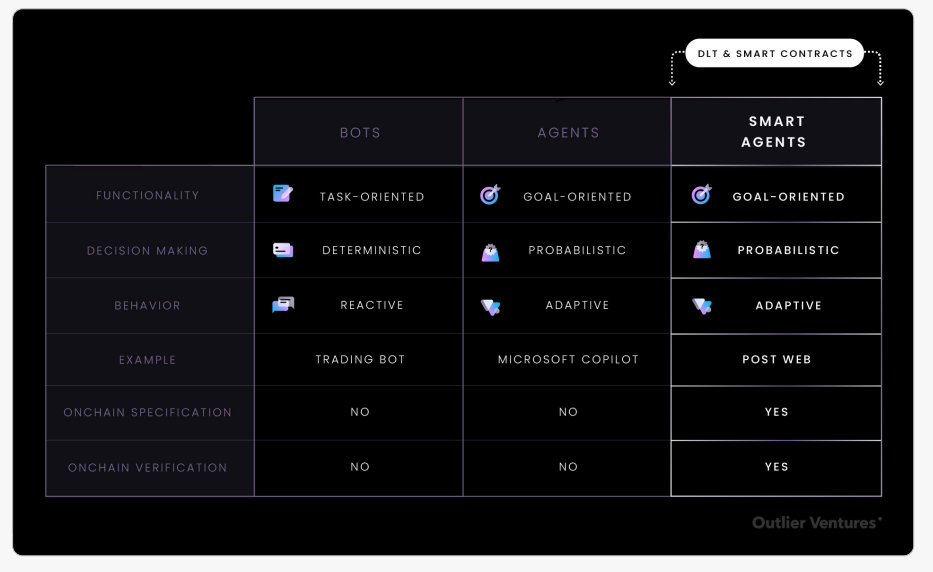
This distinction is visually represented in Exhibit 11 from the "Post Web Thesis," which clearly delineates the core differences:
| Feature | Bots | Agents |
|---|---|---|
| Instruction Following | Follow predefined instructions | Pursue goals and adapt dynamically |
| Output Nature | Deterministic (fixed input/output) | Probabilistic (outcomes evolve with context) |
| Operational Mode | Task-based and reactive | Intent-based and proactive |
| Learning Capacity | No capacity for learning | Continuously learns and optimizes |
The implications of this shift are far-reaching. Agents are goal-oriented, adaptive systems that can operate effectively in complex, dynamic environments. Their ability to learn from experience, optimize decisions, and even collaborate with other agents represents a significant departure from the static nature of Web3 interactions. This transforms digital interaction into something more akin to a living entity: responsive, context-aware, and capable of sophisticated reasoning.
Smart Agents: The Economic Engine of the Post Web
Taking this evolution a step further, the Post Web thesis introduces the concept of "Smart Agents." These represent a next-generation class of AI agents specifically designed to interact directly with distributed ledger technology (DLT) and smart contracts. Unlike conventional agents that might consume data through APIs or external feeds, Smart Agents possess the capability to autonomously own tokens, sign transactions, and execute contracts.
In essence, Smart Agents are positioned to become the primary economic actors within the Post Web. They will be capable of managing digital assets, verifying ownership claims, enforcing agreements, and executing complex workflows in real-time, all without direct human intervention for each step. This creates a new paradigm for decentralized finance and autonomous economic systems.
To enable this autonomous economic activity safely and securely, two key mechanisms are proposed within the Post Web framework:
- Decentralized Identity (DID) and Verifiable Credentials: These provide agents with a secure, self-sovereign identity that can be verified cryptographically. This ensures that agents acting on behalf of users or protocols can be reliably identified and authenticated.
- Reputation Systems and Auditable Oracles: To ensure accountability and trustworthiness, Smart Agents will operate within robust reputation systems. Auditable oracles will provide verified external data feeds, allowing agents to make informed decisions based on real-world information while ensuring transparency and preventing manipulation.
Together, these elements aim to establish a robust trust framework for autonomous digital economies, where human oversight and cryptographic verifiability can coexist and reinforce each other.
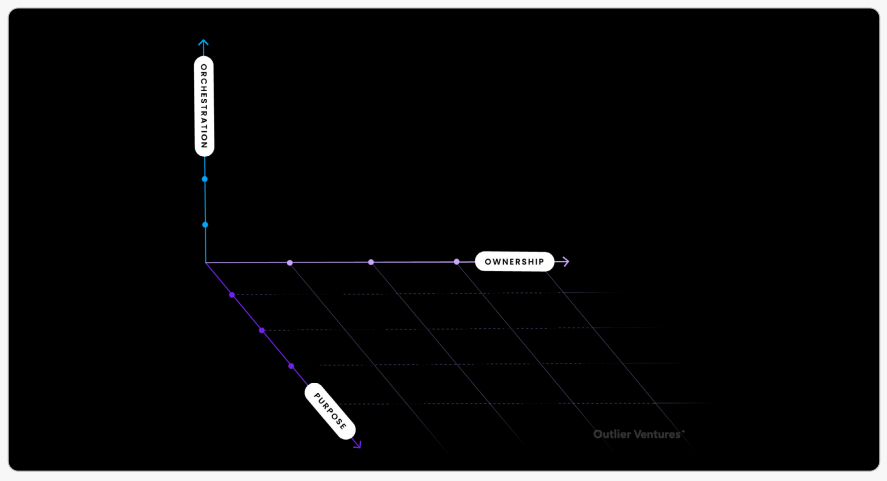
The Post Web doesn’t envision a monolithic type of agent. Instead, it anticipates an entire ecosystem of Smart Agents, classified along three critical axes:
- Orchestration: This refers to the complexity of tasks an agent can manage, ranging from simple single-step actions to intricate, multi-stage operations requiring coordination across multiple systems.
- Ownership: This denotes whether an agent acts on behalf of a human user (custodial) or independently manages its own digital assets and responsibilities (non-custodial).
- Purpose: This categorizes agents based on their primary function, such as trading, data analysis, content creation, or network management.
This multifaceted classification, detailed in Exhibit 13 of the "Post Web Thesis," highlights a future internet that functions more like a dynamic ecosystem than a static network. It will be populated by self-directing entities, each optimized for specific functions, collectively driving efficiency, value creation, and coordination across the digital realm.
From Automation to Autonomy: A Paradigm Shift in Interaction
The evolution from Web3 to the Post Web marks a significant shift from automation to autonomy. In Web3, smart contracts automated trust by executing agreements without intermediaries. However, they still relied heavily on human input for intention – users had to write the code, initiate transactions, and manage outcomes.
The Post Web, through Smart Agents, aims to automate intention itself. These agents will be able to interpret goals expressed in natural language, devise the most effective course of action, and autonomously negotiate with protocols to achieve those objectives. This opens up a spectrum of transformative possibilities:
- Personalized Financial Management: Imagine an agent that, based on your stated financial goals and risk tolerance, autonomously manages your investments across various decentralized platforms, optimizing for yield and rebalancing portfolios as market conditions change.
- Automated Content Creation and Curation: An agent could be tasked with generating regular reports on a specific industry, sourcing data from multiple decentralized sources, synthesizing it, and publishing it in a desired format, adapting its approach based on user feedback.
- Decentralized Governance Participation: Agents could represent users in decentralized autonomous organizations (DAOs), analyzing proposals, casting votes based on predefined mandates, and contributing to governance discussions.
- Seamless Cross-Platform Workflow Execution: An agent could be programmed to execute a complex workflow involving multiple decentralized applications (dApps), such as purchasing digital art, minting it as an NFT, and listing it for sale on a marketplace, all in a single, intent-driven command.
These scenarios, once theoretical, are becoming increasingly viable as advancements in reinforcement learning, natural language processing models, and decentralized computing converge. This convergence is giving rise to the "Agentic Layer," a new architectural layer of the web specifically designed to host, coordinate, and facilitate the operations of these intelligent actors.
The Significance of the Agentic Layer
The Agentic Layer represents a fundamental architectural evolution of the internet. It signifies a transition from passive interfaces, where humans are the primary drivers of action, to a paradigm of active, autonomous participants. This shift has several profound implications:
- Enhanced Efficiency and Productivity: By automating complex tasks and decision-making processes, the Agentic Layer promises to significantly boost productivity for individuals and organizations.
- Democratization of Sophisticated Capabilities: Complex financial strategies, data analysis, and workflow management, which previously required specialized expertise, will become accessible to a broader audience through intelligent agents.
- New Economic Models and Opportunities: The emergence of Smart Agents as economic actors will foster new business models, decentralized marketplaces, and novel forms of value creation and exchange.
- Increased Digital Agency and Control: While agents act autonomously, they are ultimately programmed to fulfill human intent. This can lead to greater control and more personalized digital experiences, allowing individuals to delegate complex digital interactions.
The Post Web, therefore, is envisioned as an intent-based, adaptive, and verifiable internet. It is a digital ecosystem where humans, intelligent agents, and protocols collaborate seamlessly in an economy of continuous coordination and optimization.
The Imperative of Interoperability in the Agentic Web
As the agentic web takes shape, the critical importance of interoperability cannot be overstated. As Chris Dixon, a prominent figure in the crypto space, has highlighted, the design of the network fundamentally determines who builds and who owns it. Protocol networks, characterized by their open, permissionless nature and reliance on shared standards, are essential for fostering a decentralized and equitable digital future, as opposed to closed, rent-seeking corporate networks.
For the nascent agentic economy, this distinction is not merely ideological but profoundly practical. Without robust interoperable standards, the risk of replicating the fragmentation and silos that plague today’s internet is significant. The ongoing development of composable standards such as MCPs, A2A, x402, and ACP by entities like Virtuals is crucial for the maturation of this space. However, their evolution must adhere to the core ethos of Web3: open-source principles, transparency, and anchoring on distributed ledgers to ensure accountability for agent actions.
These protocols will serve as the connective tissue of the agentic web, enabling agents to coordinate, transact, and reason safely and effectively across disparate systems. In essence, the same principles that drove the decentralization of ownership in Web3 must now be applied to decentralize agency itself, ensuring a more open and accessible future for intelligent digital participation.
The Dawn of a Living Internet
The Post Web is not merely the next iteration of internet infrastructure; it represents the emergence of a living, breathing network. It is a web that understands, adapts, and acts autonomously. Where once humans were solely responsible for programming and directing the internet’s functions, soon the act of expressing intent will be sufficient, with intelligent agents executing the intricate tasks required to fulfill those intentions.
This profound evolution will fundamentally transform how we interact with technology, data, and each other. It promises to re-architect the web by placing agency at the very core of the digital experience, ushering in an era where our digital lives are managed and enhanced by intelligent, autonomous entities working in concert with human goals.
Content derived from "The Post Web Thesis, Chapter 2: Turning the Web3 Tech Stack into the Post Web Stack," Outlier Ventures (2025). Cited pages 39-46.

