
The cryptocurrency market’s punishing downturn has inflicted heavy financial damage across the digital asset ecosystem, but few individual fortunes have mirrored the turbulence as dramatically as that of Michael Saylor. The co-founder and driving force behind business intelligence firm Strategy (formerly MicroStrategy) has seen his estimated net worth plummet by approximately $6 billion since the broader cryptocurrency market reached its cyclical peak in October 2025. According to wealth tracking data from Forbes, Saylor’s fortune—once valued at an impressive $9.3 billion during the height of the 2025 market euphoria—has contracted to roughly $3.3 billion.
This staggering decline represents the evaporation of nearly two-thirds of the billionaire’s estimated peak wealth. Yet, despite mounting paper losses that stretch into the billions of dollars for his corporate entity, Saylor and his executive team have demonstrated an unwavering commitment to their core thesis. Rather than retreating in the face of macro headwinds and sliding asset valuations, Strategy has continued its aggressive accumulation campaign, purchasing thousands of additional coins and signaling absolute confidence in the long-term viability of its treasury strategy.
However, the current market reality has exposed a complex vulnerability. For Saylor, the ongoing downturn extends far beyond the spot price of Bitcoin. Because a substantial portion of his personal net worth and professional legacy is inextricably bound to Strategy, his financial standing relies heavily on the company’s unique corporate structure. Specifically, it depends on management’s ongoing ability to convince institutional and retail investors to continue financing an ever-expanding debt-and-equity-backed Bitcoin accumulation engine.
A Chronology of Wealth Erosion: Tracking the Saylor Portfolios from Peak to Trough
To fully understand the scale of the recent correction, one must examine the timeline of Saylor’s valuation adjustments as recorded by financial monitors. The trajectory of his net worth highlights the direct correlation between the broader crypto market’s stagnation and his personal portfolio metrics:
- October 2025: Benefiting from a robust cryptocurrency market peak, Michael Saylor’s net worth reaches an all-time high of approximately $9.3 billion, largely driven by the surging valuation of Strategy’s equity and its massive underlying crypto reserves.
- February 2026: As initial market corrections take hold, Forbes reports that Saylor is among the hardest-hit billionaires in the technology and crypto sectors, with his net worth dropping by $4.7 billion down to an estimated $4.6 billion.
- June 2026: A temporary market stabilization brings a brief respite, lifting his estimated fortune marginally back to $4.7 billion.
- September 2026: Persistent macroeconomic pressures and sideways trading in the digital asset market push valuations down slightly, returning his estimated net worth to $4.6 billion.
- November 25, 2026: Following a deeper slide in both Bitcoin prices and Strategy’s equity premium, Forbes updates its valuation, placing Saylor’s net worth at approximately $3.3 billion—representing a steep 64.5% drop from the October 2025 high.
Financial analysts emphasize that these figures represent paper contractions in estimated wealth rather than realized cash losses or the execution of large-scale asset liquidation. Nevertheless, the velocity of the decline illustrates the high-beta nature of tying personal fortunes directly to corporate treasury models centered entirely on volatile digital commodities.

Dissecting Personal Holdings Versus Corporate Balance Sheets
A critical nuance in analyzing Saylor’s current financial standing is the clear demarcation between his personal investments and the corporate holdings managed by Strategy.
In October 2020, during the early phases of his corporate treasury pivot, Saylor publicly disclosed that he personally owned 17,732 BTC, which he acquired at a cumulative cost of approximately $175 million. Assuming he has maintained this exact position without selling, these holdings retain significant value. Evaluated against the $60,325 per Bitcoin price benchmark reported by Strategy in late November 2026, those personal coins would be worth roughly $1.07 billion.
This calculation reveals a fascinating paradox: even after factoring in a $6 billion reduction in his overall Forbes-estimated net worth—which accounts for the falling value of his Strategy stock equity—Saylor’s original personal Bitcoin investment remains substantially profitable, boasting an unrealized gain of approximately $895 million.
The financial reality inside Strategy, however, tells a profoundly different story. While Saylor entered the market at low average costs personally, his corporation has spent the intervening years aggressively acquiring Bitcoin at much higher, cycle-peak valuations.
Inside Strategy’s Balance Sheet: Billions in Paper Losses
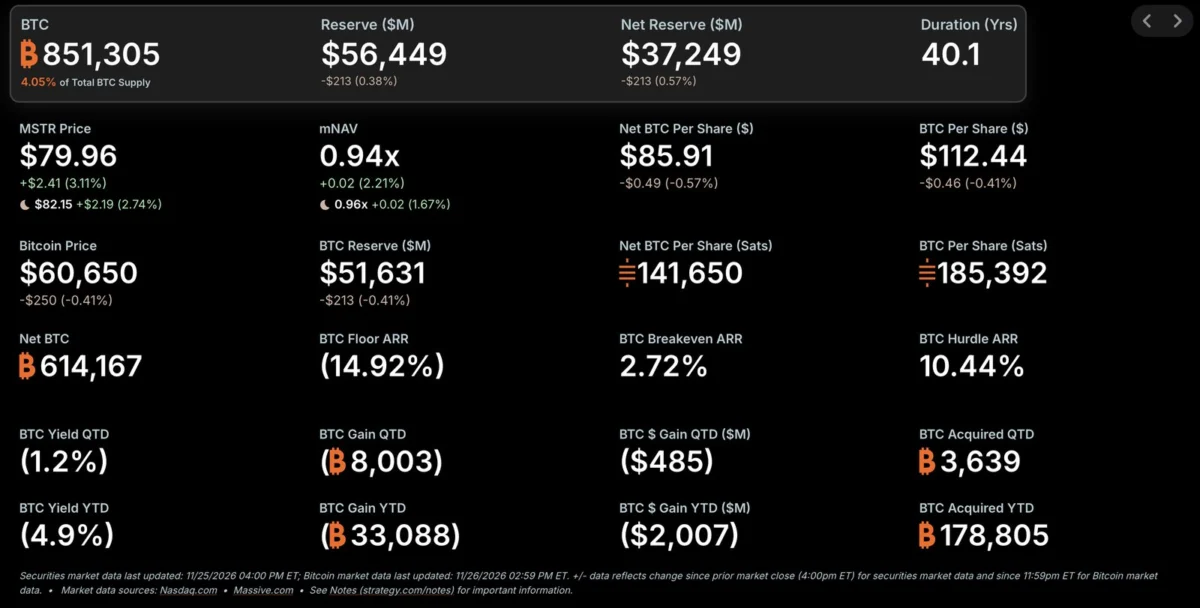
Strategy’s most recent regulatory filings with the U.S. Securities and Exchange Commission (SEC) underscore the immense capital outlays required to maintain its status as the world’s largest corporate holder of Bitcoin. According to a November 23 SEC filing, the company expanded its treasury yet again by acquiring an additional 457 BTC for roughly $29.6 million.
This purchase brought Strategy’s cumulative reserve to a staggering 851,305 BTC. To amass this unprecedented hoard, the company has deployed approximately $64.23 billion in total capital, translating to an average purchase price of $75,446 per Bitcoin.

However, with market prices hovering near the $60,000 threshold, the official corporate dashboard valued those same reserves at approximately $51.35 billion as of late November 2026. This creates a stark gap of nearly $12.88 billion between the company’s cumulative acquisition expenditure and the real-time market valuation of its digital assets.
| Strategy Bitcoin Portfolio Metric | Financial Value / Data Point |
|---|---|
| Total Holdings | 851,305 BTC |
| Average Acquisition Price | $75,446 per BTC |
| Total Acquisition Cost | $64.23 billion |
| Current Reserve Market Value | $51.35 billion |
| Estimated Shortfall Against Cost | $12.88 billion |
Corporate finance experts note that these figures do not constitute realized trading losses, as Strategy has consistently maintained a strict "HODL" policy, refusing to sell its underlying reserves regardless of market direction. Yet, the numbers starkly highlight how drastically the economic landscape of aggressive corporate accumulation has shifted during protracted market downturns.
The Disappearing Premium: Why Strategy Stock Faces Unique Pressures
For years, market dynamics favored Strategy in a way that puzzled traditional equity analysts. Investors were regularly willing to purchase Strategy shares at a substantial premium relative to the net asset value (NAV) of the Bitcoin held on its balance sheet. This willingness stemmed from the unique appeal of management’s business model: investors were buying into a proxy vehicle where skilled executives could leverage debt and equity issuances to continuously compound per-share Bitcoin exposure.
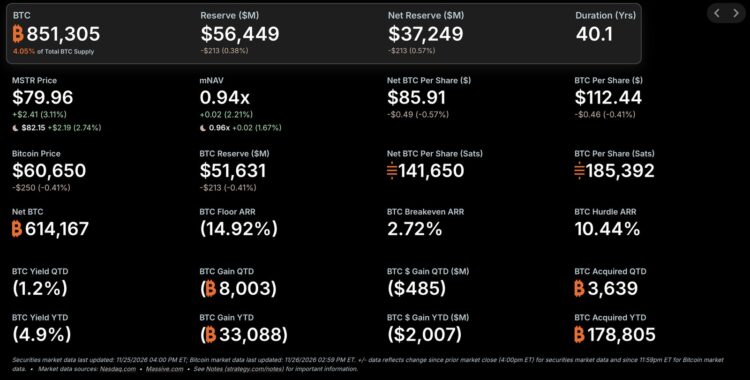
Today, that premium is no longer guaranteed. Strategy’s internal dashboards registered an mNAV ratio of 0.94 at the close of markets on November 25, utilizing the company’s proprietary net Bitcoin value-per-share methodology. When a company trades at a discount to its underlying asset value, the fundamental mechanics of its capital-raising strategy change entirely.
In recent investor briefings, Strategy executives openly addressed these shifting market dynamics, noting that a widening discount can cause the company’s stock (MSTR) to underperform Bitcoin itself, even during periods when the underlying cryptocurrency experiences upward price movements.
Sensitivity analyses provided by Strategy illustrate this vulnerability vividly. Projections show that if Bitcoin were to experience a deeper correction down to $40,000, the company’s estimated net reserve value per share would plummet to $45.37—a stark contrast to the $163.17 per share projected under a more optimistic scenario where Bitcoin trades at $100,000.
Financing Obligations and the Path to Recovery
Beyond the spot price of Bitcoin, the broader financial health of Strategy—and by extension, Michael Saylor’s personal net worth—hinges heavily on cash reserves, debt obligations, and ongoing capital market access.
In its third-quarter financial results and subsequent investor briefings, Strategy reported holding approximately $4.82 billion in combined cash and liquid dollar reserves. This capital buffer provides the firm with vital breathing room to service its financing obligations and debt commitments without being forced to liquidate its core digital asset treasury.
Market analysts and industry observers point out that a credible path to recovery exists. With more than 850,000 Bitcoin under its control, Strategy retains immense leverage over any sustained cryptocurrency market rebound. Should institutional demand return and macroeconomic tailwinds propel digital asset valuations upward, the company’s massive reserve base would experience a rapid appreciation in book value, likely restoring the equity premium that defined its previous successes.
However, the road ahead serves as a high-stakes stress test for Saylor’s corporate thesis. The immediate challenge facing the billionaire is no longer simply whether he can orchestrate the acquisition of another thousand Bitcoin. Instead, the ultimate test is whether Strategy can continue to navigate hostile market conditions, manage its debt obligations, and finance its ongoing accumulation strategy on terms that preserve and enhance value for existing shareholders.
For Michael Saylor, the ongoing market cycle has delivered a powerful reminder: while high-conviction bets can build empires during bull markets, sustaining them through prolonged downturns requires navigating a complex labyrinth of corporate finance, investor sentiment, and debt management where the price of Bitcoin is only half the equation.

