

The global cryptocurrency market is currently navigating a period of intense uncertainty, with the total market capitalization hovering near $2.69 trillion. Bitcoin, the industry’s bellwether asset, is testing the critical $80,000 psychological support level as investors recalibrate their portfolios in anticipation of the upcoming Federal Open Market Committee (FOMC) meeting scheduled for October 27-28. This period of consolidation follows a challenging week that saw Bitcoin retreat from recent highs of $84,000 to $80,000, a decline of approximately 4.74%. Market participants are currently adopting a defensive, “wait-and-see” posture as they weigh the implications of macroeconomic data against the structural health of the digital asset sector.
Macroeconomic Catalysts and the FedWatch Outlook
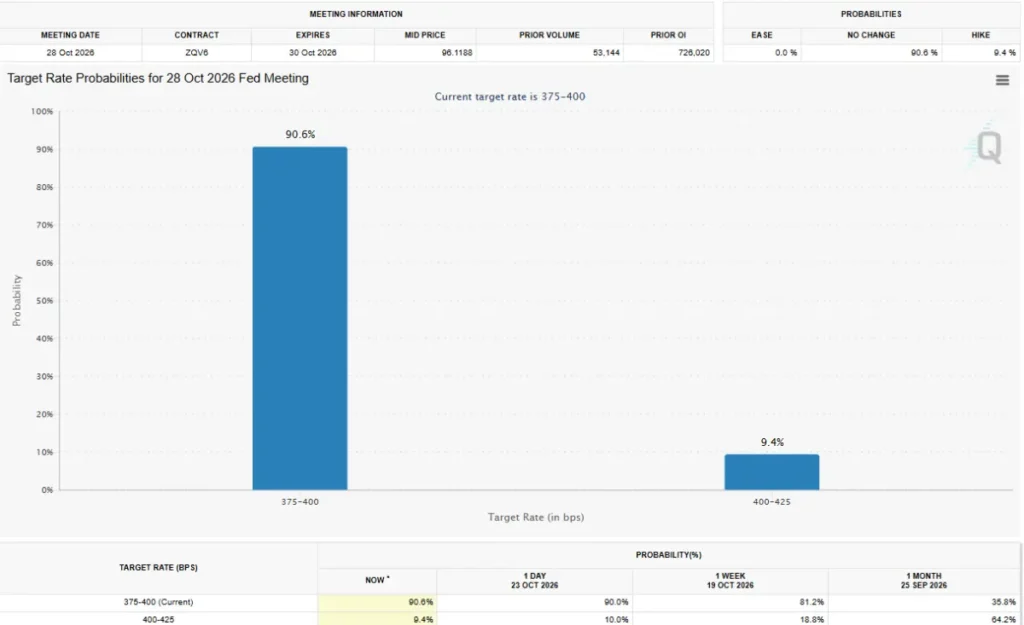
The primary driver of current market sentiment is the anticipation surrounding the U.S. Federal Reserve’s interest rate policy. According to data from the CME FedWatch Tool, there is an overwhelming 90.6% probability that the FOMC will opt to hold interest rates steady within the 3.75-4.00% target range. This consensus stems from the central bank’s aggressive stance in September, when it implemented a 25-basis-point rate hike—the first such increase in over three years—designed to combat persistent inflationary pressures.
While the market has largely priced in a pause for the upcoming session, the focus has shifted toward the forward guidance expected from Fed Chair Kevin Warsh. Investors are particularly sensitive to any rhetoric that might signal a hawkish pivot. Should the Fed adopt a more aggressive tone, it would likely cement expectations for an additional 25-basis-point hike during the final policy meeting of the year in December. The potential for prolonged high interest rates poses a significant risk to the crypto ecosystem, as rising 10-year Treasury yields—potentially climbing above 5%—could draw institutional capital away from speculative digital assets and toward the relative safety of risk-free government securities.
Inflation Metrics and the PCE Index
Beyond the FOMC decision, the market is awaiting the release of the Personal Consumption Expenditure (PCE) data, the Federal Reserve’s preferred gauge of inflation. Economists are projecting a rise in headline PCE inflation to 3.6% year-on-year, up from 3.4% in August. Furthermore, the Core PCE, which strips out volatile food and energy costs, is forecasted to climb by 3.1% annually and 0.3% month-over-month.
These figures are critical because they serve as a barometer for consumer purchasing power and economic stability. A "hotter" than expected print—meaning inflation figures exceeding these projections—would likely embolden the Federal Reserve to maintain elevated interest rates for a longer duration. For the cryptocurrency market, persistent inflation acts as a double-edged sword: while Bitcoin is often touted as an inflation hedge, it remains highly sensitive to liquidity conditions. If high inflation forces the Fed to keep the "cost of money" high, the liquidity required to fuel a sustained rally in crypto assets may remain suppressed.

Chronology of Recent Market Volatility
The current market state is the culmination of several weeks of downward pressure. Since late September, Bitcoin has been trapped in a trading range between $86,500 and $79,500. The decline earlier this month was not isolated to the crypto sector; it was part of a broader "risk-off" environment triggered by a widespread sell-off in U.S. technology stocks and rising geopolitical tensions in the Middle East and Eastern Europe.
The ripple effects were felt throughout the derivatives markets, where a wave of liquidations occurred as leveraged positions were flushed out by the sudden price drop. This cycle of liquidation exacerbated the volatility, forcing institutional and retail traders alike to reduce their exposure to high-beta assets. The following timeline illustrates the recent progression:
- Mid-September: The Fed initiates a 25-basis-point rate hike, signaling a new era of monetary tightening.
- Late September: Bitcoin attempts to reclaim the $86,000 level but meets significant resistance.
- Early October: Global geopolitical tensions escalate, leading to a flight to safety in traditional markets.
- Mid-October: U.S. technology stocks experience a correction, pulling Bitcoin down toward the $80,000 mark.
- Present: The market enters a consolidation phase as it awaits the October 27-28 FOMC meeting and upcoming inflation reports.
Technical Analysis: The Bull Flag Pattern
From a technical standpoint, Bitcoin’s recent price action is forming what analysts describe as a "bull flag" pattern. This configuration often appears during an uptrend, representing a period of consolidation before the next potential move. On the daily charts, Bitcoin is currently hugging the lower trendline of this pattern near the $80,000 level.
The technical outlook remains cautiously optimistic, provided that the support level holds. If the current consolidation matures into a breakout, market analysts suggest that Bitcoin could experience a 7.5% surge, challenging the upper resistance trendline near $86,000. An successful breach of this level would likely serve as a catalyst for renewed bullish momentum, with overhead targets set at $98,000 and eventually $106,286.
Supporting this bullish thesis is the fact that Bitcoin continues to trade above its 100-day and 200-day exponential moving averages (EMAs). In market technical analysis, the 200-day EMA is widely considered the line of demarcation between a long-term bull and bear market. Maintaining a position above this line suggests that the broader structural trend remains upward, despite the current short-term turbulence. Conversely, a definitive break below the $80,000 support would likely invalidate this thesis, potentially exposing the asset to further downward pressure toward the $75,000 support floor.
Institutional Implications and Capital Allocation
The broader impact of these developments extends beyond price action; it dictates the flow of institutional capital. Institutional investors are currently assessing whether the risk-reward ratio of crypto assets justifies continued allocation in an environment where the "risk-free" rate is increasingly attractive.
Institutional analysts note that the current environment is reminiscent of previous cycles where macroeconomic clarity was a prerequisite for major capital inflows. Until the Federal Reserve provides clear guidance on the terminal rate, many hedge funds and family offices are expected to maintain lower allocations to digital assets. This creates a vacuum in liquidity, which explains the current sideways price action and the sensitivity of the market to even minor shifts in news cycles.
Future Projections and Market Sentiment
As the market looks toward the end of the year, the interplay between the FOMC’s policy trajectory and the upcoming PCE inflation reports will likely dictate the market’s performance for the remainder of Q4. The 90% probability of a rate pause provides a temporary cushion, but the market is clearly wary of the long-term implications of "higher-for-longer" interest rates.
Furthermore, the influence of the crypto derivatives market cannot be overstated. With significant options expiries on the horizon, the potential for "gamma squeezes"—where market makers are forced to hedge their positions, driving price movement—remains high. Investors should remain cognizant of these technical factors, as they often cause price deviations that are independent of the broader macroeconomic narrative.
In summary, the crypto market is currently in a state of precarious balance. While the underlying technical indicators for Bitcoin suggest a potential for recovery, the fundamental macro landscape remains challenging. The upcoming week will be a definitive test of the market’s resilience. Whether Bitcoin can maintain its position above the $80,000 floor will ultimately depend on the Federal Reserve’s communication and the ability of the broader economy to absorb the reality of persistent, albeit cooling, inflationary pressures. Participants are advised to exercise caution, as the combination of high-impact news events and technical consolidation is a classic recipe for heightened volatility in the digital asset space.
