

The global cryptocurrency market experienced a severe contraction on Friday as investor sentiment shifted rapidly following confirmation of a record-breaking security breach at Binance, the world’s largest digital asset exchange. The incident, which has been linked by blockchain security experts to state-sponsored actors, saw an estimated $6.3 billion in digital assets compromised. This unprecedented exploit triggered an immediate cascade of panic-selling across major exchanges, wiping 2.89% off the total cryptocurrency market capitalization, which now sits at approximately $2.6 trillion.
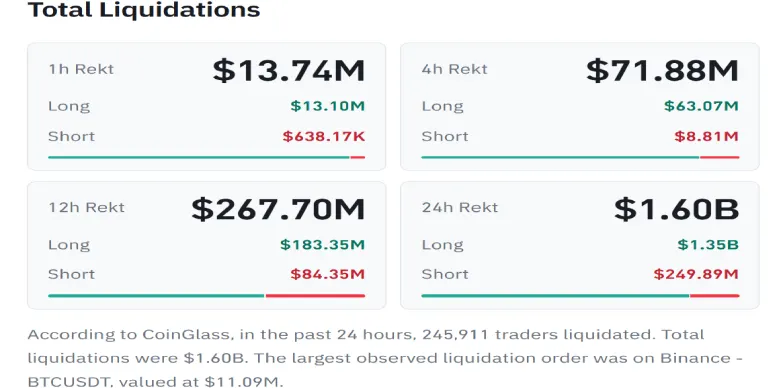
The volatility rippling through the sector is not merely a result of the hack itself but is compounded by the mass liquidation of leveraged positions. According to market data from Coinglass, more than $1.6 billion in leveraged futures contracts were liquidated within a 24-hour window, marking one of the most turbulent trading sessions in recent history. As major assets like Bitcoin, Ethereum, and XRP faced sharp declines, traders are grappling with the potential for further technical breakdowns as the market attempts to find a new floor.
Chronology of the Exploit and Immediate Response
The security breach, which has been identified as the largest in the history of the cryptocurrency industry, began to manifest early Friday. Blockchain security researchers at TRM Labs quickly mobilized, tracking the movement of stolen funds and identifying patterns consistent with the "TraderTraitor" hacking unit, a collective widely associated with the North Korean government. These entities have historically targeted centralized exchanges to circumvent international sanctions and generate capital for state interests.

Upon discovery of the anomaly, Binance moved to initiate emergency protocols. The exchange temporarily suspended all withdrawals, a move intended to prevent further illicit outflows and secure the integrity of the platform’s hot wallets. This suspension, while necessary for security, exacerbated market anxiety as users sought to offload assets during a period of high uncertainty.
Binance co-CEO Richard Teng took to social media channels shortly after the breach to address the growing panic. In a statement aimed at stabilizing the user base, Teng emphasized that the exchange’s corporate reserves were sufficient to cover the losses. "Bottom line: your money is safe, and we’re covering every loss," Teng stated. The company further clarified that there is no forensic evidence to suggest that the exchange’s private keys were compromised, pointing instead to a sophisticated exploit that bypassed internal security architecture without necessitating a total wallet takeover.
Coordinated Containment and Industry Collaboration
In a significant display of cross-industry cooperation, several ecosystem partners acted in concert to mitigate the impact of the theft. By tracking the flow of funds on-chain, major stablecoin issuers, including Tether and Circle, were able to identify and freeze approximately $2.4 billion in assets linked to the unauthorized transfers.
Combined with internal measures, this coordinated effort resulted in the successful containment of roughly $3 billion, effectively preventing a large portion of the stolen funds from being laundered through decentralized mixers or off-ramped into fiat currencies. Binance has indicated that it remains in constant contact with global law enforcement agencies and intends to resume normal withdrawal operations within 48 hours, pending a full audit of its security systems.
Analysis of Market Contagion and Price Volatility
The fallout from the Binance breach has acted as a catalyst for a broader technical breakdown across the crypto asset class. Before the incident, the market had been operating within a relatively stable consolidation phase. However, the sudden influx of sell orders has invalidated several bullish indicators that traders had been monitoring for weeks.
Bitcoin’s Struggle with Support Levels
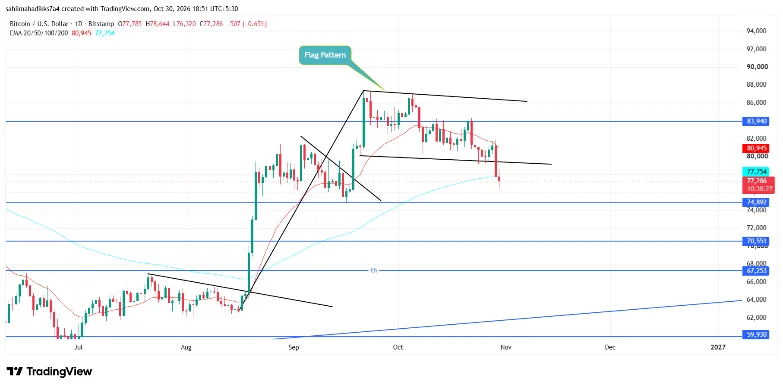
Bitcoin, which had been oscillating between $79,500 and $87,000 for the past six weeks, saw its bullish "bull flag" pattern collapse under the pressure of the sell-off. On Thursday, the asset broke below its critical support level, dropping by 4% to trade at approximately $77,351 at the time of writing. While the price remains above the 200-day exponential moving average—a key metric for long-term sentiment—the breakdown is significant. If the current support fails to hold, analysts are eyeing a potential test of lower psychological levels at $70,500 and $67,252, signaling a potential shift toward a more prolonged bearish cycle.
Ethereum and the Head-and-Shoulders Pattern
Ethereum has faced similar downward pressure, exacerbated by its technical positioning. Prior to the hack, the asset had formed a "head and shoulders" pattern, a classic bearish indicator in technical analysis. The breach served as the final trigger for a breakdown below the pattern’s neckline support. Ethereum, which had been consolidating above $2,353, is now at risk of a further 11% correction. Market analysts note that a failure to reclaim the $2,350 level could see the asset testing support as low as $1,965.
XRP’s Falling Wedge Struggle
XRP, often subject to higher volatility, has also succumbed to the market-wide decline. Having fallen below its monthly support of $1.254, the asset is currently testing the lower boundary of a "falling wedge" pattern. While this pattern typically signals a period of consolidation before a potential breakout, the current sentiment is overwhelmingly negative. XRP holders are now focused on whether the asset can maintain the $1.24 floor; failure to do so could lead to a slide toward $1.16, unless a reversal in market sentiment can spark a breakout above the wedge’s overhead trendline.
Implications for Regulatory and Security Standards
The magnitude of this exploit raises urgent questions regarding the security posture of centralized exchanges. While Binance’s commitment to covering losses from its corporate treasury serves as a buffer for retail investors, the event highlights the systemic risks associated with high-value custodial services.
Industry experts argue that this incident will likely accelerate the push for more rigorous regulatory oversight. Governments and international financial bodies have long been concerned about the use of stolen crypto assets to fund illicit state activities. The involvement of a North Korean-linked hacking unit in an exploit of this scale is expected to invite increased scrutiny from the Financial Action Task Force (FATF) and other regulatory entities.
Furthermore, the event has reignited the debate surrounding self-custody versus centralized storage. The ability of stablecoin issuers to freeze funds on-chain has demonstrated the efficacy of centralized control in recovering assets, yet it has also underscored the risks of "centralized censorship" inherent in the architecture of many modern tokens. As the industry moves forward, the tension between maintaining the decentralization of assets and implementing the robust, centralized security measures required to thwart state-sponsored actors will remain a central point of contention.
Conclusion
The next 48 hours are critical for both Binance and the broader cryptocurrency market. While the exchange has taken definitive steps to guarantee the safety of user funds, the psychological impact of the breach on market participants is profound. The technical damage to the price charts of Bitcoin, Ethereum, and XRP suggests that the recovery phase may be arduous, requiring not just a restoration of operational functionality, but a fundamental rebuilding of investor confidence. As the dust settles, the event will undoubtedly be studied as a case study in crisis management, cybersecurity, and the ongoing vulnerability of digital finance to sophisticated, state-level threats.

