

Cloud and web deployment platform Vercel is implementing Device Bound Session Credentials (DBSC) across its infrastructure to protect developers from sophisticated information-stealing malware. Announced by Vercel Chief Technology Officer Malte Ubl via social media platform X, the new mechanism cryptographically binds user authentication sessions directly to physical hardware. By leveraging Trusted Platform Module (TPM) chips embedded in modern workstations and mobile devices, the platform ensures that even if an attacker manages to illicitly harvest a session cookie, that credential remains fundamentally unusable on any alternative device or foreign system.
The deployment of DBSC marks a critical pivot in how cloud development platforms approach identity security, moving beyond traditional, easily transportable session tokens toward hardware-rooted trust. As infostealer campaigns grow more pervasive—frequently targeting developers who manage extensive cloud infrastructure, application code, and production databases—platform-level mitigations have become an essential line of defense. Alongside the DBSC rollout for browser-based platform access at vercel.com, Vercel is simultaneously deploying a parallel security protocol known as DPoP (Demonstrating Proof-of-Possession) for the Vercel Command Line Interface (CLI), further hardening the development pipeline against interception and replay attacks.
Understanding Device Bound Session Credentials and Hardware-Rooted Security
The architecture of DBSC relies on advanced cryptographic primitives embedded deeply within modern computing hardware. When a user authenticates to the Vercel platform using a supported browser, the system generates a cryptographic key pair. The private key is securely stored within the device’s hardware TPM—the exact same secure subsystem responsible for handling biometric verification data, such as fingerprint sensors and facial recognition systems on modern laptops and smartphones.

According to technical explanations provided by Ubl, this design guarantees absolute isolation of the private credential. The private key is strictly non-exportable; it cannot be retrieved by users, system administrators, or Vercel itself, rendering it entirely inaccessible to malicious infostealer payloads that scour browser storage directories for session cookies. Instead, the browser uses this hardware-bound private key to cryptographically sign session-related requests. If a threat actor steals the session cookie and attempts to inject it into a browser on a different computer, the request will fail because the remote machine lacks the corresponding hardware TPM private key required to generate the valid cryptographic signature.
This hardware-centric defensive layer complements broader industry initiatives, such as Google Chrome’s App-Bound Encryption framework, which makes it significantly more difficult for local malware to extract raw application data and cookies from browser storage. However, while App-Bound Encryption defends data at rest on the local host, DBSC addresses the threat of data in transit and credential reuse, establishing an end-to-end security chain from the physical hardware up to the cloud session endpoint. At present, Vercel’s DBSC rollout is optimized for Google Chrome running on macOS and Windows environments, with the deployment proceeding gradually to monitor edge cases, particularly regarding compatibility with complex OAuth application workflows.
Introduction of Automated Code Auditing via Security Review
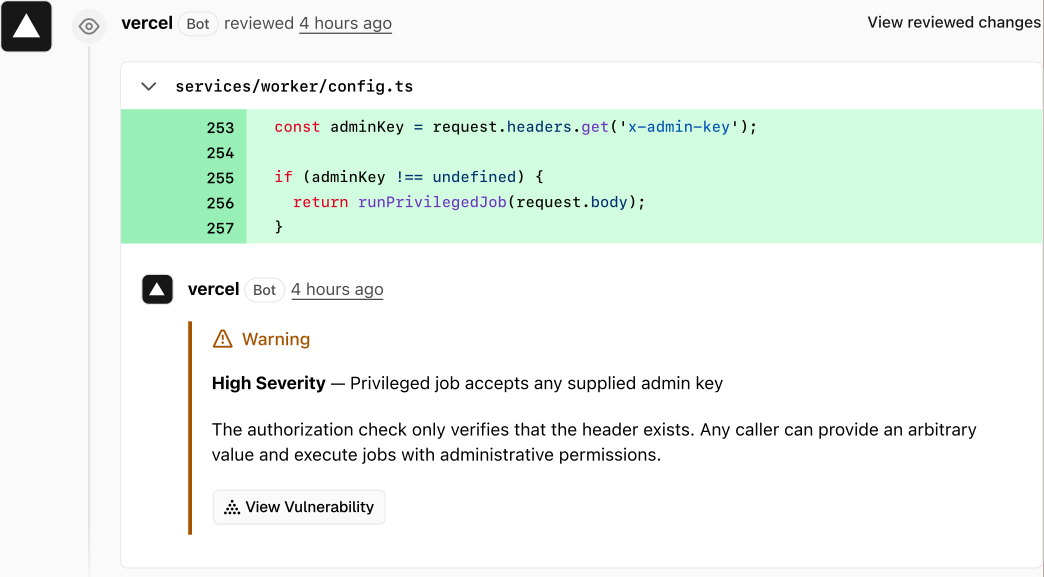
In tandem with hardware-bound session security, Vercel has launched a public beta of a new feature titled Security Review for Pro and Enterprise teams. Integrated directly into the Vercel Agent ecosystem, this automated scanning system evaluates code changes on every incoming push to connected GitHub repositories once activated by project maintainers.
The Security Review engine operates by cross-referencing code modifications against both built-in security best practices and custom, team-defined governance policies. Its primary objective is to catch critical vulnerabilities early in the software development lifecycle, specifically flagging issues such as missing authorization checks, insecure direct object references, and exposed API secrets or private keys before they reach staging or production environments. Where permissions allow, the Vercel Agent possesses the capability to not only identify these vulnerabilities but also automatically validate and commit code remediations.

To encourage widespread adoption during the initial testing phase, Vercel announced that Security Review code scans will be provided free of charge through November 10, 2026, while automated agent-generated fixes will be subject to separate usage billing. Commenting on the internal deployment timeline, Ubl noted that Vercel’s internal security engineering teams had successfully integrated and dogfooded the system months prior to its public release. Having proven its efficacy at intercepting high-risk code anomalies internally, the company chose to expand availability to its broader customer base to help organizations mitigate supply chain vulnerabilities and developer error.
Contextual Background: The April 2026 Security Breach and Evolving Threat Landscape
The aggressive rollout of hardware-rooted authentication and automated code review tools arrives against the backdrop of heightened security awareness following a targeted breach suffered by Vercel earlier in the year. In April, the cloud platform confirmed that an unauthorized third party had gained access to a subset of its internal systems. The initial vector involved the compromise of an employee’s Google Workspace account managed through a third-party partner, Context.ai.
Leveraging this compromised administrative access, the threat actor navigated into internal systems and viewed sensitive environment variables that had not been explicitly classified or marked as sensitive by users. Following the intrusion, a cybercriminal entity purporting to be the notorious extortion collective ShinyHunters attempted to commercialize the purloined assets, claiming to possess and sell proprietary source code, internal access keys, and customer database entries.
The incident underscored the severe risks associated with credential theft, cloud environment misconfigurations, and supply chain dependencies. Threat intelligence reports consistently emphasize that software developers remain prime targets for state-sponsored and financially motivated cybercrime groups. Infostealer malware families—often distributed via malvertising, compromised open-source packages, or phishing campaigns—routinely harvest browser session cookies, local storage tokens, and SSH keys to bypass multi-factor authentication (MFA) mechanisms. By shifting authentication verification from fragile software tokens to tamper-resistant hardware modules via DBSC, Vercel aims to neutralize the utility of stolen session artifacts entirely.
Broader Industry Implications and the Future of Cloud Authentication
Vercel’s proactive adoption of DBSC and automated code governance highlights a broader structural transformation within the cloud infrastructure and software-as-a-service (SaaS) industries. Traditional perimeter defenses, including traditional passwords and standard multi-factor authentication methods like SMS or standard authenticator apps, have proven increasingly vulnerable to sophisticated adversary-in-the-middle (AiTM) phishing kits and session-hijacking infostealers.
As enterprises increasingly rely on distributed development teams, continuous integration pipelines, and automated deployment architectures, securing the developer workstation has become synonymous with securing the cloud perimeter. Standards bodies, browser vendors, and major cloud providers are steadily converging around hardware-bound cryptographic standards to render stolen credentials obsolete.
The implications of Vercel’s dual deployment of DBSC and Security Review extend far beyond its immediate user base. As developers grow accustomed to hardware-enforced session integrity and automated, inline security reviews, customer expectations regarding out-of-the-box platform safety are shifting. Platforms that fail to implement robust, hardware-backed protections against credential theft risk losing the trust of security-conscious enterprise clients.
By combining cryptographic hardware bindings with proactive, agent-driven code analysis, Vercel is attempting to establish a new operational benchmark for cloud development security. While no technological safeguard can claim to eliminate risk entirely, the systematic deployment of Device Bound Session Credentials represents a decisive step toward rendering infostealer malware ineffective against modern cloud development environments. As the gradual rollout continues across operating systems and client environments, industry observers will closely monitor its impact on reducing credential-based compromises and shaping the future of web application security.

