
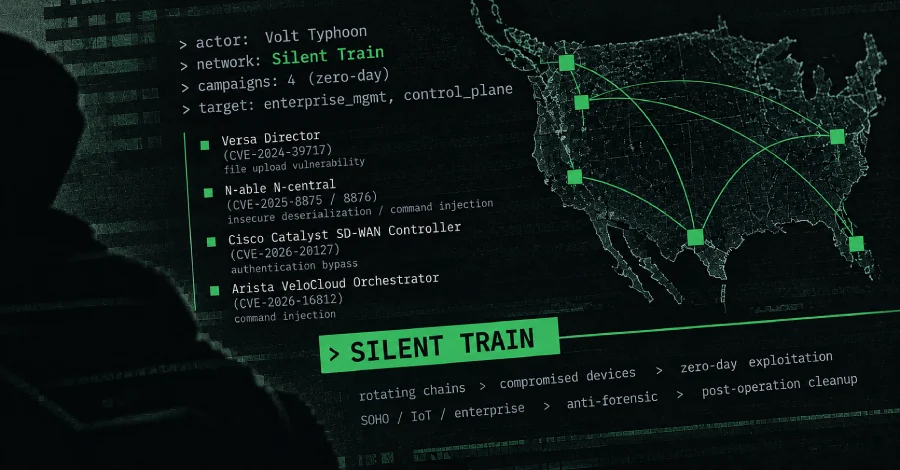
The China-nexus cyber espionage group widely identified as Volt Typhoon has been definitively linked to a sophisticated, now-disrupted covert access network codenamed Silent Train, a framework designed to facilitate persistent zero-day exploitation and long-term strategic infiltration of critical U.S. infrastructure. First emerging in the intelligence landscape in late 2023, the Silent Train architecture represents a paradigm shift in how state-sponsored actors maintain access to sensitive networks. By utilizing rotating chains of compromised Small Office/Home Office (SOHO) devices, Internet of Things (IoT) hardware, and enterprise infrastructure, the operators behind Volt Typhoon have successfully bypassed traditional signature-based detection methods.
The operational profile of Silent Train is characterized by intense discipline, anti-forensic protocols, and rigorous compartmentalization. Unlike traditional botnets that seek to infect as many devices as possible, Silent Train functions as a surgical tool, deploying ephemeral infrastructure that is assembled, utilized for specific high-value missions, and subsequently dismantled to prevent attribution and forensic analysis.
Chronology of the Silent Train Evolution
The development of Silent Train appears to be a direct response to the heightened scrutiny and disruption efforts led by U.S. federal agencies and private sector security researchers. Following the significant takedown of the KV-botnet in late 2023 and early 2024—a network previously utilized by various Chinese state-sponsored actors—Volt Typhoon underwent a rapid operational evolution.
By November 2023, the group began laying the groundwork for a more resilient, transient, and harder-to-detect framework. When the second wave of global disruptions struck the KV-botnet in January 2024, the actors behind Volt Typhoon had already successfully pivoted to the Silent Train model. This transition marked a departure from persistent, static C2 (Command and Control) infrastructure toward a fluid, multi-hop proxy network that could be rebuilt on demand.

Throughout 2024 and into early 2025, the framework underwent further maturation. While initial operations favored ephemeral, "one-time-use" nodes that lasted only hours, recent analysis by Lumen Technologies’ Black Lotus Labs indicates that the network adopted a hybrid architecture by early 2025. This newer iteration allows for the retention of high-value enterprise-grade devices for periods ranging from one to three months, providing a more stable foothold while maintaining the appearance of a transient network.
The Anatomy of a Silent Train Operation
At the core of the Silent Train framework is a layered, multi-hop relay system designed to obscure the origins of malicious traffic. When operators initiate an attack, they relay their commands through a series of compromised nodes—often spanning different geographical regions—before the traffic reaches the ultimate target. This "daisy-chaining" of compromised assets serves two primary purposes: it effectively masks the actor’s IP address and creates a complex forensic trail that is difficult for incident responders to unravel.
The diversity of devices utilized is staggering. Researchers have identified at least 27 distinct device classes enrolled in the network, including hardware from major manufacturers such as TP-Link, Intelbras, Ruckus Wireless, SATO, NETGEAR, Zyxel, and Cambium. Enterprise platforms are also routinely targeted, including appliances from Fortinet and Cisco, as well as software solutions like PRTG, Mirth Connect, and CyberPanel.
The operational methodology is highly structured:
- Target Identification: The actors focus on systems that provide centralized management and control, such as network controllers and management interfaces.
- Node Enrollment: The group exploits known and zero-day vulnerabilities in SOHO/IoT devices to gain initial access, deploying minimal tools necessary for SSH-based relay.
- Compartmentalization: Different device types are assigned specific roles. For instance, Intelbras modems have been consistently identified as relay nodes, while U.S.-based Netgear Orbi and Fortinet FortiGate appliances are frequently used as final exit points, allowing the traffic to appear as though it is originating from within the target’s domestic digital perimeter.
- Ephemerality: Sessions typically last approximately four hours. Once the objective—such as credential harvesting or data exfiltration—is achieved, the actors purge all temporary SSH keys, configuration files, and "live off the land" scripts, effectively wiping their digital fingerprints.
Targeting and Victimology
The geographic and sectoral targeting of Silent Train confirms that its primary intent is strategic, not opportunistic. The majority of activity has been concentrated in Hawaii, California, and Texas. These regions are not chosen at random; they host critical concentrations of U.S. military installations, deep-sea cable landing points, satellite communications hubs, and major logistics centers.

The list of victims is extensive and spans the entire breadth of the "critical infrastructure" definition. This includes telecommunications providers, government agencies, defense contractors, maritime and aviation authorities, energy grids, and emergency services. By targeting these sectors, Volt Typhoon maintains the capability to disrupt, surveil, or disable essential systems during moments of heightened geopolitical tension, particularly regarding the Indo-Pacific.
In one notable instance, the group leveraged a zero-day vulnerability in Versa Director (CVE-2024-39717) to deploy a bespoke web shell known as VersaMem. This tool was specifically designed to harvest credentials, providing the attackers with a master key to downstream customer networks. Additionally, the group exploited a zero-day in Quest KACE software, which remained active until a patch was released in October 2025, affecting at least 30 organizations.
Implications for National Security
The existence of a platform as sophisticated as Silent Train forces a recalibration of how cybersecurity agencies approach the threat posed by China-nexus groups. The ability of these actors to systematically "live off the land"—using legitimate administrative tools and compromised standard networking gear—makes them nearly invisible to conventional intrusion detection systems.
Security analysts have noted that the move toward a hybrid infrastructure suggests that Volt Typhoon is looking for long-term endurance. By retaining some enterprise-grade devices for longer periods, the attackers are balancing the need for stealth with the desire for consistent access to sensitive data repositories.
The U.S. government and its international partners have repeatedly characterized Volt Typhoon’s behavior as "pre-positioning." The goal is not immediate disruption, but rather the creation of a "dormant" capability that can be activated to sow chaos in the event of an armed conflict. The systematic targeting of water, rail, and energy control planes represents a significant shift from traditional espionage (stealing secrets) to cyber-sabotage (preparing for kinetic conflict).

Responding to the Silent Train Threat
Industry experts suggest that defending against a threat like Silent Train requires moving beyond perimeter-based defenses. Because the attackers use valid credentials and legitimate devices, the traditional "firewall and antivirus" approach is insufficient.
Key recommendations for defenders include:
- Enhanced Log Auditing: Monitoring for unauthorized or anomalous SSH connections from unusual internal devices, particularly those that have management interfaces exposed to the internet.
- Network Segmentation: Implementing strict controls around the management plane of critical enterprise infrastructure to ensure that a compromise of one device does not provide lateral access to the core network.
- Proactive Patching: The rapid shift to zero-day exploitation means that organizations must prioritize patching of SOHO and IoT devices, which are often left unmanaged in corporate environments.
- Zero Trust Architecture: Adopting a "never trust, always verify" model, where every access request is authenticated, regardless of whether it originates from within the network or from a "trusted" gateway device.
As the geopolitical landscape remains volatile, the persistence of the Silent Train network underscores the reality that modern warfare has expanded into the digital infrastructure of daily life. The collaboration between security researchers at firms like Lumen and government authorities remains the most effective defense against this evolving, highly structured, and intentionally elusive adversary. For now, the "train" continues to run, but each discovery by researchers serves to narrow the operational space for these sophisticated threat actors.

